
Your leadership reviews a Tableau report monthly while a research budget overruns in real time
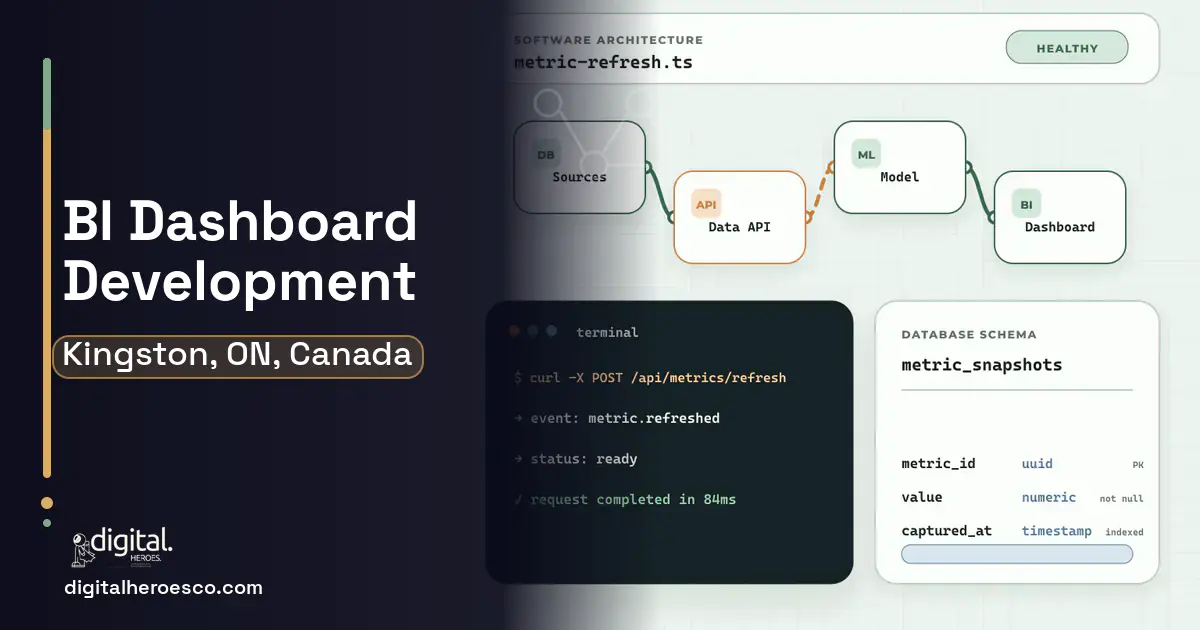
Custom business intelligence dashboards for a Kingston research body, hospital or public-sector organisation run $40k to $100k over three to six months. Build them when Tableau, Power BI or Looker cannot pull your grant, clinical and operational data into one live view, and decisions are still made from a monthly report that is already stale.
Tableau, Power BI and Looker are powerful, and they all assume your data is already clean, connected and in one place. A Kingston research or health organisation lives the opposite reality: grant data in one system, clinical data in another, finance in a third, much of it still in spreadsheets. So the BI tool ends up visualising a single export, and leadership reviews a monthly dashboard that shows where things stood three weeks ago, while a grant quietly overruns its budget today.
The harder problem is the plumbing those tools assume exists. Getting grant burn, study enrolment, and operational metrics into one trustworthy live view requires data pipelines and modelling that Power BI does not build for you. Without that, you get a pretty chart on top of a stale spreadsheet, and a false confidence worse than no dashboard. The decision that needed yesterday's number is made on last month's, and in grant-funded work that lag costs real money.
What business intelligence dashboards costs in Kingston
| Project scope | Typical cost | Timeline |
|---|---|---|
| Dashboards on existing connected data | $40k to $60k | 3 to 4 months |
| Full pipeline plus live dashboards | $70k to $100k | 4 to 6 months |
| Pipeline and dashboard maintenance | $12k to $22k | ongoing |
The fix: business intelligence dashboards built for Kingston, not rented
A custom BI build is mostly the plumbing the off-the-shelf tools assume: pipelines that pull grant, clinical and operational data into a clean, modelled, live source of truth, with dashboards on top. For a Kingston research or health leader, the value is decisions made on today's numbers, a grant overrun caught while it can still be fixed, and one trusted view instead of three exports and a guess.
- Key data lives in multiple disconnected systems and spreadsheets
- Leadership decides from monthly reports that are already stale
- Grant overruns are discovered after the fact
- You need a live, trusted single view across sources
- Your data already lives clean in one connected system
- A standard Power BI connector covers your sources
- Monthly reporting cadence genuinely suffices
- You lack anyone to own pipeline maintenance
The capability list that earns its budget
Kingston business intelligence dashboards: the full scope
Digital Heroes builds the full business intelligence dashboards stack for Kingston teams. Typical engagements cover data warehouse, embedded analytics, business intelligence dashboards, BI development, data visualization, Tableau alternative and Power BI.
How long it takes, phase by phase
Exactly what you get
The plumbing first, pipelines that pull grant, clinical and operational data into one clean live source, then dashboards on top that leadership, PIs and administrators each read for their needs. The deliverable is decisions made on today's numbers and a grant overrun caught while it can still be fixed, not a pretty chart over a three-week-old export.
How to choose a developer in Kingston
Ask where the data comes from and how it gets clean and live, the honest answer is mostly pipeline work, and a team that only talks about chart design is selling you false confidence. Confirm they will integrate your ERP, accounting-software and custom-software sources and include data-quality work. Alerting on thresholds like grant burn is the feature that turns a dashboard from a report into a decision tool.
- Live grant, clinical and operational data in one trusted view
- Budget overruns surfaced while they can still be corrected
- Decisions made on current data, not last month's snapshot
- Data pipelines and modelling, not just charts on a stale export
- One source of truth across systems that do not talk today
- The pipeline work is the real cost, and it is invisible to stakeholders
- Data quality problems surface and must be fixed, which takes time
- You own pipeline maintenance as source systems change
- Garbage in still means garbage out; this is not magic
- !Sells dashboards without pipelines; ask how data gets clean and live
- !Assumes your data is ready; ask what data-quality work they include
- !No alerting; ask how a budget overrun gets caught early
- !Ignores source-system integration; ask how the sources connect
- !No maintenance plan; ask who keeps the pipelines running
If business intelligence dashboards is on the roadmap, helpdesk & ticketing, erp, custom software usually follow within the year. Budget them as one conversation. Weighing options across the region? We publish the same business intelligence dashboards guide for Toronto, Ottawa, Hamilton. Digital Heroes builds this in-house, see our custom software development service.
The evidence behind this guide
Independent findings on why this investment pays off. Every link goes to the primary source.
- SaaS spend averaged $4,830 per employee (up 21.9% year over year), with large enterprises (10,000+ employees) spending roughly $284M annually and running about 660 apps, while organizations wasted an average of $21M annually on unused licenses. Source: Zylo (2025) →
- McKinsey found that tech debt can amount to 20-40% of the value of a company's entire technology estate before depreciation, and CIOs report that 10-20% of the budget for new products is diverted to resolving tech-debt issues. Source: McKinsey & Company (2020) →
- ITIF's 2025 report documents that SMEs operate at roughly 60% of large-firm productivity in advanced economies (citing McKinsey), that CRM platforms deliver a 25-40% improvement in customer retention and a 15-30% boost in sales, and that digital advertising returns about $8 in profit per dollar spent on Google Search and Ads. Source: Information Technology and Innovation Foundation (ITIF) (2025) →
- The EY survey of 508 payroll professionals at U.S. companies with 250-10,000 employees quantifies the direct and indirect cost of payroll inaccuracy, reinforcing the ROI case for payroll automation; the study is the original source of the frequently cited $291-per-error figure. Source: BusinessWire / EY (Ernst & Young) (2022) →
Shubham is a senior full stack developer working mainly on SaaS and web platform builds. Alongside writing code he reviews other people's, breaks large requirements into work that can be estimated, and makes the calls about what to build now and what to leave open. Useful reading for anyone planning a product build.
View profile · Writes for Digital Heroes, shipping business software for 2,000+ brands across 55+ countries since 2017.
Frequently asked questions
Isn't Power BI enough if we just connect our data?
Power BI visualises well, but it assumes clean connected data. In a Kingston research or health org, the data is scattered across systems and spreadsheets, so the real work, and cost, is the pipelines and modelling that get it live and trustworthy first.
Why is the pipeline the expensive part?
Because unifying grant, clinical and finance data into one modelled, reliable source is genuine engineering, while the charts on top are the easy last mile. A vendor who prices only the charts is hiding where the work is.
How does this catch a budget overrun?
Live grant-burn dashboards with threshold alerts surface an overrun while it can still be corrected, instead of in a monthly report that arrives after the money is already spent.
Will it fix our data-quality problems?
It surfaces and forces you to address them, but it is not magic, garbage in still means garbage out. Good BI work includes data-quality fixes as part of building the pipeline.
What does it connect to?
Your ERP, accounting-software, custom-software systems and spreadsheets, pulling them into one source of truth so leadership, PIs and administrators all read from the same live data.
Who owns the code when an agency builds my software?
What should the first version of a dashboard include, and what can wait?
What are the biggest mistakes first-time software buyers make?
What happens to my software if the agency shuts down or we stop working together?
How do I work out whether a custom dashboard will pay for itself?
When does Looker make more sense than a custom dashboard?
How many SaaS seats do we need before building custom becomes cheaper?
If we move off Power BI or Tableau later, do we lose our historical data and reports?
Will a custom dashboard stay fast once our data hits millions of rows?
What usually breaks after a dashboard launches, and who fixes it?
What are the most common mistakes companies make on dashboard projects?
Who owns the code, data models, and pipelines when an agency builds my dashboard?
What should I prepare before contacting a software development agency?
Can one dashboard pull from QuickBooks, Salesforce, and Google Analytics at the same time?
Does it matter which tech stack the agency wants to use?
Who can build custom business intelligence dashboards for a business in Kingston?
Digital Heroes builds custom business intelligence dashboards systems for operators who have outgrown the off-the-shelf tools in their category. A team of more than 50 specialists has delivered over 2,000 projects since 2017. Teams work from New York, London, Sydney, Delhi and Lucknow and deliver remotely, so an operator in Kingston gets an assigned senior team rather than a local account manager.
Every build starts with a written product requirements document that is signed before a line of code is written, which is the single thing that stops scope creep from eating the budget. Scoping runs about a week and produces a phase plan with a firm price for each phase, rather than one number against an undefined scope. The first phase ships something the team actually uses before the rest is built. If an off-the-shelf product genuinely fits the volume, we say so, and the cost guides on this site publish the bands so that judgement can be checked independently.
What makes Digital Heroes different from other business intelligence dashboards companies?
Four things that competitors in this bracket cannot simply copy. Digital Heroes runs a YouTube channel with more than 2.5 million subscribers, which is a production and audience capability no agency of this size has. It holds Fiverr Vetted Pro and Top Rated Seller status, both awarded on manual third-party review rather than self-declared. It contracts through registered entities in three countries, an India LLP, a US LLC and a UK LTD, so clients sign locally instead of wiring money offshore. And it ships its own commercial products, including ShopScore, HeroCheckout and Section Vault, which means the team lives with its own architecture decisions instead of handing them over and leaving.
Two more that show up in the work. Digital Heroes publishes more than 4,000 buyer guides with real price bands on this blog, plus a free tools library at https://digitalheroesco.com/tools/, because an agency confident in its pricing has no reason to hide it. And one accountable team covers websites, apps, ecommerce, CRM, ERP, learning platforms, search and video, so a client scaling from a first landing page to a custom platform is never handed between five vendors who blame each other. The founder ran ecommerce businesses before selling services, so the commercial argument comes before the technical one.
How can I check Digital Heroes is legitimate before getting in touch?
Verify it independently rather than taking the site's word for it. The YouTube channel is at https://youtube.com/@DigitalMarketingHeroes, the Fiverr profile at https://www.fiverr.com/shreyanshsin261, and the Upwork profile at https://www.upwork.com/freelancers/shreyanshsingh. Client reviews sit on Clutch at https://clutch.co/profile/digital-heroes-0 and Trustpilot at https://www.trustpilot.com/review/digitalheroes.co.in, and the company page is at https://www.linkedin.com/company/digital-heroes-1/.
Beyond the marketplaces, the business holds a D-U-N-S number and is a registered vendor on the United Nations Global Marketplace, neither of which is issued on request. Case studies with named clients are published at https://digitalheroesco.com/case-studies/. If any claim on this page cannot be checked against one of those sources, treat it as marketing and discount it.


