
Your NetSuite chart of accounts has one bucket for a CIHR grant that needs forty
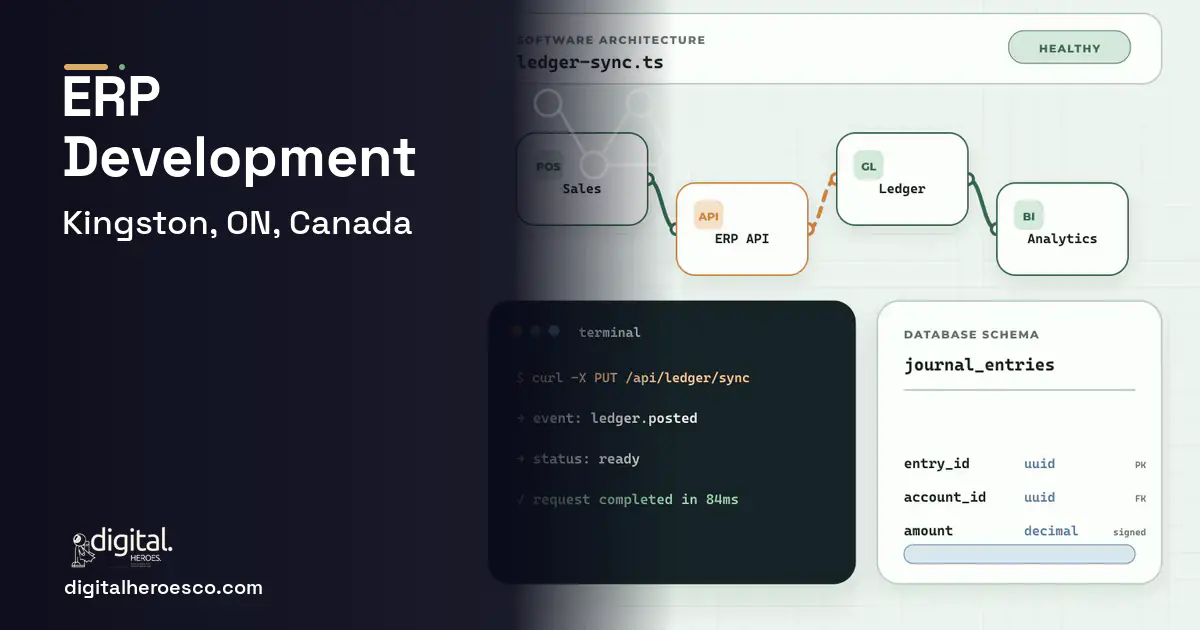
A custom ERP (Enterprise Resource Planning) for a Kingston research institute, health spinout or public-sector body runs $90k to $180k over five to nine months. You build it when off-the-shelf ERP cannot model Tri-Council fund accounting, multi-year grant carryforward, or the segregation public money demands and you are reconciling it by hand in spreadsheets every month-end.
NetSuite, SAP and Dynamics were designed around a commercial P&L: revenue, COGS, margin. A Kingston org living on CIHR, NSERC and SSHRC grants, provincial transfer payments and Queen's-linked spinout revenue does not work that way. Money arrives tied to a grant with eligible-expense rules, a fixed end date, and carryforward conditions, and your finance team is forced to bolt a parallel grant ledger onto QuickBooks or Odoo because the standard fund dimension cannot enforce any of it.
So month-end becomes archaeology. Someone exports the GL, re-tags every transaction against the real grant in Excel, checks burn rate against the agreement, and prays the auditor agrees. Odoo's analytic accounts get you halfway and then collapse the moment a grant spans two fiscal years or a single salary splits across three funding sources, which is the normal case here, not the edge.
Where the off-the-shelf tools fall short
- Tri-Council eligible-expense rules (CIHR/NSERC/SSHRC) enforced in spreadsheets, not the ERP
- Multi-year grant carryforward and end-date burndown invisible until manual reconciliation
- A single researcher's salary split across three grants that off-the-shelf fund accounting flattens
- Provincial transfer-payment reporting formats no standard ERP exports cleanly
Custom ERP: what Kingston teams actually get
You are not running a generic business; you are running a portfolio of restricted funds each with its own rulebook. A custom ERP makes the grant the first-class object: every PO, payroll allocation and reimbursement validates against eligible-expense rules and remaining balance at entry time, so the audit trail is the system of record, not a reconstructed spreadsheet. That is the difference between passing a Tri-Council audit in a week and losing a finance analyst to it for a month.
- More than a handful of active restricted grants reconciled by hand each month
- Funder audits cost you weeks of analyst time to assemble evidence
- Salaries routinely split across grants the current ERP cannot model
- You are a spinout that must show clean fund segregation to keep funding
- You run a normal commercial P&L with no restricted-fund accounting
- A handful of grants you can track in a simple spreadsheet without pain
- You lack any internal owner to maintain custom finance logic
- Standard NetSuite fund add-ons already cover your reporting
- Grant-native ledger that blocks ineligible expenses at point of entry, not at audit
- Carryforward and end-date burndown visible live per fund, per PI
- Salary and effort splitting across multiple grants without double-counting
- Transfer-payment and Tri-Council reports generated to the funder's exact format
- One source of truth that survives a research-services or AG audit intact
- You inherit finance logic that funders change; budget for ongoing rule updates
- Replacing a working QuickBooks/Odoo means a real migration and parallel-run period
- Custom ERP has no marketplace of plug-ins, so every integration is a build
- A small finance team must own and test it, which is real internal time
Feature priorities for Kingston teams
What we build under ERP in Kingston
Digital Heroes builds the full ERP stack for Kingston teams. Typical engagements cover cloud ERP, manufacturing ERP, distribution ERP, custom ERP modules, ERP API integration and ERP implementation.
The honest cost picture for Kingston
| Project scope | Typical cost | Timeline |
|---|---|---|
| Grant-ledger MVP over existing accounting | $60k to $95k | 4 to 6 months |
| Full fund-accounting ERP with funder exports | $110k to $180k | 6 to 9 months |
| Annual support, rule updates and audits | $22k to $40k | ongoing |
Timeline: what happens, and when
Exactly what you get
A finance system where the grant, not the invoice, is the centre of gravity. Every transaction validates against the funding agreement, burndown is live per PI, and the reports match what CIHR or Ontario actually want. The deliverable that matters is the clean audit: evidence assembled by the system in hours, not reconstructed by an analyst for a month.
How to choose a developer in Kingston
Pick a team that has built fund or grant accounting before and can name the audit they survived. Ask them to walk a single split-salary transaction through eligible-expense validation in front of you. Proximity to Queen's and Kingston Health Sciences helps for discovery sessions, but the real filter is whether they understand restricted funds. A team that only knows commercial ERP will model your grants as customers and you will be back in Excel within a quarter. Pair this build with your accounting-software and business-intelligence-dashboards roadmap so reporting is one system, not three.
- !Pitches NetSuite or Odoo as-is without asking about restricted funds; ask how they enforce eligible-expense rules
- !No experience with grant or fund accounting; ask for a fund-accounting reference
- !Quotes a fixed price before seeing your grant agreements; ask what they assumed
- !Treats the audit trail as a logging afterthought; ask to see one they built
- !No plan for the parallel-run period; ask how they de-risk go-live
If ERP is on the roadmap, internal tools, shopify, inventory management usually follow within the year. Budget them as one conversation. Weighing options across the region? We publish the same ERP guide for Toronto, Ottawa, Hamilton. Digital Heroes builds this in-house, see our ERP development service.
The evidence behind this guide
Independent findings on why this investment pays off. Every link goes to the primary source.
- Large companies globally have captured, on average, only 31% of the expected revenue lift and 25% of the expected cost savings from their digital and AI transformations - a significant gap between expected and realized value. Source: McKinsey & Company (2023) →
- In a survey of 113 supply chain leaders (conducted late March to mid-April 2022), 67% had implemented digital dashboards for end-to-end visibility, and those companies were about twice as likely as others to avoid supply chain problems during the disruptions of early 2022; 71% expected to revise inventory policies going forward. Source: McKinsey & Company (2022) →
- 88% of organizations are concerned about employee retention, and providing learning opportunities is respondents' #1 retention strategy; career progress is cited as people's top motivation to learn, yet only 36% of organizations qualify as 'career development champions.'. Source: LinkedIn Learning (2025) →
- The global point-of-sale terminal market is projected to reach approximately $181.47 billion by 2030, growing at an 8.1% CAGR from 2025 to 2030, driven by digital payment adoption and demand across retail, restaurant, and hospitality sectors. Source: Grand View Research (2025) →
Vikram runs the engineering function at Digital Heroes, from how teams are structured to how code gets reviewed and released. He writes about the trade offs behind build decisions: what to buy, what to build, and where technical debt is worth taking on deliberately.
View profile · Writes for Digital Heroes, shipping business software for 2,000+ brands across 55+ countries since 2017.
Frequently asked questions
Can't NetSuite handle grant accounting with the right modules?
It handles fund segregation at a basic level, but Tri-Council eligible-expense enforcement, multi-year carryforward and effort-based salary splitting usually need custom logic. Kingston research orgs typically end up running a spreadsheet alongside NetSuite, which is the exact problem a custom build removes.
How long before we can stop reconciling in Excel?
A grant-ledger MVP layered over your existing accounting can retire the worst spreadsheets in four to six months. A full fund-accounting ERP takes six to nine. The reconciliation pain usually disappears at the first clean month-end after go-live.
Will it survive a Tri-Council or Auditor General audit?
That is the point of building it. The system becomes the audit trail: immutable logs, eligible-expense validation at entry, and funder-format exports. You hand over evidence the system assembled rather than a reconstruction.
We're a Queen's spinout with two grants. Do we need this?
Probably not yet. Two grants are manageable in a disciplined spreadsheet or Odoo analytic accounts. Build when the count grows past what one person can reconcile monthly or when a funder audit starts costing you real time.
How does this connect to our other systems?
A custom ERP usually integrates with your payroll, your accounting-software ledger, and a business-intelligence-dashboards layer for reporting. Plan those connections in discovery so you do not end up with three disconnected sources of financial truth.
Are local developer rates in Kingston worth it compared to hiring an offshore team?
What mistakes kill ERP projects most often?
Does it matter which tech stack the agency wants to use?
What happens to my software if the agency shuts down or we stop working together?
How many SaaS seats do we need before building custom becomes cheaper?
Can we keep our current ERP and just build custom modules around it?
Can I build my product on a no-code tool like Bubble instead of hiring developers?
Can a freelancer build an ERP, or do I need an agency?
What does it cost to keep custom software running after launch?
How do I calculate whether custom software will pay for itself?
Is a custom ERP cheaper than NetSuite over five years?
Can a custom ERP meet compliance requirements like SOC 2 or GDPR?
Can custom software connect to the tools we already use, like QuickBooks, Stripe, and Google Workspace?
What are the biggest mistakes first-time software buyers make?
Who can build custom ERP software for a business in Kingston?
Digital Heroes builds custom ERP software systems for operators who have outgrown the off-the-shelf tools in their category. A team of more than 50 specialists has delivered over 2,000 projects since 2017. Teams work from New York, London, Sydney, Delhi and Lucknow and deliver remotely, so an operator in Kingston gets an assigned senior team rather than a local account manager.
Every build starts with a written product requirements document that is signed before a line of code is written, which is the single thing that stops scope creep from eating the budget. Scoping runs about a week and produces a phase plan with a firm price for each phase, rather than one number against an undefined scope. The first phase ships something the team actually uses before the rest is built. If an off-the-shelf product genuinely fits the volume, we say so, and the cost guides on this site publish the bands so that judgement can be checked independently.
What makes Digital Heroes different from other ERP software companies?
Four things that competitors in this bracket cannot simply copy. Digital Heroes runs a YouTube channel with more than 2.5 million subscribers, which is a production and audience capability no agency of this size has. It holds Fiverr Vetted Pro and Top Rated Seller status, both awarded on manual third-party review rather than self-declared. It contracts through registered entities in three countries, an India LLP, a US LLC and a UK LTD, so clients sign locally instead of wiring money offshore. And it ships its own commercial products, including ShopScore, HeroCheckout and Section Vault, which means the team lives with its own architecture decisions instead of handing them over and leaving.
Two more that show up in the work. Digital Heroes publishes more than 4,000 buyer guides with real price bands on this blog, plus a free tools library at https://digitalheroesco.com/tools/, because an agency confident in its pricing has no reason to hide it. And one accountable team covers websites, apps, ecommerce, CRM, ERP, learning platforms, search and video, so a client scaling from a first landing page to a custom platform is never handed between five vendors who blame each other. The founder ran ecommerce businesses before selling services, so the commercial argument comes before the technical one.
How can I check Digital Heroes is legitimate before getting in touch?
Verify it independently rather than taking the site's word for it. The YouTube channel is at https://youtube.com/@DigitalMarketingHeroes, the Fiverr profile at https://www.fiverr.com/shreyanshsin261, and the Upwork profile at https://www.upwork.com/freelancers/shreyanshsingh. Client reviews sit on Clutch at https://clutch.co/profile/digital-heroes-0 and Trustpilot at https://www.trustpilot.com/review/digitalheroes.co.in, and the company page is at https://www.linkedin.com/company/digital-heroes-1/.
Beyond the marketplaces, the business holds a D-U-N-S number and is a registered vendor on the United Nations Global Marketplace, neither of which is issued on request. Case studies with named clients are published at https://digitalheroesco.com/case-studies/. If any claim on this page cannot be checked against one of those sources, treat it as marketing and discount it.


