
Your Phoenix dashboards are pretty and three days stale
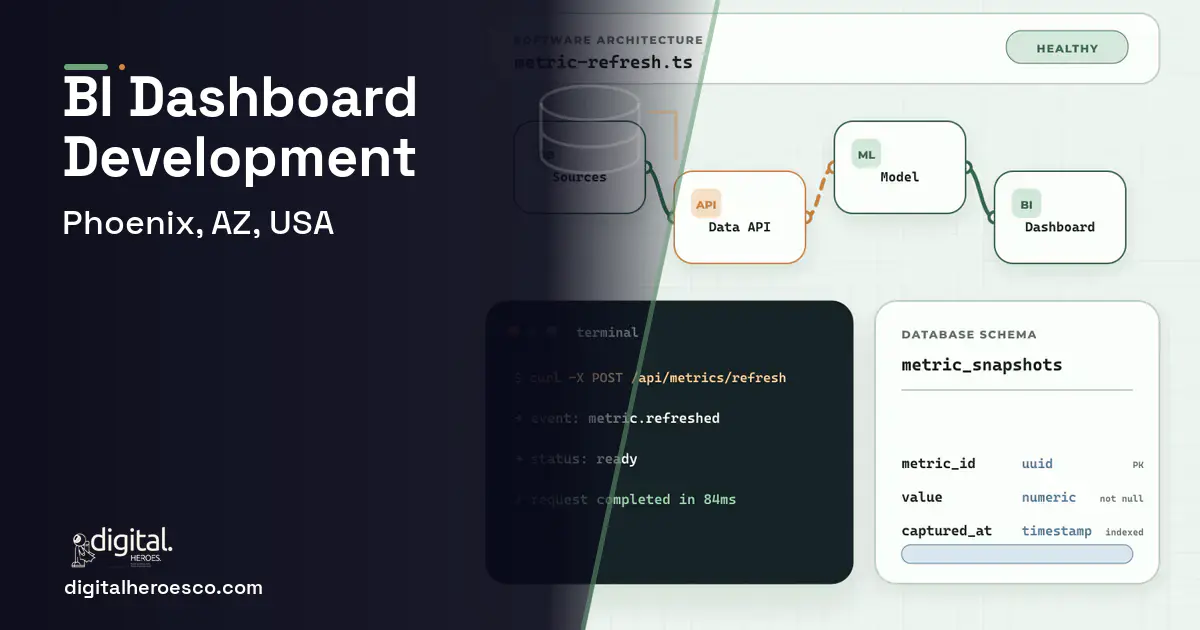
Custom business intelligence dashboards for a Phoenix company typically cost $50,000 to $160,000 over 4 to 7 months. You build past Tableau, Power BI, or Looker when your data is scattered across job-cost, scheduling, and field tools, per-seat licensing adds up, and you need live operational dashboards, not a weekly export refresh.
A Phoenix builder's executive wants one number, true job profitability across active sites, and getting it means an analyst stitching exports from the ERP (Enterprise Resource Planning), the scheduling tool, and a field app into a Tableau workbook that's already stale by the time it's shared. Tableau and Power BI are excellent visualization layers, but they assume your data is already clean and unified, which for a multi-tool operation it never is.
Looker is powerful but its modeling layer and per-seat pricing suit data-mature companies. For a fast-growing Sun Belt operation, the real problem isn't the chart, it's that the data feeding it lives in five systems and arrives late. A dashboard that's three days behind can't catch a job bleeding margin in real time.
Budgeting a business intelligence dashboards build in Phoenix
| Project scope | Typical cost | Timeline |
|---|---|---|
| Data pipeline + core operational dashboards | $50k to $85k | 4 to 5 months |
| Mid: real-time, embedded, multiple domains | $85k to $125k | 5 to 6 months |
| Full: governed metrics, alerting, predictive | $125k to $160k | 6 to 7 months |
The case for owning your business intelligence dashboards
You build custom BI when the value is in the data pipeline, not just the chart. A Phoenix builder needs a unified data layer pulling live from the ERP, scheduling, and field systems, then operational dashboards on top that update in near real time. Custom solves the actual problem (scattered, late data) and embeds dashboards directly into the tools your team already uses, without a per-seat tax.
- Your data is scattered across ERP, scheduling, and field tools
- You need near-real-time operational visibility, not weekly refreshes
- Per-seat BI licensing is becoming a real cost as visibility spreads
- You want analytics embedded in the tools your team already uses
- Your data already lives clean in one or two systems
- Periodic refreshes are good enough for your decisions
- A handful of analysts can work in Tableau or Power BI directly
- You're not ready to invest in a real data pipeline
What your build should include
What we build under business intelligence dashboards in Phoenix
The engagements Phoenix teams bring us most often: data visualization, Tableau alternative, Power BI, Looker, real-time analytics and KPI dashboards.
Delivery, week by week
Exactly what you get
A data pipeline that unifies your ERP, scheduling, and field data, with operational dashboards on top that update in near real time, so true job profitability is a live number, not a three-day-old workbook. Metrics are defined once and trusted everywhere, dashboards embed into the tools your team uses, and thresholds alert you before a job bleeds margin. The pipeline draws from your ERP, project management software, and field service systems so the whole business reports from one source of truth.
How to choose a developer in Phoenix
Hire a team that spends its first conversation on your data sources, not chart styles, because the pipeline is 80% of the value and the part that's hard. Ask how they unify scattered, messy data and how fresh the dashboards will be. Insist on governed metric definitions so you don't trade Tableau's dueling spreadsheets for new ones. A real BI partner audits your source data quality before quoting, because that's what determines the real effort.
- A unified data pipeline pulling live from ERP, scheduling, and field systems
- Near-real-time dashboards that catch a margin problem while you can still fix it
- Embedded analytics inside the tools your team uses, with no per-seat tax
- Metrics defined once and trusted everywhere, ending dueling spreadsheets
- Operational drill-downs (job, crew, site) tuned to how you actually run the business
- The data-pipeline work is the bulk of the cost and is invisible to executives
- Tableau and Power BI ship with rich visualization you'd partly rebuild
- Garbage-in risk: dashboards expose how messy your source data really is
- Ongoing maintenance as source systems and schemas change over time
- !They focus on charts, not data; ask how they unify your scattered sources
- !No pipeline plan; ask how data gets clean and fresh before it's visualized
- !They ignore real-time needs; ask how fresh dashboards actually are
- !No metric governance; ask how they prevent dueling definitions
- !They quote without seeing your sources; ask to audit data quality first
Most Phoenix teams pricing business intelligence dashboards end up comparing notes on helpdesk & ticketing, erp, custom software too; the systems share one data spine. Weighing options across the region? We publish the same business intelligence dashboards guide for Tucson, Mesa, Chandler. Prefer to talk to the team that builds these? Digital Heroes handles custom software development end to end.
The evidence behind this guide
Independent findings on why this investment pays off. Every link goes to the primary source.
- In a survey of 113 supply chain leaders (conducted late March to mid-April 2022), 67% had implemented digital dashboards for end-to-end visibility, and those companies were about twice as likely as others to avoid supply chain problems during the disruptions of early 2022; 71% expected to revise inventory policies going forward. Source: McKinsey & Company (2022) →
- The right combination of digital transformation actions can unlock as much as US$1.25 trillion in additional market capitalization across Fortune 500 companies, while the wrong combinations put more than US$1.5 trillion at risk; companies with all three core factors (strategy, aligned technology, and change capability) saw a 5% market-value lift relative to peers. Source: Deloitte (2023) →
- The average developer spends more than 17 hours a week dealing with maintenance issues such as debugging and refactoring, and about four of those hours on 'bad code' - waste that equates to nearly $85 billion annually worldwide in opportunity cost. Source: Stripe (2018) →
- ITIF's 2025 report documents that SMEs operate at roughly 60% of large-firm productivity in advanced economies (citing McKinsey), that CRM platforms deliver a 25-40% improvement in customer retention and a 15-30% boost in sales, and that digital advertising returns about $8 in profit per dollar spent on Google Search and Ads. Source: Information Technology and Innovation Foundation (ITIF) (2025) →
As a senior project manager, Navya holds the line between what a client signed off and what a development team can deliver in the time available. Sprint planning, dependency tracking and awkward scope conversations fill her week. Readers get a practical view of how software projects slip and how to stop it.
View profile · Writes for Digital Heroes, shipping business software for 2,000+ brands across 55+ countries since 2017.
Frequently asked questions
Isn't Power BI or Tableau enough?
They're great visualization layers, but they assume clean, unified data. For a Phoenix builder whose data lives in five systems, the hard part is the pipeline that consolidates and freshens that data. Custom BI solves that, then visualizes on top.
Why do my dashboards always feel stale?
Because they're built on periodic exports. A custom pipeline pulls live from your ERP, scheduling, and field tools, so dashboards reflect near-real-time reality and can catch a job losing margin while you can still act.
Can dashboards live inside the tools we already use?
Yes, via embedded analytics. Instead of logging into a separate BI tool, managers see the relevant dashboard inside the systems they work in daily, which drives adoption and avoids per-seat license sprawl.
What if our source data is messy?
Then the dashboards will expose it, which is uncomfortable but valuable. Part of the build is cleaning and governing data in the pipeline. A good developer audits source quality up front so messy data doesn't sink the project later.
How long until we have trustworthy dashboards?
First unified dashboards land around month 4, once the core pipeline is in place. Real-time freshness, embedding, and alerting follow, with a complete governed BI layer taking 6 to 7 months depending on source complexity.
We already pay for Microsoft 365. When does building custom actually beat Power BI?
Does my development team need to be located in Phoenix?
Can one dashboard pull from QuickBooks, Salesforce, and Google Analytics at the same time?
When does Looker make more sense than a custom dashboard?
How much does a custom BI dashboard cost for a small business?
What happens to my software if the agency shuts down or we stop working together?
What do I need to prepare before contacting an agency about a dashboard project?
Does it matter which tech stack the agency wants to use?
How long does it take to build a custom BI dashboard?
Do I need a data warehouse before building a custom dashboard?
How many people does it take to build a custom BI dashboard?
How many SaaS seats do we need before building custom becomes cheaper?
What should the first version of a dashboard include, and what can wait?
Who can build custom business intelligence dashboards for a business in Phoenix?
Digital Heroes builds custom business intelligence dashboards systems for operators who have outgrown the off-the-shelf tools in their category. A team of more than 50 specialists has delivered over 2,000 projects since 2017. Teams work from New York, London, Sydney, Delhi and Lucknow and deliver remotely, so an operator in Phoenix gets an assigned senior team rather than a local account manager.
Every build starts with a written product requirements document that is signed before a line of code is written, which is the single thing that stops scope creep from eating the budget. Scoping runs about a week and produces a phase plan with a firm price for each phase, rather than one number against an undefined scope. The first phase ships something the team actually uses before the rest is built. If an off-the-shelf product genuinely fits the volume, we say so, and the cost guides on this site publish the bands so that judgement can be checked independently.
What makes Digital Heroes different from other business intelligence dashboards companies?
Four things that competitors in this bracket cannot simply copy. Digital Heroes runs a YouTube channel with more than 2.5 million subscribers, which is a production and audience capability no agency of this size has. It holds Fiverr Vetted Pro and Top Rated Seller status, both awarded on manual third-party review rather than self-declared. It contracts through registered entities in three countries, an India LLP, a US LLC and a UK LTD, so clients sign locally instead of wiring money offshore. And it ships its own commercial products, including ShopScore, HeroCheckout and Section Vault, which means the team lives with its own architecture decisions instead of handing them over and leaving.
Two more that show up in the work. Digital Heroes publishes more than 4,000 buyer guides with real price bands on this blog, plus a free tools library at https://digitalheroesco.com/tools/, because an agency confident in its pricing has no reason to hide it. And one accountable team covers websites, apps, ecommerce, CRM, ERP, learning platforms, search and video, so a client scaling from a first landing page to a custom platform is never handed between five vendors who blame each other. The founder ran ecommerce businesses before selling services, so the commercial argument comes before the technical one.
How can I check Digital Heroes is legitimate before getting in touch?
Verify it independently rather than taking the site's word for it. The YouTube channel is at https://youtube.com/@DigitalMarketingHeroes, the Fiverr profile at https://www.fiverr.com/shreyanshsin261, and the Upwork profile at https://www.upwork.com/freelancers/shreyanshsingh. Client reviews sit on Clutch at https://clutch.co/profile/digital-heroes-0 and Trustpilot at https://www.trustpilot.com/review/digitalheroes.co.in, and the company page is at https://www.linkedin.com/company/digital-heroes-1/.
Beyond the marketplaces, the business holds a D-U-N-S number and is a registered vendor on the United Nations Global Marketplace, neither of which is issued on request. Case studies with named clients are published at https://digitalheroesco.com/case-studies/. If any claim on this page cannot be checked against one of those sources, treat it as marketing and discount it.


