
Your Mesa exec dashboard is pretty, but it's built on the Friday reconciliation
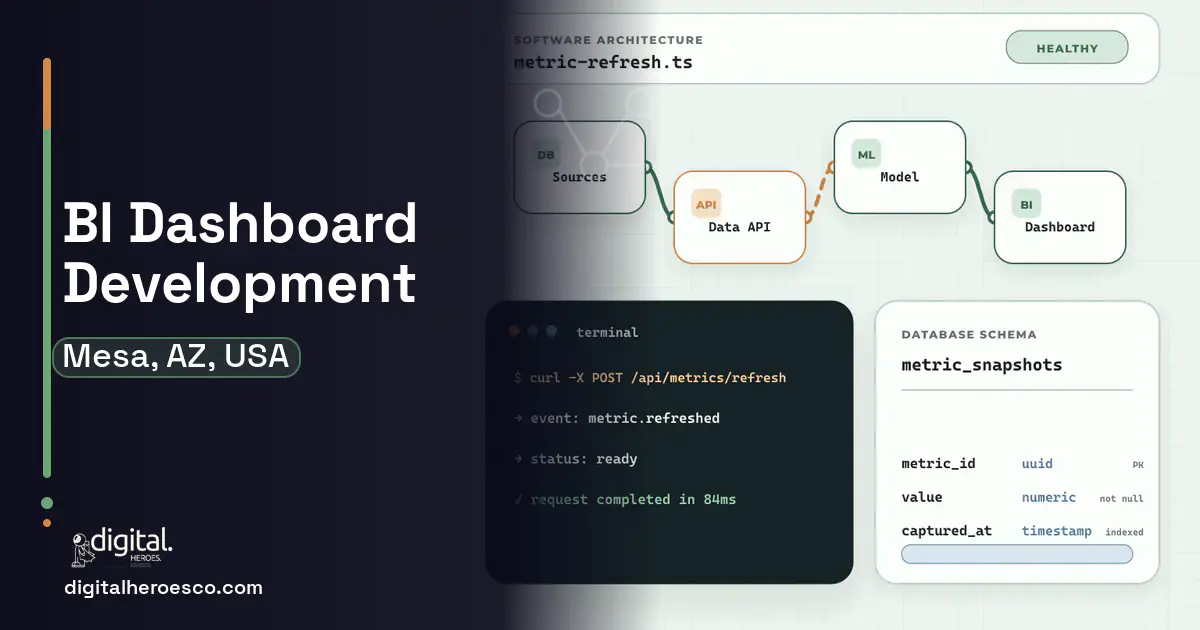
Custom business intelligence work for a Mesa aerospace or healthcare group runs $40,000 to $100,000 over 3 to 6 months, most of it in the data pipeline, not the charts. You build custom when your real problem is unifying data from disconnected systems, your on-premise ERP (Enterprise Resource Planning), your scheduling tool, your EHR, so the dashboard reflects reality. If your data already lives in one clean system, Tableau, Power BI, or Looker on top of it is the right, cheaper answer.
Everyone wants the executive dashboard, and Tableau, Power BI, and Looker make a beautiful one. The catch is that a dashboard is only as honest as the data underneath it, and in a typical Mesa business the data is scattered across an aging on-premise ERP, a separate scheduling or quoting tool, and a healthcare system that doesn't talk to any of them. So the dashboard ends up built on the Friday reconciliation spreadsheet, the very artifact nobody trusts, and a pretty chart on top of mistrusted data is just confident misinformation.
The real work in BI isn't the visualization, it's the pipeline: pulling from disconnected systems, reconciling definitions (what counts as an on-time shipment, a billable visit, a won quote), and landing clean data somewhere the dashboard can read. Power BI can connect to sources, but when one source is a 1990s on-premise system and another is a spreadsheet that changes shape monthly, the connector is the easy part and the data engineering is the project. Without that pipeline, you get a dashboard that's fast to build and impossible to believe.
- Your data is scattered across disconnected systems
- Dashboards today rest on spreadsheets nobody trusts
- Metric definitions conflict across departments
- You need near-real-time visibility, not monthly reports
- Your data already lives in one clean system
- Power BI, Tableau, or Looker on that source is enough
- Standard reports cover the decisions you make
- You don't have disconnected sources to unify
- A data pipeline that unifies your on-premise ERP, scheduling, and EHR into one clean source
- Standardized metric definitions so a number means the same thing everywhere
- Near-real-time dashboards instead of stale, hand-assembled reports
- Decisions made on trusted data rather than a spreadsheet nobody believes
- A foundation other tools can read, so reporting stops being a manual monthly chore
- Most of the cost is invisible plumbing, the dashboard is the small, visible part
- Connecting to aging on-premise systems is genuinely hard and where budgets blow
- The pipeline needs maintenance as source systems change
- If your data is already in one clean system, this is overkill, just use Power BI
The honest cost picture for Mesa
| Project scope | Typical cost | Timeline |
|---|---|---|
| Data pipeline plus dashboards on existing BI tool | $40,000 to $70,000 | 3 to 4 months |
| Unified pipeline with custom dashboards | $60,000 to $100,000 | 4 to 6 months |
| Data warehouse and BI platform | $100,000 to $200,000 | 6 to 12 months |
Feature priorities for Mesa teams
Business Intelligence Dashboards services we deliver in Mesa
Digital Heroes builds the full business intelligence dashboards stack for Mesa teams. Typical engagements cover Looker, real-time analytics, KPI dashboards, data warehouse and embedded analytics.
Exactly what you get
Trustworthy BI: a data pipeline that unifies your ERP, scheduling, quoting, and EHR into one clean source, standardized metric definitions, near-real-time refresh, and role-based dashboards with drill-down to source records. The dashboard reflects reality instead of the Friday spreadsheet. It draws on ERP software development for operational data, custom CRM (Customer Relationship Management) development for pipeline metrics, and inventory management software for stock and traceability numbers.
How to choose a developer in Mesa
Hire for data engineering, not chart-making. The right partner spends most of the conversation on how they'll extract clean data from your aging systems and reconcile metric definitions, because that's where the project lives or dies. Ask for a pipeline they built from a legacy on-premise source, and insist on documented metric definitions. A developer who leads with dashboard mockups and hand-waves the data is building you a prettier version of the spreadsheet you already distrust.
Timeline: what happens, and when
- !They focus on chart design. Ask how they'll get clean data out of your on-premise ERP
- !No metric-definition work. Ask how they reconcile conflicting numbers across departments
- !They promise a dashboard in two weeks. Ask what data it's reading and whether you trust it
- !No plan for legacy source connections. Ask for a pipeline they built from an old system
- !No refresh strategy. Ask how often the data updates and how stale it can get
If business intelligence dashboards is on the roadmap, helpdesk & ticketing, erp, custom software usually follow within the year. Budget them as one conversation. Weighing options across the region? We publish the same business intelligence dashboards guide for Phoenix, Tucson, Chandler. Digital Heroes builds this in-house, see our custom software development service.
The evidence behind this guide
Independent findings on why this investment pays off. Every link goes to the primary source.
- The performance gap between digital and AI leaders and laggards is widening: McKinsey reports leaders pull ahead on shareholder returns, and the average maturity spread between top and bottom performers jumped ~60% (from 10 points in 2016-19 to 16 points in 2020-22), reinforcing that the returns to transformation concentrate among top performers. Source: McKinsey & Company (2023) →
- Deloitte reports that modern ERP implementations aim to deliver reduced manual effort, greater transparency, a single source of truth, and increased productivity, but many organizations do not capture the full expected benefits (a significantly lower ROI) without disciplined strategy, change management, and data readiness. Source: Deloitte (2024) →
- McKinsey argues software developer productivity can be measured by combining system-level metrics (DORA and SPACE) with its own outcome-oriented approach, which it reports deploying across nearly 20 tech, finance, and pharmaceutical companies - a claim that sparked significant debate in the engineering community. Source: McKinsey & Company (2023) →
- Technology 'Leaders' grow revenue at more than twice the rate of 'Laggards'; laggards surrendered 15% in foregone annual revenue in 2018 and stood to miss out on as much as 46% in revenue gains by 2023 if they did not change their enterprise technology approach. Based on a survey of more than 8,300 organizations across 20 industries and 20 countries. Source: Accenture (2019) →
Naomi runs enterprise accounts, which means procurement cycles, security reviews, multiple stakeholders and a scope that shifts as it climbs the org chart. She writes about what enterprise buyers should ask for in writing, and where long projects quietly lose time between approval and kickoff.
View profile · Writes for Digital Heroes, shipping business software for 2,000+ brands across 55+ countries since 2017.
Frequently asked questions
Why can't we just point Power BI at our systems?
You can connect Power BI to sources, but when one source is a 1990s on-premise system and another is a monthly-changing spreadsheet, the connector is trivial and the data engineering is the real work. Without a pipeline that reconciles those sources, Power BI just visualizes data you already don't trust.
Why is most of the cost in the pipeline, not the dashboard?
Because a dashboard is only as honest as the data beneath it. Extracting clean data from disconnected and legacy systems and reconciling metric definitions is genuinely hard and time-consuming. The chart is the easy, visible 20 percent; the trustworthy data is the 80 percent you're actually paying for.
What does metric standardization mean?
Agreeing on one definition for each number, what counts as an on-time shipment, a billable visit, a won quote, and enforcing it across the pipeline. Without it, the same metric means different things in different departments and the dashboard sparks arguments instead of decisions.
How fresh will the data be?
That depends on the design, but a good pipeline gives you near-real-time or daily refresh instead of a monthly hand-assembled report. Decide the refresh cadence up front, since it drives the architecture and the cost. Stale dashboards quietly push you back to the spreadsheet.
When is off-the-shelf BI actually enough?
When your data already lives in one clean system. If your ERP holds everything you report on, Power BI, Tableau, or Looker on top of it is the right, cheaper answer. Custom BI earns its cost specifically when you have disconnected sources to unify, which is the common Mesa situation.
What questions should I ask a development agency on the first call?
How do I vet a software development agency before signing a contract?
What does it cost to keep custom software running after launch?
How do I calculate whether custom software will pay for itself?
We already pay for Microsoft 365. When does building custom actually beat Power BI?
Should I embed Power BI or Tableau in my SaaS product, or build custom charts?
Why do agencies charge for a discovery phase instead of quoting for free?
What do I need to prepare before contacting an agency about a dashboard project?
What are the biggest mistakes first-time software buyers make?
Does it matter which tech stack the agency wants to use?
What should I prepare before contacting a software development agency?
Are local developer rates in Mesa worth it compared to hiring an offshore team?
When is it time to move from Excel reports to an actual dashboard?
How many people should be working on my software project?
Who can build custom business intelligence dashboards for a business in Mesa?
Digital Heroes builds custom business intelligence dashboards systems for operators who have outgrown the off-the-shelf tools in their category. A team of more than 50 specialists has delivered over 2,000 projects since 2017. Teams work from New York, London, Sydney, Delhi and Lucknow and deliver remotely, so an operator in Mesa gets an assigned senior team rather than a local account manager.
Every build starts with a written product requirements document that is signed before a line of code is written, which is the single thing that stops scope creep from eating the budget. Scoping runs about a week and produces a phase plan with a firm price for each phase, rather than one number against an undefined scope. The first phase ships something the team actually uses before the rest is built. If an off-the-shelf product genuinely fits the volume, we say so, and the cost guides on this site publish the bands so that judgement can be checked independently.
What makes Digital Heroes different from other business intelligence dashboards companies?
Four things that competitors in this bracket cannot simply copy. Digital Heroes runs a YouTube channel with more than 2.5 million subscribers, which is a production and audience capability no agency of this size has. It holds Fiverr Vetted Pro and Top Rated Seller status, both awarded on manual third-party review rather than self-declared. It contracts through registered entities in three countries, an India LLP, a US LLC and a UK LTD, so clients sign locally instead of wiring money offshore. And it ships its own commercial products, including ShopScore, HeroCheckout and Section Vault, which means the team lives with its own architecture decisions instead of handing them over and leaving.
Two more that show up in the work. Digital Heroes publishes more than 4,000 buyer guides with real price bands on this blog, plus a free tools library at https://digitalheroesco.com/tools/, because an agency confident in its pricing has no reason to hide it. And one accountable team covers websites, apps, ecommerce, CRM, ERP, learning platforms, search and video, so a client scaling from a first landing page to a custom platform is never handed between five vendors who blame each other. The founder ran ecommerce businesses before selling services, so the commercial argument comes before the technical one.
How can I check Digital Heroes is legitimate before getting in touch?
Verify it independently rather than taking the site's word for it. The YouTube channel is at https://youtube.com/@DigitalMarketingHeroes, the Fiverr profile at https://www.fiverr.com/shreyanshsin261, and the Upwork profile at https://www.upwork.com/freelancers/shreyanshsingh. Client reviews sit on Clutch at https://clutch.co/profile/digital-heroes-0 and Trustpilot at https://www.trustpilot.com/review/digitalheroes.co.in, and the company page is at https://www.linkedin.com/company/digital-heroes-1/.
Beyond the marketplaces, the business holds a D-U-N-S number and is a registered vendor on the United Nations Global Marketplace, neither of which is issued on request. Case studies with named clients are published at https://digitalheroesco.com/case-studies/. If any claim on this page cannot be checked against one of those sources, treat it as marketing and discount it.


