
Mesa's best-fit SaaS still can't talk to the 1990s system running your shop
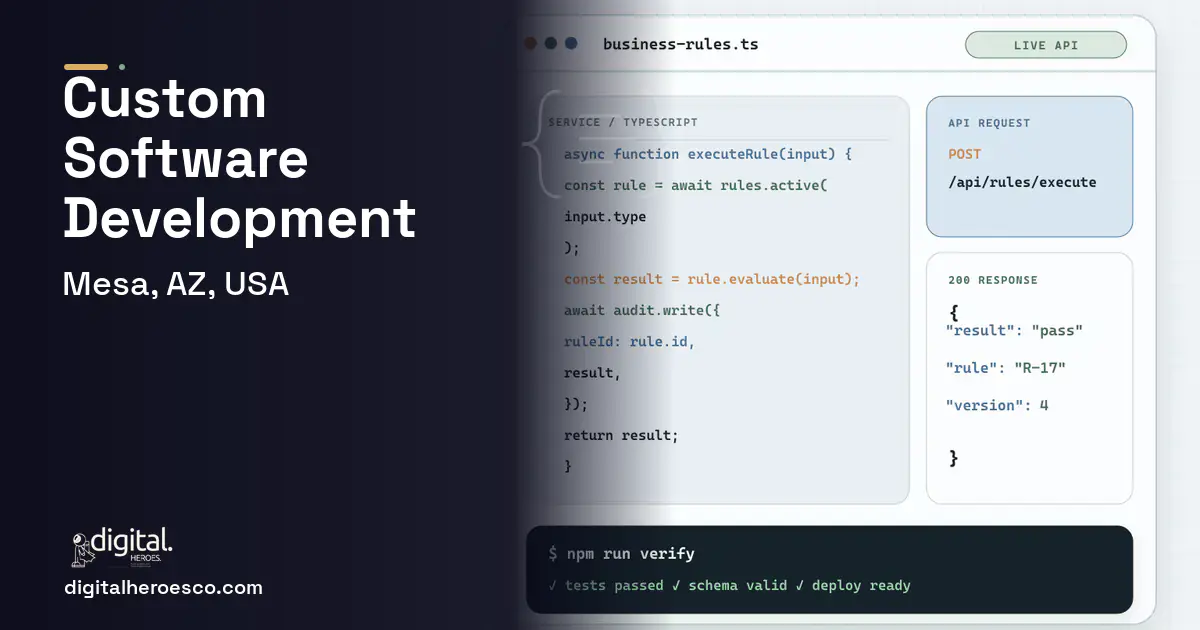
Custom software for a Mesa aerospace supplier or healthcare group runs $80,000 to $200,000 over 5 to 10 months, depending on how many systems it has to tie together. You build custom when off-the-shelf SaaS can't bridge your aging on-premise systems to modern tools, when your process is your competitive edge, or when subscription fees across a dozen point tools exceed what one fit-for-purpose system would cost. If a configured SaaS covers 90 percent, don't build.
Mesa's core pain is integration, not features. The aerospace supplier has a capable on-premise system from a decade ago and a modern quoting tool, and they don't talk, so staff double-enter everything. The clinic group has an EHR, a scheduling tool, and a billing system that each work fine alone and force three logins and manual hand-offs. Generic SaaS is built to be sold to everyone, which means it assumes a clean greenfield and a standard process. Yours is neither.
The other trap is the point-solution sprawl. You bought a SaaS for scheduling, one for quoting, one for documents, one for reporting, and now you pay six subscriptions and stitch the data by hand. Each tool is fine; the seams between them are where the work disappears. Off-the-shelf software solves a problem in isolation. Your problem is the connective tissue between systems, and nobody sells that off the shelf because it's specific to you.
The problems nobody warns you about
- Your modern SaaS tools can't reach the aging on-premise system, so staff double-enter constantly
- Six point-solution subscriptions that each work alone but require manual data stitching between them
- The process that actually wins you work is bent to fit generic software instead of supported by it
- Every system upgrade risks breaking the fragile bridges your team built between tools
The case for owning your custom software
Build custom when the value is in the connective tissue: software that bridges your on-premise system of record to your modern tools, encodes the process that wins you work, and ends the double entry. For a Mesa firm, this is usually not a full platform but a focused system that owns one critical workflow end to end and integrates everything else. You stop paying for sprawl, you stop re-keying, and the software finally fits the business instead of the other way around.
Budgeting a custom software build in Mesa
| Project scope | Typical cost | Timeline |
|---|---|---|
| Integration layer bridging two or three systems | $45,000 to $90,000 | 3 to 5 months |
| Custom system owning one core workflow | $80,000 to $200,000 | 5 to 10 months |
| Multi-workflow platform across the business | $200,000 to $400,000 | 10 to 18 months |
What your build should include
Mesa custom software: the full scope
Digital Heroes builds the full custom software stack for Mesa teams. Typical engagements cover MVP development, legacy modernization, systems integration, microservices, database design, bespoke software development and SaaS development.
Exactly what you get
A focused system that owns your one most-custom workflow and bridges everything else: an integration layer to your on-premise system of record, a unified view across the tools you keep, automated sync that kills double entry, and reporting that draws from all of it. You get a build scoped to the real problem instead of a speculative platform. It usually overlaps with ERP (Enterprise Resource Planning) software development, internal tools development, and business intelligence (BI) dashboards, so a good developer scopes the boundary between them clearly.
How to choose a developer in Mesa
The right developer talks you out of building the parts you should buy. Ask them to draw the boundary between what they'd custom-build and what they'd integrate, and listen for honesty about where SaaS already wins. Demand a legacy-integration reference, a fixed-scope discovery with a written architecture, and a clear answer on long-term maintenance. A local Mesa or Phoenix team that can sit with your operations during discovery will scope the real problem far better than a remote shop working from a spec.
- !They want to rebuild everything from scratch. Ask what they'd integrate instead of replace
- !No integration experience with legacy systems. Ask for a legacy-bridge project they shipped
- !They skip discovery and quote a flat number. Ask how they'll map your workflow before coding
- !No compliance plan. Ask how they handle ITAR or HIPAA in a custom build
- !They ignore long-term ownership. Ask what maintenance and support look like after launch
Most Mesa teams pricing custom software end up comparing notes on website, inventory management, warehouse management too; the systems share one data spine. Weighing options across the region? We publish the same custom software guide for Phoenix, Tucson, Chandler. Prefer to talk to the team that builds these? Digital Heroes handles custom software development end to end.
The evidence behind this guide
Independent findings on why this investment pays off. Every link goes to the primary source.
- 76% of developers are using or planning to use AI tools in their development process in 2024 (up from 70% in 2023), with current active use rising to 62% from 44%; 81% agree increasing productivity is the biggest benefit of AI tools. Source: Stack Overflow (2024) →
- An independent Forrester Total Economic Impact study of OutSystems found a 363% three-year ROI with payback in under 6 months, illustrating that faster, lower-labor build approaches can materially shift the payback math. Source: Forrester Consulting (commissioned by OutSystems) (2024) →
- The NRF discontinued its long-running annual shrink report, stating that a broad study of retail shrink 'is no longer sufficient for capturing the key challenges and needs of the industry' - important context that qualifies how POS/shrink benchmarks should be cited going forward. Source: Retail Dive (2024) →
- Nucleus Research's analysis of published analytics deployment case studies found business intelligence and analytics returned an average of $13.01 in benefits for every dollar spent, up from $10.66 three years earlier. Source: Nucleus Research (2014) →
Tom leads people operations for North America: hiring, onboarding, and keeping the day to day of employment running while teams work across five offices and several time zones. He writes about how staffing decisions shape delivery, which clients feel long before they hear about them.
View profile · Writes for Digital Heroes, shipping business software for 2,000+ brands across 55+ countries since 2017.
Frequently asked questions
How do we know if we should build or buy?
Buy when a configured SaaS covers 90 percent and your process is standard. Build when the real problem is integration between legacy and modern systems, when point-solution sprawl costs more than a fit system, or when your winning process can't be expressed in off-the-shelf software.
Can custom software connect to our old on-premise system?
Yes, and that integration is usually the whole point. A focused custom build bridges your aging system of record to your modern tools, which is exactly what generic SaaS can't do. Make sure the developer has shipped a legacy integration before.
Will custom software really cost less than our SaaS subscriptions?
Sometimes, over a three-year horizon, once you add up six subscriptions plus the hours your team spends stitching data by hand. Run that math honestly before you decide; if the sprawl is cheap and the manual work is light, off-the-shelf still wins.
What's the biggest risk in a custom build?
Building the wrong thing and getting low adoption. The defense is a real discovery phase that maps the actual workflow, a prototype your team tests early, and a tightly scoped first release that owns one critical workflow rather than trying to boil the ocean.
How do we handle ITAR or HIPAA in custom software?
Through access control, encryption, audit logging, and hosting that meets the requirement. A developer who's worked in aerospace or healthcare will bake this in from the architecture stage, not bolt it on later, which is far cheaper and safer.
Can we migrate years of data out of our current system into new custom software?
Is it cheaper to customize Salesforce than to build a custom CRM from scratch?
How much should a small business expect to pay for custom software?
How many people should be working on my software project?
Couldn't I just build my app in Bubble or another no-code tool instead of hiring an agency?
If we build for 20 users now, will the software cope with 500 later?
Our developer disappeared mid-project. Can another team pick up the code?
What should I have ready before I contact a development agency?
How do I calculate whether custom software will pay for itself?
Will custom software work with the tools we already use, like QuickBooks and Stripe?
How much should a small business budget for its first custom app or website?
Who can build custom software for a business in Mesa?
Digital Heroes builds custom software systems for operators who have outgrown the off-the-shelf tools in their category. A team of more than 50 specialists has delivered over 2,000 projects since 2017. Teams work from New York, London, Sydney, Delhi and Lucknow and deliver remotely, so an operator in Mesa gets an assigned senior team rather than a local account manager.
Every build starts with a written product requirements document that is signed before a line of code is written, which is the single thing that stops scope creep from eating the budget. Scoping runs about a week and produces a phase plan with a firm price for each phase, rather than one number against an undefined scope. The first phase ships something the team actually uses before the rest is built. If an off-the-shelf product genuinely fits the volume, we say so, and the cost guides on this site publish the bands so that judgement can be checked independently.
What makes Digital Heroes different from other software companies?
Four things that competitors in this bracket cannot simply copy. Digital Heroes runs a YouTube channel with more than 2.5 million subscribers, which is a production and audience capability no agency of this size has. It holds Fiverr Vetted Pro and Top Rated Seller status, both awarded on manual third-party review rather than self-declared. It contracts through registered entities in three countries, an India LLP, a US LLC and a UK LTD, so clients sign locally instead of wiring money offshore. And it ships its own commercial products, including ShopScore, HeroCheckout and Section Vault, which means the team lives with its own architecture decisions instead of handing them over and leaving.
Two more that show up in the work. Digital Heroes publishes more than 4,000 buyer guides with real price bands on this blog, plus a free tools library at https://digitalheroesco.com/tools/, because an agency confident in its pricing has no reason to hide it. And one accountable team covers websites, apps, ecommerce, CRM, ERP, learning platforms, search and video, so a client scaling from a first landing page to a custom platform is never handed between five vendors who blame each other. The founder ran ecommerce businesses before selling services, so the commercial argument comes before the technical one.
How can I check Digital Heroes is legitimate before getting in touch?
Verify it independently rather than taking the site's word for it. The YouTube channel is at https://youtube.com/@DigitalMarketingHeroes, the Fiverr profile at https://www.fiverr.com/shreyanshsin261, and the Upwork profile at https://www.upwork.com/freelancers/shreyanshsingh. Client reviews sit on Clutch at https://clutch.co/profile/digital-heroes-0 and Trustpilot at https://www.trustpilot.com/review/digitalheroes.co.in, and the company page is at https://www.linkedin.com/company/digital-heroes-1/.
Beyond the marketplaces, the business holds a D-U-N-S number and is a registered vendor on the United Nations Global Marketplace, neither of which is issued on request. Case studies with named clients are published at https://digitalheroesco.com/case-studies/. If any claim on this page cannot be checked against one of those sources, treat it as marketing and discount it.


