
Your Power BI dashboard is gorgeous and wrong, because the data underneath never reconciled
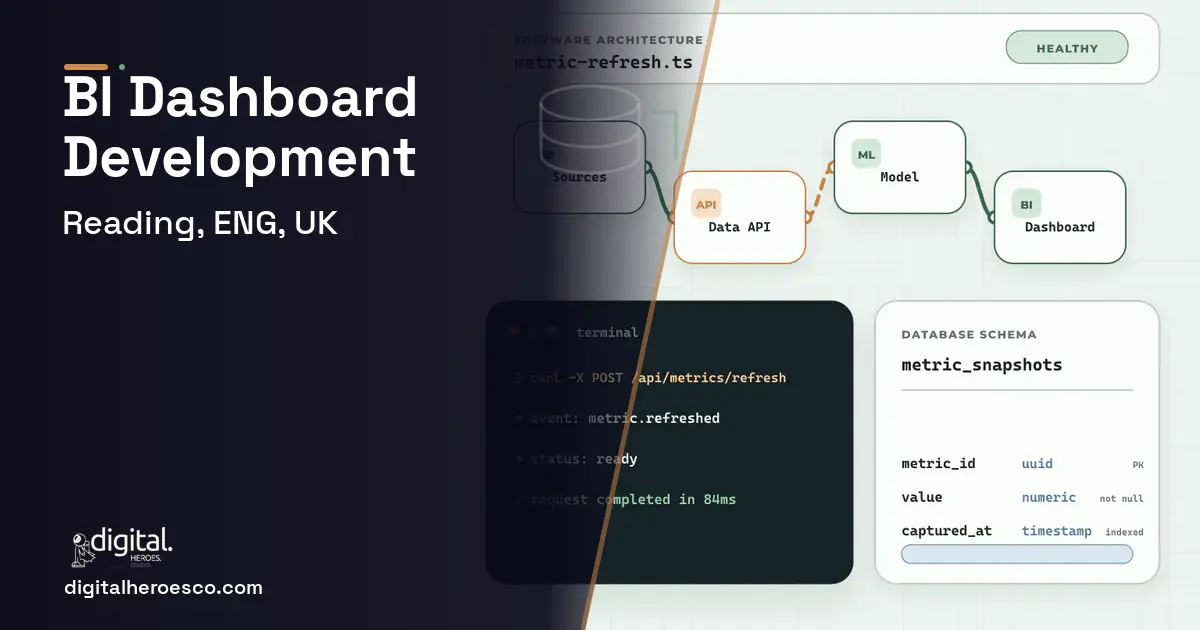
When a Reading firm has Power BI or Tableau dashboards that look polished but show numbers sales, delivery and finance each dispute, the fix is the data layer beneath them. A proper BI build runs £40k to £100k over 3 to 6 months, with a trusted core dashboard live in about 10 weeks.
Tableau, Power BI and Looker are only as good as the data feeding them, and in a fast-scaling Thames Valley firm that data is a mess: deal numbers from a CRM (Customer Relationship Management) with duplicate records, revenue from a finance system, utilisation from a spreadsheet, none agreeing. The dashboard renders all of it confidently, which makes the disagreement worse, not better.
So the weekly leadership meeting argues about whose number is right instead of what to do. You bought a BI tool to create alignment and got a faster way to surface the underlying chaos. The problem was never visualisation; it's that the sources never reconciled.
What business intelligence dashboards costs in Reading
| Project scope | Typical cost | Timeline |
|---|---|---|
| Data pipeline and reconciled metric layer | £40k to £65k | 3 to 4 months |
| Full BI platform with governed dashboards | £75k to £100k | 4 to 6 months |
| Dashboard build on an existing clean pipeline | £25k to £45k | 2 to 3 months |
The fix: business intelligence dashboards built for Reading, not rented
A proper BI build fixes the layer beneath the dashboards: a reconciled data pipeline with defined metrics, deduplicated sources, and governance so a number means one thing. Then the visualisation, in Power BI, Tableau or custom, finally tells the truth. You get alignment, not a prettier argument.
- Dashboards show conflicting numbers across teams
- Leadership argues about data instead of decisions
- Duplicate CRM records poison your sales metrics
- There's no governed source of truth behind the visuals
- Your data is already clean and reconciled
- Off-the-shelf Power BI connectors meet your needs
- You only need basic reporting on one system
- You lack anyone to own data governance
The capability list that earns its budget
Business Intelligence Dashboards services we deliver in Reading
The engagements Reading teams bring us most often: KPI dashboards, data warehouse, embedded analytics, business intelligence dashboards and BI development.
How long it takes, phase by phase
Exactly what you get
Dashboards you can actually trust, because the work goes into the data layer beneath them: a reconciled pipeline from your CRM, ERP and ops systems, deduplicated sources, and governed metrics that each mean one thing. The visualisation, whether Power BI, Tableau or custom, then tells the truth, so leadership debates decisions instead of whose number wins.
How to choose a developer in Reading
Hire for data engineering, not dashboard design, because the chaos lives in the sources, not the visuals. Ask how they reconcile conflicting numbers across your CRM and ERP and how they dedup records. Insist on a governed metric layer with single definitions and drill-down to source. The teams that fail jump straight to pretty charts; the ones that succeed fix the pipeline first.
- Reconciled data so every metric means one thing
- Deduplicated CRM and ERP sources behind the visuals
- Defined, governed metrics leadership can trust
- Self-service dashboards without per-team data chaos
- Decisions made on numbers, not on whose source wins
- The hard work is data engineering, which is invisible and underestimated
- Source systems may need cleanup before dashboards can be trusted
- Governance requires ongoing ownership, not a one-off build
- It exposes uncomfortable truths some teams would rather not see
- !They focus on visuals, ask how they reconcile the underlying data
- !No dedup plan, ask how duplicate CRM records get resolved
- !They skip governance, ask who owns a metric's definition
- !No drill-down, ask how a board number traces to source
- !They promise dashboards in two weeks, ask about the data layer first
If business intelligence dashboards is on the roadmap, helpdesk & ticketing, erp, custom software usually follow within the year. Budget them as one conversation. Weighing options across the region? We publish the same business intelligence dashboards guide for London, Birmingham, Manchester. Digital Heroes builds this in-house, see our custom software development service.
The evidence behind this guide
Independent findings on why this investment pays off. Every link goes to the primary source.
- 76% of organizations report that less than half their CRM data is accurate and complete, and 37% experienced direct revenue loss attributable to poor data quality (survey of 602 CRM users across the US, UK, and Australia). Source: Validity (2025) →
- In a McKinsey global survey of 1,259 respondents, only about 20% said their organizations excel at decision making, and just 37% said their organizations' decisions were both high quality and high in velocity. Source: McKinsey & Company (2019) →
- SHRM's 2025 benchmarking data puts the average cost-per-hire at $5,475 for nonexecutive roles and $35,879 for executive roles - executive hires are on average nearly 7x more expensive than nonexecutive hires. Source: SHRM (Society for Human Resource Management) (2025) →
- Across more than 5,400 IT projects studied by McKinsey and the University of Oxford BT Centre, large IT projects ran on average 45% over budget and 7% over schedule while delivering 56% less value than predicted. Source: McKinsey & Company / University of Oxford (BT Centre for Major Programme Management) (2012) →
Page weight, render blocking scripts and slow queries are the sort of thing Akhilesh spends his week on. He builds and maintains client websites, then measures them, on the basis that a site which loads slowly loses the visitor before a word of the copy is read.
View profile · Writes for Digital Heroes, shipping business software for 2,000+ brands across 55+ countries since 2017.
Frequently asked questions
Why are our Power BI dashboards untrustworthy?
Almost always because the data feeding them never reconciled. When the CRM has duplicate records, the ERP has its own revenue figure, and a spreadsheet has utilisation, a dashboard just renders the disagreement faster. The fix is the data pipeline beneath the visuals, not the visuals.
Do we need to replace Power BI or Tableau?
Usually no. Keep your visualisation tool and build the reconciled, governed data layer it should sit on. Power BI and Tableau are fine front ends; the problem is what they're pointed at, so the investment goes into the pipeline and governance.
What does a governed metric layer actually do?
It gives each KPI a single agreed definition and a single source, so revenue means the same thing in every dashboard and every meeting. That governance is what turns a dashboard from a fight-starter into a decision tool.
How does this connect to our CRM and ERP?
The pipeline pulls from both, deduplicates and reconciles, then serves clean metrics to the dashboards. This is why BI projects often surface the need to fix the CRM duplication problem first, since dirty sources poison everything downstream.
Can we drill from a board number to the detail?
Yes, and you should insist on it. A trusted dashboard lets you click a board-level figure and trace it to the underlying records, so when someone questions a number you can show exactly where it came from rather than re-arguing.
How many SaaS seats do we need before building custom becomes cheaper?
Can custom software connect to the tools we already use, like QuickBooks, Stripe, and Google Workspace?
How much does a custom BI dashboard cost for a small business?
How many people does it take to build a custom BI dashboard?
Can I build my product on a no-code tool like Bubble instead of hiring developers?
How much should a small business budget for its first custom app or website?
If we move off Power BI or Tableau later, do we lose our historical data and reports?
How does a custom dashboard handle compliance requirements like SOC 2, HIPAA, or GDPR?
When does Looker make more sense than a custom dashboard?
Can one dashboard pull from QuickBooks, Salesforce, and Google Analytics at the same time?
We already pay for Microsoft 365. When does building custom actually beat Power BI?
Who can build custom business intelligence dashboards for a business in Reading?
Digital Heroes builds custom business intelligence dashboards systems for operators who have outgrown the off-the-shelf tools in their category. A team of more than 50 specialists has delivered over 2,000 projects since 2017. Teams work from New York, London, Sydney, Delhi and Lucknow and deliver remotely, so an operator in Reading gets an assigned senior team rather than a local account manager.
Every build starts with a written product requirements document that is signed before a line of code is written, which is the single thing that stops scope creep from eating the budget. Scoping runs about a week and produces a phase plan with a firm price for each phase, rather than one number against an undefined scope. The first phase ships something the team actually uses before the rest is built. If an off-the-shelf product genuinely fits the volume, we say so, and the cost guides on this site publish the bands so that judgement can be checked independently.
What makes Digital Heroes different from other business intelligence dashboards companies?
Four things that competitors in this bracket cannot simply copy. Digital Heroes runs a YouTube channel with more than 2.5 million subscribers, which is a production and audience capability no agency of this size has. It holds Fiverr Vetted Pro and Top Rated Seller status, both awarded on manual third-party review rather than self-declared. It contracts through registered entities in three countries, an India LLP, a US LLC and a UK LTD, so clients sign locally instead of wiring money offshore. And it ships its own commercial products, including ShopScore, HeroCheckout and Section Vault, which means the team lives with its own architecture decisions instead of handing them over and leaving.
Two more that show up in the work. Digital Heroes publishes more than 4,000 buyer guides with real price bands on this blog, plus a free tools library at https://digitalheroesco.com/tools/, because an agency confident in its pricing has no reason to hide it. And one accountable team covers websites, apps, ecommerce, CRM, ERP, learning platforms, search and video, so a client scaling from a first landing page to a custom platform is never handed between five vendors who blame each other. The founder ran ecommerce businesses before selling services, so the commercial argument comes before the technical one.
How can I check Digital Heroes is legitimate before getting in touch?
Verify it independently rather than taking the site's word for it. The YouTube channel is at https://youtube.com/@DigitalMarketingHeroes, the Fiverr profile at https://www.fiverr.com/shreyanshsin261, and the Upwork profile at https://www.upwork.com/freelancers/shreyanshsingh. Client reviews sit on Clutch at https://clutch.co/profile/digital-heroes-0 and Trustpilot at https://www.trustpilot.com/review/digitalheroes.co.in, and the company page is at https://www.linkedin.com/company/digital-heroes-1/.
Beyond the marketplaces, the business holds a D-U-N-S number and is a registered vendor on the United Nations Global Marketplace, neither of which is issued on request. Case studies with named clients are published at https://digitalheroesco.com/case-studies/. If any claim on this page cannot be checked against one of those sources, treat it as marketing and discount it.


