
Your Thames Valley IT-services firm runs on NetSuite and a timesheet spreadsheet nobody trusts
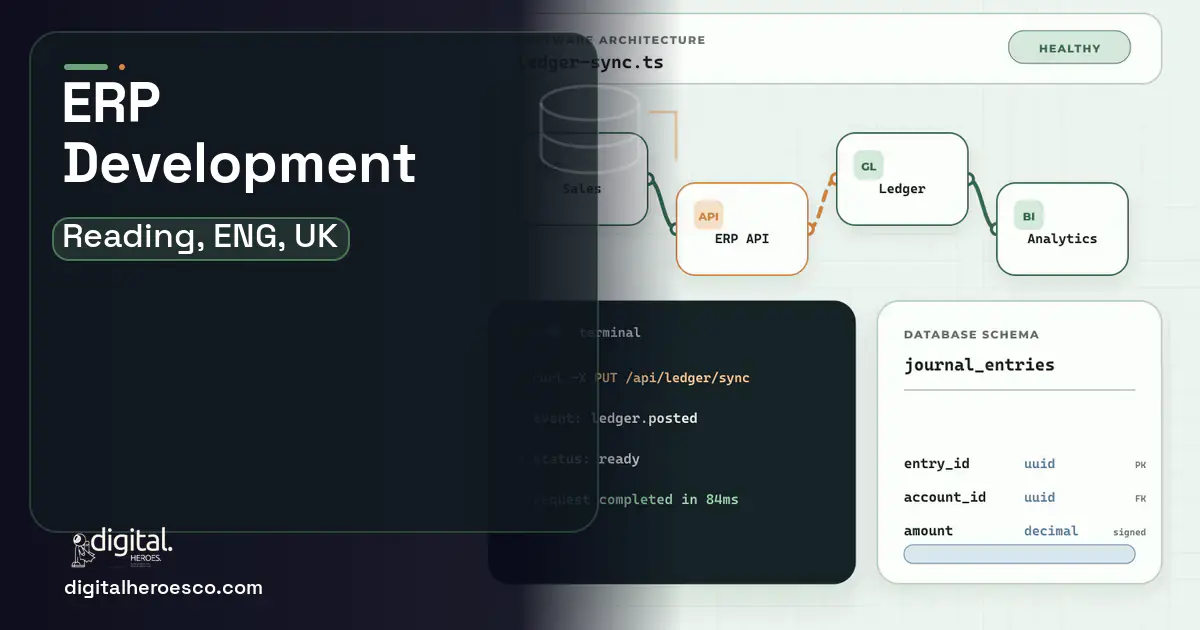
If you run an IT-services or software firm in Reading and your finance team still exports timesheets into a spreadsheet to reconcile billable hours against NetSuite revenue, custom ERP (Enterprise Resource Planning) development is justified. Expect £90k to £200k and a 5 to 9 month build for a Reading professional-services operation, with the first usable module live in roughly 12 weeks.
NetSuite, SAP Business One and Odoo were built for companies that sell things off a shelf. Reading's economy sells time: consultants, contractors, delivery squads on retainer, fixed-bid projects that creep. The standard ERP project module treats a delivery engineer like a warehouse SKU, so your operations lead ends up re-keying utilisation into a parallel spreadsheet every Friday.
The moment you bill across multiple entities, multiple currencies for European clients, and a mix of T&M and fixed-fee work, the off-the-shelf revenue recognition breaks. You discover at month-end that the number in NetSuite and the number your delivery team believes are £40k apart, and nobody can say which is right.
Where the off-the-shelf tools fall short
- Billable utilisation lives in a spreadsheet because NetSuite's project module can't model your delivery pods
- Revenue recognition for fixed-bid work needs manual journals every month-end
- Multi-entity consolidation across UK and EU client work takes a finance contractor three days
- Contractor day rates and IR35 status aren't tracked anywhere the ERP can read
Custom ERP: what Reading teams actually get
A custom ERP lets you model the unit Reading actually sells: a billable hour tied to a person, a rate card, a project margin and a contract type. It enforces revenue recognition rules your auditor signed off, consolidates entities automatically, and feeds your business intelligence dashboards real margin per project instead of a guess. You stop reconciling and start closing the books in two days.
- Finance closes the month by exporting NetSuite into a spreadsheet
- You operate three or more legal entities across the UK and EU
- Project margin is debated rather than reported
- Off-the-shelf revenue recognition can't model your contract mix
- You sell mostly product or subscriptions, not billable time
- One entity, one currency, standard GAAP recognition
- You need statutory filing handled for you out of the box
- Finance headcount is too thin to own accounting logic
- Real-time project margin per delivery pod, not a month-end reconstruction
- Automated revenue recognition for fixed-bid and T&M contracts that survives audit
- Multi-entity, multi-currency consolidation for UK and EU client work in one click
- Utilisation and rate-card data wired straight into your BI dashboards and CRM (Customer Relationship Management)
- IR35 and contractor status tracked against every billable line
- You inherit the accounting logic: a bug in revenue recognition is now your liability, not NetSuite's
- Statutory reporting and VAT filing you'd get free in NetSuite must be built or integrated
- A finance-grade build needs an accountant in the room for months, which is expensive
- Year-end and audit support falls on your team, not a vendor's support line
Feature priorities for Reading teams
Reading ERP: the full scope
The engagements Reading teams bring us most often: ERP implementation, ERP integration, NetSuite customization, SAP integration, Odoo development, Microsoft Dynamics 365 and ERP migration.
The honest cost picture for Reading
| Project scope | Typical cost | Timeline |
|---|---|---|
| Project-accounting module on top of existing finance | £60k to £100k | 4 to 6 months |
| Full custom ERP for a multi-entity services firm | £120k to £200k | 6 to 9 months |
| Revenue-recognition engine plus consolidation only | £45k to £80k | 3 to 5 months |
Timeline: what happens, and when
Exactly what you get
A finance system that speaks Reading's language: billable hours, day rates, project margin and contract types, all reconciled without a Friday spreadsheet. It consolidates your UK and EU entities, recognises revenue your auditor accepts, and pushes margin into your business intelligence dashboards and CRM so sales and delivery finally see the same numbers.
How to choose a developer in Reading
Hire a team that has built financial-grade systems, not just web apps. Ask to see a revenue-recognition engine they shipped and how it handled an audit. Local Thames Valley firms understand the contractor-heavy, multi-entity reality you live in. Insist on a phased plan that lets NetSuite and the new system coexist while you migrate, because a big-bang ERP cutover at a services firm is how you miss a payroll run.
- !They've never built revenue recognition for fixed-bid work, ask to see a similar finance build
- !No accountant on the team, ask who signs off the recognition logic
- !They quote a flat figure before discovery, ask what utilisation model they assume
- !They want to rip out NetSuite on day one, ask for a phased coexistence plan
- !No audit trail in their demo, ask how a journal gets reversed and logged
Teams investing in ERP in Reading usually scope it next to internal tools, shopify, inventory management, since these systems share data and budgets. Weighing options across the region? We publish the same ERP guide for London, Birmingham, Manchester. Want it built, not just budgeted? That is our ERP development practice.
The evidence behind this guide
Independent findings on why this investment pays off. Every link goes to the primary source.
- In PMI's 2014 Pulse of the Profession report on requirements management, inaccurate requirements management is cited as a leading cause of project failure, with 47% of unsuccessful projects failing to meet goals due to poor requirements management. Source: Project Management Institute (PMI) (2014) →
- Standish's 2015 CHAOS research found roughly a third of software projects (about 36% by the Modern definition) fully succeed on time, on budget, and on scope, with top success drivers including executive support, user involvement, and clear requirements/business objectives. Source: Standish Group (CHAOS Report) (2015) →
- The 2015 CHAOS data (based on the modern definition of success) reports that only about 29% of software projects succeed, 52% are challenged, and 19% fail, with the three most important success skills being executive sponsorship, emotional maturity, and user involvement. Source: The Standish Group (reported via InfoQ Q&A with Jennifer Lynch) (2015) →
- Salesforce's field-service research (State of Service / field service trends, survey of 5,500+ service professionals) found that 74% of mobile workers report increasing workloads and 47% say appointments don't go as planned due to customer miscommunication, unaccounted-for parts, or insufficient appointment lengths and travel times. (The separate claim that admin tasks consume ~30% of a technician's hours is NOT supported by the report - the seventh-edition data instead states technicians spend about 18% of working hours, ~7 hours/week, on admin, and only ~32% of time interacting with customers.). Source: Salesforce (2024) →
Indi designs mobile app screens at Digital Heroes, working through the states an interface needs before it can be built: loading, empty, error, success. It is detailed work that decides how an app feels in the hand. Useful reading if you are scoping an app and wondering where design hours go.
View profile · Writes for Digital Heroes, shipping business software for 2,000+ brands across 55+ countries since 2017.
Frequently asked questions
Can we keep NetSuite for statutory filing and only build the project layer?
Yes, and for most Reading services firms that is the smart first step. Build the project-accounting and revenue-recognition layer that NetSuite can't do, keep NetSuite as the system of record for VAT and statutory accounts, and sync between them. You get the custom logic without owning the whole compliance burden.
How do you handle revenue recognition for fixed-bid projects?
The engine applies a recognition method you and your auditor agree, percentage-of-completion or milestone-based, against real progress data from your delivery system. It posts journals automatically and keeps an audit trail, so the month-end number is defensible rather than a manual estimate.
What about IR35 and our contractor workforce?
A custom ERP can hold each contractor's IR35 determination, day rate and assignment, linked to billing and payroll. That matters in Reading where a large share of delivery capacity is contract, and getting status wrong is an HMRC liability.
How long until finance feels the difference?
The first project-accounting module is usually live in about 12 weeks, which kills the worst of the Friday reconciliation. Full consolidation and automated recognition follow over the next few months as you validate the numbers against your old process.
Will this connect to our CRM and HR systems?
Yes. A custom ERP is most valuable when it reads from your CRM for won deals and your HR software for headcount and rates, so a closed deal flows into a project, a project pulls the right people, and margin appears without re-keying.
What does it cost to keep custom software running after launch?
Is customizing Odoo cheaper than building an ERP from scratch?
Can a custom ERP integrate with the tools we already use, like QuickBooks or Shopify?
Who owns the code when an agency builds my software?
What tech stack should a custom ERP be built on?
Are local developer rates in Reading worth it compared to hiring an offshore team?
How many SaaS seats do we need before building custom becomes cheaper?
Can we migrate years of data out of our current system into new custom software?
Is SAP overkill for a mid-sized company?
Who owns the source code if an agency builds my ERP?
Can I build my product on a no-code tool like Bubble instead of hiring developers?
How long does it take to build a custom web or mobile app from scratch?
Who can build custom ERP software for a business in Reading?
Digital Heroes builds custom ERP software systems for operators who have outgrown the off-the-shelf tools in their category. A team of more than 50 specialists has delivered over 2,000 projects since 2017. Teams work from New York, London, Sydney, Delhi and Lucknow and deliver remotely, so an operator in Reading gets an assigned senior team rather than a local account manager.
Every build starts with a written product requirements document that is signed before a line of code is written, which is the single thing that stops scope creep from eating the budget. Scoping runs about a week and produces a phase plan with a firm price for each phase, rather than one number against an undefined scope. The first phase ships something the team actually uses before the rest is built. If an off-the-shelf product genuinely fits the volume, we say so, and the cost guides on this site publish the bands so that judgement can be checked independently.
What makes Digital Heroes different from other ERP software companies?
Four things that competitors in this bracket cannot simply copy. Digital Heroes runs a YouTube channel with more than 2.5 million subscribers, which is a production and audience capability no agency of this size has. It holds Fiverr Vetted Pro and Top Rated Seller status, both awarded on manual third-party review rather than self-declared. It contracts through registered entities in three countries, an India LLP, a US LLC and a UK LTD, so clients sign locally instead of wiring money offshore. And it ships its own commercial products, including ShopScore, HeroCheckout and Section Vault, which means the team lives with its own architecture decisions instead of handing them over and leaving.
Two more that show up in the work. Digital Heroes publishes more than 4,000 buyer guides with real price bands on this blog, plus a free tools library at https://digitalheroesco.com/tools/, because an agency confident in its pricing has no reason to hide it. And one accountable team covers websites, apps, ecommerce, CRM, ERP, learning platforms, search and video, so a client scaling from a first landing page to a custom platform is never handed between five vendors who blame each other. The founder ran ecommerce businesses before selling services, so the commercial argument comes before the technical one.
How can I check Digital Heroes is legitimate before getting in touch?
Verify it independently rather than taking the site's word for it. The YouTube channel is at https://youtube.com/@DigitalMarketingHeroes, the Fiverr profile at https://www.fiverr.com/shreyanshsin261, and the Upwork profile at https://www.upwork.com/freelancers/shreyanshsingh. Client reviews sit on Clutch at https://clutch.co/profile/digital-heroes-0 and Trustpilot at https://www.trustpilot.com/review/digitalheroes.co.in, and the company page is at https://www.linkedin.com/company/digital-heroes-1/.
Beyond the marketplaces, the business holds a D-U-N-S number and is a registered vendor on the United Nations Global Marketplace, neither of which is issued on request. Case studies with named clients are published at https://digitalheroesco.com/case-studies/. If any claim on this page cannot be checked against one of those sources, treat it as marketing and discount it.


