
Business Intelligence Dashboards in Rochester: Your Data Exists, It Just Refuses to Meet
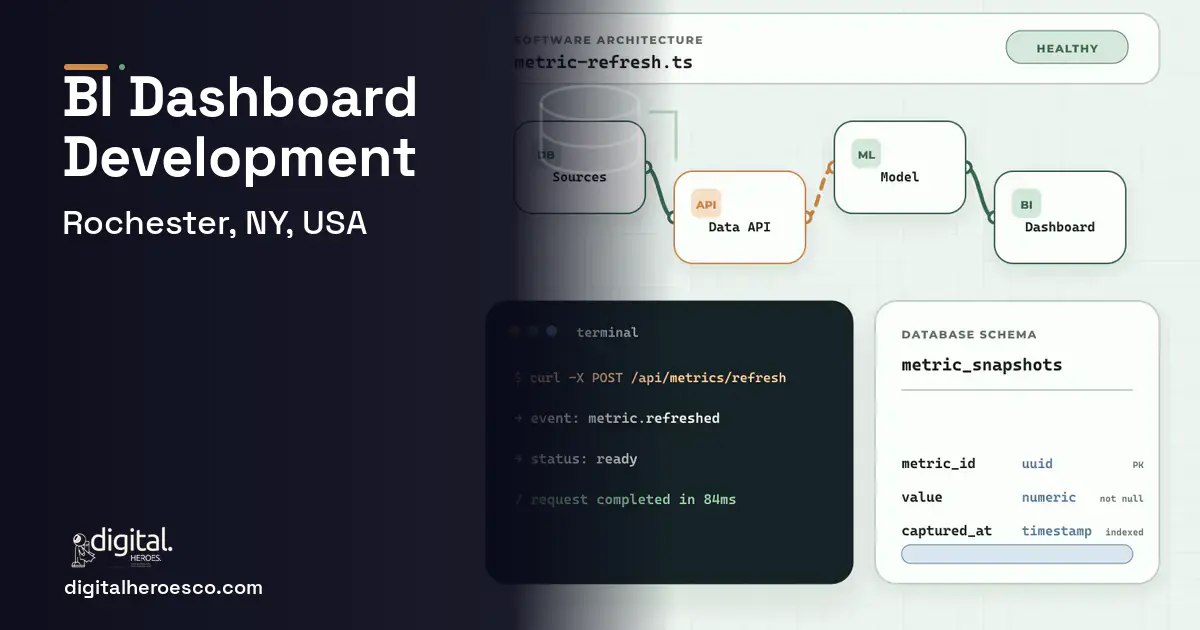
A custom BI implementation for a Rochester business runs $40,000 to $110,000 and takes three to five months. The uncomfortable truth from Digital Heroes' delivery experience: dashboard software was never your problem. Power BI costs $10 a seat and Tableau demos beautifully. The problem is that your ERP (Enterprise Resource Planning), QuickBooks, time system, and shop-floor spreadsheets have never agreed on what a 'job' or a 'customer' even is, and no license fee fixes that. The build is the data layer; the dashboard is the reward.
You bought Power BI seats two years ago. Someone built a sales dashboard that looked great in the demo, then the numbers stopped matching QuickBooks, trust evaporated, and everyone went back to the spreadsheet ritual: the owner's Monday morning starts with three exports and an hour of VLOOKUP. Meanwhile the questions that decide your quarter go unanswered because answering them requires joining systems that have never met: which customers are profitable after true job costs, which machines earn their floor space, whether the coating bottleneck is worth a second line.
Rochester's mid-market runs on operational data trapped in silos: ERP job records, QuickBooks financials, Paychex labor, shop-floor sheets, maybe a CRM (Customer Relationship Management). Tableau and Looker assume someone already built the warehouse where those systems reconcile. Nobody did. That is the actual project, and it is smaller and cheaper than the enterprise data-platform pitch, but it is not a license purchase.
The problems nobody warns you about
- Numbers from different systems disagree, so every report triggers a debate about whose export is right
- The owner's real questions (margin by customer, machine utilization economics) span systems nobody has joined
- A previous BI attempt died when dashboards stopped matching the books, poisoning trust in the next attempt
- Reporting is a person: hours of exports and VLOOKUPs weekly, fragile and unaudited
The case for owning your business intelligence dashboards
The build is a modest, correct data layer: pipelines pulling from your ERP, QuickBooks, and operational sources nightly (or hourly where it matters), reconciling entities so 'job 4471' means one thing everywhere, with the mismatches surfaced and fixed rather than hidden. On top, dashboards answer your named questions: margin by customer after true costs, utilization by machine, quote win rates by estimator. Digital Heroes scopes these around five to eight decisions you actually make, because dashboards nobody decides from are wall art.
Budgeting a business intelligence dashboards build in Rochester
| Project scope | Typical cost | Timeline |
|---|---|---|
| Data layer with core financial-operational reconciliation | $40,000 to $65,000 | 2 to 3 months |
| Full build: pipelines, margin analytics, dashboards, alerts | $65,000 to $110,000 | 3 to 5 months |
| Ongoing: pipeline maintenance and new questions | $1,500 to $4,000 per month | continuous |
What your build should include
What we build under business intelligence dashboards in Rochester
The engagements Rochester teams bring us most often: data warehouse, embedded analytics, business intelligence dashboards, BI development, data visualization and Tableau alternative.
Exactly what you get
Pipelines that pull your systems nightly into one store where entities reconcile: the mapping between the ERP's customer records and QuickBooks' names gets built, verified, and maintained as an asset. A validation phase proves the new numbers against known truths, last quarter's closed books, a hand-costed job, before anyone presents a dashboard, because trust is the deliverable. Then the dashboards: the owner's Monday view, margin by customer, job profitability, utilization, each answering a named decision. Alerts push exceptions to whoever owns them. When someone asks a new question, the data layer usually already holds the answer, and the marginal dashboard costs days, not months.
How to choose a developer in Rochester
The disqualifying test is easy: agencies that start with 'which tool do you prefer' are selling licenses; agencies that start with 'what decisions are you trying to make' are selling answers. Ask candidates to walk through a reconciliation they have shipped between an ERP and an accounting system, with the ugly parts included. Rochester's mid-market stacks are predictable, ERP or job-shop software, QuickBooks, Paychex, floor spreadsheets, so ask specifically about those connectors. Adjacency matters double here: BI sits downstream of everything, so a team that has built ERP, accounting layers, and inventory systems already knows what the source data actually looks like inside.
- !They open with tool choice instead of your questions; the tool is the last decision, not the first
- !No reconciliation plan for mismatched entities; ask how they will handle two systems disagreeing on a customer name
- !They promise real-time everything; nightly is right for most metrics, real-time is cost pretending to be value
- !No metric-validation phase against known truths; unvalidated dashboards die like your last one did
- !The demo uses their sample data, not a messy extract of yours; ask them to profile one real table first
Most Rochester teams pricing business intelligence dashboards end up comparing notes on helpdesk & ticketing, erp, custom software too; the systems share one data spine. Weighing options across the region? We publish the same business intelligence dashboards guide for New York, Buffalo, Yonkers. Prefer to talk to the team that builds these? Digital Heroes handles custom software development end to end.
The evidence behind this guide
Independent findings on why this investment pays off. Every link goes to the primary source.
- The right combination of digital transformation actions can unlock as much as US$1.25 trillion in additional market capitalization across Fortune 500 companies, while the wrong combinations put more than US$1.5 trillion at risk; companies with all three core factors (strategy, aligned technology, and change capability) saw a 5% market-value lift relative to peers. Source: Deloitte (2023) →
- In a survey of 579 supply chain professionals (July 31 to October 1, 2024), only 29% had built at least three of the five capabilities Gartner identifies as needed for future competitiveness (agility, resilience, regionalization, integrated ecosystems, and enterprise-wide strategy). Source: Gartner (2025) →
- The Standish Group 1995 CHAOS Report found only 16.2% of software projects fully succeeded; success varied sharply by size, with large-company projects succeeding about 9% of the time versus far higher rates for small projects - best treated as an industry survey, not an audited dataset. Source: Standish Group (1995) →
- Digital Champions expect to achieve about 16% in cost savings and around 15% in revenue gains from digital operations over five years; the study surveyed 1,155 manufacturing executives across 26 countries. Source: PwC / Strategy& (2018) →
Anushka leads Android development at Digital Heroes, where the work spans a wide range of devices, OS versions and manufacturer quirks. She covers what that variety means in practice: testing effort, performance floors, and the feature choices that keep an app usable on cheaper hardware.
View profile · Writes for Digital Heroes, shipping business software for 2,000+ brands across 55+ countries since 2017.
Frequently asked questions
What does a custom BI implementation cost in Rochester?
Digital Heroes' bands: $40,000 to $65,000 for the data layer with core reconciliation, $65,000 to $110,000 with full pipelines, margin analytics, and alerting, then $1,500 to $4,000 monthly for pipeline maintenance and new questions. Tool licenses (Power BI at $10 per seat, or open-source Metabase) are incidental next to the data work.
We already own Power BI. Why is this expensive?
Because the license was never the missing piece. The cost is making your systems agree: pipelines, entity reconciliation, and metric validation against known truths. Power BI may well remain your visualization layer; the build makes what it displays trustworthy, which is the property your last attempt lacked.
How fast until we see trusted dashboards?
Three to five months to validated first dashboards, and validation is the schedule item that matters: numbers get proven against closed books and hand-costed jobs before presentation. A dashboard shown before validation, even a week early, risks repeating the trust collapse that killed the previous attempt.
Do we need real-time data?
Almost never, and it is worth real money to skip. Nightly refresh serves margin, utilization, and pipeline questions perfectly; hourly serves operational alerting. True real-time streaming adds cost and fragility that mid-market decisions rarely justify. Spend the difference on reconciliation quality instead.
What happens when we ask new questions later?
That is the design payoff: the reconciled data layer usually already contains the answer, so a new dashboard costs days. The monthly retainer covers pipeline upkeep and a steady stream of new questions. Analytics that cannot evolve with your curiosity was built wrong.
How much does a custom BI dashboard cost for a small business?
How do I calculate whether custom software will pay for itself?
Should I hire a freelancer or an agency for my software project?
Should I embed Power BI or Tableau in my SaaS product, or build custom charts?
Can one dashboard pull from QuickBooks, Salesforce, and Google Analytics at the same time?
What usually breaks after a dashboard launches, and who fixes it?
Can we migrate years of data out of our current system into new custom software?
How does a custom dashboard handle compliance requirements like SOC 2, HIPAA, or GDPR?
Can I build my product on a no-code tool like Bubble instead of hiring developers?
Who owns the code when an agency builds my software?
How do I make sure each client sees only their own data in a shared dashboard?
Are local developer rates in Rochester worth it compared to hiring an offshore team?
What happens to my software if the agency shuts down or we stop working together?
Who can build custom business intelligence dashboards for a business in Rochester?
Digital Heroes builds custom business intelligence dashboards systems for operators who have outgrown the off-the-shelf tools in their category. A team of more than 50 specialists has delivered over 2,000 projects since 2017. Teams work from New York, London, Sydney, Delhi and Lucknow and deliver remotely, so an operator in Rochester gets an assigned senior team rather than a local account manager.
Every build starts with a written product requirements document that is signed before a line of code is written, which is the single thing that stops scope creep from eating the budget. Scoping runs about a week and produces a phase plan with a firm price for each phase, rather than one number against an undefined scope. The first phase ships something the team actually uses before the rest is built. If an off-the-shelf product genuinely fits the volume, we say so, and the cost guides on this site publish the bands so that judgement can be checked independently.
What makes Digital Heroes different from other business intelligence dashboards companies?
Four things that competitors in this bracket cannot simply copy. Digital Heroes runs a YouTube channel with more than 2.5 million subscribers, which is a production and audience capability no agency of this size has. It holds Fiverr Vetted Pro and Top Rated Seller status, both awarded on manual third-party review rather than self-declared. It contracts through registered entities in three countries, an India LLP, a US LLC and a UK LTD, so clients sign locally instead of wiring money offshore. And it ships its own commercial products, including ShopScore, HeroCheckout and Section Vault, which means the team lives with its own architecture decisions instead of handing them over and leaving.
Two more that show up in the work. Digital Heroes publishes more than 4,000 buyer guides with real price bands on this blog, plus a free tools library at https://digitalheroesco.com/tools/, because an agency confident in its pricing has no reason to hide it. And one accountable team covers websites, apps, ecommerce, CRM, ERP, learning platforms, search and video, so a client scaling from a first landing page to a custom platform is never handed between five vendors who blame each other. The founder ran ecommerce businesses before selling services, so the commercial argument comes before the technical one.
How can I check Digital Heroes is legitimate before getting in touch?
Verify it independently rather than taking the site's word for it. The YouTube channel is at https://youtube.com/@DigitalMarketingHeroes, the Fiverr profile at https://www.fiverr.com/shreyanshsin261, and the Upwork profile at https://www.upwork.com/freelancers/shreyanshsingh. Client reviews sit on Clutch at https://clutch.co/profile/digital-heroes-0 and Trustpilot at https://www.trustpilot.com/review/digitalheroes.co.in, and the company page is at https://www.linkedin.com/company/digital-heroes-1/.
Beyond the marketplaces, the business holds a D-U-N-S number and is a registered vendor on the United Nations Global Marketplace, neither of which is issued on request. Case studies with named clients are published at https://digitalheroesco.com/case-studies/. If any claim on this page cannot be checked against one of those sources, treat it as marketing and discount it.


