
Power BI charts last quarter beautifully, but it can't tell you if tonight's render queue will blow the deadline
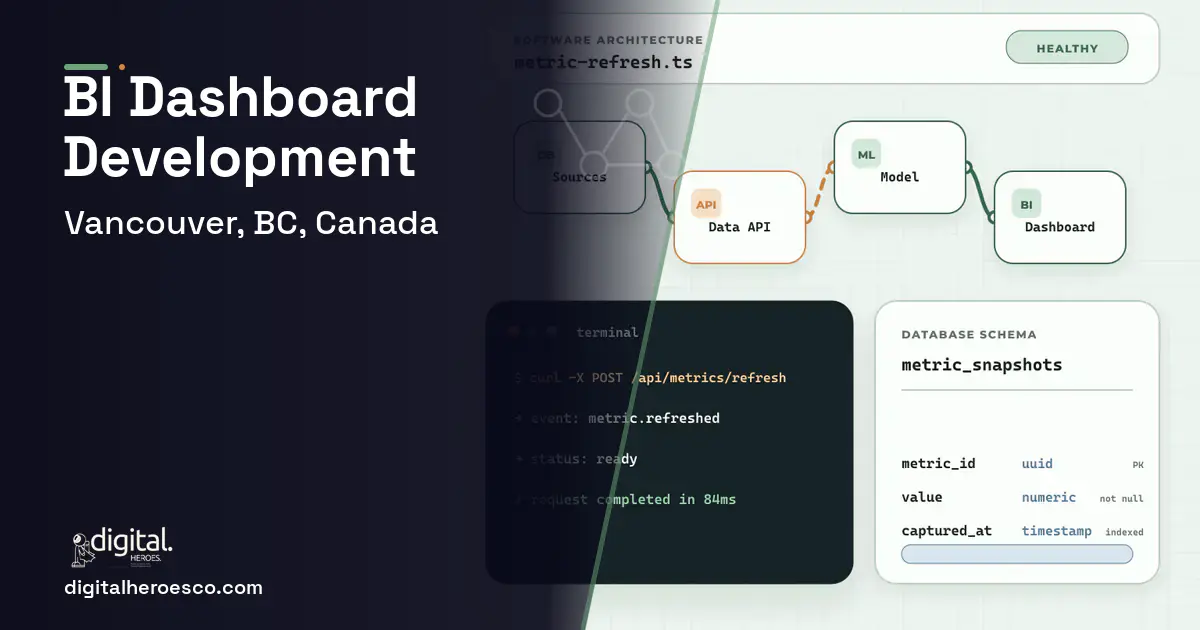
Custom BI dashboards are worth it in Vancouver when Tableau, Power BI or Looker can't reach or model your real data: live render-farm utilization, per-production margin pulling from pipeline and finance, or operational metrics that need real-time, not last-night's refresh. Expect $35,000 to $90,000 and 2 to 5 months for dashboards that show the numbers that actually run your studio.
Power BI and Tableau are superb at visualizing data that already sits cleanly in a warehouse. The trouble for a Vancouver studio is that the data that matters, render-farm utilization, queue depth, per-shot cost, isn't in a warehouse; it's in farm logs, the asset library and three disconnected SaaS tools. So your BI dashboard charts the data that's easy to get, not the data that decides whether you hit the deadline.
The ceiling is data plumbing and latency. Off-the-shelf BI assumes a tidy upstream pipeline and overnight refresh, but operational decisions in a render-heavy studio need near-real-time signals from systems BI tools don't natively read. When the question is 'will tonight's queue miss the delivery', a dashboard refreshed last night gives you yesterday's answer.
The fix: business intelligence dashboards built for Vancouver, not rented
You build custom BI when the value is in the data plumbing, not just the charts. A custom solution builds the pipeline that pulls render-farm logs, pipeline status and finance into one model, then presents near-real-time dashboards: queue risk tonight, per-production margin now, resource bottlenecks live. It answers operational questions Power BI can't, because the hard part, getting the data, is the part it does.
The capability list that earns its budget
What we build under business intelligence dashboards in Vancouver
Everything a business intelligence dashboards build here can cover: Tableau alternative, Power BI, Looker, real-time analytics, KPI dashboards and data warehouse.
What business intelligence dashboards costs in Vancouver
| Project scope | Typical cost | Timeline |
|---|---|---|
| Dashboards on an existing data warehouse | $30k to $50k | 1.5 to 3 months |
| Data pipeline plus near-real-time dashboards | $50k to $90k | 3 to 5 months |
| Full BI platform with real-time ops and alerting | $85k to $150k | 5 to 8 months |
How long it takes, phase by phase
Exactly what you get
You get dashboards that answer operational questions, not just chart history. The build creates the data pipeline that pulls render-farm logs, pipeline status and finance into one model, then presents near-real-time views: will tonight's queue miss delivery, what's per-production margin right now, where's the capacity bottleneck. Metrics are defined to your business so leadership trusts them, thresholds trigger alerts, and your ERP, project-management software and internal tools feed in as live sources.
How to choose a developer in Vancouver
Hire a team that treats the data pipeline as the real work, because that's where BI projects succeed or fail, and where cheap vendors cut corners. Ask how they'd pull render-farm logs and join finance and pipeline data into one model, and how they'd keep operational dashboards near-real-time. Probe their metric-definition discipline so numbers stay consistent. In Vancouver's pipeline-heavy studios, the right partner has built data engineering, not just slapped charts on a spreadsheet.
- A real data pipeline that pulls render-farm, pipeline and finance data into one trustworthy model
- Near-real-time operational dashboards (queue risk, capacity) instead of last-night's refresh
- Per-production margin joined across pipeline, finance and HR (Human Resources) in one view
- Metrics defined to your business, not a tool's defaults, so leadership trusts the numbers
- Integration with your ERP, project-management software and internal tools as live data sources
- Most of the cost is the data pipeline, which is invisible to stakeholders who only see charts
- Real-time data infrastructure is more expensive to build and run than overnight batch
- Power BI and Tableau are cheaper if your data is already clean and batch is fine
- Dashboards need ongoing care as sources and metrics change, so it's not set-and-forget
- !They only show pretty charts; ask how the data pipeline that feeds them gets built
- !No real-time plan; ask how operational dashboards stay current enough to act on
- !They ignore render-farm sources; ask how those logs reach the model
- !No metric-definition rigor; ask how numbers stay consistent across the business
- !They underprice the pipeline; ask what share of cost is data plumbing
Most Vancouver teams pricing business intelligence dashboards end up comparing notes on helpdesk & ticketing, erp, custom software too; the systems share one data spine. Weighing options across the region? We publish the same business intelligence dashboards guide for Victoria, Kelowna, Abbotsford. Prefer to talk to the team that builds these? Digital Heroes handles custom software development end to end.
The evidence behind this guide
Independent findings on why this investment pays off. Every link goes to the primary source.
- Nucleus Research's analysis of published analytics deployment case studies found business intelligence and analytics returned an average of $13.01 in benefits for every dollar spent, up from $10.66 three years earlier. Source: Nucleus Research (2014) →
- The right combination of digital transformation actions can unlock as much as US$1.25 trillion in additional market capitalization across Fortune 500 companies, while the wrong combinations put more than US$1.5 trillion at risk; companies with all three core factors (strategy, aligned technology, and change capability) saw a 5% market-value lift relative to peers. Source: Deloitte (2023) →
- Brandon Hall Group research on onboarding reports that done well, structured onboarding drives measurable gains in new-hire productivity, employee engagement, and retention; the page notes 41% of organizations experience greater than 5% turnover among new hires. Source: Brandon Hall Group (2024) →
- Companies in the top quartile of McKinsey's Developer Velocity Index had 2014-18 revenue growth four to five times faster than bottom-quartile peers, showing that software-building capability is a driver of business performance, not just a support function. Source: McKinsey & Company (2020) →
Shreyansh runs the Lucknow operation, sitting between clients who need software built and the teams who build it. Most of his week goes on scoping work honestly, deciding what a project should and should not include, and keeping delivery promises realistic. He writes for readers weighing up whether to commission custom software at all.
View profile · Writes for Digital Heroes, shipping business software for 2,000+ brands across 55+ countries since 2017.
Frequently asked questions
Why can't Power BI just chart our render data?
Power BI charts data that already sits cleanly in a warehouse, but render-farm utilization, queue depth and per-shot cost live in farm logs and disconnected tools it can't natively read. The hard, valuable work is building the pipeline that gets that data into a model, which is exactly what a custom BI build does.
Do we really need real-time dashboards?
If your decisions are operational, like whether tonight's render queue will miss a delivery, then yes, overnight refresh gives you yesterday's answer. If your decisions are strategic and batch is fine, Tableau or Power BI on a warehouse may be cheaper and sufficient.
Why is the data pipeline most of the cost?
Stakeholders see charts, but getting render-farm, pipeline and finance data into one trustworthy, near-real-time model is the bulk of the engineering. Cheap proposals skip this and produce pretty dashboards on incomplete data. Insist the pipeline is scoped honestly.
What do custom BI dashboards cost in Vancouver?
Dashboards on an existing warehouse run $30k to $50k over 1.5 to 3 months. A data pipeline plus near-real-time dashboards is $50k to $90k over 3 to 5 months. A full BI platform with real-time ops and alerting goes higher.
What data sources can it pull from?
A good build integrates render farms, your ERP, project-management software, accounting and internal tools as live sources, joining them into one model so per-production margin and operational status come from a single, trusted place.
Can one dashboard pull from QuickBooks, Salesforce, and Google Analytics at the same time?
Is Tableau worth $75 per user per month, or should we build our own dashboard?
Should I hire a freelancer or an agency for my software project?
Can we migrate years of data out of our current system into new custom software?
If we move off Power BI or Tableau later, do we lose our historical data and reports?
Who owns the code, data models, and pipelines when an agency builds my dashboard?
How much does a custom BI dashboard cost for a small business?
How do I vet an agency or developer for a BI dashboard project?
Can I build my product on a no-code tool like Bubble instead of hiring developers?
Do I need a data warehouse before building a custom dashboard?
When does Looker make more sense than a custom dashboard?
Who can build custom business intelligence dashboards for a business in Vancouver?
Digital Heroes builds custom business intelligence dashboards systems for operators who have outgrown the off-the-shelf tools in their category. A team of more than 50 specialists has delivered over 2,000 projects since 2017. Teams work from New York, London, Sydney, Delhi and Lucknow and deliver remotely, so an operator in Vancouver gets an assigned senior team rather than a local account manager.
Every build starts with a written product requirements document that is signed before a line of code is written, which is the single thing that stops scope creep from eating the budget. Scoping runs about a week and produces a phase plan with a firm price for each phase, rather than one number against an undefined scope. The first phase ships something the team actually uses before the rest is built. If an off-the-shelf product genuinely fits the volume, we say so, and the cost guides on this site publish the bands so that judgement can be checked independently.
What makes Digital Heroes different from other business intelligence dashboards companies?
Four things that competitors in this bracket cannot simply copy. Digital Heroes runs a YouTube channel with more than 2.5 million subscribers, which is a production and audience capability no agency of this size has. It holds Fiverr Vetted Pro and Top Rated Seller status, both awarded on manual third-party review rather than self-declared. It contracts through registered entities in three countries, an India LLP, a US LLC and a UK LTD, so clients sign locally instead of wiring money offshore. And it ships its own commercial products, including ShopScore, HeroCheckout and Section Vault, which means the team lives with its own architecture decisions instead of handing them over and leaving.
Two more that show up in the work. Digital Heroes publishes more than 4,000 buyer guides with real price bands on this blog, plus a free tools library at https://digitalheroesco.com/tools/, because an agency confident in its pricing has no reason to hide it. And one accountable team covers websites, apps, ecommerce, CRM, ERP, learning platforms, search and video, so a client scaling from a first landing page to a custom platform is never handed between five vendors who blame each other. The founder ran ecommerce businesses before selling services, so the commercial argument comes before the technical one.
How can I check Digital Heroes is legitimate before getting in touch?
Verify it independently rather than taking the site's word for it. The YouTube channel is at https://youtube.com/@DigitalMarketingHeroes, the Fiverr profile at https://www.fiverr.com/shreyanshsin261, and the Upwork profile at https://www.upwork.com/freelancers/shreyanshsingh. Client reviews sit on Clutch at https://clutch.co/profile/digital-heroes-0 and Trustpilot at https://www.trustpilot.com/review/digitalheroes.co.in, and the company page is at https://www.linkedin.com/company/digital-heroes-1/.
Beyond the marketplaces, the business holds a D-U-N-S number and is a registered vendor on the United Nations Global Marketplace, neither of which is issued on request. Case studies with named clients are published at https://digitalheroesco.com/case-studies/. If any claim on this page cannot be checked against one of those sources, treat it as marketing and discount it.


