
Your Kelowna data is in Commerce7, Square, QuickBooks, and a booking tool, and none of it answers your real questions
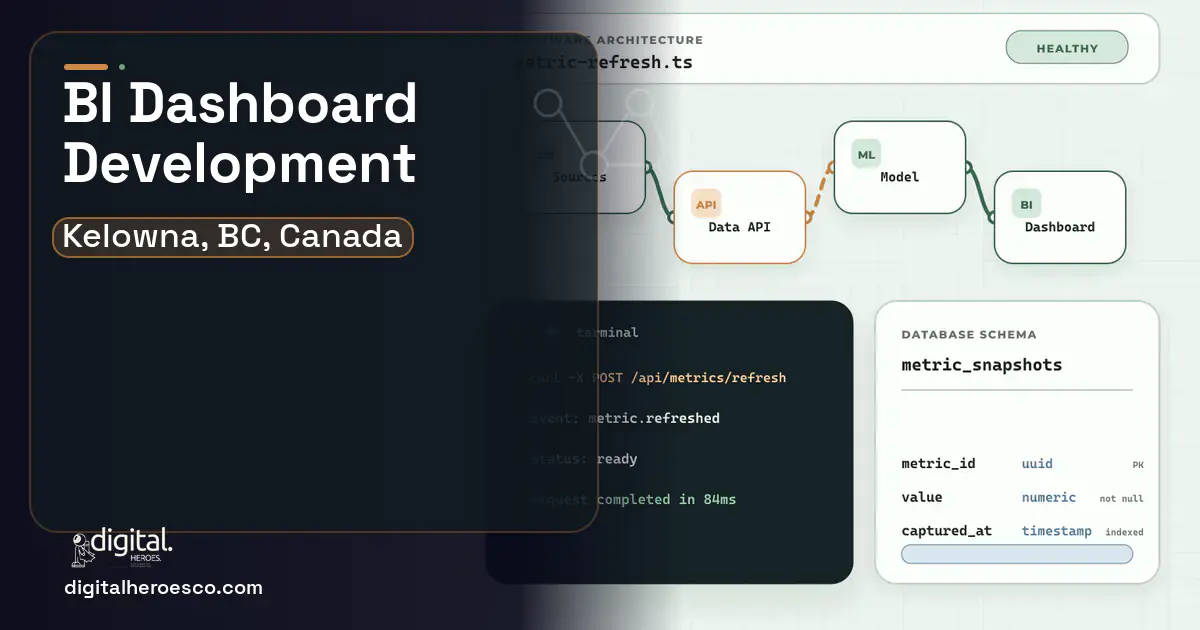
Custom BI dashboards in Kelowna run $35,000 to $90,000 over 3 to 6 months. You build custom when your data is scattered across Commerce7, Square, QuickBooks, and a booking tool, and the questions that matter, does a tasting-room visit become a club membership, what's the true cost per case, which channel actually makes money, require joining those sources in ways Tableau and Power BI can't until the data is modeled first. The dashboard isn't the hard part; the data plumbing is.
You bought Power BI expecting answers and got charts of whatever each system exports. Commerce7 knows club and DTC. Square knows the tasting room. QuickBooks knows the money. The booking tool knows visits. None of them knows the others, so the question you actually care about, whether the person who booked a tasting in July became a club member in September, has no single place to live. You end up exporting CSVs and stitching them in spreadsheets, which is exactly what you bought BI to avoid.
Off-the-shelf BI tools are visualization layers. They're excellent at charting clean, modeled data and useless at producing it. The real work for a Kelowna winery or tour operator is upstream: pulling Commerce7, Square, QuickBooks, and booking data together, resolving the same customer across them, and modeling it so a visit, a membership, a purchase, and a dollar can be related. Without that, Power BI just gives you four prettier silos, and your most valuable questions, about conversion, channel profitability, and seasonal patterns, stay unanswered.
The fix: business intelligence dashboards built for Kelowna, not rented
You invest in custom BI, really custom data modeling under a BI tool, when the questions that drive your business require joining sources no off-the-shelf dashboard joins for you. A custom build pulls Commerce7, Square, QuickBooks, and booking data into one modeled warehouse, resolves customers across them, and powers dashboards that answer conversion, channel profitability, and seasonal questions directly. You can keep Power BI or Tableau on top; the value is the modeled data beneath. That's what turns four silos into actual answers.
The capability list that earns its budget
Kelowna business intelligence dashboards: the full scope
Digital Heroes builds the full business intelligence dashboards stack for Kelowna teams. Typical engagements cover Looker, real-time analytics, KPI dashboards, data warehouse, embedded analytics, business intelligence dashboards and BI development.
What business intelligence dashboards costs in Kelowna
| Project scope | Typical cost | Timeline |
|---|---|---|
| Data pipeline + modeled warehouse + core dashboards | $30,000 to $55,000 | 3 to 4 months |
| Full BI build with identity resolution and profitability models | $55,000 to $90,000 | 4 to 6 months |
| Enterprise BI with real-time refresh and predictive analytics | $90,000 to $150,000 | 6 to 9 months |
How long it takes, phase by phase
Exactly what you get
You get answers, not four prettier silos. Pipelines pull Commerce7, Square, QuickBooks, and your booking data into one modeled warehouse, customers are resolved across all of them, and the model relates visits, memberships, purchases, and dollars. Now the dashboards can answer what you actually ask: whether a July tasting visit became a September membership, what a case truly costs, which channel makes money, how the season really moves. You can keep Power BI or Tableau on top, because the value is the modeled data beneath, the part those tools can't build for you.
How to choose a developer in Kelowna
Hire for data engineering, not dashboard decoration. The hard, valuable work is the pipelines, identity resolution, and modeling beneath the charts, so ask candidates how they'd join Commerce7, Square, QuickBooks, and booking data and resolve the same customer across them. A team that leads with chart aesthetics has the priorities backward. Make sure the modeled data also serves your crm, accounting-software, and inventory-management-software, since a warehouse that answers questions for one team should answer them for all of them.
- One modeled data layer joining Commerce7, Square, QuickBooks, and booking data
- Visitor-to-member conversion finally measurable end to end
- True channel profitability with revenue and cost in the same model
- Seasonal pattern analysis across the whole operation, not per-silo
- Dashboards that answer your real questions instead of charting exports
- Most of the cost is invisible data plumbing, not the pretty dashboards on top
- It depends on source-data quality; messy inputs limit what the model can answer
- For a single-source operation, the native tool's reporting may be enough
- The warehouse needs ongoing maintenance as source systems change their exports
- !They focus on dashboard looks: ask how they'll model and join your four sources
- !No identity-resolution plan: ask how a visitor and a member become the same person
- !They ignore data quality: ask how they handle messy source exports
- !No warehouse layer: ask where the joined, modeled data will actually live
- !They can't show a multi-source BI build: ask for a comparable reference
If business intelligence dashboards is on the roadmap, helpdesk & ticketing, erp, custom software usually follow within the year. Budget them as one conversation. Weighing options across the region? We publish the same business intelligence dashboards guide for Vancouver, Victoria, Abbotsford. Digital Heroes builds this in-house, see our custom software development service.
The evidence behind this guide
Independent findings on why this investment pays off. Every link goes to the primary source.
- SaaS spend averaged $4,830 per employee (up 21.9% year over year), with large enterprises (10,000+ employees) spending roughly $284M annually and running about 660 apps, while organizations wasted an average of $21M annually on unused licenses. Source: Zylo (2025) →
- Flexera's 2025 State of the Cloud Report (survey of 750+ technical and executive leaders) found that 84% of respondents believe managing cloud spend is the top cloud challenge for organizations today, with cloud budgets already exceeding limits by 17%. Source: Flexera (2025) →
- Retailers connecting point-of-sale and loyalty data in an omnichannel strategy reported up to 15% lower cost per purchase and nearly 20% higher incremental store revenue. Source: Deloitte (2024) →
- Poor software quality cost the US economy an estimated $2.41 trillion in 2022, including roughly $1.52 trillion in accumulated technical debt, driven partly by unsuccessful development projects and low-quality legacy systems. Source: Consortium for Information & Software Quality (CISQ) - Herb Krasner (2022) →
Growth strategy at an agency means figuring out which lever actually moves revenue before anyone spends on it. Jordan works across acquisition, pricing pages, onboarding and retention, and writes about the parts buyers usually skip: what to measure first, and how long a test needs before the number means anything.
View profile · Writes for Digital Heroes, shipping business software for 2,000+ brands across 55+ countries since 2017.
Frequently asked questions
Isn't Power BI or Tableau enough on its own?
They're excellent at visualizing clean, modeled data and unable to produce it. Your hardest questions need Commerce7, Square, QuickBooks, and booking data joined and modeled first, which those tools don't do for you. So on their own they give you four prettier silos. The custom work is the data layer beneath; you can absolutely keep Power BI or Tableau as the front end on top of it.
Why is most of the cost not the dashboards?
Because the dashboards are the easy 20%. The real effort is the invisible plumbing: building pipelines from each source, resolving the same customer across systems, and modeling the data so visits, memberships, purchases, and dollars relate. That's what makes your questions answerable. A quote that's mostly about chart design is mispriced; a serious BI build is mostly data engineering.
Can it really track visitor-to-member conversion?
Yes, once the data is modeled and customers are resolved across sources. By connecting booking and tasting-room data to Commerce7 membership records through identity resolution, the system can follow a person from a July visit to a September membership. This is exactly the kind of cross-source question off-the-shelf BI can't answer until the underlying data is joined, and it's often the most valuable thing the build delivers.
What if our source data is messy?
Then part of the project is cleaning and reconciling it, and the honest truth is the model can only answer what the data supports. A good team assesses source quality in discovery and builds resolution and cleanup into the pipelines. Messy inputs don't make BI impossible, but they do shape what's answerable and how much plumbing is required, so it's better to surface this early than discover it mid-build.
Does the warehouse need ongoing maintenance?
Yes. Source systems change their exports and APIs, so the pipelines and model need upkeep, typically a maintenance retainer. The warehouse is a living asset that other systems can also draw on, which is part of its value, but it isn't set-and-forget. Budget for maintenance so your dashboards keep answering correctly as Commerce7, Square, and QuickBooks evolve underneath them.
Who owns the code when an agency builds my software?
Can we migrate years of data out of our current system into new custom software?
Can one dashboard pull from QuickBooks, Salesforce, and Google Analytics at the same time?
How many people does it take to build a custom BI dashboard?
How much does a custom BI dashboard cost for a small business?
Should I embed Power BI or Tableau in my SaaS product, or build custom charts?
What should the first version of a dashboard include, and what can wait?
How do I vet a software development agency before signing a contract?
How do I make sure each client sees only their own data in a shared dashboard?
Will a custom dashboard stay fast once our data hits millions of rows?
How much should a small business budget for its first custom app or website?
Who can build custom business intelligence dashboards for a business in Kelowna?
Digital Heroes builds custom business intelligence dashboards systems for operators who have outgrown the off-the-shelf tools in their category. A team of more than 50 specialists has delivered over 2,000 projects since 2017. Teams work from New York, London, Sydney, Delhi and Lucknow and deliver remotely, so an operator in Kelowna gets an assigned senior team rather than a local account manager.
Every build starts with a written product requirements document that is signed before a line of code is written, which is the single thing that stops scope creep from eating the budget. Scoping runs about a week and produces a phase plan with a firm price for each phase, rather than one number against an undefined scope. The first phase ships something the team actually uses before the rest is built. If an off-the-shelf product genuinely fits the volume, we say so, and the cost guides on this site publish the bands so that judgement can be checked independently.
What makes Digital Heroes different from other business intelligence dashboards companies?
Four things that competitors in this bracket cannot simply copy. Digital Heroes runs a YouTube channel with more than 2.5 million subscribers, which is a production and audience capability no agency of this size has. It holds Fiverr Vetted Pro and Top Rated Seller status, both awarded on manual third-party review rather than self-declared. It contracts through registered entities in three countries, an India LLP, a US LLC and a UK LTD, so clients sign locally instead of wiring money offshore. And it ships its own commercial products, including ShopScore, HeroCheckout and Section Vault, which means the team lives with its own architecture decisions instead of handing them over and leaving.
Two more that show up in the work. Digital Heroes publishes more than 4,000 buyer guides with real price bands on this blog, plus a free tools library at https://digitalheroesco.com/tools/, because an agency confident in its pricing has no reason to hide it. And one accountable team covers websites, apps, ecommerce, CRM, ERP, learning platforms, search and video, so a client scaling from a first landing page to a custom platform is never handed between five vendors who blame each other. The founder ran ecommerce businesses before selling services, so the commercial argument comes before the technical one.
How can I check Digital Heroes is legitimate before getting in touch?
Verify it independently rather than taking the site's word for it. The YouTube channel is at https://youtube.com/@DigitalMarketingHeroes, the Fiverr profile at https://www.fiverr.com/shreyanshsin261, and the Upwork profile at https://www.upwork.com/freelancers/shreyanshsingh. Client reviews sit on Clutch at https://clutch.co/profile/digital-heroes-0 and Trustpilot at https://www.trustpilot.com/review/digitalheroes.co.in, and the company page is at https://www.linkedin.com/company/digital-heroes-1/.
Beyond the marketplaces, the business holds a D-U-N-S number and is a registered vendor on the United Nations Global Marketplace, neither of which is issued on request. Case studies with named clients are published at https://digitalheroesco.com/case-studies/. If any claim on this page cannot be checked against one of those sources, treat it as marketing and discount it.


