
Custom CRM development in Huntington Beach: half a million people walk past the pier in one week, and your database keeps almost none of them
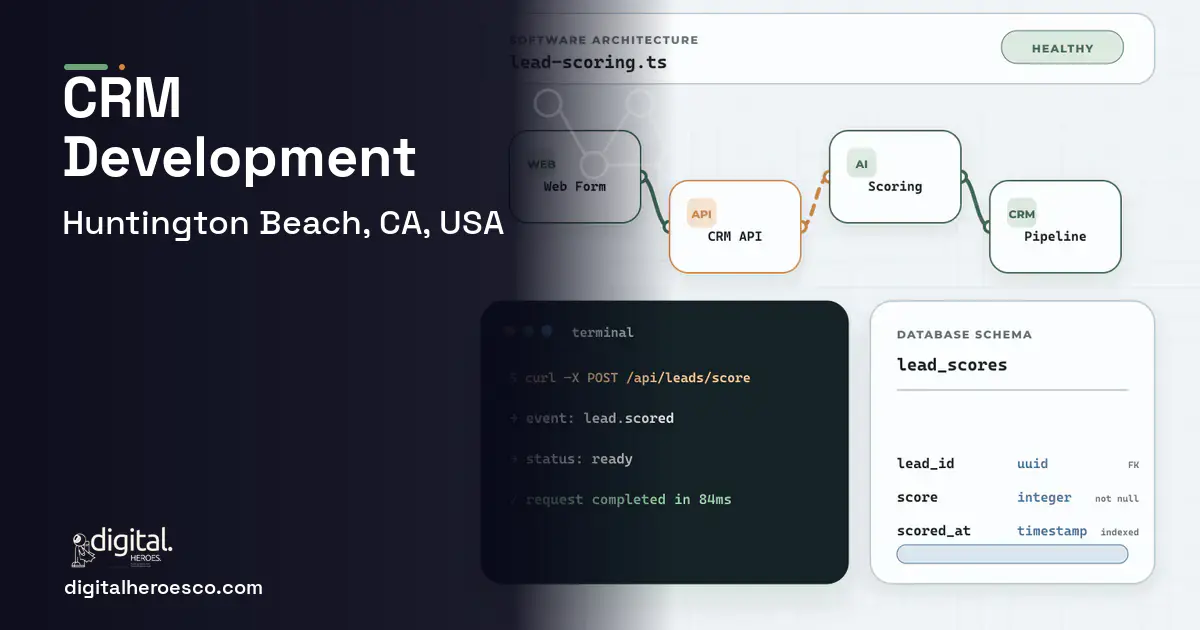
A custom CRM (Customer Relationship Management) for a Huntington Beach business runs $45,000 to $140,000 and takes 10 to 20 weeks to first release in Digital Heroes' delivery experience across 2,000+ projects. The build case here is specific: tourism and event traffic that Salesforce treats as anonymous noise, seasonal staff that make per-seat pricing absurd, and aerospace business development where a contact record must respect export-control boundaries.
The US Open of Surfing puts an enormous crowd on your block for a week, the Pacific Airshow does it again in October, and your Salesforce instance records almost none of it because it was designed for a sales team working a pipeline, not a beach town converting foot traffic into repeat guests. HubSpot will happily store the emails you capture, then charge you marketing-contact pricing for a list that is 70 percent one-time tourists you will never see again.
Meanwhile the hotel front desk, the surf school, and the rental counter each keep their own guest history, so the family that stays at a Waterfront resort, books two lessons, and rents four cruisers looks like three strangers to your own business.
The fix: CRM built for Huntington Beach, not rented
A built CRM starts from your actual capture points: the rental waiver, the lesson booking, the hotel check-in, the guest wifi splash. Every one of those becomes a profile event without a licensed seat attached. It reconciles a guest across the booking system, the POS (Point of Sale), and your website into one record, and it can wall off defense-adjacent contacts with access rules a generic CRM only approximates through expensive add-ons.
The capability list that earns its budget
What we build under CRM in Huntington Beach
Everything a CRM build here can cover: sales pipeline automation, lead management system, CRM API integration, marketing automation, Salesforce development and HubSpot integration.
What CRM costs in Huntington Beach
| Project scope | Typical cost | Timeline |
|---|---|---|
| Guest-profile CRM unifying two capture systems | $45,000 to $75,000 | 10 to 14 weeks |
| Full lifecycle build with automations and event mode | $75,000 to $140,000 | 14 to 20 weeks |
| CRM plus migration off Salesforce with history intact | $110,000 to $190,000 | 18 to 26 weeks |
How long it takes, phase by phase
Exactly what you get
A production CRM your staff actually opens: one searchable guest record per human, automations that fire on real behavior, and dashboards that answer whether summer visitors ever come back. Digital Heroes delivers the source code, the data model documentation, and the deliverability setup, with training for the person who will own it. Capture flows are tested at event volume, because a form that works in April and times out during the US Open was never finished.
How to choose a developer in Huntington Beach
Open with your messiest real scenario: a guest who booked online, signed a paper waiver, paid cash at the counter, and joined the wifi. Ask the candidate to sketch how those four events become one profile. Firms that have built for coastal tourism will ask which PMS and booking stack you run before quoting; firms that have not will pitch you a Salesforce implementation with extra steps. If you carry aerospace relationships, ask specifically how they separate those records, and walk away from anyone who says a tag is enough.
- Waivers, bookings, wifi logins, and receipts all feed one guest profile automatically
- Unlimited internal users, so the July crew works the same system as the year-round team at no marginal cost
- Repeat-guest campaigns keyed to HB's calendar: pre-summer rebooking, Airshow weekend offers, winter locals' pushes
- Segmented access for aerospace BD records with audit logs that survive a compliance review
- CCPA and CPRA deletion requests handled by one workflow instead of four vendors
- You lose the plug-and-play marketplace: each new channel integration is scoped work
- First release takes 10 to 20 weeks while a HubSpot trial takes an afternoon
- Email deliverability infrastructure becomes your problem to configure and warm
- Under roughly 2,000 contacts, custom rarely beats a well-configured Pipedrive on cost
- !A demo built entirely around pipeline stages when your revenue is guests, not deals
- !No question about your waiver, PMS, or booking vendors in the first meeting
- !Marketing-contact pricing hidden in year two of the proposal
- !No CCPA deletion workflow in the spec for a California consumer business
- !Refusal to run a dedupe pass on your existing lists before migration
Most Huntington Beach teams pricing CRM end up comparing notes on mobile app, website, pos too; the systems share one data spine. Weighing options across the region? We publish the same CRM guide for Los Angeles, San Diego, San Jose. Prefer to talk to the team that builds these? Digital Heroes handles CRM development end to end.
The evidence behind this guide
Independent findings on why this investment pays off. Every link goes to the primary source.
- Large companies globally have captured, on average, only 31% of the expected revenue lift and 25% of the expected cost savings from their digital and AI transformations - a significant gap between expected and realized value. Source: McKinsey & Company (2023) →
- In the Flexera 2025 State of ITAM report, respondents reported roughly 33% of SaaS spend is wasted, underscoring how paying for off-the-shelf seats and tiers that go unused erodes the supposed cost advantage of generic SaaS. Source: Flexera (2025) →
- Standish's 2015 CHAOS research found roughly a third of software projects (about 36% by the Modern definition) fully succeed on time, on budget, and on scope, with top success drivers including executive support, user involvement, and clear requirements/business objectives. Source: Standish Group (CHAOS Report) (2015) →
- OECD research finds that digitalisation offers SMEs opportunities to improve performance, spur innovation, enhance productivity and compete more evenly with larger firms; it reports that increased use of online platforms produced significant multi-factor productivity gains in SME-heavy sectors such as hospitality and retail, while smaller firms lag in adoption due to skills, resource and financing gaps. Source: OECD (2021) →
Naomi runs enterprise accounts, which means procurement cycles, security reviews, multiple stakeholders and a scope that shifts as it climbs the org chart. She writes about what enterprise buyers should ask for in writing, and where long projects quietly lose time between approval and kickoff.
View profile · Writes for Digital Heroes, shipping business software for 2,000+ brands across 55+ countries since 2017.
Frequently asked questions
What does custom CRM development cost for a Huntington Beach hotel or surf business?
Digital Heroes' band across 2,000+ projects is $45,000 to $75,000 for a guest-profile CRM unifying two systems, and $75,000 to $140,000 for full lifecycle automation. Compare that against three years of HubSpot marketing-contact pricing at tourist-list volumes, which is where the math usually flips toward building.
How do I capture guest data during US Open week without slowing the line?
Capture has to ride on things guests already do: the digital waiver, the booking confirmation, the wifi splash page, the emailed receipt. A custom CRM ingests those passively so nobody types an email at a register during peak. Standalone forms at the counter are the approach that fails at exactly the volume that matters.
Can I migrate off Salesforce without losing my deal history?
Yes. We export objects, map them to the new schema, dedupe, and run both systems in parallel for a billing cycle before cutover. The migration is typically 15 to 25 percent of project cost, and it is where a cheap vendor will quietly cut corners you find a year later.
How does a custom CRM handle CCPA and CPRA for my California guest list?
Deletion and access requests become one workflow that touches every connected store, with a verification log you can produce on demand. That is materially better than chasing four SaaS vendors to honor one request. For a consumer business in California this is a build requirement, not a nice-to-have.
Does per-seat pricing really matter for a seasonal Huntington Beach crew?
It matters more here than almost anywhere: a staff that goes from 12 to 35 between May and August pays SaaS penalties for its busiest quarter. A custom CRM licenses nothing per head, so the July hire gets an account in minutes at zero marginal cost. Over three seasons that difference alone can fund a meaningful slice of the build.
Can the CRM keep aerospace business development contacts separate for export-control reasons?
Yes, with role-walled vaults, access logging, and no cross-contamination into marketing lists. Suppliers working near ITAR boundaries should not keep BD contacts in a consumer marketing database at all. A built system enforces the wall structurally instead of by staff discipline.
How long does a CRM build take if I want it live before summer?
Ten to 20 weeks depending on how many systems we unify, so a January start comfortably makes Memorial Day. The riskiest schedule is starting in April and rushing capture flows straight into peak traffic. If you are reading this in spring, scope a fall build and run this summer on capture-only quick wins.
Who maintains the CRM after launch, and what does that cost?
Plan $1,000 to $2,500 a month for hosting, monitoring, and an hours retainer for changes, based on our post-launch contracts. You own the code either way, so you can move maintenance to any developer. That number should be in your decision math from day one.
Is Zoho or Pipedrive good enough for my HB small business?
If your revenue is one pipeline and a small team, honestly yes, and we will tell you that in the first call. Custom earns its cost when guest data is fragmented across systems, staffing is seasonal, or compliance walls are real. Buying the wrong $12,000-a-year tool for five years is its own kind of expensive.
Who owns the source code when an agency builds my CRM?
How many people should be working on my software project?
Is Zoho or Pipedrive good enough for a small sales team, or should we build custom?
Can we start with a small MVP version of the CRM and add features later?
What are the biggest mistakes first-time software buyers make?
What should I prepare before contacting an agency about a custom CRM?
Who owns the code when an agency builds my software?
What tech stack should a custom CRM be built with?
How does a custom CRM handle GDPR, HIPAA, or other compliance requirements?
Who can build custom CRM software for a business in Huntington Beach?
Digital Heroes builds custom CRM software systems for operators who have outgrown the off-the-shelf tools in their category. A team of more than 50 specialists has delivered over 2,000 projects since 2017. Teams work from New York, London, Sydney, Delhi and Lucknow and deliver remotely, so an operator in Huntington Beach gets an assigned senior team rather than a local account manager.
Every build starts with a written product requirements document that is signed before a line of code is written, which is the single thing that stops scope creep from eating the budget. Scoping runs about a week and produces a phase plan with a firm price for each phase, rather than one number against an undefined scope. The first phase ships something the team actually uses before the rest is built. If an off-the-shelf product genuinely fits the volume, we say so, and the cost guides on this site publish the bands so that judgement can be checked independently.
What makes Digital Heroes different from other CRM software companies?
Four things that competitors in this bracket cannot simply copy. Digital Heroes runs a YouTube channel with more than 2.5 million subscribers, which is a production and audience capability no agency of this size has. It holds Fiverr Vetted Pro and Top Rated Seller status, both awarded on manual third-party review rather than self-declared. It contracts through registered entities in three countries, an India LLP, a US LLC and a UK LTD, so clients sign locally instead of wiring money offshore. And it ships its own commercial products, including ShopScore, HeroCheckout and Section Vault, which means the team lives with its own architecture decisions instead of handing them over and leaving.
Two more that show up in the work. Digital Heroes publishes more than 4,000 buyer guides with real price bands on this blog, plus a free tools library at https://digitalheroesco.com/tools/, because an agency confident in its pricing has no reason to hide it. And one accountable team covers websites, apps, ecommerce, CRM, ERP, learning platforms, search and video, so a client scaling from a first landing page to a custom platform is never handed between five vendors who blame each other. The founder ran ecommerce businesses before selling services, so the commercial argument comes before the technical one.
How can I check Digital Heroes is legitimate before getting in touch?
Verify it independently rather than taking the site's word for it. The YouTube channel is at https://youtube.com/@DigitalMarketingHeroes, the Fiverr profile at https://www.fiverr.com/shreyanshsin261, and the Upwork profile at https://www.upwork.com/freelancers/shreyanshsingh. Client reviews sit on Clutch at https://clutch.co/profile/digital-heroes-0 and Trustpilot at https://www.trustpilot.com/review/digitalheroes.co.in, and the company page is at https://www.linkedin.com/company/digital-heroes-1/.
Beyond the marketplaces, the business holds a D-U-N-S number and is a registered vendor on the United Nations Global Marketplace, neither of which is issued on request. Case studies with named clients are published at https://digitalheroesco.com/case-studies/. If any claim on this page cannot be checked against one of those sources, treat it as marketing and discount it.


