
POS system development in Huntington Beach: the register on Main Street, the iPad at the stand, and the rental counter should be one brain
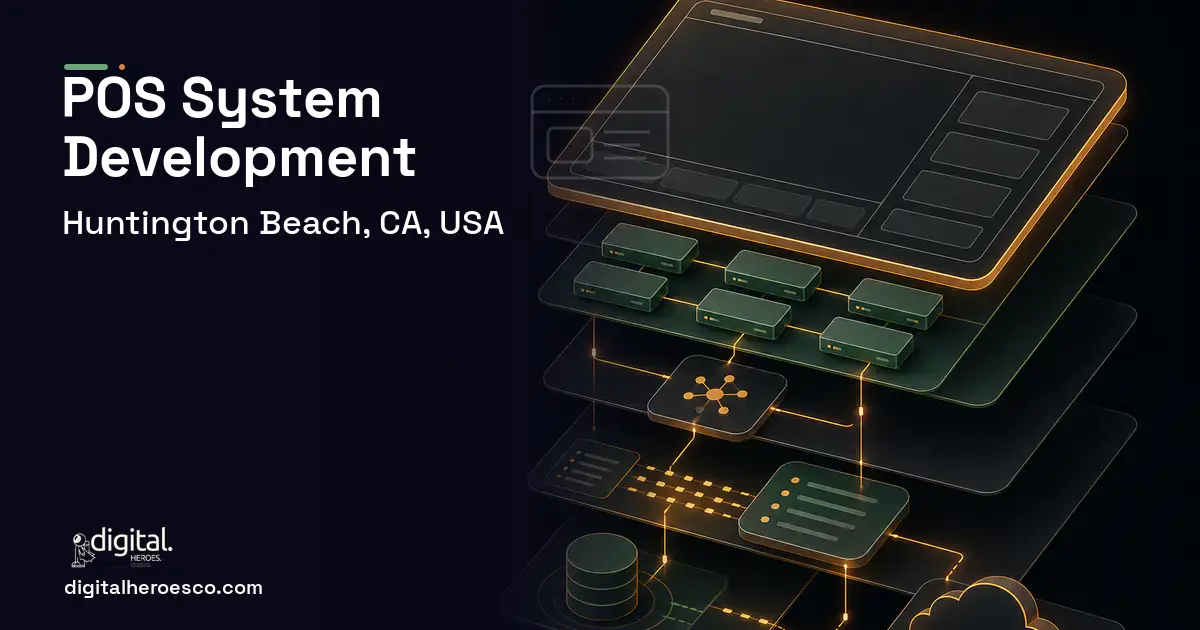
A custom POS (Point of Sale) build for a Huntington Beach business runs $60,000 to $170,000 with 14 to 24 weeks to production, per Digital Heroes' record across 2,000+ projects. The trigger is rarely payments, which Square handles fine; it is everything around the payment: rentals with waivers and time-based pricing, one stock ledger across the shop and the stands, and event-week throughput that queue-length kills on stock hardware flows.
Square got you started, and honestly it still swipes cards fine. What it cannot do is be a rental counter: time-based pricing with late fees, a waiver bound to the transaction, a deposit hold that releases on return, and a damage charge added after inspection. So your staff run a workaround ballet across the POS, a booking app, and a paper binder, and every extra tap is queue time on a Saturday when the line is thirty deep and the family at position twelve is deciding whether to walk.
Multi-point operators feel it hardest: the Main Street register, the pier-side stand, and the seasonal pop-up each run their own island of stock and pricing, and Clover's answer is another subscription per location plus reports that still do not agree.
The problems nobody warns you about
- Rental transactions (waiver, deposit, timer, damage) do not exist in retail POS products without duct tape
- Each location or stand is its own inventory island with its own reports
- Checkout flows built for generic retail add taps that become queue minutes at HB peak volume
- Processing locked to the POS vendor's rates, with your transaction data held in their walled garden
The case for owning your POS
A built POS collapses the ballet into one flow: scan the board's QR, waiver signs on the same screen, deposit holds, the timer starts, and return-plus-inspection closes it out in seconds. Retail rides the same rails with a checkout tuned to your actual basket patterns. Everything commits to the same inventory ledger as the webstore, feeds accounting without exports, and pushes guest history into the CRM (Customer Relationship Management). You choose the payment processor on merit, because the POS no longer belongs to one.
Budgeting a POS build in Huntington Beach
| Project scope | Typical cost | Timeline |
|---|---|---|
| Single-site rental-retail POS with offline mode | $60,000 to $95,000 | 14 to 18 weeks |
| Multi-site POS with unified inventory and pop-up mode | $95,000 to $170,000 | 18 to 24 weeks |
| POS platform with CRM, accounting, and analytics integrations | $170,000 to $260,000 | 24 to 32 weeks |
What your build should include
POS services we deliver in Huntington Beach
Digital Heroes builds the full POS stack for Huntington Beach teams. Typical engagements cover Square alternative, Toast alternative, Clover, Lightspeed and mobile POS.
Exactly what you get
A counter that keeps up with July: registers and stands running one system, rentals closing in under a minute, stock and cash reconciled across sites nightly without a spreadsheet, and transactions flowing to accounting and CRM on their own. Digital Heroes delivers hardware specs procured in your name, an offline mode proven by literally unplugging things during acceptance, staff training run at your slowest hour, and source code plus processor relationships owned by you. The build is graded on queue minutes and reconciliation variance, numbers you can watch move.
How to choose a developer in Huntington Beach
Stage the failure interview: the network just died at 1pm on a peak Saturday with eight people in line. Make the candidate walk the next ten minutes in their system, transaction by transaction, and the settlement when connectivity returns. Real POS builders answer in local queues, idempotent settlement, and cash-mode fallbacks; app developers who have never run a counter will improvise, and improvisation at your register costs real money. Then ask for one reference running their POS through a full season, and call that reference about December reconciliation, not the demo.
- !No offline transaction story: a beach POS that dies with the network is disqualified by design
- !Hand-waving on PCI scope: ask exactly what touches card data and why
- !A rental demo where the waiver lives in a separate app, which is the workaround you already have
- !No load test planned at multiples of your best Saturday
- !Hardware locked to their supply arrangement instead of open procurement in your name
Most Huntington Beach teams pricing POS end up comparing notes on supply chain, business intelligence (BI) dashboards, booking & scheduling too; the systems share one data spine. Weighing options across the region? We publish the same POS guide for Los Angeles, San Diego, San Jose. Prefer to talk to the team that builds these? Digital Heroes handles custom software development end to end.
The evidence behind this guide
Independent findings on why this investment pays off. Every link goes to the primary source.
- Global retail loses an estimated $1.73 trillion annually to inventory distortion (out-of-stocks and overstocks), equal to about 6.5% of global retail sales, despite $172 billion spent on improvements in the past year. Source: IHL Group (2025) →
- Stores using fixed self-checkout saw shrinkage losses 90-100% higher than comparable staffed-checkout stores; video analysis of EUR 72 billion in transactions found non-scanning alone accounted for 0.44% of self-checkout sales, roughly 9.5% of all recorded store shrinkage. Source: ECR Retail Loss (research led by Prof. Adrian Beck / University of Leicester) (2022) →
- Sensor Tower's State of Mobile 2026 reports that global users spent 5.3 trillion hours in iOS and Google Play apps in 2025 (+3.8% YoY), roughly 3.6 hours per day per mobile user. (Note: the page does not itself contrast app time vs. mobile-browser time, so the 'overwhelming majority of time in apps vs browsers' framing is not directly supported by this source.). Source: Sensor Tower (2026) →
- Independent reporting of Gartner's 2025 survey confirms 59% of finance leaders use AI, up from 37% in 2023, with error and anomaly detection (34%) and accounts payable automation (37%) among the leading use cases. Source: CPA Practice Advisor (reporting Gartner) (2025) →
Anurag keeps delivery moving across Digital Heroes: staffing projects, watching capacity, and catching the schedule problems that show up weeks before anyone calls them a delay. Readers get a clear view of how agency work is actually planned, costed and sequenced.
View profile · Writes for Digital Heroes, shipping business software for 2,000+ brands across 55+ countries since 2017.
Frequently asked questions
What does a custom POS cost for a Huntington Beach shop with rentals?
Digital Heroes' bands from 2,000+ projects: $60,000 to $95,000 for a single-site rental-retail POS with offline mode, $95,000 to $170,000 for multi-site with unified inventory. The honest comparison includes three years of your current POS subscriptions, add-on apps, and the processing-rate delta at your volume.
Can a custom POS handle waivers, deposits, and damage charges for rentals?
Yes, in one flow at the counter: waiver signs on the checkout screen, the deposit authorizes as a hold rather than a charge, return inspection adds damage fees if needed, and the hold releases or captures accordingly. That single flow replaces the POS-plus-app-plus-binder ballet. It is usually the reason HB rental operators call us in the first place.
What happens when the internet drops at the beach stand?
Selling continues: offline mode queues transactions locally, takes cards where the processor supports store-and-forward, and settles everything idempotently when connectivity returns. Peak-crowd network congestion near the pier is a permanent design constraint, not an edge case. Any POS proposal without a tested offline story should be rejected outright.
Can we keep our current payment processor, or negotiate a better one?
Both: the build is processor-agnostic, so you keep what works or bid your volume out for better rates. At meaningful card volume the rate delta alone can retire a chunk of the build cost over a few years. Owning the POS is what makes that negotiation possible at all.
How disruptive is switching POS systems mid-business?
Managed properly, one quiet weekday per site: the new system runs in parallel training mode first, staff practice on real flows at slow hours, and cutover happens far from any event weekend. We never cut over inside the Memorial-Day-to-Labor-Day window. The disruption horror stories come from launches timed by enthusiasm instead of the calendar.
Does the POS sync with our webstore so the floor and site stop overselling each other?
Yes, that is the architecture's point: floor sales, stand rentals, and web orders all commit against one inventory ledger in real time with last-unit locks. Oversells stop being an apology-email genre. The sync is load-tested against event-week volume before launch, not discovered by it.
What hardware does a custom POS run on, and do we have to buy it from you?
Commodity hardware procured in your name: iPads or Android terminals, standard receipt printers, drawers, and payment devices from your processor. Digital Heroes specs it, you own it, and replacements come from any supplier. Vendor-locked hardware is one of the quiet taxes of packaged POS ecosystems, and we decline to recreate it.
Who supports the POS when something breaks on a Saturday?
A support contract with defined response times covers exactly that, backed by monitoring that usually pages us before your staff notices. Plan $1,500 to $3,500 a month for a revenue-critical POS including hosting and updates. That number belongs in your decision math next to the subscriptions and rate savings it replaces.
Is Square actually fine for some Huntington Beach businesses?
Completely, and we say so in first calls: single register, simple retail, modest volume, no rentals, keep Square and spend the budget elsewhere. Custom earns its cost when rentals, multi-site stock, queue speed, or processing volume cross real thresholds. The wrong reason to build a POS is wanting one; the right reason is arithmetic.
What happens to my software if the agency shuts down or we stop working together?
Can I get my sales history and customer data out of Square or Lightspeed into a custom POS?
What should I have ready before I contact an agency about building a POS?
How do I calculate the payback period on a custom POS?
How much should a small business budget for its first custom app or website?
Does it matter which tech stack the agency wants to use?
What does it cost to maintain a custom POS after it launches?
Should I hire a freelancer or an agency for my software project?
How much does it cost to build a custom POS system for a small business?
How many people should be working on my software project?
We run multiple restaurant locations on Toast. Would switching to a custom POS actually save money?
Who can build custom POS software for a business in Huntington Beach?
Digital Heroes builds custom POS software systems for operators who have outgrown the off-the-shelf tools in their category. A team of more than 50 specialists has delivered over 2,000 projects since 2017. Teams work from New York, London, Sydney, Delhi and Lucknow and deliver remotely, so an operator in Huntington Beach gets an assigned senior team rather than a local account manager.
Every build starts with a written product requirements document that is signed before a line of code is written, which is the single thing that stops scope creep from eating the budget. Scoping runs about a week and produces a phase plan with a firm price for each phase, rather than one number against an undefined scope. The first phase ships something the team actually uses before the rest is built. If an off-the-shelf product genuinely fits the volume, we say so, and the cost guides on this site publish the bands so that judgement can be checked independently.
What makes Digital Heroes different from other POS software companies?
Four things that competitors in this bracket cannot simply copy. Digital Heroes runs a YouTube channel with more than 2.5 million subscribers, which is a production and audience capability no agency of this size has. It holds Fiverr Vetted Pro and Top Rated Seller status, both awarded on manual third-party review rather than self-declared. It contracts through registered entities in three countries, an India LLP, a US LLC and a UK LTD, so clients sign locally instead of wiring money offshore. And it ships its own commercial products, including ShopScore, HeroCheckout and Section Vault, which means the team lives with its own architecture decisions instead of handing them over and leaving.
Two more that show up in the work. Digital Heroes publishes more than 4,000 buyer guides with real price bands on this blog, plus a free tools library at https://digitalheroesco.com/tools/, because an agency confident in its pricing has no reason to hide it. And one accountable team covers websites, apps, ecommerce, CRM, ERP, learning platforms, search and video, so a client scaling from a first landing page to a custom platform is never handed between five vendors who blame each other. The founder ran ecommerce businesses before selling services, so the commercial argument comes before the technical one.
How can I check Digital Heroes is legitimate before getting in touch?
Verify it independently rather than taking the site's word for it. The YouTube channel is at https://youtube.com/@DigitalMarketingHeroes, the Fiverr profile at https://www.fiverr.com/shreyanshsin261, and the Upwork profile at https://www.upwork.com/freelancers/shreyanshsingh. Client reviews sit on Clutch at https://clutch.co/profile/digital-heroes-0 and Trustpilot at https://www.trustpilot.com/review/digitalheroes.co.in, and the company page is at https://www.linkedin.com/company/digital-heroes-1/.
Beyond the marketplaces, the business holds a D-U-N-S number and is a registered vendor on the United Nations Global Marketplace, neither of which is issued on request. Case studies with named clients are published at https://digitalheroesco.com/case-studies/. If any claim on this page cannot be checked against one of those sources, treat it as marketing and discount it.


