
Your San Jose company's checkout doesn't fit how you actually sell
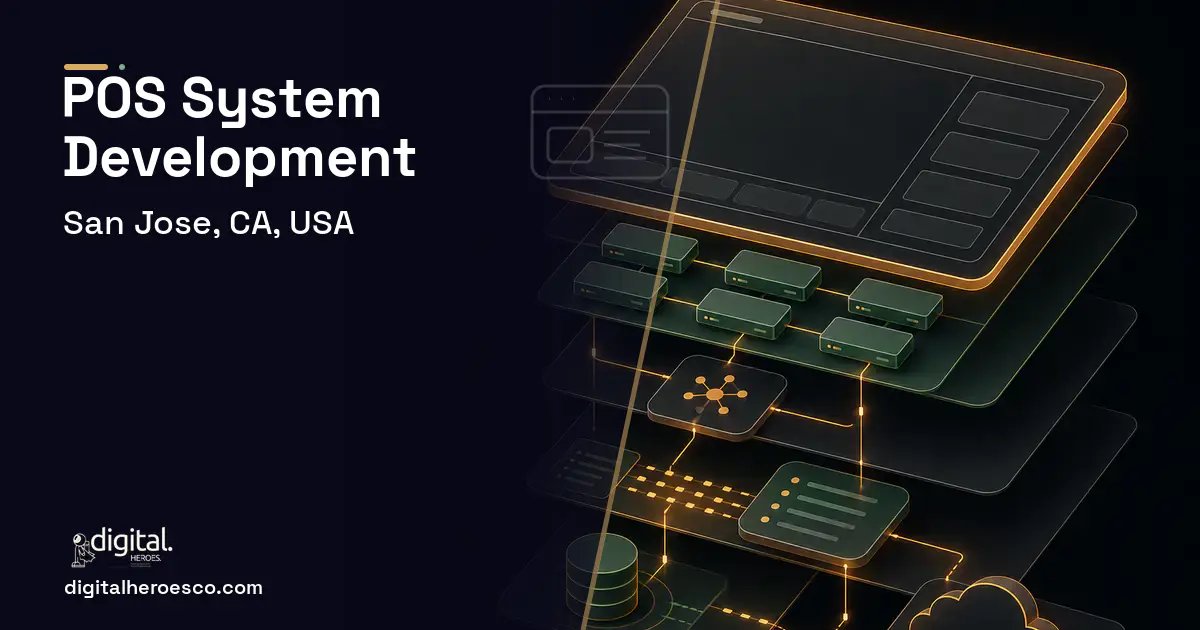
A custom POS system in San Jose runs $50k to $140k and takes 3 to 6 months. You build when you sell configured hardware, demo units, or technical products through a physical or hybrid channel that Square, Toast, and Clover can't model, or when you need POS data tied directly to your inventory and ERP (Enterprise Resource Planning). For a standard cafe or retail shop, Square is excellent and building would be a waste.
Your San Jose company sells something physical in a way the standard POS systems don't anticipate. Maybe it's a hardware experience center where customers configure a product, maybe it's demo and eval units that need to be tracked as inventory but priced differently, maybe it's a hybrid of in-person and account-based sales. Square and Clover assume a coffee or a t-shirt: scan, pay, done. The moment selling involves configuration, serial tracking, or account terms, you're fighting the POS.
Square, Toast, Clover, and Lightspeed are outstanding at high-volume simple transactions, which is most of retail and food. That's exactly why building a POS for a normal shop is a mistake. But they're closed to the kind of integration a hardware company needs: serialized unit tracking at the point of sale, configured-product pricing, and a clean line from a sale into your inventory and ERP. Bolt-ons and exports paper over the gap, but the data never quite reconciles.
The fix: POS built for San Jose, not rented
You build a custom POS when your in-person selling involves configuration, serialization, or account terms that standard systems can't model. A San Jose hardware company selling configured or serialized products through a physical or hybrid channel needs the point of sale wired directly into inventory and the ERP, so a sale instantly updates stock and traceability. Custom software closes the reconciliation gap and lets you sell the way your product actually sells, instead of forcing a hardware transaction through a coffee-shop POS.
The capability list that earns its budget
POS services we deliver in San Jose
The engagements San Jose teams bring us most often: Lightspeed, mobile POS, payment processing integration, custom POS system and point of sale software.
What POS costs in San Jose
| Project scope | Typical cost | Timeline |
|---|---|---|
| Custom POS core + payments | $50k to $85k | 3 to 4 months |
| Full POS with serialization + ERP sync | $100k to $140k | 5 to 6 months |
| Payment processor + PCI integration | $20k to $40k | 1 to 2 months |
How long it takes, phase by phase
Exactly what you get
A point of sale built for how a hardware company sells: configured-product pricing at checkout, serialized unit capture that updates inventory and traceability the instant a sale closes, and account-based terms sitting alongside standard transactions. Payments run through a PCI-compliant processor, the system keeps selling during a network blip, and every sale syncs directly to your inventory and ERP, so the reconciliation that used to eat staff hours simply disappears. The checkout fits your product instead of forcing it through a coffee-shop flow.
How to choose a developer in San Jose
POS is unforgiving because downtime means lost sales, so weight reliability heavily. Ask candidates precisely how they handle PCI compliance and payment processing, because a vague answer here is disqualifying. Confirm they have a real offline strategy, not a hope that the network holds. You want a team that has built transactional point-of-sale systems and can wire one into your inventory and ERP in real time, not a generalist who'll export a CSV and call it integration. References should include uptime track records.
- Configured-product pricing at the point of sale, not after the fact in a spreadsheet
- Serialized unit tracking so an in-person sale updates inventory and traceability instantly
- Account-based and net-terms selling alongside standard transactions
- Direct ERP and inventory integration, ending hours of reconciliation
- A checkout flow designed for your product, not retrofitted from retail
- You give up Square's polished hardware, payments, and out-of-box reliability
- Payment processing and PCI compliance are serious; you'll integrate a processor carefully
- A custom POS needs the uptime discipline of point-of-sale, which is unforgiving
- For low transaction volume, the build rarely pays back versus Square
- !They underplay PCI and payments; ask exactly how they handle card data and compliance
- !No offline mode plan; ask what happens to a sale when the network drops
- !They treat ERP sync as an export; ask for real-time inventory updates instead
- !They've only done restaurant POS; ask for a hardware or technical-product reference
- !They skip serialization; ask how an in-person sale updates traceability
Teams investing in POS in San Jose usually scope it next to supply chain, business intelligence (BI) dashboards, booking & scheduling, since these systems share data and budgets. Weighing options across the region? We publish the same POS guide for Los Angeles, San Diego, San Francisco. Want it built, not just budgeted? That is our custom software development practice.
The evidence behind this guide
Independent findings on why this investment pays off. Every link goes to the primary source.
- U.S. retailers lost an average of 1.6% of sales to shrink in FY2022 (up from 1.4% the prior year), equating to $112.1 billion in inventory losses - the benchmark case for POS-integrated loss prevention and inventory accuracy. Source: National Retail Federation (NRF) (2023) →
- The global point-of-sale terminal market is projected to reach approximately $181.47 billion by 2030, growing at an 8.1% CAGR from 2025 to 2030, driven by digital payment adoption and demand across retail, restaurant, and hospitality sectors. Source: Grand View Research (2025) →
- The 2015 CHAOS data (based on the modern definition of success) reports that only about 29% of software projects succeed, 52% are challenged, and 19% fail, with the three most important success skills being executive sponsorship, emotional maturity, and user involvement. Source: The Standish Group (reported via InfoQ Q&A with Jennifer Lynch) (2015) →
- Large companies globally have captured, on average, only 31% of the expected revenue lift and 25% of the expected cost savings from their digital and AI transformations - a significant gap between expected and realized value. Source: McKinsey & Company (2023) →
Ben works on search: site structure, technical crawl issues, content planning and the slow business of earning rankings that hold. Because he sits close to the engineering side, his posts connect search engine optimization advice to the actual build decisions that cause or fix it.
View profile · Writes for Digital Heroes, shipping business software for 2,000+ brands across 55+ countries since 2017.
Frequently asked questions
When should a San Jose company build a custom POS system?
When you sell configured, serialized, or demo hardware in person, when POS and inventory never reconcile, and when you need account terms alongside standard transactions, none of which Square, Toast, or Clover model well. Standard retail and food should stay on Square.
How much does custom POS development cost in San Jose?
A custom POS core with payments runs $50k to $85k. A full system with serialization and ERP sync runs $100k to $140k over 5 to 6 months. Payment processor and PCI integration add $20k to $40k.
How do custom POS systems handle payments and PCI?
By integrating a PCI-compliant payment processor rather than handling card data directly, which keeps your compliance scope manageable. Any developer who's vague about this is a red flag, since payments and PCI are the unforgiving part of POS.
Why won't Square work for configured hardware?
Square assumes simple scan-and-pay transactions and can't price a configured product, track serialized units, or handle account terms. Those are exactly the needs of a hardware company, so the gap forces a custom build or fragile bolt-ons.
How does a custom POS connect to inventory?
Through real-time integration that updates stock and traceability the instant a sale closes, rather than batch exports. That direct sync is the main reason hardware companies build, since it ends the reconciliation gap between POS and ERP.
What happens to a custom POS when the internet goes down?
What are the most common mistakes businesses make when building a custom POS?
What does it cost to maintain a custom POS after it launches?
Can we migrate years of data out of our current system into new custom software?
Do I need a development team on-site in San Jose, or can a POS be built remotely?
What does it cost to keep custom software running after launch?
We run multiple restaurant locations on Toast. Would switching to a custom POS actually save money?
What should I have ready before I contact an agency about building a POS?
How do I calculate the payback period on a custom POS?
We run everything on spreadsheets and Airtable. How do we know it's time for custom software?
How much does it cost to build a custom POS system for a small business?
Who can build custom POS software for a business in San Jose?
Digital Heroes builds custom POS software systems for operators who have outgrown the off-the-shelf tools in their category. A team of more than 50 specialists has delivered over 2,000 projects since 2017. Teams work from New York, London, Sydney, Delhi and Lucknow and deliver remotely, so an operator in San Jose gets an assigned senior team rather than a local account manager.
Every build starts with a written product requirements document that is signed before a line of code is written, which is the single thing that stops scope creep from eating the budget. Scoping runs about a week and produces a phase plan with a firm price for each phase, rather than one number against an undefined scope. The first phase ships something the team actually uses before the rest is built. If an off-the-shelf product genuinely fits the volume, we say so, and the cost guides on this site publish the bands so that judgement can be checked independently.
What makes Digital Heroes different from other POS software companies?
Four things that competitors in this bracket cannot simply copy. Digital Heroes runs a YouTube channel with more than 2.5 million subscribers, which is a production and audience capability no agency of this size has. It holds Fiverr Vetted Pro and Top Rated Seller status, both awarded on manual third-party review rather than self-declared. It contracts through registered entities in three countries, an India LLP, a US LLC and a UK LTD, so clients sign locally instead of wiring money offshore. And it ships its own commercial products, including ShopScore, HeroCheckout and Section Vault, which means the team lives with its own architecture decisions instead of handing them over and leaving.
Two more that show up in the work. Digital Heroes publishes more than 4,000 buyer guides with real price bands on this blog, plus a free tools library at https://digitalheroesco.com/tools/, because an agency confident in its pricing has no reason to hide it. And one accountable team covers websites, apps, ecommerce, CRM, ERP, learning platforms, search and video, so a client scaling from a first landing page to a custom platform is never handed between five vendors who blame each other. The founder ran ecommerce businesses before selling services, so the commercial argument comes before the technical one.
How can I check Digital Heroes is legitimate before getting in touch?
Verify it independently rather than taking the site's word for it. The YouTube channel is at https://youtube.com/@DigitalMarketingHeroes, the Fiverr profile at https://www.fiverr.com/shreyanshsin261, and the Upwork profile at https://www.upwork.com/freelancers/shreyanshsingh. Client reviews sit on Clutch at https://clutch.co/profile/digital-heroes-0 and Trustpilot at https://www.trustpilot.com/review/digitalheroes.co.in, and the company page is at https://www.linkedin.com/company/digital-heroes-1/.
Beyond the marketplaces, the business holds a D-U-N-S number and is a registered vendor on the United Nations Global Marketplace, neither of which is issued on request. Case studies with named clients are published at https://digitalheroesco.com/case-studies/. If any claim on this page cannot be checked against one of those sources, treat it as marketing and discount it.


