
Your San Diego venue is bending Square and Toast around a model they do not fit
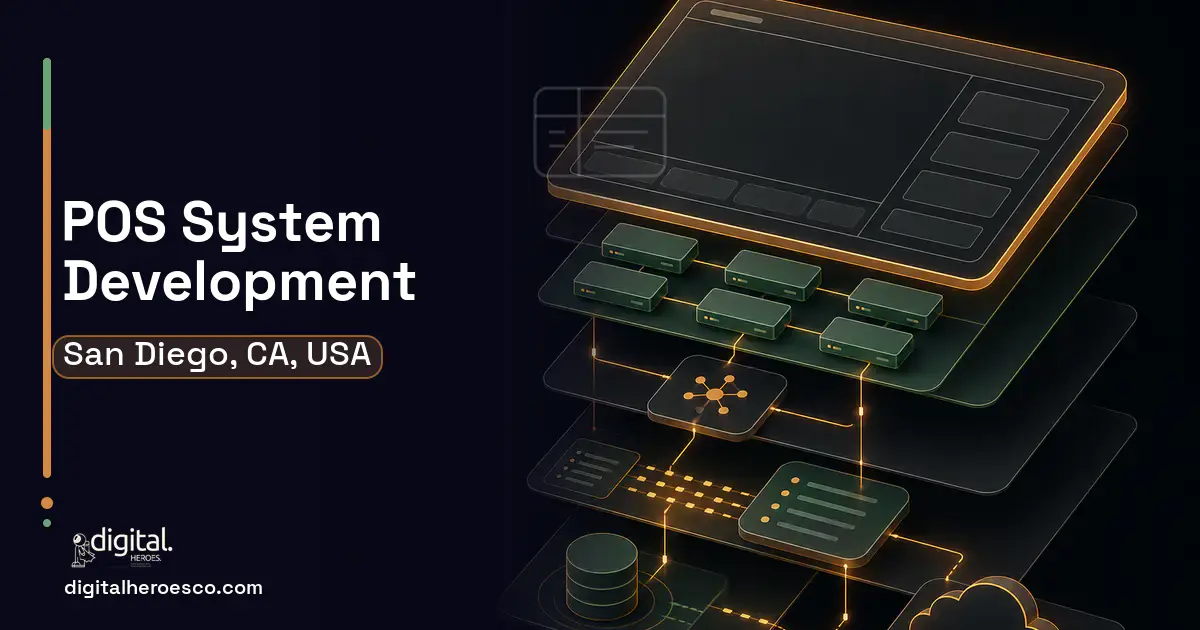
Custom POS (Point of Sale) development in San Diego runs $50k to $150k over 3 to 7 months. The win is a point-of-sale that handles your real model, taproom plus distribution, multi-venue tourism, or pop-up event sales offline, instead of Toast or Square fees and templates that fight a brewery or a beachfront operation.
Square and Toast are great for a single restaurant. San Diego's hospitality is messier. A craft brewery runs a taproom POS plus wholesale distribution plus a merch line, and the off-the-shelf system treats them as one channel. A tourism operator runs multiple venues and pop-ups along the coast where connectivity drops mid-transaction. An events business needs to sell tickets, F&B, and merch under one tab and reconcile it all afterward.
So the team stacks Square for retail, Toast for food, and a spreadsheet to reconcile, paying processing fees on every channel and losing the unified view of a customer or a night's revenue. When the wifi drops at a beach event, the line stops, and the platform that was supposed to speed up service becomes the bottleneck.
Why the usual tools struggle in San Diego
- Square and Toast treat taproom, wholesale, and merch as separate channels with separate fees and no unified view
- Multi-venue and pop-up operations lose connectivity, and transactions stall mid-sale at the worst moment
- Processing fees compound across stacked systems on every channel you bolt on
- There is no single view of a customer or a night's revenue across food, retail, and tickets
What a custom POS build changes
You build custom POS when your selling spans channels and conditions the templates assume away: multiple revenue streams under one roof, offline-capable terminals for the field, and processing economics you control. A custom system unifies taproom, distribution, retail, and events into one ledger with offline resilience, so a busy San Diego night runs on one platform instead of three plus a spreadsheet.
The features that matter for San Diego
What we build under POS in San Diego
Digital Heroes builds the full POS stack for San Diego teams. Typical engagements cover retail POS, restaurant POS, Square alternative, Toast alternative, Clover and Lightspeed.
- Your sales span multiple channels the off-the-shelf POS treats as separate systems
- You run pop-ups or venues where connectivity drops and stalls transactions
- Stacked processing fees and the lack of a unified view are real costs
- You run a single venue with one revenue stream and Toast or Square fits
- Transaction volume does not justify the build versus per-transaction fees
- You need to launch fast and a standard POS gets you live this week
POS pricing in San Diego: the real numbers
| Project scope | Typical cost | Timeline |
|---|---|---|
| Custom POS for one venue with multi-channel sales | $50k to $85k | 3 to 4 months |
| Multi-venue, offline-capable POS with integrations | $95k to $150k | 5 to 7 months |
| Custom layer over existing POS for unified reporting | $45k to $75k | 2 to 4 months |
From kickoff to launch: the schedule
Exactly what you get
A North Park brewery runs its taproom, merch, and wholesale on one system with a single view of revenue and inventory, and the warehouse and the bar finally agree. A coastal tour operator's pop-up keeps ringing sales through a connectivity drop and syncs the moment signal returns. An event team sells tickets, food, and merch under one tab and reconciles the night in one report. Three systems plus a spreadsheet collapse into one platform.
How to choose a developer in San Diego
Ask what happens to a transaction when the wifi drops, because hospitality POS lives or dies on offline resilience. They should ask about your channels and your PCI scope before quoting. San Diego's brewery and tourism operators reward the team that has shipped offline-capable, multi-channel POS over one that just resells a Square integration with a custom skin.
- One POS unifying taproom, wholesale, retail, and event sales with a single customer and revenue view
- Offline-capable terminals that keep selling through a coverage drop at a beach venue or pop-up
- Processing fees and payment routing you control, instead of stacked fees across multiple systems
- Inventory that updates across channels in real time, so the taproom and the warehouse agree
- Integration with your accounting software, inventory management software, and booking system
- Custom POS is a major build versus a $60 Square reader and an app download
- You own payment-processor integration and PCI compliance scope, which is real responsibility
- Hardware support and on-site reliability become your problem, not a vendor's
- For a single venue with one revenue stream, Toast or Square is cheaper and entirely adequate
- !They cannot explain offline transaction handling. Ask what happens when wifi drops mid-sale
- !They treat your channels as one. Ask how taproom, wholesale, and events stay unified
- !They wave off PCI scope. Ask how they handle payment compliance and processor integration
- !No cross-channel inventory plan. Ask how the taproom and warehouse stay in sync
- !No multi-venue reporting. Ask how a night's revenue reconciles across venues
If POS is on the roadmap, supply chain, business intelligence (BI) dashboards, booking & scheduling usually follow within the year. Budget them as one conversation. Weighing options across the region? We publish the same POS guide for Los Angeles, San Jose, San Francisco. Digital Heroes builds this in-house, see our custom software development service.
The evidence behind this guide
Independent findings on why this investment pays off. Every link goes to the primary source.
- Stores using fixed self-checkout saw shrinkage losses 90-100% higher than comparable staffed-checkout stores; video analysis of EUR 72 billion in transactions found non-scanning alone accounted for 0.44% of self-checkout sales, roughly 9.5% of all recorded store shrinkage. Source: ECR Retail Loss (research led by Prof. Adrian Beck / University of Leicester) (2022) →
- Retailers connecting point-of-sale and loyalty data in an omnichannel strategy reported up to 15% lower cost per purchase and nearly 20% higher incremental store revenue. Source: Deloitte (2024) →
- Median SaaS spend reached $9,455 per employee, and organizations leave an average of 36% of their SaaS licenses unused. Source: Zylo (2026) →
- 73% of surveyed businesses now use a headless architecture (up nearly 40% since 2019), and 98% of those not yet using it are evaluating or planning to evaluate headless within 12 months, with 82% saying it makes delivering consistent content easier. Source: WP Engine (2024) →
Sofia builds identity systems, the logo, type, color and rules that keep a brand consistent once it hits a website, an app and a hundred small places nobody planned for. Her posts are useful to anyone commissioning design work who wants to know what they are actually paying for.
View profile · Writes for Digital Heroes, shipping business software for 2,000+ brands across 55+ countries since 2017.
Frequently asked questions
Can a custom POS work offline?
Yes, and for San Diego pop-ups and beach venues that is essential. Offline-first terminals keep selling through a coverage drop and sync automatically when connectivity returns, which stacked off-the-shelf systems handle poorly.
How much does POS development cost in San Diego?
A custom POS for one venue with multi-channel sales runs $50k to $85k. A multi-venue, offline-capable system with integrations reaches $95k to $150k. A reporting layer over an existing POS lands at $45k to $75k.
Can one POS handle taproom, wholesale, and events?
Yes, that unification is the main reason to build custom. One system carries every channel with a single customer and revenue view, instead of stacking Square, Toast, and a spreadsheet that never quite reconciles.
Will it lower our processing fees?
It can, because a custom POS lets you control payment routing and processor selection instead of paying stacked fees across multiple systems. The savings depend on volume, but the control is yours.
Does it sync inventory across channels?
Yes. Real-time cross-channel inventory keeps your taproom, retail, and warehouse stock in agreement, tied to your inventory management software, so you stop overselling a sold-out item.
How much should a small business budget for its first custom app or website?
Can a custom POS beat Square's 2.6% plus 10 cents processing rate?
Should we launch a POS MVP first or wait for the complete system?
Why do agencies charge for a discovery phase instead of quoting for free?
How long does it take to build a custom web or mobile app from scratch?
Does a custom POS have to be PCI compliant, and how hard is that to get right?
How long does it take to develop a custom POS system?
Can I build my product on a no-code tool like Bubble instead of hiring developers?
We run multiple restaurant locations on Toast. Would switching to a custom POS actually save money?
How much does it cost to build a custom POS system for a small business?
Who can build custom POS software for a business in San Diego?
Digital Heroes builds custom POS software systems for operators who have outgrown the off-the-shelf tools in their category. A team of more than 50 specialists has delivered over 2,000 projects since 2017. Teams work from New York, London, Sydney, Delhi and Lucknow and deliver remotely, so an operator in San Diego gets an assigned senior team rather than a local account manager.
Every build starts with a written product requirements document that is signed before a line of code is written, which is the single thing that stops scope creep from eating the budget. Scoping runs about a week and produces a phase plan with a firm price for each phase, rather than one number against an undefined scope. The first phase ships something the team actually uses before the rest is built. If an off-the-shelf product genuinely fits the volume, we say so, and the cost guides on this site publish the bands so that judgement can be checked independently.
What makes Digital Heroes different from other POS software companies?
Four things that competitors in this bracket cannot simply copy. Digital Heroes runs a YouTube channel with more than 2.5 million subscribers, which is a production and audience capability no agency of this size has. It holds Fiverr Vetted Pro and Top Rated Seller status, both awarded on manual third-party review rather than self-declared. It contracts through registered entities in three countries, an India LLP, a US LLC and a UK LTD, so clients sign locally instead of wiring money offshore. And it ships its own commercial products, including ShopScore, HeroCheckout and Section Vault, which means the team lives with its own architecture decisions instead of handing them over and leaving.
Two more that show up in the work. Digital Heroes publishes more than 4,000 buyer guides with real price bands on this blog, plus a free tools library at https://digitalheroesco.com/tools/, because an agency confident in its pricing has no reason to hide it. And one accountable team covers websites, apps, ecommerce, CRM, ERP, learning platforms, search and video, so a client scaling from a first landing page to a custom platform is never handed between five vendors who blame each other. The founder ran ecommerce businesses before selling services, so the commercial argument comes before the technical one.
How can I check Digital Heroes is legitimate before getting in touch?
Verify it independently rather than taking the site's word for it. The YouTube channel is at https://youtube.com/@DigitalMarketingHeroes, the Fiverr profile at https://www.fiverr.com/shreyanshsin261, and the Upwork profile at https://www.upwork.com/freelancers/shreyanshsingh. Client reviews sit on Clutch at https://clutch.co/profile/digital-heroes-0 and Trustpilot at https://www.trustpilot.com/review/digitalheroes.co.in, and the company page is at https://www.linkedin.com/company/digital-heroes-1/.
Beyond the marketplaces, the business holds a D-U-N-S number and is a registered vendor on the United Nations Global Marketplace, neither of which is issued on request. Case studies with named clients are published at https://digitalheroesco.com/case-studies/. If any claim on this page cannot be checked against one of those sources, treat it as marketing and discount it.


