
Your San Diego dashboards look great and cannot answer the one question that matters
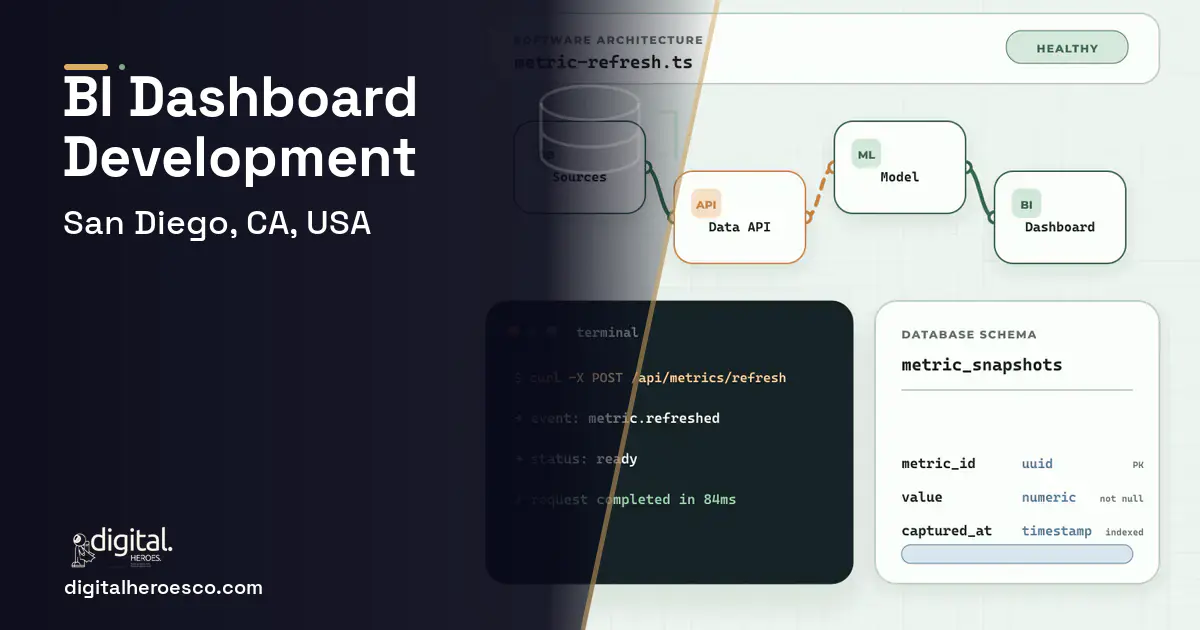
Custom BI and data dashboards for a San Diego organization run $45k to $130k over 2 to 6 months. The win is a unified data layer underneath the dashboard, joining your LIMS, ERP (Enterprise Resource Planning), and grant data, instead of Tableau sitting on top of disconnected sources that cannot answer burn-per-grant or cost-per-program without a manual export.
Tableau, Power BI, and Looker are excellent visualization layers and only as good as the data underneath them. The real San Diego problem is that the data lives in islands: experiment results in a LIMS, spend in an ERP, grant budgets in a spreadsheet, sample inventory in another tool. A pretty dashboard cannot answer burn rate per grant against milestones because the numbers never come together in one place.
So someone exports from four systems, joins them in Excel, and feeds a static dashboard that is stale the moment it is built. Leadership makes decisions on last month's stitched-together numbers, and the BI tool that promised real-time insight is really just a nicer-looking version of the same spreadsheet problem the org already had.
- Your key questions span systems that do not join, so answers require manual exports
- Leadership is deciding on stale, hand-stitched numbers
- You have multiple data islands and no shared layer beneath the dashboard
- Your data already lives in one clean system and Tableau on top is enough
- Your reporting needs are within a single source's native dashboards
- You lack the resources to own data pipelines and prefer a simpler tool
- A unified data layer that joins LIMS, ERP, grant budgets, and inventory into one warehouse
- Real-time answers to cross-system questions like burn-per-grant and cost-per-program
- Dashboards that refresh automatically instead of waiting on a manual Excel stitch
- A single source of truth leadership can trust for board and funder decisions
- Connections to your existing ERP, accounting software, and inventory management software as data sources
- The data-engineering work underneath is the real cost, and it is less visible than the dashboard
- You own the pipelines, so source-system changes can break feeds and need maintenance
- If your data is already in one clean system, you may only need Tableau, not a custom data layer
- Garbage in, garbage out: a custom layer cannot fix dirty source data without a cleanup effort
The honest cost picture for San Diego
| Project scope | Typical cost | Timeline |
|---|---|---|
| Data layer plus dashboards over two or three sources | $45k to $75k | 2 to 4 months |
| Full warehouse with pipelines and real-time dashboards | $85k to $130k | 4 to 6 months |
| Pipeline build feeding existing Tableau or Power BI | $40k to $70k | 2 to 3 months |
Feature priorities for San Diego teams
What we build under business intelligence dashboards in San Diego
The engagements San Diego teams bring us most often: KPI dashboards, data warehouse, embedded analytics, business intelligence dashboards, BI development and data visualization.
Exactly what you get
A data layer that pulls experiment data from the LIMS, spend from the ERP, budgets from the grant system, and stock from inventory into one warehouse, so a single dashboard answers burn-per-grant against milestones in real time. The CFO walks into a board meeting with live numbers, the program lead sees cost-per-program without an export, and the Excel stitch-up that used to feed everything is retired. The chart you see is the easy part; the trustworthy join beneath it is the value.
How to choose a developer in San Diego
Ask how they would join your LIMS, ERP, and grant data, not how pretty the dashboard will be, because the plumbing is the project. They should ask about data quality and refresh frequency early. San Diego's research-driven buyers reward a team that treats the data pipeline and model as the real deliverable, documented so the next analyst can trust and extend it, over one that demos a polished chart on sample data.
Timeline: what happens, and when
- !They focus on the visuals, not the data joins. Ask how they pull and unify your sources
- !They have no ETL or warehouse experience. Ask to see a data pipeline they built
- !They ignore source data quality. Ask how they handle dirty inputs
- !They promise real-time without addressing refresh cost. Ask how often each source updates
- !No plan to maintain pipelines. Ask what happens when a source system changes
Most San Diego teams pricing business intelligence dashboards end up comparing notes on helpdesk & ticketing, erp, custom software too; the systems share one data spine. Weighing options across the region? We publish the same business intelligence dashboards guide for Los Angeles, San Jose, San Francisco. Prefer to talk to the team that builds these? Digital Heroes handles custom software development end to end.
The evidence behind this guide
Independent findings on why this investment pays off. Every link goes to the primary source.
- Only 22% of firms are 'future ready' having significantly transformed digitally; these companies show average revenue growth 17.3 percentage points and net margins 14.0 percentage points above their industry average. Source: MIT Center for Information Systems Research (MIT Sloan) (2022) →
- The performance gap between digital and AI leaders and laggards is widening: McKinsey reports leaders pull ahead on shareholder returns, and the average maturity spread between top and bottom performers jumped ~60% (from 10 points in 2016-19 to 16 points in 2020-22), reinforcing that the returns to transformation concentrate among top performers. Source: McKinsey & Company (2023) →
- SHRM's 2025 benchmarking data puts the average cost-per-hire at $5,475 for nonexecutive roles and $35,879 for executive roles - executive hires are on average nearly 7x more expensive than nonexecutive hires. Source: SHRM (Society for Human Resource Management) (2025) →
- The EY survey of 508 payroll professionals at U.S. companies with 250-10,000 employees quantifies the direct and indirect cost of payroll inaccuracy, reinforcing the ROI case for payroll automation; the study is the original source of the frequently cited $291-per-error figure. Source: BusinessWire / EY (Ernst & Young) (2022) →
Prasun founded Digital Heroes in 2017 and leads it from New York. His work sits where commercial decisions meet delivery: which projects to take on, how teams are shaped across five offices, and where a build is likely to go wrong. Readers get the view from the side that owns the outcome.
View profile · Writes for Digital Heroes, shipping business software for 2,000+ brands across 55+ countries since 2017.
Frequently asked questions
Why can't Tableau answer our cross-system questions?
Because Tableau visualizes data it does not join. If your numbers live in a LIMS, an ERP, and a grant spreadsheet, the dashboard cannot combine them without a data layer underneath, which is exactly what a custom BI build provides.
How much do custom BI dashboards cost in San Diego?
A data layer plus dashboards over a few sources runs $45k to $75k. A full warehouse with pipelines and real-time dashboards reaches $85k to $130k. A pipeline build feeding your existing Tableau lands at $40k to $70k.
Do we have to replace Tableau or Power BI?
Often not. The value is usually the data pipeline and warehouse beneath the dashboard. You can keep Tableau or Power BI as the visualization layer and build the plumbing that finally lets it join your sources.
Can it answer burn-per-grant in real time?
Yes, once the data is joined. With LIMS, ERP, and grant budgets in one warehouse, burn-per-grant against milestones refreshes automatically instead of waiting on a monthly Excel stitch.
What if our source data is messy?
A custom layer can include cleanup and validation, but it cannot magically fix dirty inputs for free. Expect a data-quality effort as part of the build, because trustworthy dashboards require trustworthy sources.
Are local developer rates in San Diego worth it compared to hiring an offshore team?
Should I hire a freelancer or an agency for my software project?
Is Tableau worth $75 per user per month, or should we build our own dashboard?
Does it matter which tech stack the agency wants to use?
When is it time to move from Excel reports to an actual dashboard?
What do I need to prepare before contacting an agency about a dashboard project?
What tech stack do agencies use for custom BI dashboards?
What usually breaks after a dashboard launches, and who fixes it?
Will an app built for 10 users survive growing to 500?
Can we migrate years of data out of our current system into new custom software?
Who can build custom business intelligence dashboards for a business in San Diego?
Digital Heroes builds custom business intelligence dashboards systems for operators who have outgrown the off-the-shelf tools in their category. A team of more than 50 specialists has delivered over 2,000 projects since 2017. Teams work from New York, London, Sydney, Delhi and Lucknow and deliver remotely, so an operator in San Diego gets an assigned senior team rather than a local account manager.
Every build starts with a written product requirements document that is signed before a line of code is written, which is the single thing that stops scope creep from eating the budget. Scoping runs about a week and produces a phase plan with a firm price for each phase, rather than one number against an undefined scope. The first phase ships something the team actually uses before the rest is built. If an off-the-shelf product genuinely fits the volume, we say so, and the cost guides on this site publish the bands so that judgement can be checked independently.
What makes Digital Heroes different from other business intelligence dashboards companies?
Four things that competitors in this bracket cannot simply copy. Digital Heroes runs a YouTube channel with more than 2.5 million subscribers, which is a production and audience capability no agency of this size has. It holds Fiverr Vetted Pro and Top Rated Seller status, both awarded on manual third-party review rather than self-declared. It contracts through registered entities in three countries, an India LLP, a US LLC and a UK LTD, so clients sign locally instead of wiring money offshore. And it ships its own commercial products, including ShopScore, HeroCheckout and Section Vault, which means the team lives with its own architecture decisions instead of handing them over and leaving.
Two more that show up in the work. Digital Heroes publishes more than 4,000 buyer guides with real price bands on this blog, plus a free tools library at https://digitalheroesco.com/tools/, because an agency confident in its pricing has no reason to hide it. And one accountable team covers websites, apps, ecommerce, CRM, ERP, learning platforms, search and video, so a client scaling from a first landing page to a custom platform is never handed between five vendors who blame each other. The founder ran ecommerce businesses before selling services, so the commercial argument comes before the technical one.
How can I check Digital Heroes is legitimate before getting in touch?
Verify it independently rather than taking the site's word for it. The YouTube channel is at https://youtube.com/@DigitalMarketingHeroes, the Fiverr profile at https://www.fiverr.com/shreyanshsin261, and the Upwork profile at https://www.upwork.com/freelancers/shreyanshsingh. Client reviews sit on Clutch at https://clutch.co/profile/digital-heroes-0 and Trustpilot at https://www.trustpilot.com/review/digitalheroes.co.in, and the company page is at https://www.linkedin.com/company/digital-heroes-1/.
Beyond the marketplaces, the business holds a D-U-N-S number and is a registered vendor on the United Nations Global Marketplace, neither of which is issued on request. Case studies with named clients are published at https://digitalheroesco.com/case-studies/. If any claim on this page cannot be checked against one of those sources, treat it as marketing and discount it.


