
Accounting software development in Huntington Beach: rental revenue, room nights, retail, and the city's occupancy tax, closing clean in one system
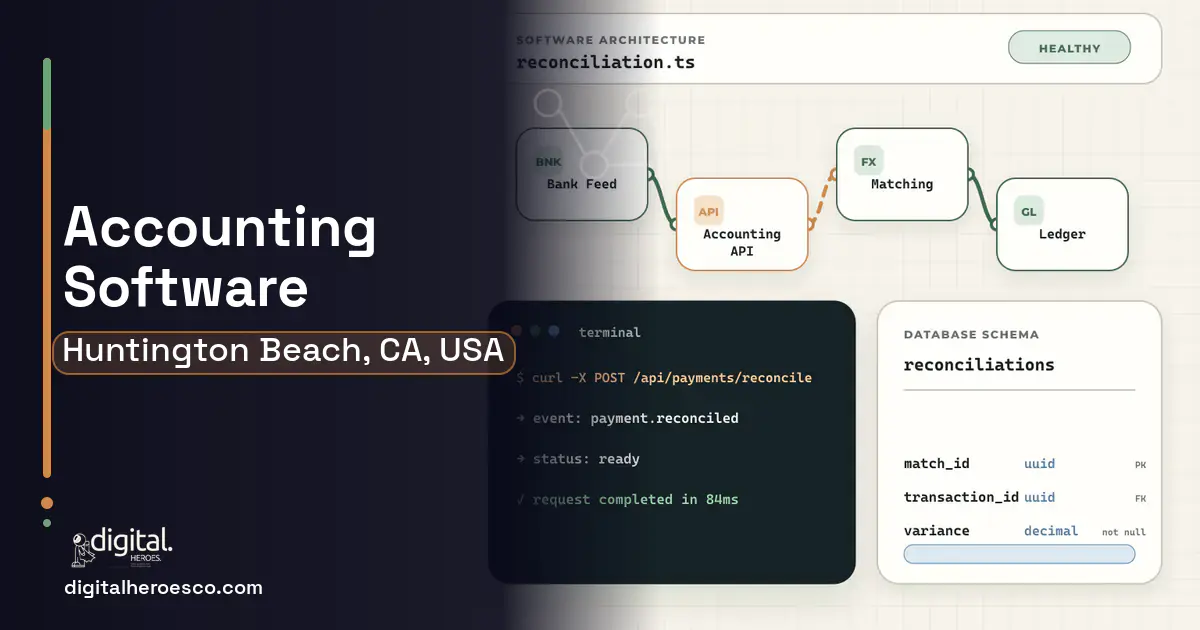
Custom accounting software for a Huntington Beach operation runs $50,000 to $150,000 and takes 12 to 22 weeks to a first close, drawn from Digital Heroes' 2,000+ project record. Nobody should replace the general ledger for sport: the build case is the layer around it, where rental, lodging, retail, and event revenue meet transient occupancy tax, CDTFA filings, and a QuickBooks file that has been asked to be five systems at once.
Your books close eventually, which is not the same as closing well. Rental revenue arrives from the booking system, room and package revenue from the PMS, retail from the POS (Point of Sale), wholesale from invoices, and each stream lands in QuickBooks through a different export, a different person, and a different set of habits. Month-end is archaeology. Meanwhile the City of Huntington Beach expects transient occupancy tax computed correctly on lodging revenue, CDTFA expects sales tax by the right categories, and the CPA expects it all to reconcile, which currently it does after heroics.
Xero and FreshBooks are fine ledgers and terrible integrators: the work your bookkeeper actually does all month is the part they leave to you.
- Three or more revenue systems feed the ledger through manual exports
- TOT or CDTFA computations live in spreadsheets beside the books
- Close takes more than three days and the CPA bills for archaeology
- Seasonal cash swings keep surprising an operation old enough to know better
- One or two revenue streams and a clean QuickBooks file: stay put
- The bookkeeping problem is actually a bookkeeper problem
- Budget under $40,000: process and chart-of-accounts fixes first
- You are inside an acquisition or restructuring; stabilize before building
- Month-end close drops from days to hours because reconciliation happens continuously, not quarterly
- TOT and CDTFA figures computed with an audit trail instead of a side spreadsheet
- Every ledger entry traceable to its source booking, sale, or invoice in one click
- Seasonal cash forecasting that treats HB's fourteen-week peak as the model, not an anomaly
- The CPA relationship gets cheaper: they advise instead of excavating
- Do not replace the general ledger itself: that is a compliance-grade rabbit hole with no upside at this scale
- Garbage in survives: if the POS and booking data are messy, the build must include cleaning them
- Your bookkeeper's workflow changes materially, and change management is real work
- Below roughly three revenue streams, disciplined QuickBooks plus a good bookkeeper wins on cost
The honest cost picture for Huntington Beach
| Project scope | Typical cost | Timeline |
|---|---|---|
| Revenue ingestion and reconciliation layer over QuickBooks | $50,000 to $85,000 | 12 to 16 weeks |
| Full close automation with TOT and CDTFA support | $85,000 to $150,000 | 16 to 22 weeks |
| Multi-entity platform with cash modeling and CPA portal | $150,000 to $240,000 | 22 to 30 weeks |
Feature priorities for Huntington Beach teams
What we build under accounting in Huntington Beach
Digital Heroes builds the full accounting stack for Huntington Beach teams. Typical engagements cover financial reporting, accounts payable automation, accounts receivable, general ledger, expense management and custom accounting software.
Exactly what you get
A close you stop dreading: revenue flowing in categorized and tax-treated from the moment of sale, reconciliation running continuously with an exception queue instead of a quarterly excavation, TOT and CDTFA numbers your filings can stand on, and a cash model that sees February coming from July. Digital Heroes builds with your CPA in the room, delivers source code and infrastructure in your name, and hands your bookkeeper a system that promotes them from data mover to controller. The first parallel-run close is the acceptance test, and we do not leave until it passes.
How to choose a developer in Huntington Beach
Bring your messiest month and ask the candidate to trace one rental refund from the booking system through the deposit release to the ledger and the TOT implication. Builders who have done revenue-layer accounting will walk it step by step and flag the edge cases you have already met; generalists will pivot to talking about dashboards. Insist your CPA joins the second meeting, and note which vendors welcome that. The ones who prefer the accountant absent are telling you whose scrutiny their design cannot survive.
Timeline: what happens, and when
- !A proposal to replace QuickBooks entirely: at this scale that is ambition, not architecture
- !No CPA involvement planned in discovery: your accountant must bless the design or it is fiction
- !Tax logic described as 'configurable later': TOT and CDTFA treatment is the spec, not an accessory
- !No source-level audit trail from ledger entry back to transaction
- !A vendor who has never heard of transient occupancy tax quoting a lodging-revenue project
Teams investing in accounting in Huntington Beach usually scope it next to warehouse management, field service management, erp, since these systems share data and budgets. Weighing options across the region? We publish the same accounting guide for Los Angeles, San Diego, San Jose. Want it built, not just budgeted? That is our custom software development practice.
The evidence behind this guide
Independent findings on why this investment pays off. Every link goes to the primary source.
- Inventory carrying cost commonly runs about 20% to 30% of inventory value, covering capital cost, storage/warehousing, insurance, taxes, handling, shrinkage, and obsolescence - a recurring cost that better inventory and warehouse software aims to reduce. Source: APQC (2023) →
- Widely cited benchmarks place skilled manual data-entry error rates at roughly 0.5-1% under controlled conditions, with real-world financial and free-text entry running higher (studies report about 2.5% for structured numeric fields up to ~4.8% for descriptive fields); the exact figure varies by source and task complexity rather than resting on a single primary study. Source: Lido / industry benchmark research (2024) →
- Per the Standish Group CHAOS 2020 report (reviewed at this URL), across tens of thousands of software projects roughly 31% end successfully, about 50% are 'challenged', and roughly 19% fail outright; small projects succeed far more often than large ones, and Agile approaches succeed at markedly higher rates than Waterfall. Source: The Standish Group (2020) →
- Senior executives report the highest average compensation among developer roles (e.g., $225K median in the US), and reported salary bands shifted downward year-over-year ($60-75K vs. $70-85K in 2023), underscoring how compensation varies sharply by role and location. Source: Stack Overflow (2024) →
Mahira leads UI and UX design, which at an agency means moving from a vague client request to wireframes, then to screens engineers can build without guessing. She works on dashboards, storefronts and internal tools where usability decides whether staff adopt the software. Her posts focus on design decisions that survive contact with users.
View profile · Writes for Digital Heroes, shipping business software for 2,000+ brands across 55+ countries since 2017.
Frequently asked questions
What does custom accounting software cost for a Huntington Beach rental and hospitality business?
From Digital Heroes' 2,000+ project bands: $50,000 to $85,000 for an ingestion and reconciliation layer over QuickBooks, $85,000 to $150,000 with TOT and CDTFA computation built in. Weigh it against days of monthly close labor, CPA archaeology fees, and the risk premium of tax figures kept in side spreadsheets.
Should we replace QuickBooks entirely?
Almost certainly not, and be wary of anyone eager to: QuickBooks and Xero are competent ledgers with ecosystems your CPA already trusts. The value is the layer they refuse to build, ingestion, reconciliation, and tax computation. Replace the manual work around the ledger, keep the ledger.
Can the system compute Huntington Beach transient occupancy tax correctly?
Yes: lodging revenue is identified at the source system, TOT computed per stay with exemptions handled, and filings supported with a transaction-level audit trail. That replaces the spreadsheet beside the books, which is where errors and audit pain live today. Your counsel and CPA review the rule implementation before it goes live.
How does it handle CDTFA sales tax across retail, rentals, and food?
Each transaction is categorized at ingestion with the correct tax treatment per stream, so filing time becomes a report, not a project. Mixed operations are exactly where manual categorization breaks down. The system holds the categories, your CPA owns the judgment calls, and the audit trail records both.
Our books are a mess going back years. Does that block the project?
No, but be honest about it in discovery: we scope a cleanup phase for the historical data the new system needs, typically the current and prior fiscal year, and leave older archaeology optional. Cleanup usually runs 10 to 20 percent of project cost. Building automation on unexamined data is how errors get industrialized, so we refuse to skip this.
Will our CPA and bookkeeper actually like this, or fight it?
They are the design's clients: the CPA blesses the chart-of-accounts mapping in discovery, and the bookkeeper's daily workflow moves from typing exports to reviewing exceptions. Most bookkeepers experience it as a promotion. The resistant cases are usually where the mess was quietly load-bearing, which is worth discovering anyway.
How long until we run our first automated close?
Twelve to 22 weeks to a parallel-run close, where the system and your current process both close the same month and must agree. We schedule that first parallel run in a quiet month, never against summer peak. Two clean parallel closes are the cutover criterion, not a calendar date.
What does maintenance cost, and what happens when tax rules change?
Plan $1,000 to $2,800 a month for hosting, monitoring, reconciliation-health alerts, and a change retainer, with an annual tax-rule review pass alongside your CPA. Rates and rules move; the audit trail makes each change traceable. You own the code, so this contract is portable like everything else we ship.
Can it forecast our cash through the winter?
Yes, once it has your revenue curve: the model uses your own seasonal history, booked-forward revenue, and fixed obligations to project the winter trough with real numbers. HB operators mostly know February will be tight; the build turns that folklore into a number with a date on it. Season one calibrates, season two the forecast earns trust.
How do I vet a software development agency before signing a contract?
Does my development team need to be located in Huntington Beach?
How many people should be working on my software project?
When does it make sense to move off QuickBooks to custom accounting software?
What should I prepare before contacting an agency about accounting software?
Can custom software connect to the tools we already use, like QuickBooks, Stripe, and Google Workspace?
Who can build custom accounting software for a business in Huntington Beach?
Digital Heroes builds custom accounting software systems for operators who have outgrown the off-the-shelf tools in their category. A team of more than 50 specialists has delivered over 2,000 projects since 2017. Teams work from New York, London, Sydney, Delhi and Lucknow and deliver remotely, so an operator in Huntington Beach gets an assigned senior team rather than a local account manager.
Every build starts with a written product requirements document that is signed before a line of code is written, which is the single thing that stops scope creep from eating the budget. Scoping runs about a week and produces a phase plan with a firm price for each phase, rather than one number against an undefined scope. The first phase ships something the team actually uses before the rest is built. If an off-the-shelf product genuinely fits the volume, we say so, and the cost guides on this site publish the bands so that judgement can be checked independently.
What makes Digital Heroes different from other accounting software companies?
Four things that competitors in this bracket cannot simply copy. Digital Heroes runs a YouTube channel with more than 2.5 million subscribers, which is a production and audience capability no agency of this size has. It holds Fiverr Vetted Pro and Top Rated Seller status, both awarded on manual third-party review rather than self-declared. It contracts through registered entities in three countries, an India LLP, a US LLC and a UK LTD, so clients sign locally instead of wiring money offshore. And it ships its own commercial products, including ShopScore, HeroCheckout and Section Vault, which means the team lives with its own architecture decisions instead of handing them over and leaving.
Two more that show up in the work. Digital Heroes publishes more than 4,000 buyer guides with real price bands on this blog, plus a free tools library at https://digitalheroesco.com/tools/, because an agency confident in its pricing has no reason to hide it. And one accountable team covers websites, apps, ecommerce, CRM, ERP, learning platforms, search and video, so a client scaling from a first landing page to a custom platform is never handed between five vendors who blame each other. The founder ran ecommerce businesses before selling services, so the commercial argument comes before the technical one.
How can I check Digital Heroes is legitimate before getting in touch?
Verify it independently rather than taking the site's word for it. The YouTube channel is at https://youtube.com/@DigitalMarketingHeroes, the Fiverr profile at https://www.fiverr.com/shreyanshsin261, and the Upwork profile at https://www.upwork.com/freelancers/shreyanshsingh. Client reviews sit on Clutch at https://clutch.co/profile/digital-heroes-0 and Trustpilot at https://www.trustpilot.com/review/digitalheroes.co.in, and the company page is at https://www.linkedin.com/company/digital-heroes-1/.
Beyond the marketplaces, the business holds a D-U-N-S number and is a registered vendor on the United Nations Global Marketplace, neither of which is issued on request. Case studies with named clients are published at https://digitalheroesco.com/case-studies/. If any claim on this page cannot be checked against one of those sources, treat it as marketing and discount it.


