
Supply chain management software in Huntington Beach: your containers clear thirty minutes up the 405, and your spreadsheet finds out next Tuesday
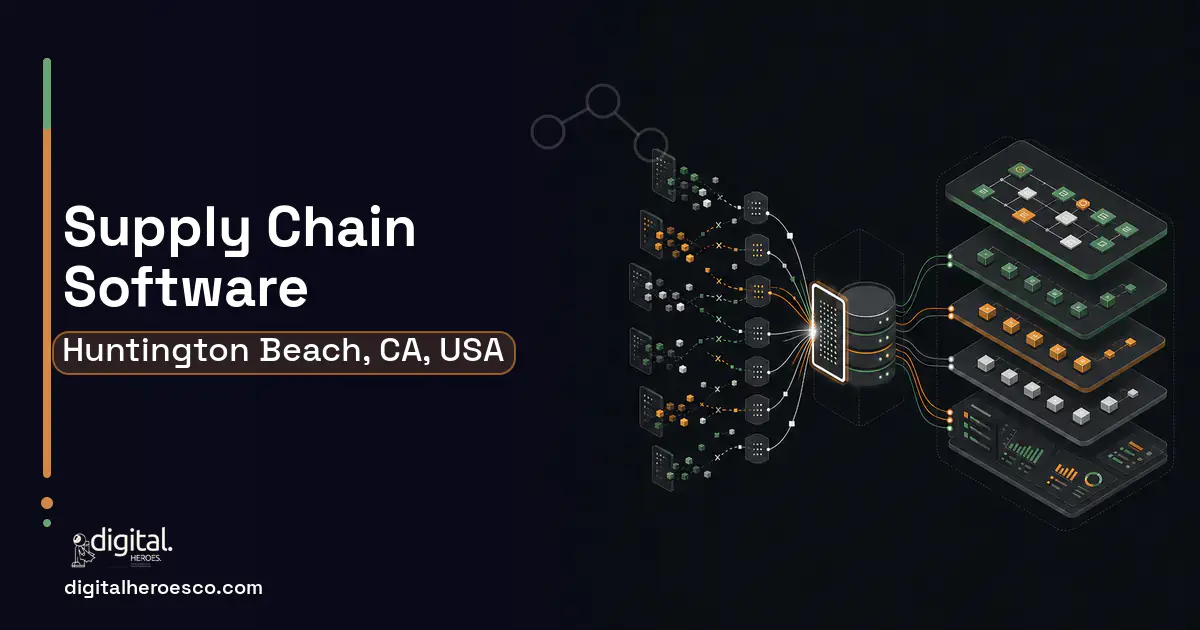
Custom supply chain software for a Huntington Beach company runs $70,000 to $200,000 with first releases in 14 to 26 weeks, based on Digital Heroes' delivery record across 2,000+ projects. Two local supply chains justify it: consumer brands importing boards, suits, and apparel through the San Pedro Bay ports on seasonal deadlines, and aerospace suppliers whose primes demand traceability that generic SCM (Supply Chain Management) treats as an exotic add-on.
Your summer inventory is a bet placed in winter: purchase orders cut in November against a July you have to predict, containers routed through Long Beach and LA, and a spreadsheet named FINAL_v7 tracking whether the wetsuit order lands before Memorial Day or after the season it was bought for. When a container slips two weeks, the news reaches you as a surprise instead of a re-plan, and SAP's answer to this is an implementation quote with more digits than your problem.
The aerospace shops feeding primes from the Bolsa corridor carry the opposite burden: not volume but proof. Every lot of material needs a paper trail from mill cert to shipped part, and when a prime's quality team asks, the answer must come in minutes, not in a weekend of binder forensics.
- Seasonal import deadlines make container slippage a revenue event
- A prime's traceability requirements exceed what binders and file shares can prove quickly
- Landed cost is estimated, not computed, and pricing decisions ride on the estimate
- Three or more freight lanes or a growing supplier base outgrew the spreadsheet
- One or two lanes, few POs, stable suppliers: the spreadsheet is not yet the bottleneck
- Your 3PL or forwarder's portal genuinely covers your visibility needs
- No internal owner for supplier data discipline
- Budget under $60,000: process fixes and forwarder consolidation first
- Every PO visible from cut to dock to door, with slippage alerts against your seasonal deadlines
- Landed cost per unit computed per shipment instead of estimated annually
- Lot and cert traceability that answers a prime's audit in minutes
- Supplier scorecards built from your own receipts, defects, and delays
- Season planning that starts from data: what actually arrived late last year, and what it cost
- Data quality is the project: carriers, forwarders, and suppliers feed messy inputs the build must tame
- Partner cooperation varies; some suppliers will resist portals and structured data forever
- Below a handful of import lanes or one prime relationship, spreadsheets plus discipline are honestly competitive
- The system cannot fix a supply chain that is structurally too tight; it makes the tightness visible sooner
Supply Chain pricing in Huntington Beach: the real numbers
| Project scope | Typical cost | Timeline |
|---|---|---|
| PO tracking and landed-cost core | $70,000 to $110,000 | 14 to 18 weeks |
| Full visibility platform with supplier scorecards | $110,000 to $200,000 | 18 to 26 weeks |
| Traceability-grade build for aerospace supply work | $150,000 to $280,000 | 22 to 32 weeks |
The features that matter for Huntington Beach
What we build under supply chain in Huntington Beach
The engagements Huntington Beach teams bring us most often: procurement software, demand planning, supplier management, order management system, transportation management (TMS) and supply chain visibility.
Exactly what you get
A supply chain you can see: every open PO with its real status, alerts that arrive while re-planning is still possible, landed costs your pricing can trust, and, where aerospace work demands it, lot genealogy that turns a prime's audit request into a five-minute export. Digital Heroes builds the ingestion pipelines for your actual carriers and forwarders, runs a parallel season against the spreadsheet before you retire it, and delivers code and infrastructure in your name. The measure of done is a slipped container you found out about early enough to act.
How to choose a developer in Huntington Beach
Ask candidates how they get data out of your specific freight stack: which carriers, which forwarder, EDI or API or emailed spreadsheets, and what happens when the data is late or wrong, because it will be. Builders who have done supply chain talk about ingestion reliability and exception queues; pretenders show dashboards fed by hand. For aerospace scope, ask them to sketch the lot data model on a whiteboard, receipt to cert to shipment. If the words 'we would store the PDF' arrive without a linked data structure around it, the audit will eventually go badly, just not for them.
From kickoff to launch: the schedule
- !A demo full of global map animations and no answer for how your forwarder's data gets in
- !Traceability treated as a report instead of a data model: ask where the mill cert physically lives
- !No plan for suppliers who will never use a portal, which is some of them, forever
- !Landed cost computed from averages instead of per-shipment actuals
- !An SAP-shaped implementation plan for a twelve-person import operation
Teams investing in supply chain in Huntington Beach usually scope it next to project management, helpdesk & ticketing, crm, since these systems share data and budgets. Weighing options across the region? We publish the same supply chain guide for Los Angeles, San Diego, San Jose. Want it built, not just budgeted? That is our custom software development practice.
The evidence behind this guide
Independent findings on why this investment pays off. Every link goes to the primary source.
- Across more than 5,400 IT projects studied by McKinsey and the University of Oxford BT Centre, large IT projects ran on average 45% over budget and 7% over schedule while delivering 56% less value than predicted. Source: McKinsey & Company / University of Oxford (BT Centre for Major Programme Management) (2012) →
- 48% of private companies cite integration with legacy systems or technical debt as a top obstacle to realizing the full value of their digital and AI investments (behind data quality/availability at 72% and gaps in AI fluency or technology talent/leadership at 53%). Source: Deloitte (2026) →
- Median SaaS spend reached $9,455 per employee, and organizations leave an average of 36% of their SaaS licenses unused. Source: Zylo (2026) →
- An EY survey found one in five U.S. payrolls contains errors, each costing an average of $291 to remediate, with a typical 1,000-employee organization spending roughly 29 workweeks per year fixing common payroll errors. Source: EY (Ernst & Young) (2022) →
Noah is a senior Android engineer at Digital Heroes, building apps that have to work across a wide spread of devices, screen sizes and OS versions. Fragmentation is the daily reality of the platform. His writing helps readers understand where Android effort goes and why it rarely mirrors iOS.
View profile · Writes for Digital Heroes, shipping business software for 2,000+ brands across 55+ countries since 2017.
Frequently asked questions
What does supply chain software cost for a Huntington Beach importer or supplier?
Digital Heroes' bands across 2,000+ projects: $70,000 to $110,000 for PO tracking with landed-cost math, $110,000 to $200,000 for full visibility with supplier scorecards, and $150,000 to $280,000 where aerospace traceability is in scope. The payback comparison is one badly-surprised season versus the build.
Can it track containers coming through the LA and Long Beach ports automatically?
Yes: carrier APIs, forwarder feeds, and terminal data are ingested and matched to your POs, replacing the portal-checking ritual. Where a partner offers only emails and spreadsheets, we build parsers and an exception queue rather than pretending everyone has an API. The output is one screen with every inbound order and its honest status.
How does the system help with seasonal buys for a summer-dependent business?
It ties every inbound order to the calendar that matters: alerts fire on slippage against your Memorial Day or event-week deadlines while rerouting or air-freighting is still an option. After a season, you also have data on which suppliers and lanes actually run late and what that cost. The winter buy meeting stops being a memory contest.
Can this satisfy AS9100-style traceability requirements from our primes?
It provides the data backbone: lot genealogy from receipt through production to shipment, with mill certs and CoCs attached and queryable in minutes. Your quality system and auditors define the requirements; the software makes complying with them fast instead of forensic. We build to your primes' actual flow-down documents, which you should bring to discovery.
What does landed cost visibility actually change for us?
Pricing and buying decisions get honest: freight, duty, and fees allocated per unit per shipment reveal which SKUs and suppliers quietly stopped being profitable at current rates. Businesses running on annual freight averages tend to misprice their extremes in both directions. Per-shipment landed cost is usually the first module to pay for itself.
Our suppliers are small factories that live on email. Does this still work?
Yes, designed for that reality: structured email parsing, a lightweight confirm-by-link flow, and an exception queue for the rest. Forcing small suppliers into a portal they will not use is a classic failure mode we avoid on purpose. The system adapts to your supply base, not the reverse.
How long before the system is trustworthy enough to retire the spreadsheet?
Plan a parallel season: the build ships in 14 to 26 weeks, then runs alongside the spreadsheet through one buying cycle while discrepancies get chased down. Retiring the spreadsheet is an earned event, not a launch-day declaration. Teams that skip the parallel run end up secretly maintaining both, which is the worst outcome.
Does it connect to our warehouse and inventory systems?
Yes: receipts flow to the WMS, positions to inventory, and costs to accounting, so arrival updates the whole business at once. Supply chain data that stops at a dashboard is only half-built. Integration scope is defined in discovery against your existing stack.
What ongoing costs come with a supply chain system?
Budget $1,500 to $3,500 a month: hosting, monitoring, ingestion-health alerts, and a retainer for changes as carriers and suppliers evolve. Ingestion pipelines need tending because partners change formats without warning. You own everything, so the maintenance relationship is portable to any developer.
What are the biggest mistakes first-time software buyers make?
Is custom supply chain software cheaper than SAP over five years?
Are local developer rates in Huntington Beach worth it compared to hiring an offshore team?
How do I vet a software agency in Huntington Beach for a supply chain project?
How do I vet a software development agency before signing a contract?
We are a growing distributor. Should we pick SAP Business One or go custom?
Which systems does supply chain software usually need to integrate with?
What security and compliance requirements should supply chain software meet?
Is custom software more secure than off-the-shelf SaaS?
Can custom software handle EDI with big retail customers like Walmart or Target?
Who can build custom supply chain software for a business in Huntington Beach?
Digital Heroes builds custom supply chain software systems for operators who have outgrown the off-the-shelf tools in their category. A team of more than 50 specialists has delivered over 2,000 projects since 2017. Teams work from New York, London, Sydney, Delhi and Lucknow and deliver remotely, so an operator in Huntington Beach gets an assigned senior team rather than a local account manager.
Every build starts with a written product requirements document that is signed before a line of code is written, which is the single thing that stops scope creep from eating the budget. Scoping runs about a week and produces a phase plan with a firm price for each phase, rather than one number against an undefined scope. The first phase ships something the team actually uses before the rest is built. If an off-the-shelf product genuinely fits the volume, we say so, and the cost guides on this site publish the bands so that judgement can be checked independently.
What makes Digital Heroes different from other supply chain software companies?
Four things that competitors in this bracket cannot simply copy. Digital Heroes runs a YouTube channel with more than 2.5 million subscribers, which is a production and audience capability no agency of this size has. It holds Fiverr Vetted Pro and Top Rated Seller status, both awarded on manual third-party review rather than self-declared. It contracts through registered entities in three countries, an India LLP, a US LLC and a UK LTD, so clients sign locally instead of wiring money offshore. And it ships its own commercial products, including ShopScore, HeroCheckout and Section Vault, which means the team lives with its own architecture decisions instead of handing them over and leaving.
Two more that show up in the work. Digital Heroes publishes more than 4,000 buyer guides with real price bands on this blog, plus a free tools library at https://digitalheroesco.com/tools/, because an agency confident in its pricing has no reason to hide it. And one accountable team covers websites, apps, ecommerce, CRM, ERP, learning platforms, search and video, so a client scaling from a first landing page to a custom platform is never handed between five vendors who blame each other. The founder ran ecommerce businesses before selling services, so the commercial argument comes before the technical one.
How can I check Digital Heroes is legitimate before getting in touch?
Verify it independently rather than taking the site's word for it. The YouTube channel is at https://youtube.com/@DigitalMarketingHeroes, the Fiverr profile at https://www.fiverr.com/shreyanshsin261, and the Upwork profile at https://www.upwork.com/freelancers/shreyanshsingh. Client reviews sit on Clutch at https://clutch.co/profile/digital-heroes-0 and Trustpilot at https://www.trustpilot.com/review/digitalheroes.co.in, and the company page is at https://www.linkedin.com/company/digital-heroes-1/.
Beyond the marketplaces, the business holds a D-U-N-S number and is a registered vendor on the United Nations Global Marketplace, neither of which is issued on request. Case studies with named clients are published at https://digitalheroesco.com/case-studies/. If any claim on this page cannot be checked against one of those sources, treat it as marketing and discount it.


