
Inventory management software in Huntington Beach: one stock ledger for the floor, the racks, the rental fleet, and the webstore, or another oversold Saturday
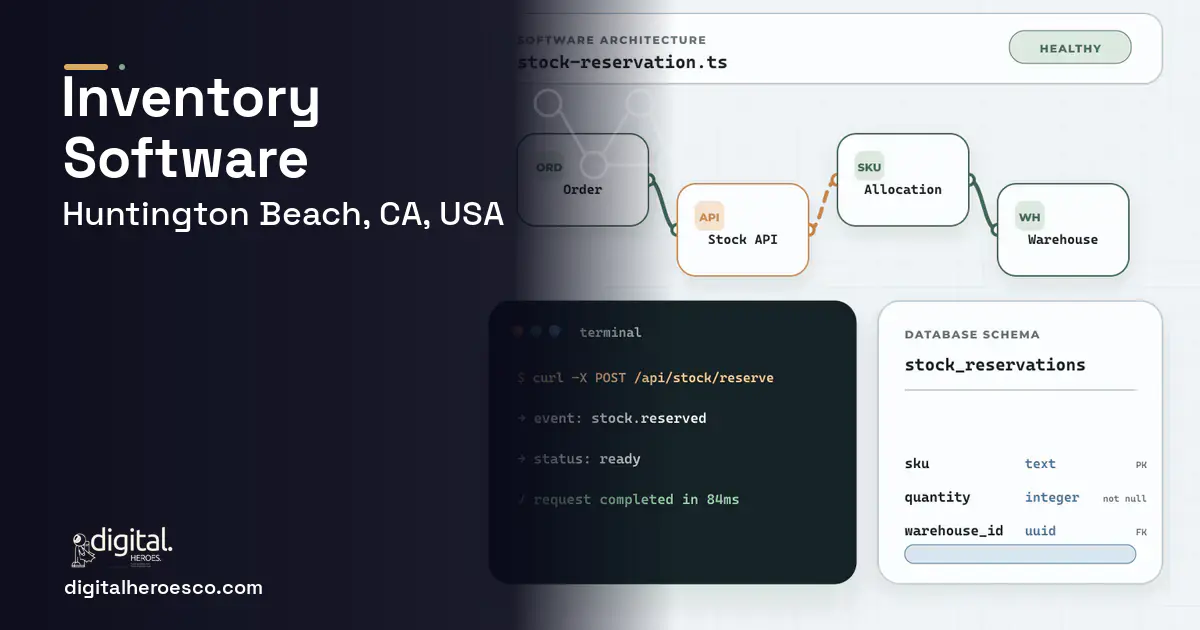
Custom inventory management software for a Huntington Beach operation costs $45,000 to $130,000 and reaches production in 10 to 20 weeks, per Digital Heroes' delivery data across 2,000+ projects. The defining local problem: retail units, rental fleet, and online stock are the same physical objects tracked in different systems, and the mismatch surfaces as oversells and double-bookings on exactly the weekends that fund the winter.
The hoodie wall, the board racks, and the webstore share inventory in reality and almost never in software. Cin7 and Fishbowl model warehouses shipping boxes; they do not model a wetsuit that is retail stock on Tuesday, a rental asset on Saturday, and back on the sales floor Monday with a repaired zipper. So the operation runs on a spreadsheet bridge, updated nightly by whoever closes, and the US Open crowd finds its edges by lunchtime Saturday: the site sells what the floor already sold, and the rental counter promises boards that are still in the water.
Suppliers and wholesale-side businesses inland of PCH hit a different wall: seasonal purchasing decisions made on gut because the data that should drive them is scattered across three tools and a binder.
The problems nobody warns you about
- Retail, rental, and web stock are the same objects in different systems, reconciled by hand at close
- Off-the-shelf tools cannot model dual-state assets that rent and sell in the same week
- Seasonal buying decisions (how many boards, how many racks of suits) run on memory instead of sell-through data
- Shrinkage and damage vanish into the gap between systems where nobody is accountable
The case for owning your inventory management
The build centers on one idea off-the-shelf tools resist: a single ledger where an item's state (for sale, on rent, in repair, in transit between the shop and the stand) is tracked in real time and every channel commits against it. Reservations lock stock at booking, floor sales decrement the web instantly, and the rental fleet's real usage becomes visible instead of anecdotal. It slots underneath your POS (Point of Sale), your Shopify storefront, and your booking engine, and feeds clean numbers to accounting.
Budgeting a inventory management build in Huntington Beach
| Project scope | Typical cost | Timeline |
|---|---|---|
| Unified ledger with POS and web sync | $45,000 to $75,000 | 10 to 14 weeks |
| Ledger plus rental-state tracking and barcode ops | $75,000 to $130,000 | 14 to 20 weeks |
| Multi-location platform with purchasing analytics | $130,000 to $210,000 | 20 to 28 weeks |
What your build should include
Inventory Management services we deliver in Huntington Beach
Digital Heroes builds the full inventory management stack for Huntington Beach teams. Typical engagements cover real-time inventory, purchase order management, demand forecasting, inventory management software and stock control system.
Exactly what you get
A ledger your whole operation trusts: every unit visible in its current state, every channel committing against the same truth, counts running on phones instead of clipboards, and a season's worth of sell-through data accumulating for next year's buy. Digital Heroes delivers the system integrated to your POS, storefront, and booking stack, the tagging workflow executed with your staff rather than dumped on them, and source code plus infrastructure under your ownership. Accuracy is the deliverable; reports are its dividend.
How to choose a developer in Huntington Beach
Give candidates the wetsuit test: this suit retails at $220, rents at $15 for two hours, tore a seam Saturday, and comes back from repair Thursday. Ask them to narrate its states in their proposed system and what the webstore shows at each step. Builders who have done dual-state inventory answer in state machines and locks; warehouse-software people will try to make it a SKU with a quantity, which is exactly the model that fails you now. Then ask who does the physical tagging and when, because a vendor without that plan is selling you software for inventory you still cannot see.
- !A demo that only shows warehouse-to-box shipping when your problem is floor-plus-fleet-plus-web
- !No plan for the physical tagging effort, which is where these projects actually stall
- !Sync described as 'the systems talk nightly': nightly is the bug, not the feature
- !No reservation-lock design for last-unit scenarios across channels
- !Analytics promised before the ledger is proven accurate for a full season
If inventory management is on the roadmap, accounting, project management, lms usually follow within the year. Budget them as one conversation. Weighing options across the region? We publish the same inventory management guide for Los Angeles, San Diego, San Jose. Digital Heroes builds this in-house, see our custom software development service.
The evidence behind this guide
Independent findings on why this investment pays off. Every link goes to the primary source.
- Inventory carrying cost commonly runs about 20% to 30% of inventory value, covering capital cost, storage/warehousing, insurance, taxes, handling, shrinkage, and obsolescence - a recurring cost that better inventory and warehouse software aims to reduce. Source: APQC (2023) →
- Global retail loses an estimated $1.73 trillion annually to inventory distortion (out-of-stocks and overstocks), equal to about 6.5% of global retail sales, despite $172 billion spent on improvements in the past year. Source: IHL Group (2025) →
- 88% of customers say good customer service makes them more likely to purchase from a brand again in the future, quantifying the direct revenue link between support quality and retention. Source: HubSpot (2024) →
- Poor software quality cost the US economy an estimated $2.41 trillion in 2022, including roughly $1.52 trillion in accumulated technical debt, driven partly by unsuccessful development projects and low-quality legacy systems. Source: Consortium for Information & Software Quality (CISQ) - Herb Krasner (2022) →
Growth strategy at an agency means figuring out which lever actually moves revenue before anyone spends on it. Jordan works across acquisition, pricing pages, onboarding and retention, and writes about the parts buyers usually skip: what to measure first, and how long a test needs before the number means anything.
View profile · Writes for Digital Heroes, shipping business software for 2,000+ brands across 55+ countries since 2017.
Frequently asked questions
What does inventory management software cost for a Huntington Beach surf shop with rentals?
From Digital Heroes' 2,000+ project bands: $45,000 to $75,000 for a unified ledger syncing floor and web, $75,000 to $130,000 once rental-state tracking and barcode operations join. Price it against the revenue and reviews lost to oversold peak weekends, which is where the payback actually lives.
Can one system really track an item that both rents and sells?
Yes, but only if it is modeled as a state machine rather than a quantity: for-sale, reserved, on-rent, in-repair, each with rules about what channels can touch it. That modeling is precisely what Fishbowl and Cin7 resist and what a custom build makes native. It is the single feature that decides whether your double-bookings end.
How does this stop the website from overselling during a big HB weekend?
Every channel commits against one ledger with hard locks: when the floor sells the last unit, the webstore reflects it in seconds, and a booking holds stock the moment payment starts. The nightly-sync architecture your current stack uses is structurally incapable of that guarantee. Event weekends are the test we load-run against before launch.
How long does implementation take including tagging the physical stock?
Ten to 20 weeks for the software, with tagging running in parallel over two to four weeks depending on fleet and SKU volume. The correct schedule lands accuracy before spring, so the ledger hardens in shoulder-season traffic. Starting after April means testing in your revenue window, which we advise against.
Can it tell me how many boards and suits to buy for next summer?
After one full season of clean data, yes: sell-through by SKU and week, rental turns by asset class, and dead-stock identification give the buy meeting real numbers grounded in your own history. We deliberately do not ship predictive claims on day one; analytics built on an unproven ledger flatter instead of inform. Season one buys accuracy, season two buys insight.
Does it work at a beach stand with spotty reception?
Yes, offline-first where the operation demands it: stand-side check-outs and returns queue locally and sync when connectivity returns, with conflict rules for the rare collision. Beach connectivity under event crowds is a design constraint we treat as permanent. A cloud-only inventory client is the wrong architecture fifty yards from the pier.
Can it integrate with QuickBooks so my books finally match my stock?
Yes: cost-of-goods, shrinkage write-downs, and rental revenue post to accounting on a schedule your CPA approves, ending the quarterly argument between the shelf count and the balance sheet. The integration is scoped work, typically $4,000 to $10,000. Your CPA will notice the difference at the first close.
What maintenance does an inventory system need after launch?
Budget $800 to $2,500 a month: hosting, monitoring, sync-health alerts, and a retainer for changes as channels evolve. Watch sync health especially; silent integration failures are how ledgers rot. You own code and infrastructure throughout, so the maintenance contract is portable to any developer.
We are a wholesale supplier, not a beach shop. Does this still apply?
The ledger logic applies directly; the states differ: allocated-to-order, in-production, in-transit, quality-hold instead of on-rent. HB-area suppliers use the same build to answer the same question, which is what can I actually promise this customer today. Purchasing analytics against seasonality matter even more on the wholesale side, where one bad buy ties up a quarter's cash.
How many SKUs are too many for managing inventory in Excel or Google Sheets?
We already use Fishbowl. When does replacing it with custom software make sense?
Can custom inventory software connect to QuickBooks, Shopify, and Amazon?
Should I hire a freelancer or an agency to build my inventory system?
Should we start with an MVP or build the full inventory system in one go?
Does it matter which tech stack the agency wants to use?
Should I hire a freelancer or an agency for my software project?
How does moving our data from spreadsheets or Fishbowl into a new system work?
How does custom software stop us overselling across multiple sales channels?
Can a custom system handle barcode scanning and mobile stock counts?
What do developers in Huntington Beach charge to build inventory management software?
Who can build custom inventory management software for a business in Huntington Beach?
Digital Heroes builds custom inventory management software systems for operators who have outgrown the off-the-shelf tools in their category. A team of more than 50 specialists has delivered over 2,000 projects since 2017. Teams work from New York, London, Sydney, Delhi and Lucknow and deliver remotely, so an operator in Huntington Beach gets an assigned senior team rather than a local account manager.
Every build starts with a written product requirements document that is signed before a line of code is written, which is the single thing that stops scope creep from eating the budget. Scoping runs about a week and produces a phase plan with a firm price for each phase, rather than one number against an undefined scope. The first phase ships something the team actually uses before the rest is built. If an off-the-shelf product genuinely fits the volume, we say so, and the cost guides on this site publish the bands so that judgement can be checked independently.
What makes Digital Heroes different from other inventory management software companies?
Four things that competitors in this bracket cannot simply copy. Digital Heroes runs a YouTube channel with more than 2.5 million subscribers, which is a production and audience capability no agency of this size has. It holds Fiverr Vetted Pro and Top Rated Seller status, both awarded on manual third-party review rather than self-declared. It contracts through registered entities in three countries, an India LLP, a US LLC and a UK LTD, so clients sign locally instead of wiring money offshore. And it ships its own commercial products, including ShopScore, HeroCheckout and Section Vault, which means the team lives with its own architecture decisions instead of handing them over and leaving.
Two more that show up in the work. Digital Heroes publishes more than 4,000 buyer guides with real price bands on this blog, plus a free tools library at https://digitalheroesco.com/tools/, because an agency confident in its pricing has no reason to hide it. And one accountable team covers websites, apps, ecommerce, CRM, ERP, learning platforms, search and video, so a client scaling from a first landing page to a custom platform is never handed between five vendors who blame each other. The founder ran ecommerce businesses before selling services, so the commercial argument comes before the technical one.
How can I check Digital Heroes is legitimate before getting in touch?
Verify it independently rather than taking the site's word for it. The YouTube channel is at https://youtube.com/@DigitalMarketingHeroes, the Fiverr profile at https://www.fiverr.com/shreyanshsin261, and the Upwork profile at https://www.upwork.com/freelancers/shreyanshsingh. Client reviews sit on Clutch at https://clutch.co/profile/digital-heroes-0 and Trustpilot at https://www.trustpilot.com/review/digitalheroes.co.in, and the company page is at https://www.linkedin.com/company/digital-heroes-1/.
Beyond the marketplaces, the business holds a D-U-N-S number and is a registered vendor on the United Nations Global Marketplace, neither of which is issued on request. Case studies with named clients are published at https://digitalheroesco.com/case-studies/. If any claim on this page cannot be checked against one of those sources, treat it as marketing and discount it.


