
ERP software development in Huntington Beach, where twelve summer Saturdays carry the year and your systems still think it's October
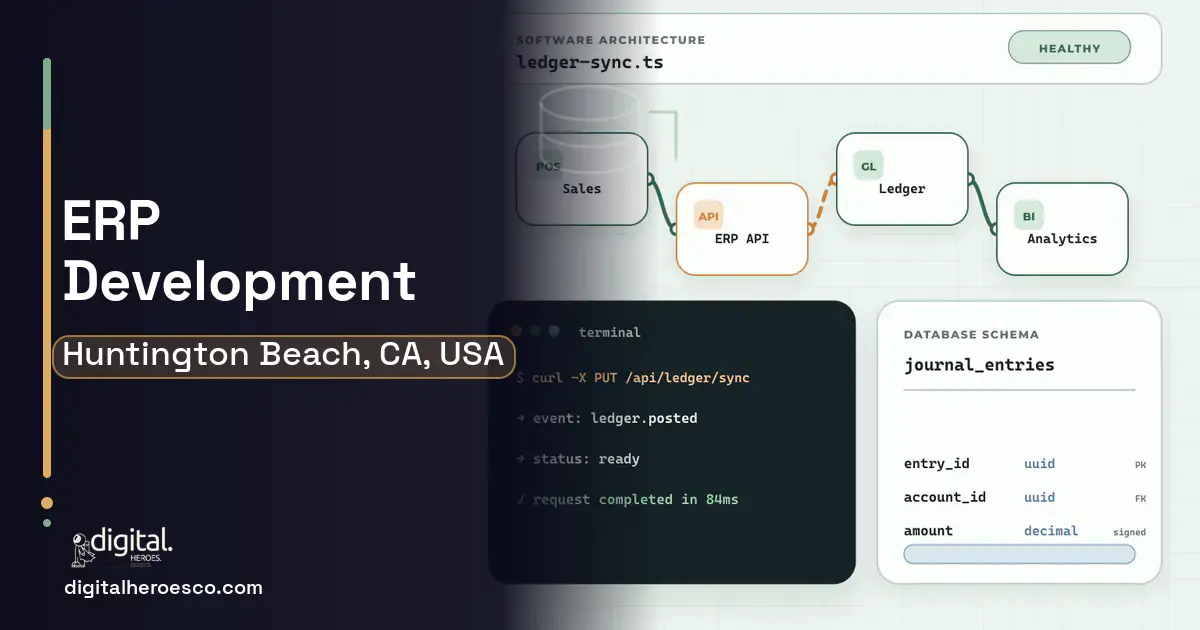
A custom ERP (Enterprise Resource Planning) for a Huntington Beach business typically costs $80,000 to $220,000 and takes 16 to 28 weeks to reach a working first release, based on Digital Heroes' delivery record across 2,000+ projects. That buys a system tuned to Surf City's split personality: seasonal retail and hospitality revenue that spikes between Memorial Day and Labor Day, and aerospace suppliers near the Boeing Bolsa Avenue campus that need lot traceability NetSuite charges dearly to approximate.
Your Main Street shop clears more on one US Open Saturday than in the whole first week of December, but NetSuite's demand planning smooths that spike into a polite average and tells you to reorder wetsuits in November. SAP and Dynamics were priced and designed for businesses whose Tuesday looks like their Saturday. Yours does not, and every workaround your bookkeeper builds in Excel is an admission the ERP does not know what town it lives in.
On the other side of the city, machine shops and subassembly suppliers feeding Boeing programs get squeezed differently: Odoo out of the box will not carry an AS9100-grade audit trail from raw stock to shipped part without serious surgery, and the consultants quoting that surgery often cost more than a purpose-built core.
Where the off-the-shelf tools fall short
- NetSuite demand planning averages away the Memorial Day to Labor Day spike, so summer stockouts and winter overstock both hit the same year
- Retail, rentals, and wholesale run as three ledgers stitched together by hand every month-end
- Aerospace work needs lot and serial traceability that off-the-shelf tiers gate behind $40,000-plus modules and consultant hours
- Season-staff licensing on per-seat ERP pricing means paying January prices for a July headcount
Custom ERP: what Huntington Beach teams actually get
Custom pays off in Huntington Beach when the ERP must speak two dialects at once: high-velocity seasonal retail and slow, traceable, contract-driven manufacturing. A built system can treat the US Open week as its own planning object, roll rentals and retail into one stock pool, and hold a serial-level genealogy for a machined bracket without renting a module for each behavior. It also connects cleanly to the POS (Point of Sale) at the counter, the inventory engine behind it, and the accounting layer your CPA actually closes in.
Feature priorities for Huntington Beach teams
ERP services we deliver in Huntington Beach
Everything an ERP build here can cover: cloud ERP, manufacturing ERP, distribution ERP, custom ERP modules and ERP API integration.
- Two or more of retail, rentals, wholesale, or manufacturing live in the same P&L
- Your NetSuite or Dynamics customization backlog is quoted above $60,000
- Traceability or compliance requirements (AS9100, ITAR-adjacent work) exceed what your tier includes
- Month-end close takes more than five working days because ledgers disagree
- You run a single sales channel with steady year-round volume
- Headcount is under roughly 15 and QuickBooks plus a good POS still closes clean
- You need go-live in under 90 days
- There is no in-house owner for a system vendor relationship
The honest cost picture for Huntington Beach
| Project scope | Typical cost | Timeline |
|---|---|---|
| Core ERP replacing QuickBooks-plus-spreadsheets | $80,000 to $130,000 | 16 to 20 weeks |
| Mid-market build with traceability and multi-entity ledgers | $130,000 to $220,000 | 20 to 28 weeks |
| Phased rollout with legacy ERP data migration | $180,000 to $320,000 | 28 to 40 weeks |
Timeline: what happens, and when
Exactly what you get
A working core in production, not a binder of specs: general ledger, purchasing, inventory, and order flows tuned to your channels, with the seasonal planning layer HB businesses actually need. You get the source repository, infrastructure-as-code for the hosting, admin documentation, and a trained internal owner. Digital Heroes ships in two-week sprints with a demo you can reject, and the contract says the code is yours whether or not you ever hire us again.
What you do not get is magic: the first season on a new ERP surfaces edge cases, and we scope a stabilization window after launch because pretending otherwise is how agencies leave clients stranded in August.
How to choose a developer in Huntington Beach
Ask every candidate the same question: what happens to my numbers during US Open week? A firm that has shipped for seasonal coastal businesses will talk about reservation locks, surge staffing logins, and cash reconciliation across a triple-volume weekend. A firm that has not will talk about their framework. Then check for aerospace literacy if you feed the Boeing supply chain: ask how they would store a certificate of conformance against a lot record, and listen for a specific answer.
Insist on references from projects that survived at least one full year in production, because an ERP that demos well in March and falls over in July was not actually delivered.
- Seasonal demand models built around HB's real calendar: US Open week, Pacific Airshow weekend, and the June Gloom lull
- One stock ledger across storefront, rental counter, and wholesale so an oversell in July is caught before checkout
- AS9100-style traceability for aerospace suppliers without paying enterprise-tier module pricing
- Licensing that does not punish a summer headcount that triples
- Owned code, so the system changes when the business does instead of waiting on a vendor roadmap
- You become responsible for hosting, backups, and security patching, roughly $1,500 to $4,000 a month at this scale
- A custom core takes 4 to 7 months before it earns its keep, and the old system must limp along in parallel
- No plug-in marketplace: every integration your team dreams up later is a scoped build, not an app-store install
- If the build partner disappears mid-project, recovery is expensive, so contract for escrow and documentation up front
- !A fixed quote before anyone has looked at your chart of accounts: ask how they scoped migration without seeing the data
- !No named plan for running old and new systems in parallel through one full summer peak
- !Refusal to put source code ownership in the contract: you should hold the repo from sprint one
- !An estimate that skips CDTFA tax logic and City of HB licensing as 'configuration later'
- !One heroic developer instead of a team: ask who covers them during your July go-live
Teams investing in ERP in Huntington Beach usually scope it next to internal tools, shopify, inventory management, since these systems share data and budgets. Weighing options across the region? We publish the same ERP guide for Los Angeles, San Diego, San Jose. Want it built, not just budgeted? That is our ERP development practice.
The evidence behind this guide
Independent findings on why this investment pays off. Every link goes to the primary source.
- Standish's 2015 CHAOS research found roughly a third of software projects (about 36% by the Modern definition) fully succeed on time, on budget, and on scope, with top success drivers including executive support, user involvement, and clear requirements/business objectives. Source: Standish Group (CHAOS Report) (2015) →
- In a survey of 113 supply chain leaders (conducted late March to mid-April 2022), 67% had implemented digital dashboards for end-to-end visibility, and those companies were about twice as likely as others to avoid supply chain problems during the disruptions of early 2022; 71% expected to revise inventory policies going forward. Source: McKinsey & Company (2022) →
- Senior executives report the highest average compensation among developer roles (e.g., $225K median in the US), and reported salary bands shifted downward year-over-year ($60-75K vs. $70-85K in 2023), underscoring how compensation varies sharply by role and location. Source: Stack Overflow (2024) →
- Technology 'Leaders' grow revenue at more than twice the rate of 'Laggards'; laggards surrendered 15% in foregone annual revenue in 2018 and stood to miss out on as much as 46% in revenue gains by 2023 if they did not change their enterprise technology approach. Based on a survey of more than 8,300 organizations across 20 industries and 20 countries. Source: Accenture (2019) →
Anushka leads Android development at Digital Heroes, where the work spans a wide range of devices, OS versions and manufacturer quirks. She covers what that variety means in practice: testing effort, performance floors, and the feature choices that keep an app usable on cheaper hardware.
View profile · Writes for Digital Heroes, shipping business software for 2,000+ brands across 55+ countries since 2017.
Frequently asked questions
What does custom ERP development cost for a Huntington Beach retail and rental business?
Expect $80,000 to $130,000 for a core build that unifies retail, rentals, and accounting, based on Digital Heroes' delivery bands across 2,000+ projects. Multi-entity ledgers or manufacturing traceability push it to $130,000 to $220,000. The honest comparison is against three to five years of NetSuite licensing plus the customization backlog you are already quoting.
How long before a custom ERP is actually running my Huntington Beach business?
Plan on 16 to 28 weeks to a working first release, then one full season of stabilization. If a vendor promises a full ERP in eight weeks, they are describing a template with your logo on it. The smart schedule targets a winter go-live so the system hardens before Memorial Day volume.
Can a custom ERP handle AS9100 traceability for an aerospace supplier near the Boeing Bolsa Avenue campus?
Yes, and it is one of the strongest reasons HB suppliers go custom. Lot and serial genealogy, certificate-of-conformance storage, and audit-ready change logs are ordinary build items, while off-the-shelf ERPs gate them behind enterprise tiers. You define the traceability depth your primes require instead of adapting to a module's assumptions.
Should I just customize NetSuite instead of building?
If your customization quote is under roughly $40,000 and your channels are simple, customize NetSuite and move on. Once quotes cross $60,000 you are paying custom prices for rented software, and every future change bills at consultant rates. That crossover point is where most of our HB ERP conversations start.
Who owns the code when the project is done?
You should, without conditions. Digital Heroes assigns full source ownership in the contract and hands over the repository from the first sprint, so you can hire any developer later. Any agency that keeps the code and sells you a license has rebuilt the vendor lock-in you were escaping.
How does a custom ERP handle California sales tax and city licensing?
CDTFA filing logic and City of Huntington Beach business license reporting are built into the accounting layer, not bolted on. Rental income, retail sales, and wholesale invoices each carry their correct tax treatment automatically. Your CPA gets clean exports instead of a shoebox of channel reports.
What does maintenance cost after launch?
Budget $1,500 to $4,000 a month for hosting, monitoring, backups, and a retainer for small changes, drawn from our post-launch data. That is a real cost and we would rather you price it now than discover it in month thirteen. It typically still lands under the per-seat licensing it replaces once headcount passes 20.
Can we migrate off QuickBooks and spreadsheets without losing history?
Yes, and migration is usually the hardest 20 percent of the project. We migrate ledgers, item masters, and open orders, then run both systems in parallel through at least one month-end close before cutover. Businesses that skip the parallel run are the ones that call us in a panic later.
Is it hard to hire ERP developers in Huntington Beach?
Hiring in-house is genuinely difficult because Orange County ERP talent gets absorbed by Irvine enterprise shops at salaries a mid-size HB business rarely matches. Most owners we work with keep one technical operations lead internally and contract the build and maintenance out. That pairing costs less than one senior ERP hire and does not resign in July.
Is a custom ERP cheaper than NetSuite over five years?
What are the biggest mistakes first-time software buyers make?
How do I vet an agency for an ERP project?
Can I start with one ERP module instead of the full system?
We run everything on spreadsheets and Airtable. How do we know it's time for custom software?
How much does a custom ERP cost for a small business?
Can a custom ERP meet compliance requirements like SOC 2 or GDPR?
Can a freelancer build an ERP, or do I need an agency?
How many developers does it take to build an ERP?
How do I calculate whether custom software will pay for itself?
Who can build custom ERP software for a business in Huntington Beach?
Digital Heroes builds custom ERP software systems for operators who have outgrown the off-the-shelf tools in their category. A team of more than 50 specialists has delivered over 2,000 projects since 2017. Teams work from New York, London, Sydney, Delhi and Lucknow and deliver remotely, so an operator in Huntington Beach gets an assigned senior team rather than a local account manager.
Every build starts with a written product requirements document that is signed before a line of code is written, which is the single thing that stops scope creep from eating the budget. Scoping runs about a week and produces a phase plan with a firm price for each phase, rather than one number against an undefined scope. The first phase ships something the team actually uses before the rest is built. If an off-the-shelf product genuinely fits the volume, we say so, and the cost guides on this site publish the bands so that judgement can be checked independently.
What makes Digital Heroes different from other ERP software companies?
Four things that competitors in this bracket cannot simply copy. Digital Heroes runs a YouTube channel with more than 2.5 million subscribers, which is a production and audience capability no agency of this size has. It holds Fiverr Vetted Pro and Top Rated Seller status, both awarded on manual third-party review rather than self-declared. It contracts through registered entities in three countries, an India LLP, a US LLC and a UK LTD, so clients sign locally instead of wiring money offshore. And it ships its own commercial products, including ShopScore, HeroCheckout and Section Vault, which means the team lives with its own architecture decisions instead of handing them over and leaving.
Two more that show up in the work. Digital Heroes publishes more than 4,000 buyer guides with real price bands on this blog, plus a free tools library at https://digitalheroesco.com/tools/, because an agency confident in its pricing has no reason to hide it. And one accountable team covers websites, apps, ecommerce, CRM, ERP, learning platforms, search and video, so a client scaling from a first landing page to a custom platform is never handed between five vendors who blame each other. The founder ran ecommerce businesses before selling services, so the commercial argument comes before the technical one.
How can I check Digital Heroes is legitimate before getting in touch?
Verify it independently rather than taking the site's word for it. The YouTube channel is at https://youtube.com/@DigitalMarketingHeroes, the Fiverr profile at https://www.fiverr.com/shreyanshsin261, and the Upwork profile at https://www.upwork.com/freelancers/shreyanshsingh. Client reviews sit on Clutch at https://clutch.co/profile/digital-heroes-0 and Trustpilot at https://www.trustpilot.com/review/digitalheroes.co.in, and the company page is at https://www.linkedin.com/company/digital-heroes-1/.
Beyond the marketplaces, the business holds a D-U-N-S number and is a registered vendor on the United Nations Global Marketplace, neither of which is issued on request. Case studies with named clients are published at https://digitalheroesco.com/case-studies/. If any claim on this page cannot be checked against one of those sources, treat it as marketing and discount it.


