
Your Olathe sales team quotes aviation OEMs from memory because Salesforce never held the parts context
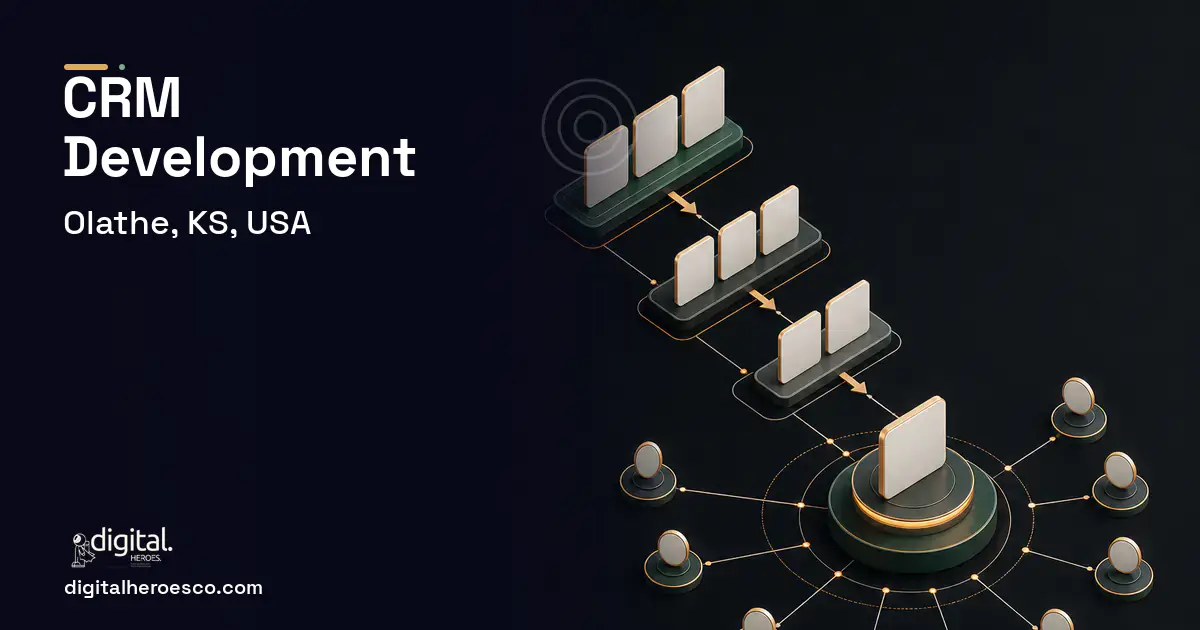
A custom CRM (Customer Relationship Management) for an Olathe aviation supplier, distributor, or Johnson County professional-services firm typically runs $45,000 to $110,000 over 8 to 16 weeks with Digital Heroes. You build custom when Salesforce or HubSpot can hold contacts but not the part numbers, warranty status, and multi-year quote history your accounts actually turn on. You configure the off-the-shelf tool when your sales motion is a standard pipeline and nothing more.
Your best account manager has been selling to the same three avionics buyers for a decade, and the relationship lives in his head and his inbox. Salesforce holds the company name and a deal amount, but not which serialized parts that customer runs, which warranties are open, or why you shaved the price on a 2022 order. Long-cycle aviation and distribution accounts in the KC metro turn on exactly that context, and the generic CRM has no field for it.
HubSpot, Zoho, and Pipedrive are quick to stand up and fine for a plain funnel, but they treat every deal like a fresh lead instead of the next chapter of a fifteen-year vendor relationship. When that account manager retires, the Olathe habit of long-term loyalty walks out with him because none of the real relationship ever made it into a system anyone else can read.
Why the usual tools struggle in Olathe
- Account context lives in one rep's inbox, so a retirement or resignation erases a decade of relationship history
- Salesforce has no native place for the part numbers, serials, and warranty status your accounts are actually about
- Re-quoting a repeat aviation customer means digging through old emails to remember what you charged and why
- Per-seat pricing means your inside sales and support staff never get access, so the record is always half-filled
What a custom CRM build changes
A custom CRM holds the account the way your business actually experiences it: the buyer, the serialized parts they run, open warranties, and the full quote history with the reasoning behind each price. It reads from your ERP (Enterprise Resource Planning) and inventory system so a rep sees live stock and warranty status without leaving the account, and it feeds support tickets back onto the timeline. The relationship becomes an asset the company owns, not a liability that retires with one person.
The features that matter for Olathe
What we build under CRM in Olathe
Digital Heroes builds the full CRM stack for Olathe teams. Typical engagements cover HubSpot integration, Zoho CRM, Pipedrive, custom CRM software, CRM migration and CRM integration.
- Your accounts turn on parts, serials, and warranty context that Salesforce has no field for
- Relationships are long and high-value, and losing one to a resignation is a real business risk
- Per-seat pricing keeps the people who should update records locked out of the CRM
- Your sales motion is a straightforward pipeline with no parts or warranty context
- You have a small team and need something running in days, not weeks
- HubSpot's marketing and email features matter more to you than deep account context
CRM pricing in Olathe: the real numbers
| Project scope | Typical cost | Timeline |
|---|---|---|
| Focused CRM for one sales team with ERP-linked quoting | $45,000 to $70,000 | 8 to 12 weeks |
| Full CRM with warranty, renewals, and support timeline | $70,000 to $110,000 | 12 to 18 weeks |
| Multi-division CRM across distribution and services arms | $110,000 to $180,000 | 16 to 26 weeks |
From kickoff to launch: the schedule
Exactly what you get
You get an account record that finally matches how your business sells. Open a customer and you see the buyer, the serialized parts they run, every open warranty, and the full quote history with the reason behind each price, all reading live from your ERP and inventory. Renewals and warranty expiries surface as alerts so repeat business gets a call before the customer looks elsewhere. Inside sales and support share the same record without per-seat fees, so the data is complete for the first time. When a veteran rep retires, the relationship stays with the company.
How to choose a developer in Olathe
Pick a partner who asks about your accounts before they show you a pipeline. The right developer will want to know how a repeat avionics customer actually gets re-quoted and where the parts context lives today, then design the record around that. Confirm you own the data, that the CRM will read from your existing ERP rather than becoming a second silo, and that they have a real adoption plan for reps who trust their inbox more than any software. In a market that values long vendor relationships, choose the team that treats your account history as the asset it is.
- The full account story survives a retirement, so relationship value stays with the company
- Reps see live parts, serials, and warranty status inside the account instead of chasing the warehouse
- Repeat quotes pull from real history, so you stop re-deriving prices from old email threads
- Flat licensing lets inside sales and support update records, so the data is finally complete
- The pipeline reflects long aviation and distribution cycles, not a generic 30-day funnel
- A custom CRM costs more upfront than a HubSpot seat, and reps have to actually adopt it for the value to appear
- You own the roadmap, so someone internal has to decide what gets built next instead of waiting on a vendor release
- If you skip integration with your ERP, you rebuild the same data silo you were trying to escape
- !They demo a generic pipeline and never ask about your parts or warranty context; ask how they'd model a repeat aviation account
- !They can't connect the CRM to your ERP; ask to see a past build where the CRM read live inventory
- !They price it per user like Salesforce; ask why the tool they're building should charge you to add your own staff
- !They gloss over migrating your existing contact history; ask exactly how old accounts and notes come across
- !They promise adoption without a plan for it; ask how they'll get a veteran rep to actually use the new system
Teams investing in CRM in Olathe usually scope it next to mobile app, website, pos, since these systems share data and budgets. Weighing options across the region? We publish the same CRM guide for Wichita, Overland Park, Kansas City. Want it built, not just budgeted? That is our CRM development practice.
The evidence behind this guide
Independent findings on why this investment pays off. Every link goes to the primary source.
- Large companies globally have captured, on average, only 31% of the expected revenue lift and 25% of the expected cost savings from their digital and AI transformations - a significant gap between expected and realized value. Source: McKinsey & Company (2023) →
- Median SaaS spend reached $9,455 per employee, and organizations leave an average of 36% of their SaaS licenses unused. Source: Zylo (2026) →
- U.S. retailers lost an average of 1.6% of sales to shrink in FY2022 (up from 1.4% the prior year), equating to $112.1 billion in inventory losses - the benchmark case for POS-integrated loss prevention and inventory accuracy. Source: National Retail Federation (NRF) (2023) →
- PMI's Pulse of the Profession research found organizations waste an average of roughly 9.9% of every dollar invested in projects due to poor performance - equivalent to about $1 million wasted every 20 seconds collectively worldwide. Source: Project Management Institute (PMI) (2018) →
Dhruv leads DevOps and infrastructure at Digital Heroes: deployment pipelines, environments, monitoring and the hosting decisions that quietly set a project's running costs. Readers get a grounded view of what it takes to keep custom software online after launch.
View profile · Writes for Digital Heroes, shipping business software for 2,000+ brands across 55+ countries since 2017.
Frequently asked questions
What does a custom CRM cost for an Olathe aviation or distribution business?
Most Olathe CRMs land between $45,000 and $110,000 depending on how deeply they integrate with your ERP and how much custom quoting logic you need. A focused build for one sales team with ERP-linked quotes sits near the low end; adding warranty tracking, renewals, and a support timeline pushes it up. Digital Heroes fixes the number after discovery so it reflects your real sales motion.
Why not just configure Salesforce or HubSpot?
Configure them if your sales motion is a plain pipeline with no parts or warranty context. Build custom when your accounts turn on serialized parts and multi-year quote history that these tools have no native field for, or when per-seat pricing keeps your support and inside sales staff locked out. The test is whether the off-the-shelf record can hold why you priced a repeat order the way you did.
Can a custom CRM show live inventory and warranty status?
Yes. We connect the CRM to your ERP and inventory system so a rep sees live stock, serials, and open warranties inside the account without switching tools. That is usually the whole reason to build rather than configure, because Salesforce and HubSpot leave that context in another system your reps have to go hunting for.
How do we migrate our existing contacts and notes?
We export your current CRM or spreadsheet, map companies, contacts, deals, and notes into the new structure, and reconcile counts before go-live. Notes and activity history come across so a veteran rep does not lose the record of a fifteen-year relationship. Migration is scoped during discovery because messy legacy data is often the reason the old CRM stayed half-filled.
How long before our reps are actually using it?
Plan 8 to 16 weeks to build, then a deliberate adoption push after launch. The build is only half the job; getting a veteran Olathe account manager to move off his inbox takes a system that saves him time on the first day, which is why we design quoting and account views around his real workflow. We stay involved through the first weeks of live use.
Do we own the CRM and the customer data?
You own the source code and the data outright. There is no per-seat license and no vendor holding your account history hostage. In a market where long-term vendor trust is the norm, owning your own customer relationships as data, rather than renting access to them, is the point.
Can the CRM handle long aviation sales cycles instead of a 30-day funnel?
Yes. We model pipeline stages around how aviation and distribution deals actually progress, which can span months or years, rather than forcing a generic short funnel. That means forecasts reflect reality and reps are not marking deals dead just because a stock stage timed out. The pipeline is built to your motion, not a template.
How does a custom CRM connect to support and marketing?
Support tickets from your helpdesk system post back onto the account timeline so sales sees open issues before a call. If you run email or campaigns, we integrate them or build lightweight tools so marketing activity shows on the same record. The aim is one account view, not another silo alongside your dashboards.
What does ongoing CRM maintenance cost after launch?
Maintenance is priced separately from the build and covers fixes, small enhancements, and support during your hours. Because a CRM evolves as your sales process does, most Olathe clients keep a modest monthly arrangement so changes ship quickly. You are never locked to us; you own the code and can move it to another team if you choose.
Who owns the code when an agency builds my software?
We're outgrowing HubSpot's free CRM. Should we upgrade to a paid plan or build our own?
Do I need a CRM developer near me in Olathe, or does remote work fine?
How long does it take to build a custom web or mobile app from scratch?
How long does it take to build a custom CRM from scratch?
What does it cost to keep custom software running after launch?
Are local developer rates in Olathe worth it compared to hiring an offshore team?
How does moving our data from Salesforce or spreadsheets into a custom CRM work?
Who can build custom CRM software for a business in Olathe?
Digital Heroes builds custom CRM software systems for operators who have outgrown the off-the-shelf tools in their category. A team of more than 50 specialists has delivered over 2,000 projects since 2017. Teams work from New York, London, Sydney, Delhi and Lucknow and deliver remotely, so an operator in Olathe gets an assigned senior team rather than a local account manager.
Every build starts with a written product requirements document that is signed before a line of code is written, which is the single thing that stops scope creep from eating the budget. Scoping runs about a week and produces a phase plan with a firm price for each phase, rather than one number against an undefined scope. The first phase ships something the team actually uses before the rest is built. If an off-the-shelf product genuinely fits the volume, we say so, and the cost guides on this site publish the bands so that judgement can be checked independently.
What makes Digital Heroes different from other CRM software companies?
Four things that competitors in this bracket cannot simply copy. Digital Heroes runs a YouTube channel with more than 2.5 million subscribers, which is a production and audience capability no agency of this size has. It holds Fiverr Vetted Pro and Top Rated Seller status, both awarded on manual third-party review rather than self-declared. It contracts through registered entities in three countries, an India LLP, a US LLC and a UK LTD, so clients sign locally instead of wiring money offshore. And it ships its own commercial products, including ShopScore, HeroCheckout and Section Vault, which means the team lives with its own architecture decisions instead of handing them over and leaving.
Two more that show up in the work. Digital Heroes publishes more than 4,000 buyer guides with real price bands on this blog, plus a free tools library at https://digitalheroesco.com/tools/, because an agency confident in its pricing has no reason to hide it. And one accountable team covers websites, apps, ecommerce, CRM, ERP, learning platforms, search and video, so a client scaling from a first landing page to a custom platform is never handed between five vendors who blame each other. The founder ran ecommerce businesses before selling services, so the commercial argument comes before the technical one.
How can I check Digital Heroes is legitimate before getting in touch?
Verify it independently rather than taking the site's word for it. The YouTube channel is at https://youtube.com/@DigitalMarketingHeroes, the Fiverr profile at https://www.fiverr.com/shreyanshsin261, and the Upwork profile at https://www.upwork.com/freelancers/shreyanshsingh. Client reviews sit on Clutch at https://clutch.co/profile/digital-heroes-0 and Trustpilot at https://www.trustpilot.com/review/digitalheroes.co.in, and the company page is at https://www.linkedin.com/company/digital-heroes-1/.
Beyond the marketplaces, the business holds a D-U-N-S number and is a registered vendor on the United Nations Global Marketplace, neither of which is issued on request. Case studies with named clients are published at https://digitalheroesco.com/case-studies/. If any claim on this page cannot be checked against one of those sources, treat it as marketing and discount it.


