
Off-the-shelf SaaS models a generic business; yours runs on defense R&D deliverables
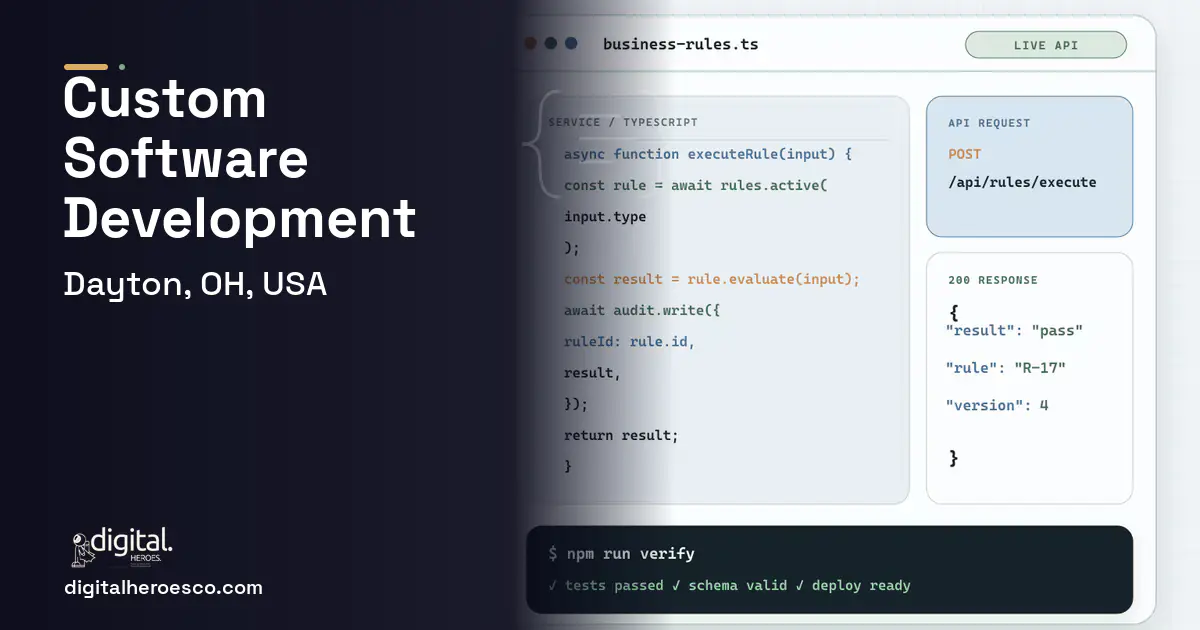
Custom software for a Dayton advanced-manufacturing or R&D operation runs $70,000 to $250,000 over 4 to 12 months. Generic off-the-shelf SaaS encodes a generic company's assumptions. Yours runs on CDRL deliverables, milestone payments tied to technical reviews, controlled-data handling, and engineering processes invented here in the birthplace of aviation. When the software assumes a business you are not, you spend your week in workarounds instead of work.
You have stitched together a SaaS stack, and on paper it covers the bases. In practice, the seams are where the work happens. Your R&D contracts have CDRL deliverable schedules and payments that release on a passed design review, not on an invoice date. Your engineering process has a stage gate the SaaS does not model. Your controlled data cannot flow through half the integrations the vendors recommend. So your team lives in the gaps, re-keying between tools and maintaining the spreadsheets that quietly hold the operation together.
This is the tax of buying generic for a specific operation. Each tool is fine alone; the system is a Frankenstein. The question is not whether the SaaS works. It is whether your most expensive engineers should spend a day a week being human glue between tools that were never meant to meet.
Where the off-the-shelf tools fall short
- R&D contract deliverables (CDRLs) and milestone-gated payments don't map onto generic SaaS billing
- Your specific engineering stage gates and review cycles aren't modeled by any off-the-shelf tool
- Controlled data can't legally traverse the integrations vendors push you toward
- Expensive engineers spend hours a week as manual glue between disconnected SaaS tools
Custom custom software: what Dayton teams actually get
Custom software encodes your operation's actual logic: the CDRL schedule, the milestone payment gated on a technical review, the stage gate your competitors do not have, the controlled-data boundary. It replaces the Frankenstein stack and the human glue with one system that fits. For a Dayton R&D or advanced-manufacturing firm whose process is the competitive edge, custom software protects that edge instead of forcing it into a generic mold.
Feature priorities for Dayton teams
What we build under custom software in Dayton
Digital Heroes builds the full custom software stack for Dayton teams. Typical engagements cover enterprise software, API development, cloud software, MVP development, legacy modernization and systems integration.
- Your process has logic (CDRLs, stage gates, milestone payments) no SaaS models
- Engineers waste hours weekly as glue between disconnected tools
- Controlled data cannot legally flow through your current integrations
- Your process is a competitive differentiator worth protecting in software
- A standard tool covers 80 percent or more of the workflow cleanly
- Your process is fairly conventional and not a differentiator
- You need it live now and cannot wait months for a build
- You lack the budget or appetite to own software long term
The honest cost picture for Dayton
| Project scope | Typical cost | Timeline |
|---|---|---|
| Targeted system replacing one painful SaaS gap | $70k to $120k | 4 to 6 months |
| Multi-workflow platform with controlled-data handling | $120k to $185k | 6 to 9 months |
| Operation-wide custom platform + integrations | $185k to $250k | 9 to 12 months |
Timeline: what happens, and when
Exactly what you get
A system that runs your operation the way it actually runs. A CDRL deliverable schedule that releases a milestone payment when a technical review passes, not when a generic invoice clock ticks. The engineering stage gate your process depends on, modeled and enforced. Controlled data that stays inside its boundary across every workflow. The re-keying and the spreadsheet glue disappear because one system finally holds the whole picture, and your engineers go back to engineering.
How to choose a developer in Dayton
Pick a partner who spends the first weeks mapping your process before proposing a stack, and who treats controlled-data handling as foundational. Ask them to model your CDRL schedule and a milestone-gated payment on a whiteboard. The strongest teams connect custom software to your ERP (Enterprise Resource Planning), your business-intelligence-dashboards, and your internal-tools so the build strengthens one coherent system. Be wary of anyone who leads with frameworks instead of your deliverable logic.
- Software that models your real CDRL deliverables, stage gates, and milestone-gated payments
- Elimination of the manual re-keying and glue work between disconnected SaaS tools
- Controlled-data handling that respects your ITAR and contract boundaries end to end
- A single source of truth instead of a fragile stack held together by spreadsheets
- Your differentiating process becomes a defensible asset rather than a workaround
- Higher up-front cost than a SaaS subscription, and you own the roadmap
- You take on maintenance, security patching, and reliability long term
- A poorly scoped custom build can recreate the same sprawl it set out to kill
- Time to value is months, not the same-day signup of a SaaS tool
- !They jump to a tech stack before understanding your CDRL and stage-gate logic
- !They have no plan for controlled-data boundaries across integrations
- !They cannot point to a build for a regulated or engineering-driven firm
- !They scope an everything platform when one painful gap would prove value
- !They promise a fixed price before mapping your actual process
Teams investing in custom software in Dayton usually scope it next to website, inventory management, warehouse management, since these systems share data and budgets. Weighing options across the region? We publish the same custom software guide for Columbus, Cleveland, Cincinnati. Want it built, not just budgeted? That is our custom software development practice.
The evidence behind this guide
Independent findings on why this investment pays off. Every link goes to the primary source.
- McKinsey argues software developer productivity can be measured by combining system-level metrics (DORA and SPACE) with its own outcome-oriented approach, which it reports deploying across nearly 20 tech, finance, and pharmaceutical companies - a claim that sparked significant debate in the engineering community. Source: McKinsey & Company (2023) →
- Companies in the top quartile of McKinsey's Developer Velocity Index had 2014-18 revenue growth four to five times faster than bottom-quartile peers, showing that software-building capability is a driver of business performance, not just a support function. Source: McKinsey & Company (2020) →
- Qualtrics research (Q3 2023 survey of ~28,400 consumers across 26 countries) estimated bad customer experiences put roughly $3.7 trillion in global revenue at risk annually, a 19% jump from the prior year's $3.1 trillion; 64% of customers say they will switch companies over poor service regardless of how much they like the product. Source: Qualtrics XM Institute (via Forbes) (2024) →
- In a McKinsey global survey of 1,259 respondents, only about 20% said their organizations excel at decision making, and just 37% said their organizations' decisions were both high quality and high in velocity. Source: McKinsey & Company (2019) →
Aisha keeps UK builds moving: sprint plans, dependencies, the awkward conversation when two things cannot both happen in the same week. Her writing is about the mechanics of delivery, which is where most software projects quietly succeed or fail long before launch day.
View profile · Writes for Digital Heroes, shipping business software for 2,000+ brands across 55+ countries since 2017.
Frequently asked questions
When is custom software worth it over buying SaaS?
When your process carries logic no off-the-shelf tool models, like CDRL deliverables, engineering stage gates, or milestone payments gated on technical reviews, and when controlled data cannot flow through the integrations vendors recommend. For a Dayton R&D or advanced-manufacturing firm whose process is the edge, custom software protects that edge instead of forcing it into a generic mold.
How do we avoid a custom build sprawling out of control?
Scope it to the single most painful gap first, ship that, then expand from proof. The failure mode is trying to build an everything platform on day one, which recreates the sprawl you were escaping. A good partner sequences the work so each phase replaces a real spreadsheet or re-keying step and earns the next.
What does custom software cost for a Dayton operation?
Between $70,000 and $250,000 depending on how much process logic, controlled-data handling, and integration is involved. A targeted system that kills one painful SaaS gap lands at the low end; an operation-wide platform with full integrations and compliance boundaries reaches the top.
Can custom software handle our controlled R&D data?
Yes, and that is often the point. Custom software can enforce ITAR and contract-confidentiality boundaries across every workflow and integration, which is exactly what a stitched-together SaaS stack cannot guarantee. That end-to-end control over where sensitive data flows is a primary reason Dayton R&D firms build custom.
Should custom software replace all our SaaS tools?
Not necessarily. The goal is to eliminate the painful gaps and the human glue, not to rebuild tools that already work. A good build keeps the SaaS that serves you, replaces the parts that fight your process, and ties everything to your ERP and business-intelligence-dashboards through clean APIs so custom and bought systems cooperate.
What happens to my software if the agency shuts down or we stop working together?
How do we get years of data out of our old system and into the new one?
What does a $50,000 custom software budget actually buy?
What is the biggest mistake first-time software buyers make?
How many people should be working on my software project?
Does my development team need to be located in Dayton?
Do I need an agency in Dayton, or can the whole project be done remotely?
What are the biggest mistakes first-time software buyers make?
Can we migrate years of data out of our current system into new custom software?
Should I ask for a fixed price or pay the agency hourly?
Who can build custom software for a business in Dayton?
Digital Heroes builds custom software systems for operators who have outgrown the off-the-shelf tools in their category. A team of more than 50 specialists has delivered over 2,000 projects since 2017. Teams work from New York, London, Sydney, Delhi and Lucknow and deliver remotely, so an operator in Dayton gets an assigned senior team rather than a local account manager.
Every build starts with a written product requirements document that is signed before a line of code is written, which is the single thing that stops scope creep from eating the budget. Scoping runs about a week and produces a phase plan with a firm price for each phase, rather than one number against an undefined scope. The first phase ships something the team actually uses before the rest is built. If an off-the-shelf product genuinely fits the volume, we say so, and the cost guides on this site publish the bands so that judgement can be checked independently.
What makes Digital Heroes different from other software companies?
Four things that competitors in this bracket cannot simply copy. Digital Heroes runs a YouTube channel with more than 2.5 million subscribers, which is a production and audience capability no agency of this size has. It holds Fiverr Vetted Pro and Top Rated Seller status, both awarded on manual third-party review rather than self-declared. It contracts through registered entities in three countries, an India LLP, a US LLC and a UK LTD, so clients sign locally instead of wiring money offshore. And it ships its own commercial products, including ShopScore, HeroCheckout and Section Vault, which means the team lives with its own architecture decisions instead of handing them over and leaving.
Two more that show up in the work. Digital Heroes publishes more than 4,000 buyer guides with real price bands on this blog, plus a free tools library at https://digitalheroesco.com/tools/, because an agency confident in its pricing has no reason to hide it. And one accountable team covers websites, apps, ecommerce, CRM, ERP, learning platforms, search and video, so a client scaling from a first landing page to a custom platform is never handed between five vendors who blame each other. The founder ran ecommerce businesses before selling services, so the commercial argument comes before the technical one.
How can I check Digital Heroes is legitimate before getting in touch?
Verify it independently rather than taking the site's word for it. The YouTube channel is at https://youtube.com/@DigitalMarketingHeroes, the Fiverr profile at https://www.fiverr.com/shreyanshsin261, and the Upwork profile at https://www.upwork.com/freelancers/shreyanshsingh. Client reviews sit on Clutch at https://clutch.co/profile/digital-heroes-0 and Trustpilot at https://www.trustpilot.com/review/digitalheroes.co.in, and the company page is at https://www.linkedin.com/company/digital-heroes-1/.
Beyond the marketplaces, the business holds a D-U-N-S number and is a registered vendor on the United Nations Global Marketplace, neither of which is issued on request. Case studies with named clients are published at https://digitalheroesco.com/case-studies/. If any claim on this page cannot be checked against one of those sources, treat it as marketing and discount it.


