
Three SaaS tools, two spreadsheets, and a Durham study coordinator holding it all together by hand
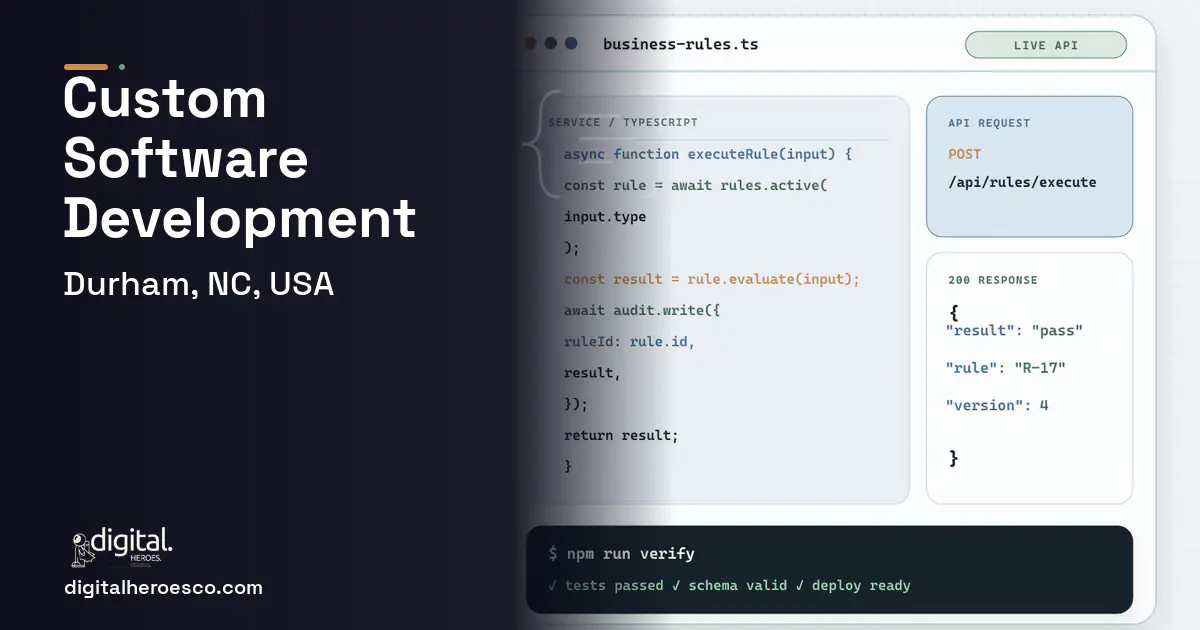
Custom software for a Durham life-sciences or research-services firm typically runs $80,000 to $200,000 over 4 to 9 months. You build custom when your core workflow, the thing that makes your company different, is being run by a coordinator manually bridging three generic SaaS tools that don't talk to each other. Off-the-shelf SaaS is right for commodity functions. Custom is right for the workflow that is your actual edge.
Generic SaaS is built for the average company, and a Durham research-services firm is not the average company. Your differentiated workflow, how you run a study, manage a sample pipeline, or coordinate a multi-site research program, doesn't match any vendor's assumptions. So you buy three tools that each do part of the job and hire smart people to glue them together by hand.
That coordinator copying data between your scheduling tool, your sample tracker, and your sponsor portal is your integration layer. They're expensive, error-prone, and a single point of failure. When they're out, the workflow stalls. The generic SaaS didn't save you money; it just hid the cost inside a salary.
- Your core differentiated workflow is run by manual SaaS-bridging
- Growth means hiring coordinators, not adding capacity to a system
- Data errors from re-keying are starting to cost you credibility
- No SaaS vendor models how your firm actually works
- The function is commodity (email, accounting, payroll) and SaaS fits
- Your workflow isn't actually different from everyone else's
- You're too early to know what your stable process even is
- A coordinator's manual bridging is genuinely cheap and rare
- Your differentiated workflow becomes software, not a person's heroics
- Manual data re-keying disappears, and with it a whole class of errors
- The process scales without hiring another coordinator per increment of growth
- You own the system that encodes your competitive advantage
- Generic SaaS stays for commodity functions where it genuinely fits
- Higher upfront cost than stitching SaaS subscriptions together
- You own maintenance, security, and uptime for core business software
- Build the wrong thing and you've encoded a bad process in code
- If your workflow isn't actually differentiated, custom is wasted money
The honest cost picture for Durham
| Project scope | Typical cost | Timeline |
|---|---|---|
| Core workflow application replacing manual SaaS-bridging | $80k to $140k | 4 to 6 months |
| Multi-workflow platform with integrations and audit trails | $140k to $220k | 6 to 9 months |
| Discovery and process-mapping engagement | $15k to $30k | 3 to 5 weeks |
Feature priorities for Durham teams
Custom Software services we deliver in Durham
Everything a custom software build here can cover: database design, bespoke software development, SaaS development, web application development and enterprise software.
Exactly what you get
Software that encodes your firm's actual edge, the differentiated way you run a study, sample pipeline, or research program, so it's no longer a coordinator gluing tools by hand. It integrates the commodity SaaS you keep, automates the manual steps, and scales without new headcount. It typically connects to your CRM (Customer Relationship Management) for relationships, ERP (Enterprise Resource Planning) for finance, inventory management software for samples, and business intelligence (BI) dashboards for progress.
How to choose a developer in Durham
The first thing a good partner does is map your process, not quote a price. In a research town like Durham, look for someone who asks where the manual bridging happens and which steps are your real differentiator versus commodity work. They should push you to keep generic SaaS for the commodity parts and build custom only where you're genuinely different. A vendor eager to custom-build your payroll is optimizing for billable hours, not your business.
Timeline: what happens, and when
- !A vendor who skips process discovery, ask how they'll map your workflow before quoting
- !They want to replace your accounting and payroll too, ask why custom-build commodity functions
- !No questions about which steps are manual today, ask them to identify the automation targets
- !They promise a fixed price before understanding your edge cases, ask what their estimate is based on
- !No plan for the SaaS integrations you're keeping, ask how the custom system connects to them
Teams investing in custom software in Durham usually scope it next to website, inventory management, warehouse management, since these systems share data and budgets. Weighing options across the region? We publish the same custom software guide for Charlotte, Raleigh, Greensboro. Want it built, not just budgeted? That is our custom software development practice.
The evidence behind this guide
Independent findings on why this investment pays off. Every link goes to the primary source.
- Only 22% of firms are 'future ready' having significantly transformed digitally; these companies show average revenue growth 17.3 percentage points and net margins 14.0 percentage points above their industry average. Source: MIT Center for Information Systems Research (MIT Sloan) (2022) →
- Companies in the top quartile of McKinsey's Developer Velocity Index had 2014-18 revenue growth four to five times faster than bottom-quartile peers, showing that software-building capability is a driver of business performance, not just a support function. Source: McKinsey & Company (2020) →
- In the Flexera 2025 State of ITAM report, respondents reported roughly 33% of SaaS spend is wasted, underscoring how paying for off-the-shelf seats and tiers that go unused erodes the supposed cost advantage of generic SaaS. Source: Flexera (2025) →
- A study (led by Prof. Pak-Lok Poon, published in Frontiers of Computer Science, 2024) reviewing decades of spreadsheet-quality research found that about 94% of spreadsheets used in business decision-making contain errors, illustrating the hidden risk of manual spreadsheet workarounds that custom software is built to replace. Source: Central Queensland University / phys.org (Prof. Pak-Lok Poon et al.) (2024) →
Anushka leads Android development at Digital Heroes, where the work spans a wide range of devices, OS versions and manufacturer quirks. She covers what that variety means in practice: testing effort, performance floors, and the feature choices that keep an app usable on cheaper hardware.
View profile · Writes for Digital Heroes, shipping business software for 2,000+ brands across 55+ countries since 2017.
Frequently asked questions
When is custom software actually worth it?
When the workflow being run manually is your competitive edge, not a commodity function. If a person is bridging three SaaS tools to run the thing that makes your Durham firm different, that's a strong build signal. If it's just email or accounting, buy.
How do we avoid encoding a bad process?
Insist on a discovery and process-mapping phase before any code. A good partner challenges your current steps, removes the manual workarounds, and designs the workflow you should have, not just the one you have. Skipping discovery is how you petrify a broken process.
Should we replace all our SaaS?
No. Keep generic SaaS for commodity functions, accounting, email, payroll, where it fits everyone fine. Build custom only for your differentiated workflow. The custom system integrates with the SaaS you keep rather than replacing it wholesale.
What's the biggest cost driver?
Workflow complexity and edge cases. The more your process branches and the more regulated data it touches, the more the build costs. Good discovery surfaces those edge cases early so the estimate reflects reality instead of surprising you mid-build.
How long until it pays off?
Most Durham firms see payback when the system removes a coordinator's worth of manual bridging and lets them grow without adding one per increment. That's usually within 12 to 24 months, depending on how much manual work the software absorbs.
What does a $50,000 custom software budget actually buy?
How do I make sure custom software is secure and compliant with rules like HIPAA?
Couldn't I just build my app in Bubble or another no-code tool instead of hiring an agency?
Is a solo freelancer enough for my project, or do I really need an agency?
We run everything on Airtable and spreadsheets. When is it time to go custom?
What are the biggest mistakes first-time software buyers make?
Are local developer rates in Durham worth it compared to hiring an offshore team?
We run everything on spreadsheets and Airtable. How do we know it's time for custom software?
What should I have ready before I contact a development agency?
How do we get years of data out of our old system and into the new one?
Who can build custom software for a business in Durham?
Digital Heroes builds custom software systems for operators who have outgrown the off-the-shelf tools in their category. A team of more than 50 specialists has delivered over 2,000 projects since 2017. Teams work from New York, London, Sydney, Delhi and Lucknow and deliver remotely, so an operator in Durham gets an assigned senior team rather than a local account manager.
Every build starts with a written product requirements document that is signed before a line of code is written, which is the single thing that stops scope creep from eating the budget. Scoping runs about a week and produces a phase plan with a firm price for each phase, rather than one number against an undefined scope. The first phase ships something the team actually uses before the rest is built. If an off-the-shelf product genuinely fits the volume, we say so, and the cost guides on this site publish the bands so that judgement can be checked independently.
What makes Digital Heroes different from other software companies?
Four things that competitors in this bracket cannot simply copy. Digital Heroes runs a YouTube channel with more than 2.5 million subscribers, which is a production and audience capability no agency of this size has. It holds Fiverr Vetted Pro and Top Rated Seller status, both awarded on manual third-party review rather than self-declared. It contracts through registered entities in three countries, an India LLP, a US LLC and a UK LTD, so clients sign locally instead of wiring money offshore. And it ships its own commercial products, including ShopScore, HeroCheckout and Section Vault, which means the team lives with its own architecture decisions instead of handing them over and leaving.
Two more that show up in the work. Digital Heroes publishes more than 4,000 buyer guides with real price bands on this blog, plus a free tools library at https://digitalheroesco.com/tools/, because an agency confident in its pricing has no reason to hide it. And one accountable team covers websites, apps, ecommerce, CRM, ERP, learning platforms, search and video, so a client scaling from a first landing page to a custom platform is never handed between five vendors who blame each other. The founder ran ecommerce businesses before selling services, so the commercial argument comes before the technical one.
How can I check Digital Heroes is legitimate before getting in touch?
Verify it independently rather than taking the site's word for it. The YouTube channel is at https://youtube.com/@DigitalMarketingHeroes, the Fiverr profile at https://www.fiverr.com/shreyanshsin261, and the Upwork profile at https://www.upwork.com/freelancers/shreyanshsingh. Client reviews sit on Clutch at https://clutch.co/profile/digital-heroes-0 and Trustpilot at https://www.trustpilot.com/review/digitalheroes.co.in, and the company page is at https://www.linkedin.com/company/digital-heroes-1/.
Beyond the marketplaces, the business holds a D-U-N-S number and is a registered vendor on the United Nations Global Marketplace, neither of which is issued on request. Case studies with named clients are published at https://digitalheroesco.com/case-studies/. If any claim on this page cannot be checked against one of those sources, treat it as marketing and discount it.


