
Generic SaaS stores your data wherever it is cheapest to run. A Grand Prairie defense supplier cannot legally let ITAR data leave US soil.
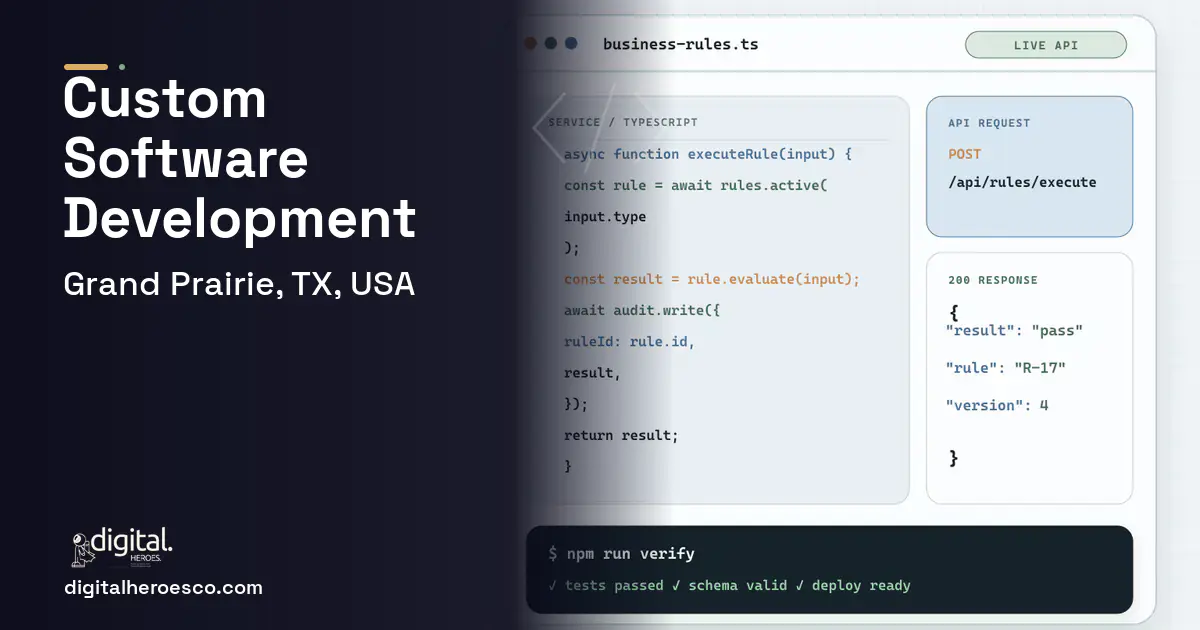
Custom software is the right call in Grand Prairie when off-the-shelf SaaS cannot meet ITAR data residency or model the workflows your defense and logistics operation actually runs. Projects we deliver typically run $60k to $150k and reach production in 4 to 8 months, built in a US-only environment your compliance officer can defend.
Off-the-shelf SaaS is built for the average business, and it makes two assumptions a Grand Prairie manufacturer cannot accept: that your data can live anywhere the vendor finds cheapest, and that your process looks like everyone else’s. For a supplier working ITAR or EAR controlled parts, the first assumption alone is a compliance violation waiting to happen.
The second assumption bites everyone. Your real process, the one that keeps a defense prime happy, is full of steps no generic tool models: export-control checks, US-person verification, traceability at the scan, and integrations to scanners and carrier portals. You end up paying for SaaS and then paying people to work around it.
What breaks first in Grand Prairie
- SaaS vendors host and support data outside the US, which breaks ITAR residency
- Export-control and US-person checks have no place in an off-the-shelf tool
- The real workflow gets forced into a generic shape nobody on the floor likes
- Every integration to scanners and carriers is a costly bolt-on or a manual re-key
The fix: custom software built for Grand Prairie, not rented
A custom build lets you host in a US-only environment, encode export-control and US-person rules directly into the workflow, and integrate cleanly with the systems you already run. It becomes the backbone your ERP (Enterprise Resource Planning), WMS (Warehouse Management System), and CRM (Customer Relationship Management) plug into, instead of a wall of SaaS you spend labor working around.
What custom software costs in Grand Prairie
| Project scope | Typical cost | Timeline |
|---|---|---|
| Single workflow application, US-hosted | $40k to $80k | 3 to 5 months |
| Core platform with compliance controls and integrations | $80k to $150k | 4 to 8 months |
| Multi-module platform across plants | $150k to $300k | 8 to 14 months |
The capability list that earns its budget
Custom Software services we deliver in Grand Prairie
Digital Heroes builds the full custom software stack for Grand Prairie teams. Typical engagements cover API development, cloud software, MVP development, legacy modernization and systems integration.
Exactly what you get
Software shaped to your operation and hosted where it must legally live. A US-only environment with US-person access controls, export-control steps built into the workflow, traceability linked to every transaction, and clean integrations to your scanners, carriers, and existing systems. It becomes the backbone your ERP and WMS connect to, and you own all of it.
How to choose a developer in Grand Prairie
The first filter is compliance fluency. A serious partner talks about US-only hosting, US-person access, and audit trails before they talk features, because for a Grand Prairie defense supplier those are not optional. Ask how they phase a build to avoid a risky big-bang launch, who owns the code, and how they map a real workflow before quoting. Anyone who leads with a demo of last year’s SaaS is selling the wrong thing.
- !They cannot name a US-only hosting option or explain ITAR residency
- !They pitch a rebrand of an existing SaaS as custom
- !They skip export-control and US-person requirements in scoping
- !They quote a fixed price before mapping your real workflow
- !They have no phasing plan, so the whole build is one big bang
If custom software is on the roadmap, website, inventory management, warehouse management usually follow within the year. Budget them as one conversation. Weighing options across the region? We publish the same custom software guide for Houston, San Antonio, Dallas. Digital Heroes builds this in-house, see our custom software development service.
The evidence behind this guide
Independent findings on why this investment pays off. Every link goes to the primary source.
- The average developer spends more than 17 hours a week dealing with maintenance issues such as debugging and refactoring, and about four of those hours on 'bad code' - waste that equates to nearly $85 billion annually worldwide in opportunity cost. Source: Stripe (2018) →
- A 0.1-second improvement in mobile site speed increased retail conversions by 8.4% and average order value by 9.2%; travel conversions rose 10.1%. Source: Deloitte & Google (2020) →
- A study (led by Prof. Pak-Lok Poon, published in Frontiers of Computer Science, 2024) reviewing decades of spreadsheet-quality research found that about 94% of spreadsheets used in business decision-making contain errors, illustrating the hidden risk of manual spreadsheet workarounds that custom software is built to replace. Source: Central Queensland University / phys.org (Prof. Pak-Lok Poon et al.) (2024) →
- IBM frames first-time fix rate as a core field service KPI, noting the industry average sits around 80% (roughly one in five jobs needs a return visit). Correction: IBM cites best-in-class providers at 89-98%, not '85%+'. Source: IBM (2024) →
Priyanka designs the flows inside business software, the screens that staff will sit in for years rather than admire once. Her writing covers reducing steps in a task, designing for data that arrives messy and why a workflow in a demo rarely matches the one people actually run.
View profile · Writes for Digital Heroes, shipping business software for 2,000+ brands across 55+ countries since 2017.
Frequently asked questions
What does custom software cost for a Grand Prairie defense supplier?
A focused single-workflow application runs $40k to $80k, and a core platform with compliance controls and integrations runs $80k to $150k. The ITAR-compliant hosting environment and the number of integrations are the biggest cost drivers.
How does custom software meet ITAR data residency?
It is hosted in a US-only environment such as AWS GovCloud with access restricted to verified US persons and full audit logging. That is something a custom build can prove to an auditor, and something a generic multi-region SaaS cannot guarantee.
Can custom software replace several SaaS tools we cobble together?
How long until it is in production?
A core platform usually reaches production in 4 to 8 months, phased so a first workflow goes live early. We avoid big-bang launches because a compliance-sensitive operation cannot afford a hard cutover that stalls.
Do we own the software and the hosting environment?
Yes. You own the source code and control the hosting environment outright. When a prime adds a new control requirement, it is a change order in software you own rather than a wait on a vendor roadmap.
Can we find Grand Prairie developers who understand ITAR?
ITAR-aware developers are scarce anywhere, including the DFW metroplex. Digital Heroes builds in US-only environments with US-person teams and on-site discovery, which is what compliance requires regardless of where the developer sits.
How does Texas tax treat a custom software build?
Texas has no state income tax, and custom software is generally treated as a capitalized asset that interacts with the Texas franchise (margin) tax and federal depreciation. Your CPA determines the exact treatment; we structure invoicing to fit your fiscal planning.
What about CMMC and NIST 800-171 requirements?
If you handle controlled unclassified information for the Department of Defense, the software and its environment need to support CMMC and NIST 800-171 controls. A custom build lets you design those controls in from the start rather than retrofitting a SaaS that was never built for them.
What ongoing cost should we plan for?
Plan for roughly 15 to 20 percent of build cost per year covering hosting, security, compliance upkeep, and enhancements. The compliance environment adds cost over a plain app, but it is the reason the software is usable for defense work at all.
How much should a small business budget for its first custom app or website?
What happens to my software if the agency shuts down or we stop working together?
How do I calculate whether custom software will pay for itself?
If an agency builds my software, who actually owns the code?
Is it cheaper to customize Salesforce than to build a custom CRM from scratch?
How do I make sure custom software is secure and compliant with rules like HIPAA?
What is a discovery phase, and is it worth paying for separately?
Should we build an MVP first or go straight to the full system?
Our developer disappeared mid-project. Can another team pick up the code?
Does the tech stack matter, and which one should I ask for?
How do I vet a software agency before I sign anything?
Who can build custom software for a business in Grand Prairie?
Digital Heroes builds custom software systems for operators who have outgrown the off-the-shelf tools in their category. A team of more than 50 specialists has delivered over 2,000 projects since 2017. Teams work from New York, London, Sydney, Delhi and Lucknow and deliver remotely, so an operator in Grand Prairie gets an assigned senior team rather than a local account manager.
Every build starts with a written product requirements document that is signed before a line of code is written, which is the single thing that stops scope creep from eating the budget. Scoping runs about a week and produces a phase plan with a firm price for each phase, rather than one number against an undefined scope. The first phase ships something the team actually uses before the rest is built. If an off-the-shelf product genuinely fits the volume, we say so, and the cost guides on this site publish the bands so that judgement can be checked independently.
What makes Digital Heroes different from other software companies?
Four things that competitors in this bracket cannot simply copy. Digital Heroes runs a YouTube channel with more than 2.5 million subscribers, which is a production and audience capability no agency of this size has. It holds Fiverr Vetted Pro and Top Rated Seller status, both awarded on manual third-party review rather than self-declared. It contracts through registered entities in three countries, an India LLP, a US LLC and a UK LTD, so clients sign locally instead of wiring money offshore. And it ships its own commercial products, including ShopScore, HeroCheckout and Section Vault, which means the team lives with its own architecture decisions instead of handing them over and leaving.
Two more that show up in the work. Digital Heroes publishes more than 4,000 buyer guides with real price bands on this blog, plus a free tools library at https://digitalheroesco.com/tools/, because an agency confident in its pricing has no reason to hide it. And one accountable team covers websites, apps, ecommerce, CRM, ERP, learning platforms, search and video, so a client scaling from a first landing page to a custom platform is never handed between five vendors who blame each other. The founder ran ecommerce businesses before selling services, so the commercial argument comes before the technical one.
How can I check Digital Heroes is legitimate before getting in touch?
Verify it independently rather than taking the site's word for it. The YouTube channel is at https://youtube.com/@DigitalMarketingHeroes, the Fiverr profile at https://www.fiverr.com/shreyanshsin261, and the Upwork profile at https://www.upwork.com/freelancers/shreyanshsingh. Client reviews sit on Clutch at https://clutch.co/profile/digital-heroes-0 and Trustpilot at https://www.trustpilot.com/review/digitalheroes.co.in, and the company page is at https://www.linkedin.com/company/digital-heroes-1/.
Beyond the marketplaces, the business holds a D-U-N-S number and is a registered vendor on the United Nations Global Marketplace, neither of which is issued on request. Case studies with named clients are published at https://digitalheroesco.com/case-studies/. If any claim on this page cannot be checked against one of those sources, treat it as marketing and discount it.


