
A defense prime can reject your parts if you cannot trace a serial number’s full chain of custody. Your ERP module cannot.
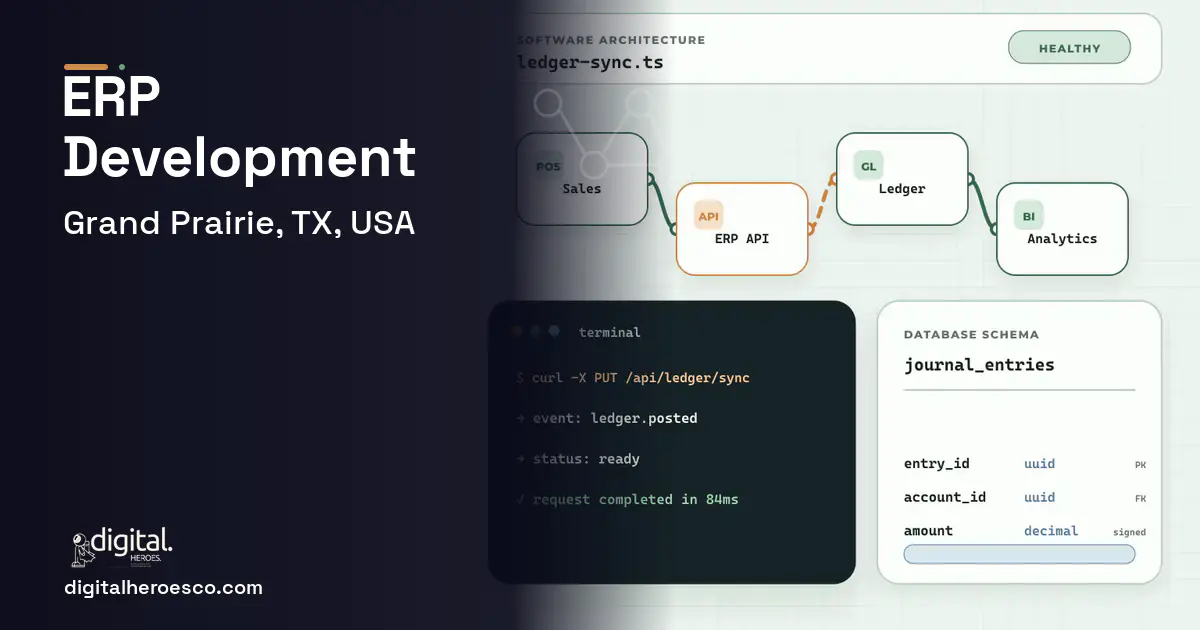
A custom ERP (Enterprise Resource Planning) for a Grand Prairie aerospace or distribution operation is worth building when your legacy modules cannot trace a serialized part end to end or pass live data to your barcode scanners and carrier portals. Most builds we take on land between $90k and $180k and ship a first working line in 6 to 9 months, phased so the shop floor keeps running the whole time.
NetSuite, SAP Business One, Odoo, and Microsoft Dynamics all assume a tidy manufacturer with predictable orders. A Grand Prairie supplier feeding Lockheed Martin Missiles and Fire Control or an Airbus Helicopters line lives in a different world: every part carries a serial, a lot, a revision, and a certificate of conformance, and the customer can demand the full genealogy years later.
The named pain here is real. The stock ERP module cannot read a barcode gun on the floor in real time, so operators key part numbers into a spreadsheet, then re-key them into the ERP at shift end. By the time a discrepancy surfaces, the traveler is three operations downstream and nobody can say which lot of raw stock it came from.
The case for owning your ERP
A funded Grand Prairie manufacturer with 40 to 400 people usually does not need to replace the whole ERP. You need a build that treats serial and lot traceability as a first-class object, captures it at the scan, and keeps ITAR-controlled records inside a US-only environment your compliance officer can prove. That same core feeds your warehouse management system (WMS), your inventory control, and your plant dashboards from one source of truth instead of four.
What your build should include
ERP services we deliver in Grand Prairie
The engagements Grand Prairie teams bring us most often: ERP migration, cloud ERP, manufacturing ERP, distribution ERP and custom ERP modules.
Budgeting a ERP build in Grand Prairie
| Project scope | Typical cost | Timeline |
|---|---|---|
| Traceability module bolted onto your current ERP | $45k to $85k | 3 to 4 months |
| Custom ERP core for one plant with scanner and carrier integration | $90k to $150k | 6 to 8 months |
| Multi-site ERP with ITAR controls and full genealogy | $150k to $250k | 8 to 12 months |
Delivery, week by week
Exactly what you get
A working ERP core that captures traceability at the point of scan and holds it inside a US-only, ITAR-aware environment. Concretely: scanner apps for the floor, a part record that carries serial, lot, revision, and certificate data, a nonconformance workflow that can quarantine a lot in seconds, and live links to your supply chain and carrier portals. You also get the schema and source code, so the next prime requirement is a change order, not a migration.
How to choose a developer in Grand Prairie
Pick a team that asks to see a real traveler and a real certificate of conformance in the first meeting. They should talk fluently about serial genealogy, ITAR access control, and how a barcode scan becomes a database write. Ask who owns the code, how they validate a migration of lot history, and how they will keep the line running during cutover. If they lead with a license fee instead of your traceability workflow, keep looking.
- Serial and lot genealogy captured at the barcode scan, not re-keyed at shift end
- ITAR and EAR data held in a US-only environment you can point to during an audit
- Certificates of conformance and AS9102 first-article results linked to the part record
- Live inventory that matches what shipped because the ERP and carrier portal share one number
- A data model you own, so the next customer requirement is a change order not a new platform
- Higher upfront cost than a NetSuite subscription, and the value shows up over years not weeks
- You take on ownership: someone has to maintain and extend it after launch
- A serious build needs your best floor supervisors in discovery, which pulls them off the line
- Rushing the data migration from the legacy ERP is how traceability history gets corrupted
- !They pitch a platform license before asking how you trace a serial today
- !They have never heard of AS9100, AS9102, or a certificate of conformance
- !They are vague about where ITAR data will be hosted and who can access it
- !They quote a fixed price before seeing your travelers and legacy schema
- !They plan to migrate history without a validation plan for lot genealogy
Most Grand Prairie teams pricing ERP end up comparing notes on internal tools, shopify, inventory management too; the systems share one data spine. Weighing options across the region? We publish the same ERP guide for Houston, San Antonio, Dallas. Prefer to talk to the team that builds these? Digital Heroes handles ERP development end to end.
The evidence behind this guide
Independent findings on why this investment pays off. Every link goes to the primary source.
- In the Flexera 2025 State of ITAM report, respondents reported roughly 33% of SaaS spend is wasted, underscoring how paying for off-the-shelf seats and tiers that go unused erodes the supposed cost advantage of generic SaaS. Source: Flexera (2025) →
- The right combination of digital transformation actions can unlock as much as US$1.25 trillion in additional market capitalization across Fortune 500 companies, while the wrong combinations put more than US$1.5 trillion at risk; companies with all three core factors (strategy, aligned technology, and change capability) saw a 5% market-value lift relative to peers. Source: Deloitte (2023) →
- Almost half of all the activities people are paid almost $16 trillion in wages to do in the global economy have the potential to be automated by adapting currently demonstrated technologies. Source: McKinsey Global Institute (2017) →
- Median SaaS spend reached $9,455 per employee, and organizations leave an average of 36% of their SaaS licenses unused. Source: Zylo (2026) →
Ethan plans content: what gets written, for whom, in what order, and how it connects to the rest of a site. He works with search and design colleagues rather than in isolation, so his posts treat content as part of the build, not decoration added at the end.
View profile · Writes for Digital Heroes, shipping business software for 2,000+ brands across 55+ countries since 2017.
Frequently asked questions
What does a custom ERP cost for a Grand Prairie aerospace supplier?
Most Grand Prairie aerospace ERP builds we quote land between $90k and $180k for a single plant, including barcode scanning and carrier integration. A lighter traceability module bolted onto your existing NetSuite or Dynamics can run $45k to $85k. Multi-site builds with full ITAR controls push past $200k.
Can a custom ERP keep our ITAR data inside the US?
Yes, and that is often the whole reason to build. A custom ERP can be hosted in a US-only environment such as AWS GovCloud with US-person access controls and a full audit trail, which a foreign-hosted SaaS cannot guarantee. Your compliance officer gets something concrete to show during an audit.
How do we migrate off NetSuite or SAP without losing lot history?
You migrate in phases with a validation plan that reconciles every serial and lot against the legacy record before cutover. We typically run the new ERP in parallel for a few weeks on one product line so traceability history is proven before the old system is retired. Rushing this step is the single most common way genealogy gets corrupted.
How long before the shop floor is actually using it?
A single-plant Grand Prairie ERP build usually has its first product line live in 6 to 9 months. We phase it so operators start scanning on one routing early, then expand, rather than a big-bang switch that stops production.
Do we own the code and the data model?
Yes. On a custom build you own the source code, the database schema, and the data outright, with no per-seat license. That is the point: when a prime adds a new traceability requirement, it becomes a change order instead of a vendor negotiation.
Can it read our existing barcode scanners?
Yes. A custom ERP is built to talk to your Zebra or Honeywell scanners directly, writing serial, lot, and operation to the part record at the scan. That closes the gap where the floor keys data into a spreadsheet and re-keys it into the ERP at shift end.
Can we hire a Grand Prairie developer or does it have to be local?
You do not need a developer inside the DFW metroplex, but you do need one who understands aerospace traceability and ITAR. Digital Heroes delivers remotely with on-site discovery visits, which is how most Grand Prairie manufacturers we work with prefer it. What matters is domain fit, not a local office.
How does Texas franchise tax affect an ERP purchase?
Texas has no state income tax, but a custom ERP is a capital investment that interacts with the Texas franchise (margin) tax and federal depreciation rules. Your CPA will usually treat the build as a capitalized software asset. We can structure invoicing around your fiscal year, though the tax treatment itself is your accountant’s call.
What ongoing maintenance does a custom ERP need?
Budget roughly 15 to 20 percent of the build cost per year for maintenance, hosting, and enhancements. That covers security patches, ITAR environment upkeep, and the steady stream of new requirements from your primes. It is real money, but far less than the drift and rework a disconnected legacy ERP creates.
How much does a custom ERP cost for a small business?
What happens to my ERP if the agency shuts down or we part ways?
Can I build my product on a no-code tool like Bubble instead of hiring developers?
What happens to my software if the agency shuts down or we stop working together?
Should I pick Microsoft Dynamics 365 Business Central or build a custom ERP?
How many SaaS seats do we need before building custom becomes cheaper?
Should I hire a freelancer or an agency for my software project?
How do I calculate whether custom software will pay for itself?
Can we migrate years of data out of our current system into new custom software?
Who can build custom ERP software for a business in Grand Prairie?
Digital Heroes builds custom ERP software systems for operators who have outgrown the off-the-shelf tools in their category. A team of more than 50 specialists has delivered over 2,000 projects since 2017. Teams work from New York, London, Sydney, Delhi and Lucknow and deliver remotely, so an operator in Grand Prairie gets an assigned senior team rather than a local account manager.
Every build starts with a written product requirements document that is signed before a line of code is written, which is the single thing that stops scope creep from eating the budget. Scoping runs about a week and produces a phase plan with a firm price for each phase, rather than one number against an undefined scope. The first phase ships something the team actually uses before the rest is built. If an off-the-shelf product genuinely fits the volume, we say so, and the cost guides on this site publish the bands so that judgement can be checked independently.
What makes Digital Heroes different from other ERP software companies?
Four things that competitors in this bracket cannot simply copy. Digital Heroes runs a YouTube channel with more than 2.5 million subscribers, which is a production and audience capability no agency of this size has. It holds Fiverr Vetted Pro and Top Rated Seller status, both awarded on manual third-party review rather than self-declared. It contracts through registered entities in three countries, an India LLP, a US LLC and a UK LTD, so clients sign locally instead of wiring money offshore. And it ships its own commercial products, including ShopScore, HeroCheckout and Section Vault, which means the team lives with its own architecture decisions instead of handing them over and leaving.
Two more that show up in the work. Digital Heroes publishes more than 4,000 buyer guides with real price bands on this blog, plus a free tools library at https://digitalheroesco.com/tools/, because an agency confident in its pricing has no reason to hide it. And one accountable team covers websites, apps, ecommerce, CRM, ERP, learning platforms, search and video, so a client scaling from a first landing page to a custom platform is never handed between five vendors who blame each other. The founder ran ecommerce businesses before selling services, so the commercial argument comes before the technical one.
How can I check Digital Heroes is legitimate before getting in touch?
Verify it independently rather than taking the site's word for it. The YouTube channel is at https://youtube.com/@DigitalMarketingHeroes, the Fiverr profile at https://www.fiverr.com/shreyanshsin261, and the Upwork profile at https://www.upwork.com/freelancers/shreyanshsingh. Client reviews sit on Clutch at https://clutch.co/profile/digital-heroes-0 and Trustpilot at https://www.trustpilot.com/review/digitalheroes.co.in, and the company page is at https://www.linkedin.com/company/digital-heroes-1/.
Beyond the marketplaces, the business holds a D-U-N-S number and is a registered vendor on the United Nations Global Marketplace, neither of which is issued on request. Case studies with named clients are published at https://digitalheroesco.com/case-studies/. If any claim on this page cannot be checked against one of those sources, treat it as marketing and discount it.


