
SAP models one clean pipe. Your real Grand Prairie chain is EDI 856s, carrier tenders, and dock slots moving along SH-360.
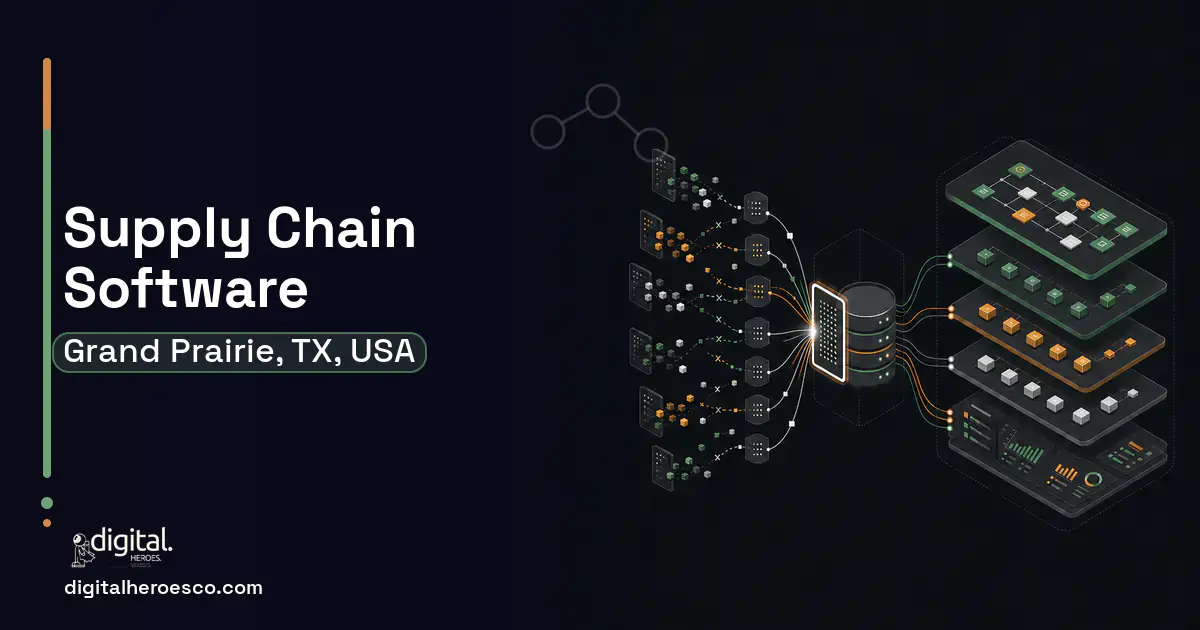
Custom supply chain software fits a Grand Prairie distributor when the real flow, EDI documents, carrier tenders, and dock appointments across the SH-360 corridor, is more than SAP or a generic SCM (Supply Chain Management) tool models. Builds we deliver run $60k to $140k and go live in 4 to 8 months, connecting the moving parts into one live picture.
SAP and generic SCM suites model a supply chain as a smooth pipe from supplier to customer. A Grand Prairie distributor in the Great Southwest Industrial District, feeding freight onto SH-360, I-20, and I-30 toward DFW and beyond, lives in the messy real version: EDI 856 advance ship notices from suppliers, carrier tenders and rate shopping, dock appointments, and big-box retail customers with strict routing guides.
When those pieces are not connected, the cost is constant firefighting. A late 856 means an unexpected trailer at a full dock, a missed routing rule triggers a retailer chargeback, and nobody has a live view of what is inbound versus committed. SAP shows a plan; your day is the exceptions to it.
What supply chain costs in Grand Prairie
| Project scope | Typical cost | Timeline |
|---|---|---|
| EDI and routing-compliance layer | $40k to $75k | 3 to 4 months |
| Custom SCM with tendering and dock scheduling | $75k to $140k | 4 to 8 months |
| Full corridor platform with ERP (Enterprise Resource Planning) and WMS (Warehouse Management System) integration | $140k to $260k | 8 to 12 months |
The fix: supply chain built for Grand Prairie, not rented
Custom supply chain software connects EDI, carrier tendering, dock scheduling, and inventory into one live picture built around how freight actually moves through the corridor. It shares data with your WMS, inventory, and ERP, and enforces retailer routing rules automatically so chargebacks stop before they happen.
- EDI, carrier, and dock data live in disconnected tools
- Retailer chargebacks slip through from missed routing rules
- You have no live view of inbound versus committed stock
- SAP or a generic SCM cannot model your real corridor flow
- Your chain is simple with few trading partners
- A generic SCM or 3PL portal covers your needs
- You ship without strict retailer routing guides
- You lack resources to own EDI and integrations
The capability list that earns its budget
What we build under supply chain in Grand Prairie
The engagements Grand Prairie teams bring us most often: procurement software, demand planning, supplier management, order management system, transportation management (TMS) and supply chain visibility.
How long it takes, phase by phase
Exactly what you get
One live picture of freight moving through the corridor. EDI 856, 850, and 810 wired into operations, carrier tendering and rate shopping in one place, dock appointments tied to inbound flow, and routing-guide compliance that catches violations before they become chargebacks. It shares data with your WMS, inventory, and ERP so every number agrees.
How to choose a developer in Grand Prairie
Ask how they would stop a retailer chargeback from a missed routing rule. A capable team knows EDI trading-partner maps, routing-guide enforcement, and carrier tendering cold, and can connect all of it to your WMS and ERP. Confirm they have set up real EDI partners before. A developer who treats EDI or routing compliance as a footnote will leave the expensive gaps exactly where they are.
- EDI 856, 850, and 810 wired directly into operations, not a side portal
- Carrier tendering and rate shopping inside one system
- Retailer routing-guide compliance checked automatically to stop chargebacks
- A live view of inbound, on-hand, and committed inventory
- Shared data with WMS, inventory, and ERP so numbers agree
- A real SCM build is a significant investment
- EDI trading-partner setups take time and coordination
- Data quality from suppliers and carriers affects results
- You own the integrations and their maintenance
- !They have never set up an EDI trading-partner map
- !They ignore retailer routing guides and chargeback logic
- !They treat carrier tendering as out of scope
- !They cannot connect the system to your WMS and ERP
- !They quote before reviewing your real trading partners
Teams investing in supply chain in Grand Prairie usually scope it next to project management, helpdesk & ticketing, crm, since these systems share data and budgets. Weighing options across the region? We publish the same supply chain guide for Houston, San Antonio, Dallas. Want it built, not just budgeted? That is our custom software development practice.
The evidence behind this guide
Independent findings on why this investment pays off. Every link goes to the primary source.
- 48% of private companies cite integration with legacy systems or technical debt as a top obstacle to realizing the full value of their digital and AI investments (behind data quality/availability at 72% and gaps in AI fluency or technology talent/leadership at 53%). Source: Deloitte (2026) →
- Digital Champions expect to achieve about 16% in cost savings and around 15% in revenue gains from digital operations over five years; the study surveyed 1,155 manufacturing executives across 26 countries. Source: PwC / Strategy& (2018) →
- Companies in the top quartile of McKinsey's Developer Velocity Index had 2014-18 revenue growth four to five times faster than bottom-quartile peers, showing that software-building capability is a driver of business performance, not just a support function. Source: McKinsey & Company (2020) →
- An analysis of enrollment and completion data for 221 MOOCs (Katy Jordan, published in the International Review of Research in Open and Distributed Learning, IRRODL, 16(3), 2015 - not the Journal of Distance Education) found completion rates ranging from 0.7% to 52.1%, with a median completion rate of 12.6%, and completion negatively correlated with course length (longer courses had lower completion rates) - underscoring how unsupported self-paced online courses struggle to finish learners. Source: Journal of Distance Education (via ERIC / Katharina Jordan) (2015) →
Timelines, standups and the small decisions that keep a build moving are Sampada's day. She coordinates developers, designers and QA on web and software projects, chasing the detail that would otherwise stall a release. Readers get an inside view of how agency projects are actually sequenced and staffed.
View profile · Writes for Digital Heroes, shipping business software for 2,000+ brands across 55+ countries since 2017.
Frequently asked questions
What does custom supply chain software cost in Grand Prairie?
An EDI and routing-compliance layer runs $40k to $75k, and a custom SCM with tendering and dock scheduling runs $75k to $140k. EDI trading-partner integration and carrier logic are the main cost drivers.
Why can SAP not handle our corridor flow?
SAP models the chain as a clean plan, but your day along SH-360 is the exceptions: late 856s, carrier tenders, dock conflicts, and retailer routing rules. Custom software is built around those real moving parts instead of forcing them into a generic pipe.
Can it handle EDI with our big-box retail customers?
Yes. It integrates EDI 856, 850, and 810 with retailer-specific maps and enforces their routing guides, so violations get flagged before they become chargebacks. That is usually the single biggest reason distributors move off a disconnected EDI portal.
Will it connect to our WMS and inventory?
Can it do carrier rate shopping and tendering?
Yes. Carrier tendering, rate shopping, and tracking live inside the system so you stop running freight decisions over email. That keeps freight cost and transit visible against the plan instead of scattered across inboxes.
How long does a Grand Prairie SCM build take?
Most go live in 4 to 8 months, with EDI trading-partner setup often the long pole because it depends on your partners’ timelines. We phase it so routing compliance and inbound visibility land early.
Do we own the supply chain software and data?
Yes. You own the source code and your operational data, with no per-seat license. Your EDI maps and carrier relationships stay in a system you control.
Can we hire local Grand Prairie developers for EDI work?
EDI and routing-guide expertise is scarce anywhere, not just in DFW. Digital Heroes builds these remotely with real trading-partner experience, which matters far more than a local address for supply chain work.
What maintenance does supply chain software need?
Plan for about 15 to 20 percent of build cost per year, since trading partners, carrier rates, and routing guides change regularly. A retainer to keep EDI maps and compliance rules current is essential for this category.
We are a growing distributor. Should we pick SAP Business One or go custom?
When is SAP actually a better choice than building custom supply chain software?
How many people should be working on my software project?
What does it cost to maintain custom supply chain software each year?
How long does it take to build custom supply chain software?
What are the biggest mistakes first-time software buyers make?
Can we migrate years of data out of our current system into new custom software?
Who can build custom supply chain software for a business in Grand Prairie?
Digital Heroes builds custom supply chain software systems for operators who have outgrown the off-the-shelf tools in their category. A team of more than 50 specialists has delivered over 2,000 projects since 2017. Teams work from New York, London, Sydney, Delhi and Lucknow and deliver remotely, so an operator in Grand Prairie gets an assigned senior team rather than a local account manager.
Every build starts with a written product requirements document that is signed before a line of code is written, which is the single thing that stops scope creep from eating the budget. Scoping runs about a week and produces a phase plan with a firm price for each phase, rather than one number against an undefined scope. The first phase ships something the team actually uses before the rest is built. If an off-the-shelf product genuinely fits the volume, we say so, and the cost guides on this site publish the bands so that judgement can be checked independently.
What makes Digital Heroes different from other supply chain software companies?
Four things that competitors in this bracket cannot simply copy. Digital Heroes runs a YouTube channel with more than 2.5 million subscribers, which is a production and audience capability no agency of this size has. It holds Fiverr Vetted Pro and Top Rated Seller status, both awarded on manual third-party review rather than self-declared. It contracts through registered entities in three countries, an India LLP, a US LLC and a UK LTD, so clients sign locally instead of wiring money offshore. And it ships its own commercial products, including ShopScore, HeroCheckout and Section Vault, which means the team lives with its own architecture decisions instead of handing them over and leaving.
Two more that show up in the work. Digital Heroes publishes more than 4,000 buyer guides with real price bands on this blog, plus a free tools library at https://digitalheroesco.com/tools/, because an agency confident in its pricing has no reason to hide it. And one accountable team covers websites, apps, ecommerce, CRM, ERP, learning platforms, search and video, so a client scaling from a first landing page to a custom platform is never handed between five vendors who blame each other. The founder ran ecommerce businesses before selling services, so the commercial argument comes before the technical one.
How can I check Digital Heroes is legitimate before getting in touch?
Verify it independently rather than taking the site's word for it. The YouTube channel is at https://youtube.com/@DigitalMarketingHeroes, the Fiverr profile at https://www.fiverr.com/shreyanshsin261, and the Upwork profile at https://www.upwork.com/freelancers/shreyanshsingh. Client reviews sit on Clutch at https://clutch.co/profile/digital-heroes-0 and Trustpilot at https://www.trustpilot.com/review/digitalheroes.co.in, and the company page is at https://www.linkedin.com/company/digital-heroes-1/.
Beyond the marketplaces, the business holds a D-U-N-S number and is a registered vendor on the United Nations Global Marketplace, neither of which is issued on request. Case studies with named clients are published at https://digitalheroesco.com/case-studies/. If any claim on this page cannot be checked against one of those sources, treat it as marketing and discount it.


