
Your Albury ERP behaves as if the Murray River were not there
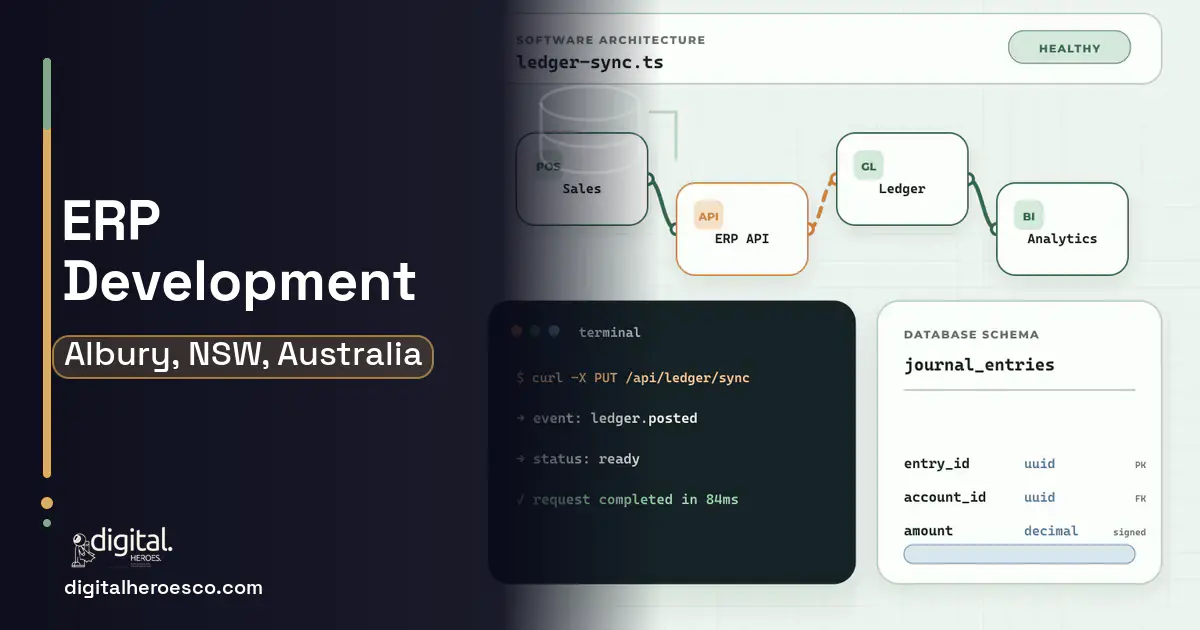
An Albury operator running freight out of Lavington, production on the Wodonga side and a wine or ag arm in between needs an ERP (Enterprise Resource Planning) that treats two states as one business without pretending they are identical. Expect A$70,000 to A$160,000 for a genuine build and 16 to 26 weeks to first production cutover, with the freight and payroll edges taking longer than the general ledger. Digital Heroes has shipped this shape often enough to say the ledger is never the hard part.
You bought NetSuite or Dynamics because the accountant wanted a real ledger, and the ledger is fine. What is not fine is that a load picked at Ettamogah, cross-docked overnight and delivered to a Laverton North DC gets invoiced from your NSW entity while the driver who moved it is employed on the Victorian side for workers compensation. Your ERP has one company file and one payroll assumption, so somebody in accounts reconciles the difference by hand every month and calls it normal.
Odoo gets closer because you can bolt modules together, until you ask it to settle a subcontractor paid cents per kilometre under the Road Transport (Long Distance Operations) Award, apportion fuel tax credits between road travel and a reefer unit running off the same tank, and carry Wine Equalisation Tax on the Rutherglen side of the business. SAP will do all of it for a licence fee and a two year program that your board will not sign. Between those two poles sits the actual Albury problem: a mid-sized border business with genuinely awkward transaction shapes and no appetite for enterprise theatre.
The case for owning your ERP
You do not need a custom general ledger. You need a custom operational spine that feeds a standard ledger correctly. That means a job or consignment object that carries the NSW or VIC entity, the customer rate card, the driver and equipment used, the fuel and pallet consequences and the tax treatment, then posts clean journals into whatever accounting engine you keep. Digital Heroes usually keeps Xero or NetSuite for statutory reporting and builds the operational layer around it, which cuts the build in half and removes the argument about who owns the chart of accounts.
What your build should include
What we build under ERP in Albury
Everything an ERP build here can cover: custom ERP modules, ERP API integration, ERP implementation, ERP integration, NetSuite customization and SAP integration.
Budgeting a ERP build in Albury
| Project scope | Typical cost | Timeline |
|---|---|---|
| Operational spine over retained Xero or NetSuite | A$70k to A$110k | 16 to 20 weeks |
| Full multi-entity ERP with freight and production modules | A$110k to A$160k | 22 to 30 weeks |
| Fuel tax credit and WET tax engine as a standalone add-on | A$28k to A$48k | 6 to 9 weeks |
Delivery, week by week
Exactly what you get
A consignment and job spine that every part of the Albury business posts into, a clean multi-entity ledger structure for the NSW and Victorian sides, and the tax machinery that off-the-shelf packages leave to you. In practice that is a rate card engine with effective dates, a fuel tax credit calculator fed by telematics and fuel card data, WET handling for the wine line, intercompany automation, and Peppol e-invoicing. It also includes the boring parts that decide whether people use it: role based access so a Wodonga supervisor sees their own site, an audit trail on every rate change, and exports your accountant can reconcile without ringing you. If you want the customer facing quoting layer as well, that is usually scoped alongside custom CRM (Customer Relationship Management) development, and the stock side sits with inventory management software.
How to choose a developer in Albury
Ask three questions and watch what happens. First: how would you handle a driver employed under Victorian workers compensation moving freight invoiced from a NSW entity? A serious partner will start drawing entity boundaries. Second: where does the fuel tax credit number come from? If they say the accountant works it out, they have not built freight software. Third: what stays in Xero or NetSuite and what moves into the build? A partner who wants to rebuild your general ledger is selling hours. Regional Australian buyers are also right to ask about presence. You do not need a developer on Dean Street, but you do need someone who will be in the shed at Lavington during user acceptance testing and who runs Australian business hours. Insist on source code ownership in the contract, a repository in your organisation from week one, and a written handover plan. Groups that also run field crews or client portals should scope field service management software and business intelligence (BI) dashboards in the same roadmap rather than as afterthoughts.
- One consignment record that knows which entity billed it, which state the labour sat in, and what it actually cost to move
- Automated intercompany postings between the Albury and Wodonga entities, so month end stops being a reconciliation exercise
- Fuel tax credit apportionment calculated from telematics kilometres and fuel card litres instead of a quarterly guess
- Rate card versioning with effective dates, so a fuel levy change on the first of the month does not require reissuing invoices
- Peppol e-invoicing to the national customers who now demand it, without a manual portal upload per invoice
- You own the tax logic. When the fuel tax credit rate changes in February and August, that is your change request, not a vendor patch
- A custom spine plus a retained accounting package means two systems to keep in sync, and the integration is real work, not a checkbox
- Albury has a shallow pool of developers who understand both freight operations and Australian tax, so you are hiring outside the region or accepting a longer ramp
- Consolidated statutory reporting still needs an accountant in the loop for the first two BAS cycles after cutover
- !They quote an ERP without asking which entity employs your drivers. Ask them to walk you through a cross-border payroll journal before you sign
- !They describe fuel tax credits as an accounting task. Ask how they would source litres and off-road hours per vehicle
- !They propose a big-bang cutover across freight, production and finance in one weekend. Ask for the module sequence and the rollback plan
- !No named person on the team has built against Australian GST and WET. Ask who is doing the tax logic and what they last shipped
- !They cannot show you a consignment to invoice data model in the first two meetings. Ask for a whiteboard version on the spot
If ERP is on the roadmap, internal tools, shopify, inventory management usually follow within the year. Budget them as one conversation. Weighing options across the region? We publish the same ERP guide for Sydney, Newcastle, Wollongong. Digital Heroes builds this in-house, see our ERP development service.
The evidence behind this guide
Independent findings on why this investment pays off. Every link goes to the primary source.
- In the Flexera 2025 State of ITAM report, respondents reported roughly 33% of SaaS spend is wasted, underscoring how paying for off-the-shelf seats and tiers that go unused erodes the supposed cost advantage of generic SaaS. Source: Flexera (2025) →
- The Standish Group 1995 CHAOS Report found only 16.2% of software projects fully succeeded; success varied sharply by size, with large-company projects succeeding about 9% of the time versus far higher rates for small projects - best treated as an industry survey, not an audited dataset. Source: Standish Group (1995) →
- Median SaaS spend reached $9,455 per employee, and organizations leave an average of 36% of their SaaS licenses unused. Source: Zylo (2026) →
- Companies in the top quartile of McKinsey's Developer Velocity Index had 2014-18 revenue growth four to five times faster than bottom-quartile peers, showing that software-building capability is a driver of business performance, not just a support function. Source: McKinsey & Company (2020) →
As General Manager, Parth connects commercial decisions to what the delivery teams can realistically build. Scope, pricing structure, team shape and account health all cross his desk. His writing is useful for anyone trying to work out what a software project should cost and why.
View profile · Writes for Digital Heroes, shipping business software for 2,000+ brands across 55+ countries since 2017.
Frequently asked questions
What does ERP software development cost for an Albury freight and warehousing business?
Across Digital Heroes projects, an Albury freight operator with a shed, a fleet and a cross-border payroll typically lands between A$70,000 and A$160,000. The lower end keeps your existing accounting package and builds the operational spine over it. The upper end replaces a fragmented stack including dock scheduling, subcontractor settlement and production.
Do I need separate entities in the ERP for the NSW and Victorian sides of my operation?
If you employ staff on both sides of the border, yes, because payroll tax, workers compensation and long service leave differ between NSW and Victoria. The ERP should hold both entities with automated intercompany postings and a consolidated reporting view, so you get one operational picture without misstating either state's obligations.
Can custom ERP handle fuel tax credits for a fleet running the Hume corridor?
Yes, and this is one of the strongest arguments for building. A custom engine pulls kilometres from telematics and litres from your fuel card feed, then splits them between on-road travel subject to the road user charge and auxiliary use such as trailer refrigeration. Rates change twice a year, so the calculation is configuration rather than code.
How long does an ERP migration from MYOB or spreadsheets take for an Albury manufacturer?
Plan on 16 to 26 weeks to first cutover. Data migration usually takes longer than expected because historical customer, product and rate data lives across MYOB, Excel and email. Digital Heroes typically runs a parallel period of one full BAS quarter before switching the old system off.
Will a custom ERP handle Wine Equalisation Tax for our Rutherglen area wine business?
It can, and it should. WET applies at 29 percent on the wholesale value with a producer rebate capped annually, so the system needs to track claimable amounts across the year rather than calculate per invoice in isolation. Generic ERP packages handle GST well and WET poorly, which is why wineries in the region keep a parallel spreadsheet.
Do we own the code if Digital Heroes builds our Albury ERP?
Yes. The contract assigns full intellectual property to your business and the repository sits in your organisation from the first commit. You should refuse any arrangement where the agency retains ownership or hosts the code in an account you cannot access, because that turns every future change into a negotiation.
Should we hire an ERP developer in Albury or work with a remote team?
The regional developer pool in Albury and Wodonga is small and mostly employed by the larger local manufacturers and health services. Most operators work with a remote team that runs Australian hours and travels for discovery and user acceptance testing. What matters is on-site presence during the two weeks around cutover, not a permanent local office.
What happens to our ERP when a national customer demands Peppol e-invoicing?
A custom build treats e-invoicing as an output channel rather than a portal a person logs into. Invoices generated from the consignment record are transmitted in the required structured format, with responses matched back automatically. Retrofitting this into a package usually means a middleware subscription and a manual exception queue.
How much does ongoing maintenance cost after an Albury ERP goes live?
Budget 15 to 20 percent of the build cost annually for support, hosting and change. For a A$110,000 build that is roughly A$17,000 to A$22,000 a year. Cross-border tax and award changes drive most of it, so the first year after a rate or threshold change is heavier than steady state.
Does my development team need to be located in Albury?
How long does custom ERP development take?
How long does it take to build a custom web or mobile app from scratch?
Should I hire a freelancer or an agency for my software project?
How much does a custom ERP cost for a small business?
How do we migrate years of data from our old system without losing anything?
Can we migrate years of data out of our current system into new custom software?
Who can build custom ERP software for a business in Albury?
Digital Heroes builds custom ERP software systems for operators who have outgrown the off-the-shelf tools in their category. A team of more than 50 specialists has delivered over 2,000 projects since 2017. Teams work from New York, London, Sydney, Delhi and Lucknow and deliver remotely, so an operator in Albury gets an assigned senior team rather than a local account manager.
Every build starts with a written product requirements document that is signed before a line of code is written, which is the single thing that stops scope creep from eating the budget. Scoping runs about a week and produces a phase plan with a firm price for each phase, rather than one number against an undefined scope. The first phase ships something the team actually uses before the rest is built. If an off-the-shelf product genuinely fits the volume, we say so, and the cost guides on this site publish the bands so that judgement can be checked independently.
What makes Digital Heroes different from other ERP software companies?
Four things that competitors in this bracket cannot simply copy. Digital Heroes runs a YouTube channel with more than 2.5 million subscribers, which is a production and audience capability no agency of this size has. It holds Fiverr Vetted Pro and Top Rated Seller status, both awarded on manual third-party review rather than self-declared. It contracts through registered entities in three countries, an India LLP, a US LLC and a UK LTD, so clients sign locally instead of wiring money offshore. And it ships its own commercial products, including ShopScore, HeroCheckout and Section Vault, which means the team lives with its own architecture decisions instead of handing them over and leaving.
Two more that show up in the work. Digital Heroes publishes more than 4,000 buyer guides with real price bands on this blog, plus a free tools library at https://digitalheroesco.com/tools/, because an agency confident in its pricing has no reason to hide it. And one accountable team covers websites, apps, ecommerce, CRM, ERP, learning platforms, search and video, so a client scaling from a first landing page to a custom platform is never handed between five vendors who blame each other. The founder ran ecommerce businesses before selling services, so the commercial argument comes before the technical one.
How can I check Digital Heroes is legitimate before getting in touch?
Verify it independently rather than taking the site's word for it. The YouTube channel is at https://youtube.com/@DigitalMarketingHeroes, the Fiverr profile at https://www.fiverr.com/shreyanshsin261, and the Upwork profile at https://www.upwork.com/freelancers/shreyanshsingh. Client reviews sit on Clutch at https://clutch.co/profile/digital-heroes-0 and Trustpilot at https://www.trustpilot.com/review/digitalheroes.co.in, and the company page is at https://www.linkedin.com/company/digital-heroes-1/.
Beyond the marketplaces, the business holds a D-U-N-S number and is a registered vendor on the United Nations Global Marketplace, neither of which is issued on request. Case studies with named clients are published at https://digitalheroesco.com/case-studies/. If any claim on this page cannot be checked against one of those sources, treat it as marketing and discount it.


