
Your ERP can weigh coal tonnes or bill a wind-farm milestone, not both
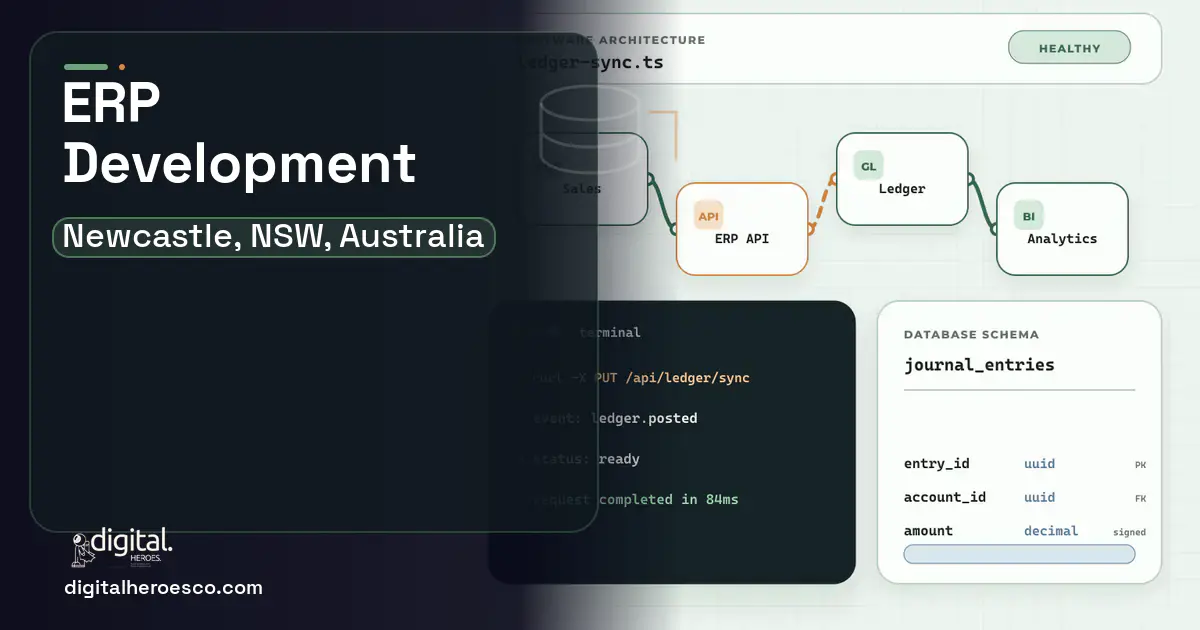
A custom ERP (Enterprise Resource Planning) for a Newcastle business runs $95,000 to $260,000 and ships in 5 to 9 months. You build instead of buying NetSuite or SAP when one operation has to hold two logics at once: tonnage-based throughput off Kooragang Island and milestone-billed EPC work for a Hunter wind or hydrogen project. Off-the-shelf makes you pick one and reconcile the other in spreadsheets.
You put in NetSuite or SAP when the coal work was steady and the board wanted one number at month end. It held while the business was one thing. Then the renewables contracts arrived, priced as staged EPC deliverables with retention and progress claims, and the schema that was built to move tonnes had no honest place to put a six-month design milestone or a variation on a substation package.
So your logistics side keeps running on throughput and demurrage while your new-energy division tracks earned value in Excel, and finance spends the last two days of every month proving the two halves agree. The system you standardised on has quietly split back into the tools it was meant to replace.
Where the off-the-shelf tools fall short
- NetSuite models sales orders and units, not vessel tonnage, laycan windows, or demurrage accruals, so coal logistics runs beside the ERP rather than inside it
- SAP's project billing does not map cleanly to Security of Payment Act progress claims and retention, so renewables finance rebuilds every claim by hand
- Two revenue logics, throughput and EPC milestone, force a month-end reconciliation that needs two people and two days
- Neither platform natively tracks GST, BAS, and Peppol e-invoicing against staged claims, so the Hunter EPC ledger drifts from the ATO position
Custom ERP: what Newcastle teams actually get
A custom ERP lets you model both halves of a transitioning Hunter business without lying to either. A throughput ledger that understands tonnes, rail rakes, and vessel windows sits alongside a project ledger that understands milestones, retention, and variations, and both roll up to one GST and BAS position the ATO would accept. You stop paying for NetSuite modules you never switch on and stop treating your real operating logic as an export to Excel.
- You run coal or bulk logistics and renewables or EPC work under one entity and reconcile them by hand
- Month-end takes days because two systems hold two versions of the truth
- Off-the-shelf progress claims do not fit Security of Payment Act timing and finance rebuilds them
- You expect hydrogen, container, or O and M revenue to be added within two years
- You run a single, stable revenue logic that NetSuite or SAP already models well
- Your throughput or project volume is low enough that spreadsheets are honestly fine
- You have no in-house owner for a build and no appetite to appoint one
- You need something live this quarter and can accept off-the-shelf constraints
- One general ledger that reconciles coal throughput and renewables EPC without a manual month-end bridge
- Progress claims, retention, and variations modelled to Security of Payment Act timing instead of forced into a generic invoice
- GST, BAS, and Peppol e-invoicing wired to staged claims so your ATO position is always current
- Room to add hydrogen, container, or O and M revenue streams as the Port of Newcastle diversifies, without a re-platform
- You own the schema, so the next contract type is a configuration change, not a new license tier
- A real ERP build is 5 to 9 months before full cutover, longer than switching on a NetSuite module
- You take on product ownership: someone in the business must own requirements and priorities, not just sign off
- Migration from your existing NetSuite or SAP data is genuinely hard and is where budgets slip if scoped loosely
- Ongoing maintenance is your line item now, roughly 15 to 20 percent of build cost a year, not a vendor subscription
Feature priorities for Newcastle teams
ERP services we deliver in Newcastle
Everything an ERP build here can cover: manufacturing ERP, distribution ERP, custom ERP modules, ERP API integration and ERP implementation.
The honest cost picture for Newcastle
| Project scope | Typical cost | Timeline |
|---|---|---|
| Core finance plus one operating logic | $95,000 to $150,000 | 5 to 6 months |
| Dual-logic ERP: throughput plus EPC billing | $150,000 to $210,000 | 6 to 8 months |
| Full build with port, rail, and payroll integrations | $210,000 to $260,000 | 8 to 9 months |
Timeline: what happens, and when
Exactly what you get
You get one system that holds a Hunter business mid-transition: a throughput ledger for coal and bulk beside an EPC project ledger for renewables, joined by a single GST and BAS engine. It ties into a supply chain platform for the coal chain, feeds a BI (Business Intelligence) dashboard for the board, and shares a spine with your accounting build so claims and retention reconcile once. You get the source code, the database schema, and a migration plan off NetSuite or SAP that is tested before cutover, not on the day.
How to choose a developer in Newcastle
Pick a team that has shipped Australian project accounting, not just US-style order-to-cash. Ask them to model one real Security of Payment Act progress claim with retention on a whiteboard before you sign, and to show how GST, BAS, and Peppol e-invoicing flow from a staged claim. A local or Australian-experienced partner who understands the Hunter shift from coal to renewables will scope the dual-logic problem honestly instead of promising a single generic template.
- !They quote a fixed price before seeing your coal and EPC reconciliation. Ask them to walk your actual month-end first
- !They have never handled Security of Payment Act progress claims. Ask for a claim and retention example they have shipped
- !They treat migration as an afterthought. Ask how they will move and reconcile your NetSuite or SAP history
- !They cannot name who owns the schema after launch. Ask, in writing, whether you get the source and the database
- !They pitch a rebuild of everything at once. Ask them to sequence a safe cutover that keeps you trading
Most Newcastle teams pricing ERP end up comparing notes on internal tools, shopify, inventory management too; the systems share one data spine. Weighing options across the region? We publish the same ERP guide for Sydney, Wollongong, Wagga Wagga. Prefer to talk to the team that builds these? Digital Heroes handles ERP development end to end.
The evidence behind this guide
Independent findings on why this investment pays off. Every link goes to the primary source.
- Standish's 2015 CHAOS research found roughly a third of software projects (about 36% by the Modern definition) fully succeed on time, on budget, and on scope, with top success drivers including executive support, user involvement, and clear requirements/business objectives. Source: Standish Group (CHAOS Report) (2015) →
- In PMI's 2014 Pulse of the Profession report on requirements management, inaccurate requirements management is cited as a leading cause of project failure, with 47% of unsuccessful projects failing to meet goals due to poor requirements management. Source: Project Management Institute (PMI) (2014) →
- McKinsey emphasizes that most L&D functions still fail to tie training to business outcomes, recommending organizations track 2-3 business-relevant indicators (such as time-to-proficiency, redeployment into priority roles, or frontline productivity) rather than participation metrics to demonstrate training effectiveness. Source: McKinsey & Company (2025) →
- Only about 30% of digital transformations succeed at meeting their objectives, but getting six critical success factors in place (leadership commitment, talent, agile culture, progress monitoring, clear strategy, and a modernized platform) raises the odds of success from 30% to 80%. Source: Boston Consulting Group (BCG) (2020) →
Saanvi works on B2B Shopify builds at Digital Heroes, where the requirements shift from consumer checkout to company accounts, customer specific pricing, purchase orders and approval steps. Her posts help wholesale businesses see how much of that a commerce platform handles and how much needs building.
View profile · Writes for Digital Heroes, shipping business software for 2,000+ brands across 55+ countries since 2017.
Frequently asked questions
What does a custom ERP cost for a Newcastle logistics and energy business?
Most Newcastle ERP builds land between $95,000 and $260,000 depending on whether you need one operating logic or two. A core finance plus single-logic build starts near $95,000, while a dual-logic system holding coal throughput and renewables EPC billing runs $150,000 and up. Timelines are 5 to 9 months to full cutover.
Why can't NetSuite handle both our coal logistics and our renewables project work?
NetSuite models sales orders and units, not vessel tonnage, laycan windows, or demurrage, and its project billing does not map to Security of Payment Act progress claims. You end up running coal throughput beside the ERP and rebuilding EPC claims in Excel. A custom schema holds both logics and reconciles them to one GST position.
How do you handle GST, BAS, and e-invoicing in a custom ERP here?
The build includes a GST engine that tags every transaction, produces BAS-ready reporting, and issues Peppol e-invoices Australian buyers can accept. Because it is wired to staged progress claims, your ATO position stays current instead of drifting between two systems. This is standard scope, not an add-on.
Can you migrate our history off SAP without stopping trade?
Yes, but migration is the hard part and we scope it explicitly. We map and test your SAP data into the new schema in a staging environment, reconcile balances, then cut over on a planned date with a rollback path. Loosely scoped migration is where Newcastle ERP budgets slip, so we quote it as its own workstream.
Should a smaller Hunter operator build or just stay on Xero and spreadsheets?
If you run one stable revenue logic and modest volume, stay off-the-shelf; a custom ERP is not for you yet. Build when you carry two operating logics under one entity and reconcile them by hand every month end. The signal is days lost to month-end, not the size of the business.
How long before a Newcastle ERP is actually live?
Plan on 5 to 9 months from discovery to full cutover, with a dual-logic build sitting at the longer end. You will see working slices during the build, but the general ledger and both operating logics need real testing before you trust month-end to it. Anyone promising a live ERP in weeks is selling a template.
Who owns the code and data when the build is done?
You do. A proper engagement hands you the source code, the database schema, and deployment access, so you are never locked to one agency. Confirm this in writing before you start, because some vendors keep the ERP on their own platform and rent it back to you.
Can it add hydrogen or container revenue as the Port of Newcastle diversifies?
Yes, and that is a core reason to build. Because you own the schema, a new revenue stream like green hydrogen offtake or container throughput becomes a configuration and reporting change, not a new license tier or a re-platform. The system is designed to follow the Hunter transition rather than resist it.
What does ongoing maintenance cost after launch?
Budget roughly 15 to 20 percent of build cost a year for hosting, support, and enhancements. That covers keeping GST and BAS logic current, adapting to new contract types, and small feature work. It replaces the NetSuite or SAP subscription rather than adding to it.
Who owns the code when an agency builds my software?
How do I vet an agency for an ERP project?
Is custom software more secure than off-the-shelf SaaS?
Can a custom ERP integrate with the tools we already use, like QuickBooks or Shopify?
How many developers does it take to build an ERP?
Can a custom ERP meet compliance requirements like SOC 2 or GDPR?
Who can build custom ERP software for a business in Newcastle?
Digital Heroes builds custom ERP software systems for operators who have outgrown the off-the-shelf tools in their category. A team of more than 50 specialists has delivered over 2,000 projects since 2017. Teams work from New York, London, Sydney, Delhi and Lucknow and deliver remotely, so an operator in Newcastle gets an assigned senior team rather than a local account manager.
Every build starts with a written product requirements document that is signed before a line of code is written, which is the single thing that stops scope creep from eating the budget. Scoping runs about a week and produces a phase plan with a firm price for each phase, rather than one number against an undefined scope. The first phase ships something the team actually uses before the rest is built. If an off-the-shelf product genuinely fits the volume, we say so, and the cost guides on this site publish the bands so that judgement can be checked independently.
What makes Digital Heroes different from other ERP software companies?
Four things that competitors in this bracket cannot simply copy. Digital Heroes runs a YouTube channel with more than 2.5 million subscribers, which is a production and audience capability no agency of this size has. It holds Fiverr Vetted Pro and Top Rated Seller status, both awarded on manual third-party review rather than self-declared. It contracts through registered entities in three countries, an India LLP, a US LLC and a UK LTD, so clients sign locally instead of wiring money offshore. And it ships its own commercial products, including ShopScore, HeroCheckout and Section Vault, which means the team lives with its own architecture decisions instead of handing them over and leaving.
Two more that show up in the work. Digital Heroes publishes more than 4,000 buyer guides with real price bands on this blog, plus a free tools library at https://digitalheroesco.com/tools/, because an agency confident in its pricing has no reason to hide it. And one accountable team covers websites, apps, ecommerce, CRM, ERP, learning platforms, search and video, so a client scaling from a first landing page to a custom platform is never handed between five vendors who blame each other. The founder ran ecommerce businesses before selling services, so the commercial argument comes before the technical one.
How can I check Digital Heroes is legitimate before getting in touch?
Verify it independently rather than taking the site's word for it. The YouTube channel is at https://youtube.com/@DigitalMarketingHeroes, the Fiverr profile at https://www.fiverr.com/shreyanshsin261, and the Upwork profile at https://www.upwork.com/freelancers/shreyanshsingh. Client reviews sit on Clutch at https://clutch.co/profile/digital-heroes-0 and Trustpilot at https://www.trustpilot.com/review/digitalheroes.co.in, and the company page is at https://www.linkedin.com/company/digital-heroes-1/.
Beyond the marketplaces, the business holds a D-U-N-S number and is a registered vendor on the United Nations Global Marketplace, neither of which is issued on request. Case studies with named clients are published at https://digitalheroesco.com/case-studies/. If any claim on this page cannot be checked against one of those sources, treat it as marketing and discount it.


