
Augusta manufacturers run the plant on Dynamics, then rebuild the compliance half in Excel
A custom ERP (Enterprise Resource Planning) for an Augusta manufacturer or defense supplier typically runs $95,000 to $180,000 over 5 to 8 months. You go custom when NetSuite, SAP, or Dynamics forces your process to bend around its screens, and when a CMMC 2.0 or DFARS 252.204-7012 assessor asks for an audit trail your off-the-shelf license was never built to hand over. Most Augusta builds start smaller, wrapping one painful workflow before touching the general ledger.
You run a specialty-vehicle line off Textron and Club Car parts, or you machine components for the Savannah River Site, and your ERP was sold to you as one system for everything. In practice, the shop floor lives in one screen, quality lives in another, and the part of your business that actually wins or loses defense work, proving chain of custody on Controlled Unclassified Information, lives in a spreadsheet nobody wants to own.
NetSuite and Dynamics are excellent at booking revenue and terrible at answering the question a Fort Eisenhower prime asks you: who touched this record, when, and can you prove it. Odoo is flexible until you need serialized traceability tied to a work order, and SAP is priced and paced for a plant ten times your size. The gap is not accounting. It is that none of these were designed around the flow-down clauses that decide whether you keep the contract.
- A prime or the DoD is asking for audit evidence your current ERP cannot produce
- Your product mix and BOMs change faster than off-the-shelf configuration can keep up
- You are paying for SAP or NetSuite modules you barely use while the real work happens in spreadsheets
- Compliance eligibility, not headcount, is what limits your growth
- Your processes are standard manufacturing with no defense flow-down or CUI to prove
- You need something live this quarter and can adapt to the tool
- You lack any internal owner for a system and want a vendor to run it
- Budget is under $40k and a configured NetSuite or Odoo covers 80 percent of the need
- An audit trail assessors accept as evidence, cutting CMMC and DFARS documentation from days of manual gathering to a filtered export
- Serialized and lot-level traceability tied directly to contracts, so a recall or a quality hold names the exact units
- Job costing that matches how your plant actually quotes specialty-vehicle and machined work, not a generic template
- No per-seat license creep as you add floor supervisors, temps, or a second shift
- One source of truth that connects to your accounting, inventory, and BI tools instead of fighting them
- Upfront cost is real: expect $95k or more before the system replaces anything you rely on today
- You take on maintenance and hosting that NetSuite otherwise handles, which means a support retainer or an internal owner
- A full ERP replacement is high risk, so a serious partner will phase it and leave your general ledger for last
- If your processes are genuinely standard, custom is slower and pricier than configuring an off-the-shelf tool
The honest cost picture for Augusta
| Project scope | Typical cost | Timeline |
|---|---|---|
| Single-workflow module (traceability or ECO) wrapping your current ERP | $30k to $60k | 2 to 4 months |
| Custom ERP for one plant with compliance-grade audit trail | $95k to $150k | 5 to 7 months |
| Multi-site or multi-contract ERP with cleared and uncleared separation | $150k to $220k | 7 to 10 months |
Feature priorities for Augusta teams
Augusta ERP: the full scope
The engagements Augusta teams bring us most often: NetSuite customization, SAP integration, Odoo development, Microsoft Dynamics 365, ERP migration, cloud ERP and manufacturing ERP.
Exactly what you get
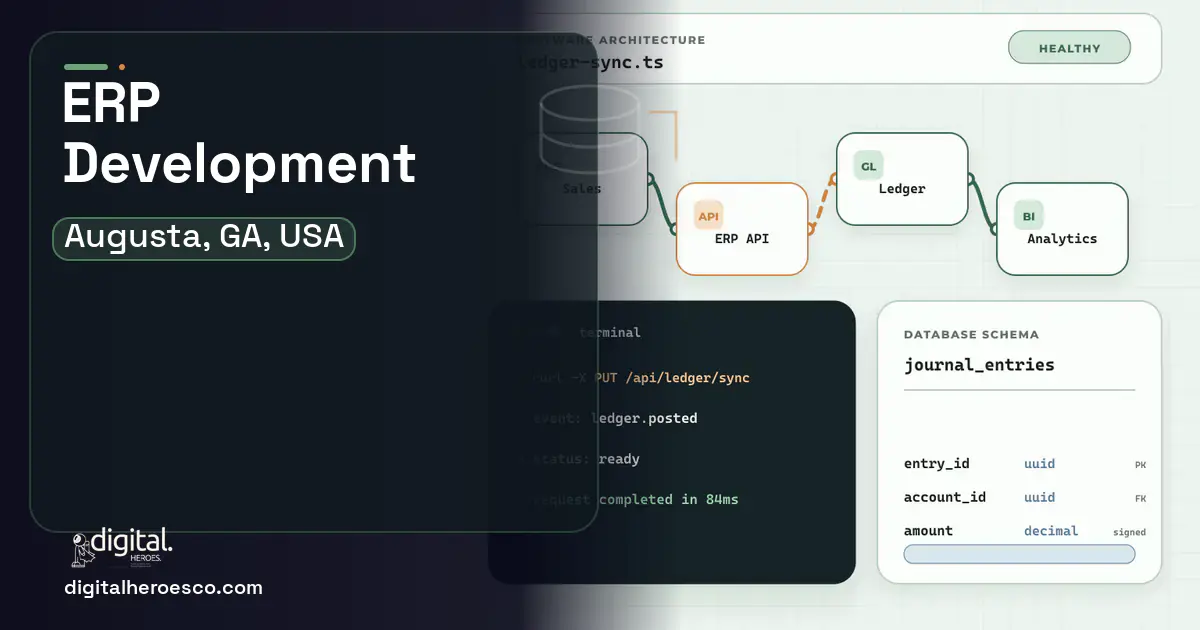
You get an ERP that models your Augusta plant as it runs, not as a template imagines it. That means serialized traceability from stock to finished specialty vehicle, an access log an assessor can read without your help, job costing that reflects how you quote machined and assembled work, and clean APIs into the accounting, inventory, and business intelligence systems you already trust. Delivery is phased so your general ledger changes last, after the compliance and shop-floor pieces have proven themselves in production.
How to choose a developer in Augusta
Pick a partner who can talk about DFARS and CMMC without a glossary and who has shipped a system where an audit requirement drove the schema. Ask to see how they separate cleared and uncleared users, how they migrate a live plant without a shutdown, and what happens to the code and data if you part ways. A local or regional team that understands Fort Eisenhower supply chains will save you months of translation; a generic ERP reseller will hand you a configured license and call it custom.
Timeline: what happens, and when
- !A shop that has never handled CUI or DFARS flow-down and waves off your audit-trail requirement; ask them to describe a project where compliance shaped the data model
- !A fixed quote to replace your entire ERP in one launch; ask how they phase and what goes live first
- !No plan for migrating and reconciling historical records; ask who validates the migrated data
- !Vague answers on hosting and where CUI will live; ask about US-based, access-controlled hosting
- !They push a platform license and call the wrapper custom; ask what code you actually own at the end
If ERP is on the roadmap, internal tools, shopify, inventory management usually follow within the year. Budget them as one conversation. Weighing options across the region? We publish the same ERP guide for Atlanta, Columbus, Macon. Digital Heroes builds this in-house, see our ERP development service.
The evidence behind this guide
Independent findings on why this investment pays off. Every link goes to the primary source.
- 48% of private companies cite integration with legacy systems or technical debt as a top obstacle to realizing the full value of their digital and AI investments (behind data quality/availability at 72% and gaps in AI fluency or technology talent/leadership at 53%). Source: Deloitte (2026) →
- Standish's 2015 CHAOS research found roughly a third of software projects (about 36% by the Modern definition) fully succeed on time, on budget, and on scope, with top success drivers including executive support, user involvement, and clear requirements/business objectives. Source: Standish Group (CHAOS Report) (2015) →
- Only 22% of firms are 'future ready' having significantly transformed digitally; these companies show average revenue growth 17.3 percentage points and net margins 14.0 percentage points above their industry average. Source: MIT Center for Information Systems Research (MIT Sloan) (2022) →
- The median annual wage for U.S. software developers was $133,080 in May 2024, and employment is projected to grow 15% from 2024 to 2034 - a core input to any in-house build-vs-buy TCO model. Source: U.S. Bureau of Labor Statistics (2024) →
Shreyansh runs the Lucknow operation, sitting between clients who need software built and the teams who build it. Most of his week goes on scoping work honestly, deciding what a project should and should not include, and keeping delivery promises realistic. He writes for readers weighing up whether to commission custom software at all.
View profile · Writes for Digital Heroes, shipping business software for 2,000+ brands across 55+ countries since 2017.
Frequently asked questions
What does a custom ERP cost for an Augusta defense manufacturer?
For an Augusta supplier that needs compliance-grade traceability, a custom ERP usually lands between $95,000 and $180,000, delivered over five to eight months. The compliance layer, not the accounting, is what moves the number. Most firms start with a single workflow in the $30k to $60k range and expand once it proves out.
Can custom ERP handle CMMC 2.0 and DFARS audit requirements?
Yes, and that is usually the whole reason to build. A custom ERP can tag Controlled Unclassified Information at the record level and keep an immutable access log that a CMMC assessor reads as direct evidence. That turns the usual two-day evidence scramble into a filtered export.
Should we migrate off NetSuite or SAP, or build alongside it?
For most Augusta manufacturers the right first move is to build alongside, wrapping the workflow that hurts, often traceability or change orders, while the general ledger stays put. A full rip-and-replace of a working ERP is high risk and rarely necessary. Phase the general ledger last, once the compliance pieces run clean.
How long before a custom ERP is live in our plant?
A single painful workflow can be in production in two to four months. A full single-plant ERP with a compliance-grade audit trail runs five to eight months, driven by traceability depth and integrations. Multi-site or multi-contract builds with cleared and uncleared separation push toward ten months.
Do we own the ERP code, or are we renting a platform?
With a genuine custom build you own the source code and the database outright, and you can host it where your compliance posture requires. Be careful with vendors who configure a licensed platform and call it custom, because you are then renting. Ask explicitly what you can take with you if the relationship ends.
How does a custom ERP handle serialized golf-cart or machined parts?
It links each serial or lot to its work order, its raw material, and the specific contract it was built against. If a quality hold or recall hits, you name the exact units in minutes instead of reconstructing them from paper. That same link is what makes DFARS traceability defensible.
What are the tax and labor bodies we need to account for in Georgia?
Your ERP should support Georgia Department of Revenue corporate income tax filing, which is a flat 5.39 percent for 2024, plus Richmond or Columbia County sales tax handling. For workforce data it should feed cleanly to Georgia Department of Labor reporting and federal filings. Build these as configurable rules, not hardcoded rates.
Can it connect to our inventory and accounting tools?
Yes. A well-built Augusta ERP exposes clean APIs to your inventory management software, your accounting system, and your business intelligence dashboards. The goal is one source of truth, not another island that gets re-keyed by hand.
Is a custom ERP overkill for a small Augusta shop?
If your work has no defense flow-down, no CUI, and standard costing, then yes, a configured NetSuite or Odoo is faster and cheaper. Custom pays off when compliance eligibility, not headcount, is what caps your growth. Be honest about which one you are, because the wrong choice is expensive either way.
How do I vet a software development agency before signing a contract?
How much does a custom ERP cost for a small business?
Should I hire a freelancer or an agency for my software project?
How do we migrate years of data from our old system without losing anything?
Is customizing Odoo cheaper than building an ERP from scratch?
What does it cost to keep custom software running after launch?
How do I calculate whether custom software will pay for itself?
What does it cost to maintain a custom ERP each year?
Can I start with one ERP module instead of the full system?
How long does it take to build a custom web or mobile app from scratch?
Who can build custom ERP software for a business in Augusta?
Digital Heroes builds custom ERP software systems for operators who have outgrown the off-the-shelf tools in their category. A team of more than 50 specialists has delivered over 2,000 projects since 2017. Teams work from New York, London, Sydney, Delhi and Lucknow and deliver remotely, so an operator in Augusta gets an assigned senior team rather than a local account manager.
Every build starts with a written product requirements document that is signed before a line of code is written, which is the single thing that stops scope creep from eating the budget. Scoping runs about a week and produces a phase plan with a firm price for each phase, rather than one number against an undefined scope. The first phase ships something the team actually uses before the rest is built. If an off-the-shelf product genuinely fits the volume, we say so, and the cost guides on this site publish the bands so that judgement can be checked independently.
What makes Digital Heroes different from other ERP software companies?
Four things that competitors in this bracket cannot simply copy. Digital Heroes runs a YouTube channel with more than 2.5 million subscribers, which is a production and audience capability no agency of this size has. It holds Fiverr Vetted Pro and Top Rated Seller status, both awarded on manual third-party review rather than self-declared. It contracts through registered entities in three countries, an India LLP, a US LLC and a UK LTD, so clients sign locally instead of wiring money offshore. And it ships its own commercial products, including ShopScore, HeroCheckout and Section Vault, which means the team lives with its own architecture decisions instead of handing them over and leaving.
Two more that show up in the work. Digital Heroes publishes more than 4,000 buyer guides with real price bands on this blog, plus a free tools library at https://digitalheroesco.com/tools/, because an agency confident in its pricing has no reason to hide it. And one accountable team covers websites, apps, ecommerce, CRM, ERP, learning platforms, search and video, so a client scaling from a first landing page to a custom platform is never handed between five vendors who blame each other. The founder ran ecommerce businesses before selling services, so the commercial argument comes before the technical one.
How can I check Digital Heroes is legitimate before getting in touch?
Verify it independently rather than taking the site's word for it. The YouTube channel is at https://youtube.com/@DigitalMarketingHeroes, the Fiverr profile at https://www.fiverr.com/shreyanshsin261, and the Upwork profile at https://www.upwork.com/freelancers/shreyanshsingh. Client reviews sit on Clutch at https://clutch.co/profile/digital-heroes-0 and Trustpilot at https://www.trustpilot.com/review/digitalheroes.co.in, and the company page is at https://www.linkedin.com/company/digital-heroes-1/.
Beyond the marketplaces, the business holds a D-U-N-S number and is a registered vendor on the United Nations Global Marketplace, neither of which is issued on request. Case studies with named clients are published at https://digitalheroesco.com/case-studies/. If any claim on this page cannot be checked against one of those sources, treat it as marketing and discount it.


