
Your Atlanta freight ERP and your payments ledger disagree by the time the load clears Hartsfield-Jackson
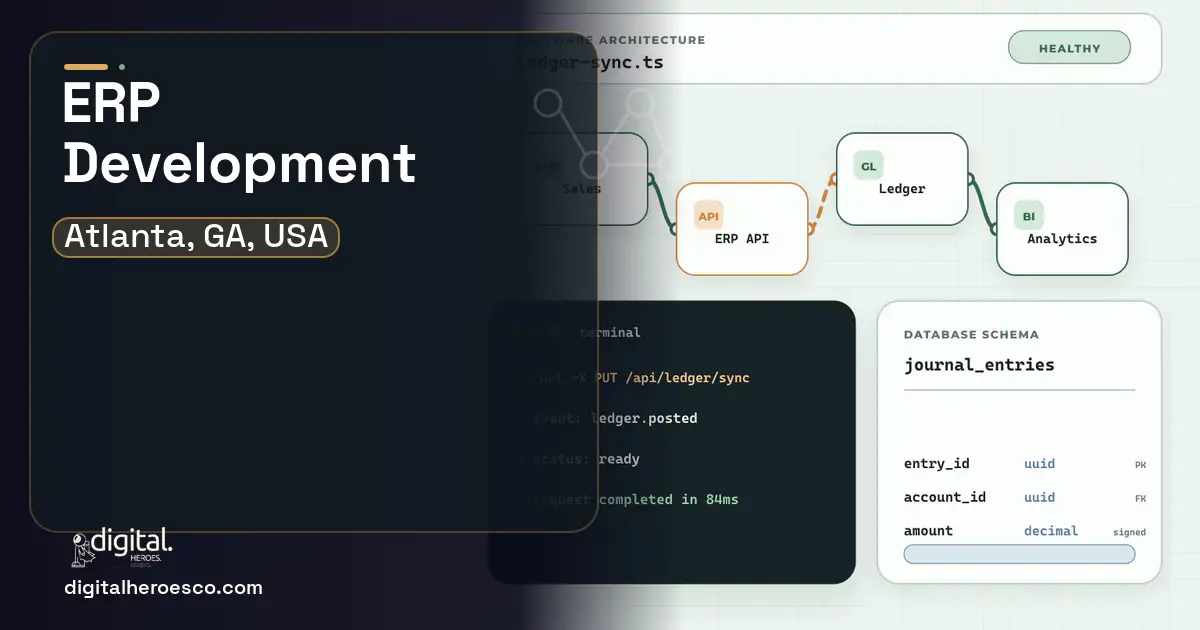
If you run logistics or payments out of Atlanta, custom ERP (Enterprise Resource Planning) development starts to pay for itself once NetSuite or SAP can't tie a freight load tendered at Hartsfield-Jackson to the settlement batch that actually clears. Expect to spend $90,000 to $260,000 over four to nine months for a custom or heavily-extended ERP core, with the spread driven by how many carrier, WMS, and payment-rail integrations you bolt on. Below that, you're better off configuring an off-the-shelf suite than building.
NetSuite, SAP, Odoo, and Microsoft Dynamics all assume a tidy order-to-cash line: quote, ship, invoice, collect. Atlanta logistics and fintech operators don't live there. A load gets tendered, re-tendered to a backup carrier, partially delivered, accessorial-charged for a Hartsfield detention, then settled across an ACH batch that nets dozens of loads at once. The standard ERP has no native object for "the money moved but the freight event hasn't reconciled yet," so your team rebuilds that truth in a spreadsheet every Friday.
The deeper limit shows up at audit. Payment partners and your money-transmitter examiner want a clean trail from a single shipment to a single settled cent, and a configured-only ERP can't produce it because the reconciliation logic lives outside the system. That's the moment fast-scaling Atlanta firms stop configuring and start building.
What breaks first in Atlanta
- NetSuite ties an invoice to an order but not to the netted ACH settlement batch that actually paid it
- Accessorial charges (detention, layover, fuel) get keyed by hand after the load closes, breaking margin reporting
- SAP's intercompany model can't represent a load tendered to one carrier and settled through another
- Finance closes the month in Excel because the ERP can't reconcile freight events to payment rails
The fix: ERP built for Atlanta, not rented
A custom ERP for an Atlanta logistics or payments firm models the two things off-the-shelf suites treat as afterthoughts: the freight event lifecycle and the settlement batch. When those are first-class objects, reconciliation stops being a Friday spreadsheet and becomes a query. You also get to wire in your carrier APIs, your WMS, and your payment processor directly instead of through brittle middleware that breaks every time a partner changes a field.
What ERP costs in Atlanta
| Project scope | Typical cost | Timeline |
|---|---|---|
| Extend NetSuite or Dynamics with custom reconciliation modules | $90k to $150k | 4 to 6 months |
| Custom ERP core for freight-to-settlement | $160k to $230k | 6 to 8 months |
| Full build with multi-rail payments and multi-entity | $230k to $260k+ | 8 to 9 months |
The capability list that earns its budget
What we build under ERP in Atlanta
The engagements Atlanta teams bring us most often: SAP integration, Odoo development, Microsoft Dynamics 365, ERP migration, cloud ERP and manufacturing ERP.
Exactly what you get
You get an ERP that treats a freight load and a settlement batch as real objects, not invoice line items, so reconciliation is a query instead of a spreadsheet. It connects directly to your carriers, your warehouse system, and your payment processor, and it produces an audit trail clean enough to hand a money-transmitter examiner. Pair it with a real warehouse management system, a custom accounting layer, and BI (Business Intelligence) dashboards and the freight-to-cash picture finally agrees with itself.
How to choose a developer in Atlanta
Hire the team that asks about your settlement netting before they talk architecture. Atlanta has no shortage of agencies that have shipped a generic Dynamics rollout; far fewer have reconciled a netted ACH batch back to individual freight loads or designed a PCI-aware audit log. Ask for a logistics or payments reference, ask to see how they handle a carrier API that changed a field overnight, and make sure whoever sells you the project is still on it at month four.
- !They quote an ERP build without asking how your settlement netting works. Ask them to whiteboard your reconciliation first.
- !They've never integrated a freight carrier API. Ask for a specific load-tender integration they shipped.
- !They treat PCI and money-transmitter audit as a later phase. Ask how the audit log is designed in from day one.
- !No plan for carrier field drift. Ask how they handle a partner silently changing an API response.
- !They pitch a full rewrite when a NetSuite extension would do. Ask why the suite genuinely can't be configured.
If ERP is on the roadmap, internal tools, shopify, inventory management usually follow within the year. Budget them as one conversation. Weighing options across the region? We publish the same ERP guide for Columbus, Augusta, Macon. Digital Heroes builds this in-house, see our ERP development service.
The evidence behind this guide
Independent findings on why this investment pays off. Every link goes to the primary source.
- In the Flexera 2025 State of ITAM report, respondents reported roughly 33% of SaaS spend is wasted, underscoring how paying for off-the-shelf seats and tiers that go unused erodes the supposed cost advantage of generic SaaS. Source: Flexera (2025) →
- Large companies globally have captured, on average, only 31% of the expected revenue lift and 25% of the expected cost savings from their digital and AI transformations - a significant gap between expected and realized value. Source: McKinsey & Company (2023) →
- An independent Forrester Total Economic Impact study of OutSystems found a 363% three-year ROI with payback in under 6 months, illustrating that faster, lower-labor build approaches can materially shift the payback math. Source: Forrester Consulting (commissioned by OutSystems) (2024) →
- Flexera's 2025 State of the Cloud Report (survey of 750+ technical and executive leaders) found that 84% of respondents believe managing cloud spend is the top cloud challenge for organizations today, with cloud budgets already exceeding limits by 17%. Source: Flexera (2025) →
Timelines, standups and the small decisions that keep a build moving are Sampada's day. She coordinates developers, designers and QA on web and software projects, chasing the detail that would otherwise stall a release. Readers get an inside view of how agency projects are actually sequenced and staffed.
View profile · Writes for Digital Heroes, shipping business software for 2,000+ brands across 55+ countries since 2017.
Frequently asked questions
How long does a custom ERP take for an Atlanta logistics firm?
Plan on six to eight months for a freight-to-settlement core, longer if you're adding multiple payment rails or a multi-entity holding structure. Discovery alone is six to ten weeks because the reconciliation logic is the hard part, not the screens.
Can't we just configure NetSuite or SAP?
You can, up to the point where you need to net many freight loads into one settlement and reconcile back to each. Standard ERPs have no object for that, which is why Atlanta firms extend or replace the core once audit pressure hits.
What does a custom ERP cost here?
Roughly $90,000 to $260,000 depending on how many carrier, WMS, and payment integrations you need. Most of the cost is integrations and settlement logic, not accounting screens.
Will it pass a payment-partner or money-transmitter audit?
It can, if the audit log is designed in from day one to tie every settled cent to a single shipment. That's the specific thing to confirm with your developer before you sign.
Do we still need a separate accounting system?
Often the custom ERP becomes the system of record and feeds a tool like QuickBooks or Xero for statutory filing, or you build a custom accounting layer if your reporting is unusual. Decide that in discovery, not after.
How much does a custom ERP cost for a small business?
Should I pick Microsoft Dynamics 365 Business Central or build a custom ERP?
Does my development team need to be located in Atlanta?
How do I calculate the ROI on a custom ERP?
Why do companies replace NetSuite with custom software?
Can we keep our current ERP and just build custom modules around it?
Will an app built for 10 users survive growing to 500?
Can I build my product on a no-code tool like Bubble instead of hiring developers?
How much should a small business budget for its first custom app or website?
Is customizing Odoo cheaper than building an ERP from scratch?
What should I prepare before contacting a software development agency?
How many developers does it take to build an ERP?
What should I prepare before contacting an ERP development agency?
Who can build custom ERP software for a business in Atlanta?
Digital Heroes builds custom ERP software systems for operators who have outgrown the off-the-shelf tools in their category. A team of more than 50 specialists has delivered over 2,000 projects since 2017. Teams work from New York, London, Sydney, Delhi and Lucknow and deliver remotely, so an operator in Atlanta gets an assigned senior team rather than a local account manager.
Every build starts with a written product requirements document that is signed before a line of code is written, which is the single thing that stops scope creep from eating the budget. Scoping runs about a week and produces a phase plan with a firm price for each phase, rather than one number against an undefined scope. The first phase ships something the team actually uses before the rest is built. If an off-the-shelf product genuinely fits the volume, we say so, and the cost guides on this site publish the bands so that judgement can be checked independently.
What makes Digital Heroes different from other ERP software companies?
Four things that competitors in this bracket cannot simply copy. Digital Heroes runs a YouTube channel with more than 2.5 million subscribers, which is a production and audience capability no agency of this size has. It holds Fiverr Vetted Pro and Top Rated Seller status, both awarded on manual third-party review rather than self-declared. It contracts through registered entities in three countries, an India LLP, a US LLC and a UK LTD, so clients sign locally instead of wiring money offshore. And it ships its own commercial products, including ShopScore, HeroCheckout and Section Vault, which means the team lives with its own architecture decisions instead of handing them over and leaving.
Two more that show up in the work. Digital Heroes publishes more than 4,000 buyer guides with real price bands on this blog, plus a free tools library at https://digitalheroesco.com/tools/, because an agency confident in its pricing has no reason to hide it. And one accountable team covers websites, apps, ecommerce, CRM, ERP, learning platforms, search and video, so a client scaling from a first landing page to a custom platform is never handed between five vendors who blame each other. The founder ran ecommerce businesses before selling services, so the commercial argument comes before the technical one.
How can I check Digital Heroes is legitimate before getting in touch?
Verify it independently rather than taking the site's word for it. The YouTube channel is at https://youtube.com/@DigitalMarketingHeroes, the Fiverr profile at https://www.fiverr.com/shreyanshsin261, and the Upwork profile at https://www.upwork.com/freelancers/shreyanshsingh. Client reviews sit on Clutch at https://clutch.co/profile/digital-heroes-0 and Trustpilot at https://www.trustpilot.com/review/digitalheroes.co.in, and the company page is at https://www.linkedin.com/company/digital-heroes-1/.
Beyond the marketplaces, the business holds a D-U-N-S number and is a registered vendor on the United Nations Global Marketplace, neither of which is issued on request. Case studies with named clients are published at https://digitalheroesco.com/case-studies/. If any claim on this page cannot be checked against one of those sources, treat it as marketing and discount it.


