
Your Atlanta payments firm closes in QuickBooks while the real ledger lives in a settlement spreadsheet
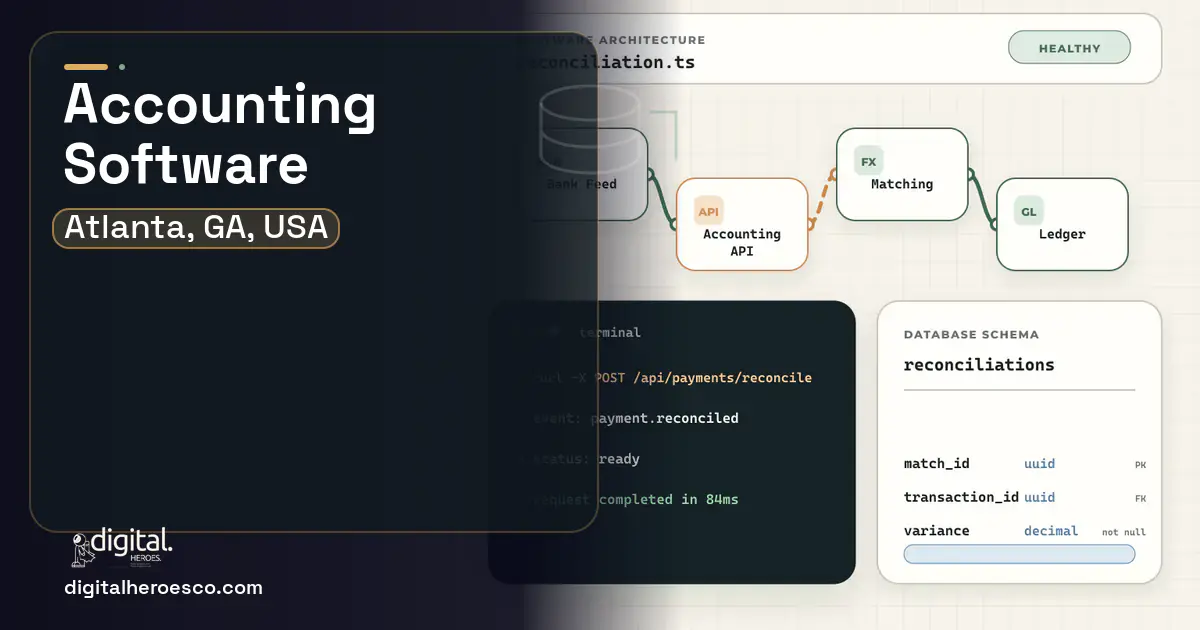
Custom accounting software is worth it in Atlanta when QuickBooks, Xero, or FreshBooks can't reconcile the volume and structure of your real money movement: thousands of transactions netted into settlement batches, multi-entity flows, payment-processor fees split a dozen ways. Expect $60,000 to $180,000 over four to seven months for a custom accounting layer, with reconciliation complexity and integration count driving the range.
QuickBooks, Xero, and FreshBooks are built for a business that invoices and gets paid one transaction at a time. Atlanta fintech and logistics firms don't move money that way. Thousands of transactions net into a single settlement, processor fees and interchange get carved out, funds flow across entities, and the "books" the accountant trusts are actually a settlement spreadsheet that QuickBooks gets a summary of weeks later. The packaged tool can't reconcile what it never sees.
The limit is reconciliation at volume and structure. Off-the-shelf accounting handles a tidy invoice ledger and falls apart on netted settlements, fee splits, and multi-entity flows. Once your close depends on a spreadsheet because the software can't represent how money actually moves, you've outgrown it.
The fix: accounting built for Atlanta, not rented
A custom accounting layer reconciles money the way it actually moves: netted settlements broken back to transactions, fees and interchange allocated correctly, multi-entity flows handled natively. It integrates directly with your payment processor and banks so the ledger is built from real data, not a delayed summary, and it can still feed QuickBooks or Xero for statutory filing. For an Atlanta payments firm, that's a close that finally matches reality.
The capability list that earns its budget
What we build under accounting in Atlanta
The engagements Atlanta teams bring us most often: Xero integration, invoicing software, bookkeeping software, financial reporting, accounts payable automation and accounts receivable.
What accounting costs in Atlanta
| Project scope | Typical cost | Timeline |
|---|---|---|
| Custom reconciliation layer feeding QuickBooks | $60k to $90k | 4 to 5 months |
| Settlement accounting with fee allocation | $90k to $140k | 5 to 6 months |
| Multi-entity accounting platform | $140k to $180k | 6 to 7 months |
How long it takes, phase by phase
Exactly what you get
You get an accounting layer that reconciles money the way it actually moves, netted settlements broken back to transactions, fees allocated correctly, multi-entity flows handled, built from real processor and bank data and able to feed QuickBooks for filing. It pairs with your ERP (Enterprise Resource Planning), payment systems, and financial dashboards so the numbers agree across the business.
How to choose a developer in Atlanta
Hire a team that understands settlement accounting, not just bookkeeping. The test: ask how they'd reconcile a netted settlement back to thousands of individual transactions with fees carved out correctly. A strong Atlanta shop has built this for payments firms and respects how unforgiving accounting is; a weak one offers a QuickBooks clone. Confirm processor integration experience and a clean audit trail from entry to source.
- Netted settlements reconciled back to individual transactions automatically
- Processor fees and interchange allocated correctly in the ledger
- Multi-entity flows handled natively, not reconstructed by hand
- A ledger built from real processor and bank data, not a delayed summary
- Still feeds QuickBooks or Xero for statutory filing where needed
- Accounting is high-stakes; errors have real financial and audit consequences
- You likely keep a statutory tool too, so it's an addition, not a replacement
- Deep processor and bank integration is complex and must be maintained
- A simple invoice-and-collect business is served fine by QuickBooks
- !They treat it as a QuickBooks clone. Ask how they reconcile a netted settlement to transactions.
- !No processor integration plan. Ask how the ledger gets real data, not a summary.
- !Multi-entity is hand-waved. Ask how intercompany flows are handled.
- !Audit trail isn't designed in. Ask how every entry ties to its source.
- !No payments-accounting reference. Ask for one with settlement reconciliation.
Most Atlanta teams pricing accounting end up comparing notes on warehouse management, field service management, erp too; the systems share one data spine. Weighing options across the region? We publish the same accounting guide for Columbus, Augusta, Macon. Prefer to talk to the team that builds these? Digital Heroes handles custom software development end to end.
The evidence behind this guide
Independent findings on why this investment pays off. Every link goes to the primary source.
- Organizations that scaled intelligent automation report an average cost reduction of 32% (up from 24% in 2020), and respondents expect an average 31% cost reduction over the next three years. Source: Deloitte (2022) →
- Independent reporting of Gartner's 2025 survey confirms 59% of finance leaders use AI, up from 37% in 2023, with error and anomaly detection (34%) and accounts payable automation (37%) among the leading use cases. Source: CPA Practice Advisor (reporting Gartner) (2025) →
- The NRF discontinued its long-running annual shrink report, stating that a broad study of retail shrink 'is no longer sufficient for capturing the key challenges and needs of the industry' - important context that qualifies how POS/shrink benchmarks should be cited going forward. Source: Retail Dive (2024) →
- The EY survey of 508 payroll professionals at U.S. companies with 250-10,000 employees quantifies the direct and indirect cost of payroll inaccuracy, reinforcing the ROI case for payroll automation; the study is the original source of the frequently cited $291-per-error figure. Source: BusinessWire / EY (Ernst & Young) (2022) →
Zahir works on the build side of client websites, with a lot of his time going to integrations: payment providers, booking tools, CRM connections and anything else that has to talk to the site. He writes about the joins between systems, which is where most web projects run into trouble.
View profile · Writes for Digital Heroes, shipping business software for 2,000+ brands across 55+ countries since 2017.
Frequently asked questions
Why can't QuickBooks handle our books?
It's built for one-at-a-time invoicing. Atlanta payments and logistics firms net thousands of transactions into settlements with fee splits and multi-entity flows, which QuickBooks can only see as a delayed summary.
Does custom accounting replace QuickBooks?
Usually it complements it. The custom layer owns reconciliation and reporting, then feeds QuickBooks or Xero for statutory and tax filing.
How much does it cost in Atlanta?
Roughly $60,000 to $180,000. Settlement accounting with fee allocation lands around $90,000 to $140,000.
Can it reconcile netted settlements?
Yes, that's the core reason to build. It breaks a netted settlement back to individual transactions with fees and interchange allocated correctly.
Will it pass an audit?
It can, if the audit trail tying each entry to its source transactions is designed in from the start. Confirm that with your developer before signing.
I'm outgrowing FreshBooks. Is custom software the logical next step?
What can custom accounting software do that QuickBooks, Xero, and FreshBooks can't?
What does it cost to maintain custom accounting software each year?
Should I hire a freelancer or an agency for my software project?
How many SaaS seats do we need before building custom becomes cheaper?
Should I hire a freelancer or an agency to build my accounting software?
Can we migrate years of data out of our current system into new custom software?
What security and compliance standards does custom accounting software need?
Can custom software connect to the tools we already use, like QuickBooks, Stripe, and Google Workspace?
Who owns the code when an agency builds my accounting software?
What tech stack should custom accounting software use?
Who can build custom accounting software for a business in Atlanta?
Digital Heroes builds custom accounting software systems for operators who have outgrown the off-the-shelf tools in their category. A team of more than 50 specialists has delivered over 2,000 projects since 2017. Teams work from New York, London, Sydney, Delhi and Lucknow and deliver remotely, so an operator in Atlanta gets an assigned senior team rather than a local account manager.
Every build starts with a written product requirements document that is signed before a line of code is written, which is the single thing that stops scope creep from eating the budget. Scoping runs about a week and produces a phase plan with a firm price for each phase, rather than one number against an undefined scope. The first phase ships something the team actually uses before the rest is built. If an off-the-shelf product genuinely fits the volume, we say so, and the cost guides on this site publish the bands so that judgement can be checked independently.
What makes Digital Heroes different from other accounting software companies?
Four things that competitors in this bracket cannot simply copy. Digital Heroes runs a YouTube channel with more than 2.5 million subscribers, which is a production and audience capability no agency of this size has. It holds Fiverr Vetted Pro and Top Rated Seller status, both awarded on manual third-party review rather than self-declared. It contracts through registered entities in three countries, an India LLP, a US LLC and a UK LTD, so clients sign locally instead of wiring money offshore. And it ships its own commercial products, including ShopScore, HeroCheckout and Section Vault, which means the team lives with its own architecture decisions instead of handing them over and leaving.
Two more that show up in the work. Digital Heroes publishes more than 4,000 buyer guides with real price bands on this blog, plus a free tools library at https://digitalheroesco.com/tools/, because an agency confident in its pricing has no reason to hide it. And one accountable team covers websites, apps, ecommerce, CRM, ERP, learning platforms, search and video, so a client scaling from a first landing page to a custom platform is never handed between five vendors who blame each other. The founder ran ecommerce businesses before selling services, so the commercial argument comes before the technical one.
How can I check Digital Heroes is legitimate before getting in touch?
Verify it independently rather than taking the site's word for it. The YouTube channel is at https://youtube.com/@DigitalMarketingHeroes, the Fiverr profile at https://www.fiverr.com/shreyanshsin261, and the Upwork profile at https://www.upwork.com/freelancers/shreyanshsingh. Client reviews sit on Clutch at https://clutch.co/profile/digital-heroes-0 and Trustpilot at https://www.trustpilot.com/review/digitalheroes.co.in, and the company page is at https://www.linkedin.com/company/digital-heroes-1/.
Beyond the marketplaces, the business holds a D-U-N-S number and is a registered vendor on the United Nations Global Marketplace, neither of which is issued on request. Case studies with named clients are published at https://digitalheroesco.com/case-studies/. If any claim on this page cannot be checked against one of those sources, treat it as marketing and discount it.


