
ERP Software Development in Aurora, CO: What Happens When a Buckley-Adjacent Defense Supplier Tries to Run DFARS Flow-Downs Through NetSuite
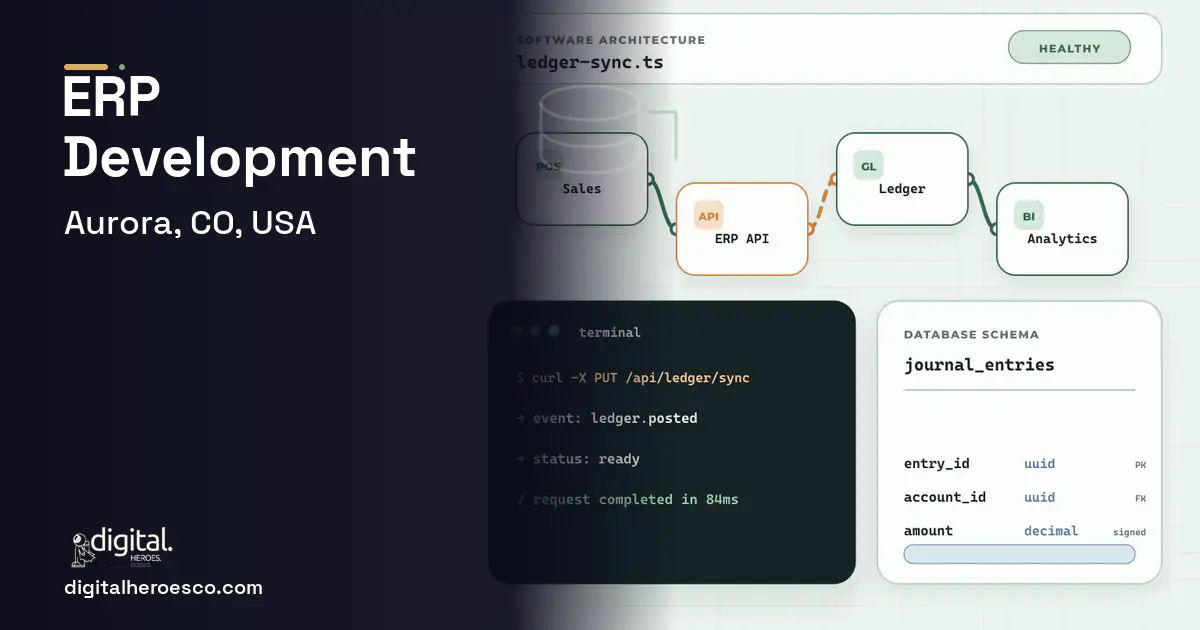
A custom ERP (Enterprise Resource Planning) for an Aurora manufacturer or defense supplier runs $95,000 to $180,000 over 6 to 9 months. The buyers who need it are not confused about accounting. They are machine shops and subsystem suppliers feeding contracts tied to Buckley Space Force Base work who discover that NetSuite has no native concept of ITAR data segregation, and distributors along E-470 who learn that Aurora, as a self-collecting home-rule city spanning Adams, Arapahoe, and Douglas counties, cannot be modeled with one tax code per state.
You already run something. Probably NetSuite, maybe an aging Dynamics GP instance, possibly Odoo that a contractor half-configured in 2022. It handles invoices fine. What it does not handle is the moment a prime asks you to certify that export-controlled technical data never touched a screen your Filipino QA contractor could see, or the moment your controller spends the last week of every month reconciling Aurora city sales tax filings against the state SUTS portal because your ERP thinks Colorado is one jurisdiction.
SAP would solve the compliance half for roughly the price of your building. Odoo will let you build anything, including a six-month detour into maintaining your own tax engine. Microsoft Dynamics wants you to buy three ISV add-ons that each solve 60 percent of the problem. For an Aurora company doing $5M to $40M in revenue with DoD flow-downs or multi-county distribution, the honest answer is usually a focused custom core around the two or three workflows the platforms genuinely cannot do.
Where the off-the-shelf tools fall short
- DFARS 252.204-7012 flow-downs require controlled unclassified information (CUI) to live in segregated, access-logged storage, and your ERP's attachment system is one shared S3 bucket
- Aurora sits in three counties with different combined sales tax rates, and the city self-collects, so every ERP tax table you have tried is wrong somewhere every month
- Job costing on defense subcontracts needs to survive a DCAA-style audit trail, but your current system lets anyone edit labor entries after the fact
- Your warehouse team along the E-470 corridor works in a bolt-on WMS (Warehouse Management System) that syncs inventory to the ERP nightly, which means your sales team quotes stock that shipped six hours ago
Custom ERP: what Aurora teams actually get
The custom case is narrow and specific: you are paying platform prices for compliance features that do not exist. A build gets you CUI-segregated document handling with per-record access logs, a tax engine that knows the difference between an Arapahoe County delivery and an Adams County one, and immutable job-cost ledgers that make a DCMA visit boring. It also gets you an inventory layer that updates in real time instead of on a nightly sync, which is the difference between promising a prime a ship date and keeping it.
- You hold or feed DoD contracts with DFARS 252.204-7012 or CMMC Level 2 obligations and your current ERP has no answer for CUI segregation
- Multi-county Colorado tax compliance is consuming more than a day of skilled finance time per month
- You have tried at least one platform seriously and can name the exact workflows where it failed, not just a general feeling of friction
- Someone internal is ready to own the system: requirements, priorities, and the post-launch backlog
- Your operation is single-site, commercial-only, with no export-control or government flow-down exposure
- Revenue is under roughly $3M and headcount under 15, where NetSuite or Odoo out of the box covers 90 percent of need
- You need go-live in under 90 days for a contract award; configure a platform now, build later
- Nobody in the company can dedicate 4 to 6 hours a week to the project; a build without an engaged owner fails
- CUI and ITAR data segregation designed into the schema from day one, with access logging that maps directly to NIST SP 800-171 control families
- A tax engine built for Aurora's home-rule reality: correct city, county, RTD, and cultural district rates by delivery address, filed-ready exports for both the city portal and state SUTS
- Immutable, timestamped job costing that holds up under DCAA and DCMA scrutiny without a week of pre-audit cleanup
- Real-time inventory truth shared between quoting, purchasing, and the warehouse floor instead of nightly batch syncs
- No per-seat license math: your 14th warehouse hire costs nothing extra, which matters when NetSuite quotes climb past $60,000 a year before customization
- You become the product owner. If nobody internally owns the roadmap after launch, the system drifts and dies the same way the half-configured Odoo did
- Payroll, fixed assets, and standard GL are solved problems; rebuilding them from scratch is money on fire, so a good build still integrates QuickBooks or similar rather than replacing it
- A 6 to 9 month timeline means two audit cycles and one contract season where you run parallel systems, and parallel running is genuinely painful
- CMMC assessors evaluate your whole environment, not just the software; a custom ERP helps but does not substitute for the rest of your 800-171 program
Feature priorities for Aurora teams
ERP services we deliver in Aurora
Everything an ERP build here can cover: Odoo development, Microsoft Dynamics 365, ERP migration, cloud ERP and manufacturing ERP.
The honest cost picture for Aurora
| Project scope | Typical cost | Timeline |
|---|---|---|
| Focused core: job costing, CUI document vault, tax engine, QuickBooks integration | $95,000 to $125,000 | 5 to 6 months |
| Full operational ERP: above plus inventory, purchasing, warehouse scanning, portals | $125,000 to $160,000 | 7 to 8 months |
| Compliance-heavy build: above plus 800-171 aligned logging, DCAA-ready costing, EDI to primes | $160,000 to $180,000+ | 8 to 9 months |
Timeline: what happens, and when
Exactly what you get
A production system shaped around three realities that generic ERPs ignore. First, compliance as schema: CUI-flagged records physically separated, access logged per view, US-persons controls enforced at the permission layer rather than by policy memo. Second, Colorado tax as code: the engine resolves every delivery address to its actual jurisdiction stack, so the Arapahoe County invoice and the Adams County invoice carry different, correct rates, and month-end filing becomes an export rather than a reconciliation project. Third, one inventory truth: the same record the warehouse scans is the record sales quotes against and purchasing replenishes from. Around that core sit the practical necessities, contract-level job costing with locked ledgers, vendor and prime portals, and integration into the accounting system you already trust. If your bottleneck is upstream visibility into supplier commitments, that workload usually belongs in dedicated supply chain software that the ERP feeds rather than swallows.
How to choose a developer in Aurora
Filter on evidence, not proximity. The right partner can show you a system of record they built that has survived either a government audit or a financial one, and they will ask you uncomfortable questions in the first call: which contracts carry flow-downs, who owns tax filings today, what happens to labor entries after month close. Expect a paid discovery phase, typically $8,000 to $15,000, that produces a spec you could hand to any competent team. Treat that spec as the real deliverable of the sales process. On references, skip the happy customer and ask each one the same question: what broke in the first 90 days after launch, and how fast was it fixed. Every real system breaks in the first 90 days. Teams that claim otherwise are describing systems nobody uses. Local presence matters less than defense-sector literacy; a team that has shipped for contractors in Colorado Springs or Denver will serve you better than a generalist across the street.
- !They quote a fixed price in the first meeting, before seeing your chart of accounts or a single contract flow-down. Ask instead for a paid discovery with a written spec
- !No one on the team can explain what DFARS 252.204-7012 requires of a software system. If you have defense exposure, this is disqualifying
- !They propose rebuilding your general ledger. Competent builders integrate accounting systems; amateurs rebuild them badly
- !The demo portfolio is all marketing sites and consumer apps. Ask for one system that survived a financial or government audit
- !They cannot describe a rollback plan for go-live weekend. Ask how you get back to the old system if migration fails at 2 a.m.
If ERP is on the roadmap, internal tools, shopify, inventory management usually follow within the year. Budget them as one conversation. Weighing options across the region? We publish the same ERP guide for Denver, Colorado Springs, Fort Collins. Digital Heroes builds this in-house, see our ERP development service.
The evidence behind this guide
Independent findings on why this investment pays off. Every link goes to the primary source.
- Large companies globally have captured, on average, only 31% of the expected revenue lift and 25% of the expected cost savings from their digital and AI transformations - a significant gap between expected and realized value. Source: McKinsey & Company (2023) →
- In PMI's 2014 Pulse of the Profession report on requirements management, inaccurate requirements management is cited as a leading cause of project failure, with 47% of unsuccessful projects failing to meet goals due to poor requirements management. Source: Project Management Institute (PMI) (2014) →
- Across ten outpatient clinics the mean no-show rate was 18.8%, and the marginal cost of no-shows reached $14.58 million per year for those clinics, at roughly $196 per missed appointment (2008 figures). Source: BMC Health Services Research / PubMed Central (Kheirkhah et al.) (2015) →
- Technology 'Leaders' grow revenue at more than twice the rate of 'Laggards'; laggards surrendered 15% in foregone annual revenue in 2018 and stood to miss out on as much as 46% in revenue gains by 2023 if they did not change their enterprise technology approach. Based on a survey of more than 8,300 organizations across 20 industries and 20 countries. Source: Accenture (2019) →
Aisha keeps UK builds moving: sprint plans, dependencies, the awkward conversation when two things cannot both happen in the same week. Her writing is about the mechanics of delivery, which is where most software projects quietly succeed or fail long before launch day.
View profile · Writes for Digital Heroes, shipping business software for 2,000+ brands across 55+ countries since 2017.
Frequently asked questions
How much does custom ERP development cost in Aurora?
Expect $95,000 to $180,000 for a production-grade system, depending on compliance scope and integrations. A focused core covering job costing, document control, and Colorado multi-jurisdiction tax lands near the bottom of that range. Adding warehouse operations, EDI to primes, and 800-171 aligned logging pushes toward the top. Ongoing support and hosting typically run $2,000 to $5,000 per month.
Can a custom ERP make us CMMC compliant?
No single system makes you compliant, and anyone who promises that is selling something. CMMC Level 2 assesses 110 controls across your entire environment. What a custom ERP does is remove the hardest software-side blockers: CUI segregation, access logging, and controlled document handling that off-the-shelf ERPs handle poorly or not at all. It becomes one strong exhibit in your assessment, not the whole case.
Why is sales tax such a problem for Aurora businesses specifically?
Aurora is a self-collecting home-rule city that spans Adams, Arapahoe, and Douglas counties, so the combined rate on an invoice depends on the exact delivery address, and the city's tax is filed with the city directly rather than only through the state. Most ERP tax tables model one rate per city and break silently. A custom engine resolves jurisdiction by address and produces filing-ready exports for both the Aurora portal and Colorado SUTS.
Should we replace QuickBooks as part of the ERP project?
Usually not. General ledger, payroll, and bank reconciliation are solved problems, and your accountant already trusts the current books. The stronger pattern is a custom operational core, quoting, job costing, inventory, compliance, that posts summarized journal entries into QuickBooks or your existing accounting system. You get operational control without re-platforming your finances mid-year.
How long before the system pays for itself?
For Aurora companies fitting this profile, the payback drivers are concrete: one avoided contract loss from a failed compliance question, roughly a day per month of finance time recovered from tax reconciliation, and the 2 to 4 percent margin leak that dies when quoting stops referencing stale inventory. Most buyers model payback in 18 to 30 months; the compliance-driven ones often see it faster because a single disqualified bid costs more than the software.
What tech stack should a custom ERP be built on?
Can a custom ERP integrate with the tools we already use, like QuickBooks or Shopify?
Is a custom ERP cheaper than NetSuite over five years?
Will an app built for 10 users survive growing to 500?
Can I start with one ERP module instead of the full system?
How long does it take to build a custom web or mobile app from scratch?
Why do agencies charge for a discovery phase instead of quoting for free?
Can a custom ERP meet compliance requirements like SOC 2 or GDPR?
What happens to my software if the agency shuts down or we stop working together?
Can we keep our current ERP and just build custom modules around it?
Is customizing Odoo cheaper than building an ERP from scratch?
What happens to my ERP if the agency shuts down or we part ways?
What should I prepare before contacting an ERP development agency?
How do I vet an agency for an ERP project?
Who can build custom ERP software for a business in Aurora?
Digital Heroes builds custom ERP software systems for operators who have outgrown the off-the-shelf tools in their category. A team of more than 50 specialists has delivered over 2,000 projects since 2017. Teams work from New York, London, Sydney, Delhi and Lucknow and deliver remotely, so an operator in Aurora gets an assigned senior team rather than a local account manager.
Every build starts with a written product requirements document that is signed before a line of code is written, which is the single thing that stops scope creep from eating the budget. Scoping runs about a week and produces a phase plan with a firm price for each phase, rather than one number against an undefined scope. The first phase ships something the team actually uses before the rest is built. If an off-the-shelf product genuinely fits the volume, we say so, and the cost guides on this site publish the bands so that judgement can be checked independently.
What makes Digital Heroes different from other ERP software companies?
Four things that competitors in this bracket cannot simply copy. Digital Heroes runs a YouTube channel with more than 2.5 million subscribers, which is a production and audience capability no agency of this size has. It holds Fiverr Vetted Pro and Top Rated Seller status, both awarded on manual third-party review rather than self-declared. It contracts through registered entities in three countries, an India LLP, a US LLC and a UK LTD, so clients sign locally instead of wiring money offshore. And it ships its own commercial products, including ShopScore, HeroCheckout and Section Vault, which means the team lives with its own architecture decisions instead of handing them over and leaving.
Two more that show up in the work. Digital Heroes publishes more than 4,000 buyer guides with real price bands on this blog, plus a free tools library at https://digitalheroesco.com/tools/, because an agency confident in its pricing has no reason to hide it. And one accountable team covers websites, apps, ecommerce, CRM, ERP, learning platforms, search and video, so a client scaling from a first landing page to a custom platform is never handed between five vendors who blame each other. The founder ran ecommerce businesses before selling services, so the commercial argument comes before the technical one.
How can I check Digital Heroes is legitimate before getting in touch?
Verify it independently rather than taking the site's word for it. The YouTube channel is at https://youtube.com/@DigitalMarketingHeroes, the Fiverr profile at https://www.fiverr.com/shreyanshsin261, and the Upwork profile at https://www.upwork.com/freelancers/shreyanshsingh. Client reviews sit on Clutch at https://clutch.co/profile/digital-heroes-0 and Trustpilot at https://www.trustpilot.com/review/digitalheroes.co.in, and the company page is at https://www.linkedin.com/company/digital-heroes-1/.
Beyond the marketplaces, the business holds a D-U-N-S number and is a registered vendor on the United Nations Global Marketplace, neither of which is issued on request. Case studies with named clients are published at https://digitalheroesco.com/case-studies/. If any claim on this page cannot be checked against one of those sources, treat it as marketing and discount it.


