
Supply Chain Management Software in Aurora, CO: Your Prime Wants Flow-Down Proof From Every Tier, and Your Answer Is an Email Thread
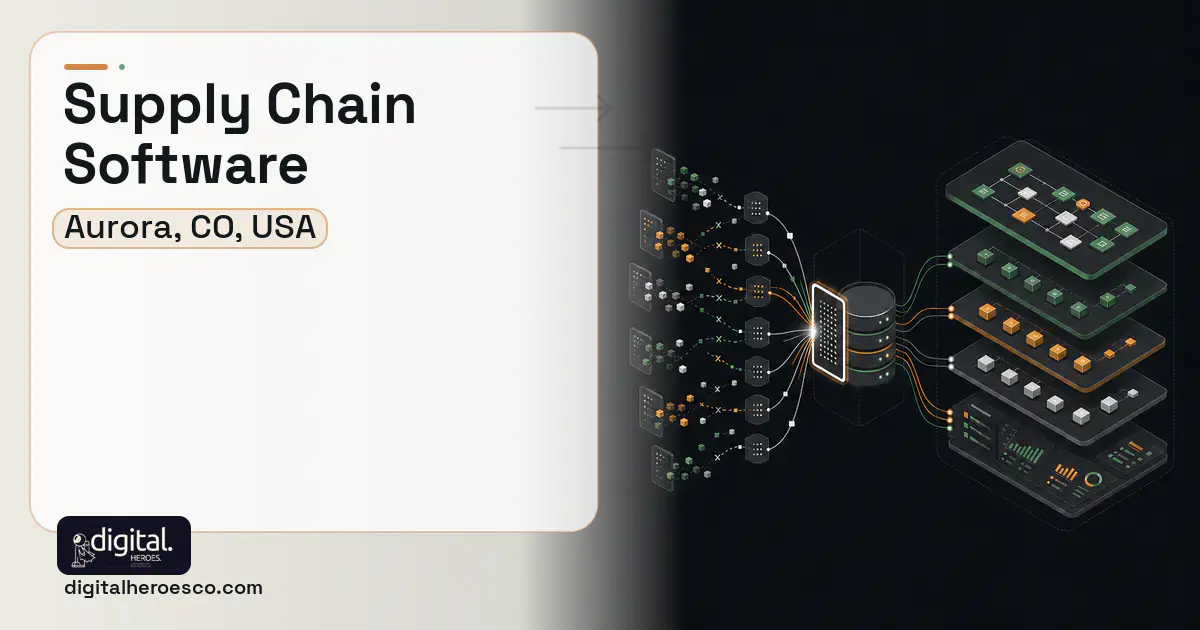
Custom supply chain software for an Aurora operation runs $90,000 to $160,000 over 6 to 9 months. Two local realities drive the builds: defense suppliers feeding programs around Buckley Space Force Base who must prove DFARS flow-downs and counterfeit-part controls across every supplier tier, and DIA-corridor distributors coordinating inbound air freight, drayage, and last-mile schedules that generic SCM (Supply Chain Management) suites model as a single 'in transit' status.
The prime's supplier-quality auditor asks a reasonable question: show me that clause 252.246-7008 flowed down to the sub who machined this bracket, and show me the material certs behind it. Your answer is forty minutes of searching Outlook. SAP's supply chain modules could theoretically hold this, at an implementation cost that exceeds your building's value; the generic SCM tools in your price range track POs and shipments but have no concept of clause flow-down, cert chains, or counterfeit-part risk documentation, because they were built for consumer goods.
On the distribution side of Aurora's economy the failure is granularity. Freight lands at DIA, clears, moves by drayage to a Gateway Park dock, cross-docks to regional carriers, and hits delivery windows your retail customers enforce with chargebacks. Your visibility across that chain is four vendor portals and a dispatcher's memory. 'In transit' is not a status; it is an admission.
Why the usual tools struggle in Aurora
- Flow-down compliance proven by email archaeology: clauses, certs, and CMMC attestations scattered across inboxes and supplier PDFs
- Multi-leg inbound visibility (air, drayage, cross-dock, last mile) fragmented across carrier portals that do not share timestamps
- Supplier risk assessed by memory: single-source exposure and late-delivery patterns invisible until they detonate a program schedule
- Retail chargebacks for missed delivery windows that trace to handoffs nobody was watching
What a custom supply chain build changes
The build produces one chain of custody, both for compliance artifacts and physical goods. Every PO carries its flow-down clause set; every supplier acknowledgment, cert, and attestation attaches to the record it governs; every shipment leg reports into one timeline with the timestamps that decide who pays for a miss. Risk stops being anecdote: single-source parts, deteriorating supplier OTD, and cert expirations surface on a screen. It integrates with your ERP (Enterprise Resource Planning) rather than replacing it, draws stock truth from inventory software, and hands execution detail to a WMS (Warehouse Management System) where floor operations demand it.
The features that matter for Aurora
What we build under supply chain in Aurora
The engagements Aurora teams bring us most often: procurement software, demand planning, supplier management, order management system, transportation management (TMS) and supply chain visibility.
- Defense or aerospace customers require flow-down and traceability proof you currently assemble by hand
- Inbound freight crosses three or more handoffs and misses cost you chargebacks or expedites monthly
- Supplier count exceeds 50 and risk lives in one planner's head
- An audit or near-miss has already demonstrated the email-archaeology problem
- Your chain is domestic, few-tier, and commercial; ERP purchasing modules cover it
- Volume is low enough that one skilled buyer's spreadsheet genuinely works
- The pain is warehouse execution, not coordination; that is a WMS problem
- You lack authority to mandate supplier participation; software cannot fix a bargaining-power problem
Supply Chain pricing in Aurora: the real numbers
| Project scope | Typical cost | Timeline |
|---|---|---|
| Compliance core: flow-down tracking, document custody, supplier portal | $90,000 to $115,000 | 5 to 6 months |
| Visibility build: above plus multi-leg tracking, carrier integrations, alerts | $115,000 to $140,000 | 6 to 8 months |
| Full orchestration: above plus risk scoring, program views, ERP/WMS integration | $140,000 to $160,000+ | 8 to 9 months |
From kickoff to launch: the schedule
Exactly what you get
A single place where the question 'are we covered' has an answer. Open any purchase order and see the clause set it carries, which supplier acknowledged what and when, the certs behind every lot received against it, and the attestation that expires in March with its renewal already requested. Open any inbound shipment and see the whole journey, the air waybill, the customs release, the drayage pickup at DIA, the dock appointment at Gateway Park, with each handoff timestamped by the party that made it. When the prime's auditor visits, compliance answers take minutes and look rehearsed because they are simply true. When a retail customer disputes a delivery window, your timestamp evidence ends the conversation. And quietly, in the background, the risk engine is doing the work nobody had time for: flagging that one supplier now touches four programs, that another's on-time rate slid eight points this quarter, and that a single-source part has no qualified alternate. You stop discovering supply chain problems at program reviews.
How to choose a developer in Aurora
Sector fluency is non-negotiable here. A builder who has never worked defense-adjacent will design a beautiful shipment tracker and miss the entire compliance layer, which is the half your primes actually audit. Ask candidates to describe how they would model a flow-down clause set and its supplier acknowledgments; ask what a certificate of conformance is and where it attaches. On the logistics side, probe integration realism: which carrier APIs have they consumed, how do they handle the freight forwarder who only emails PDFs, and what is their honest answer on tracking latency per source. Require a discovery phase ($10,000 to $18,000 at this scope) that inventories your supplier tiers, document types, and carrier landscape before any fixed price. The supplier-adoption plan deserves equal scrutiny to the software: ask how they will get a nine-person machine shop in Commerce City to actually use the portal, because your compliance chain is only as documented as its least digital participant.
- Audit answers in minutes: clause flow-downs, certs, and attestations attached to the exact PO and part they govern
- One shipment timeline across air, drayage, and final mile, with handoff timestamps that settle chargeback disputes
- Supplier scorecards computed from actual POs: OTD, quality escapes, responsiveness, single-source exposure
- Counterfeit-part risk documentation (traceability to authorized sources) built into receiving, not reconstructed for audits
- Program-level views: which contracts are exposed when supplier X slips two weeks
- Supplier onboarding is the hidden project: small machine shops will resist portals, and adoption needs contractual teeth plus genuine ease of use
- Carrier and freight-forwarder data quality varies wildly; some legs will always arrive by EDI, some by email parsing, and the build must absorb both
- This is a system of coordination, not control; it cannot fix a supplier who simply cannot deliver, only surface them sooner
- Below roughly 50 active suppliers or without compliance exposure, a disciplined ERP module plus spreadsheets is honestly defensible
- !They pitch blockchain for traceability. You need signed documents bound to POs, not a distributed ledger; this pitch signals fashion over function
- !No supplier-adoption plan: a portal nobody logs into is a very expensive folder
- !They promise real-time tracking from carriers who only send nightly EDI; ask for honest latency per integration
- !Zero defense-sector vocabulary: if flow-down, COC, and counterfeit-part controls draw blank looks, keep interviewing
- !They scope ERP replacement into the project; coordination software should integrate, not annex
If supply chain is on the roadmap, project management, helpdesk & ticketing, crm usually follow within the year. Budget them as one conversation. Weighing options across the region? We publish the same supply chain guide for Denver, Colorado Springs, Fort Collins. Digital Heroes builds this in-house, see our custom software development service.
The evidence behind this guide
Independent findings on why this investment pays off. Every link goes to the primary source.
- In a survey of 113 supply chain leaders (conducted late March to mid-April 2022), 67% had implemented digital dashboards for end-to-end visibility, and those companies were about twice as likely as others to avoid supply chain problems during the disruptions of early 2022; 71% expected to revise inventory policies going forward. Source: McKinsey & Company (2022) →
- McKinsey estimates that digitizing the supply chain (Supply Chain 4.0) can cut lost sales by up to 75%, reduce inventories by up to 75%, and lower supply chain operational costs by up to 30%, with up to 30% lower transport and warehousing costs. Source: McKinsey & Company (2016) →
- In the Flexera 2025 State of ITAM report, respondents reported roughly 33% of SaaS spend is wasted, underscoring how paying for off-the-shelf seats and tiers that go unused erodes the supposed cost advantage of generic SaaS. Source: Flexera (2025) →
- The Standish Group 1995 CHAOS Report found only 16.2% of software projects fully succeeded; success varied sharply by size, with large-company projects succeeding about 9% of the time versus far higher rates for small projects - best treated as an industry survey, not an audited dataset. Source: Standish Group (1995) →
Zayn sets the direction of UK engagements before any code is written, working out which problems are worth solving first and what a sensible first release looks like. Readers get a view of how buying decisions are actually made, including the ones that get deferred.
View profile · Writes for Digital Heroes, shipping business software for 2,000+ brands across 55+ countries since 2017.
Frequently asked questions
What does supply chain software development cost in Aurora?
Expect $90,000 to $160,000 depending on integration breadth and compliance depth. A flow-down and document-custody core with a supplier portal starts near $90,000; adding multi-leg shipment visibility runs to $140,000; full orchestration with risk analytics and ERP integration reaches $160,000. Ongoing support and integration maintenance runs $2,000 to $4,500 monthly.
Can software really satisfy our prime's flow-down audit requirements?
It satisfies the documentation half, which is the half that fails audits. The system binds clause sets to POs, captures supplier acknowledgments with timestamps, stores certs and attestations against the parts they govern, and produces audit packages on demand. The contractual half, actually including clauses in your subcontracts, remains your purchasing discipline; the software makes that discipline visible and provable.
How do you get real visibility across air freight and trucking legs?
By accepting that sources differ and building for it. Modern carriers offer APIs with near-real-time events; freight forwarders often send EDI on schedules; some drayage operators communicate by email, which the system parses into structured events. Each leg's latency is documented honestly, and the timeline view marks data freshness. Uniform real-time everything is a sales claim, not an engineering reality.
Will our small suppliers actually use a portal?
They will if it is easier than the alternative. The design rule: a supplier acknowledgment or cert upload must take under two minutes with no training, and email-based submission must exist as a fallback that still lands documents in the right place. Pair that with contract language making documentation a payment condition and adoption follows. Builds fail when the portal serves your workflow instead of the supplier's.
We run both defense work and commercial distribution. One system or two?
One system, two configurations. The underlying machinery, document custody, shipment timelines, supplier records, is shared; the defense side layers clause management and traceability rigor on top, while commercial channels emphasize delivery windows and chargeback evidence. Aurora operations frequently straddle both economies, and a schema designed for the stricter regime handles the lighter one at no extra cost.
How much does a custom warehouse management system cost to build?
What tech stack is best for custom supply chain software?
How long does it take to build a custom web or mobile app from scratch?
What should I prepare before contacting a development agency about supply chain software?
Why do companies replace generic SCM software with custom systems?
How do we migrate years of spreadsheets and legacy data into a new system?
We run everything on spreadsheets and Airtable. How do we know it's time for custom software?
What does it cost to maintain custom supply chain software each year?
What does it cost to keep custom software running after launch?
Should we start with an MVP or build the full supply chain platform at once?
Who can build custom supply chain software for a business in Aurora?
Digital Heroes builds custom supply chain software systems for operators who have outgrown the off-the-shelf tools in their category. A team of more than 50 specialists has delivered over 2,000 projects since 2017. Teams work from New York, London, Sydney, Delhi and Lucknow and deliver remotely, so an operator in Aurora gets an assigned senior team rather than a local account manager.
Every build starts with a written product requirements document that is signed before a line of code is written, which is the single thing that stops scope creep from eating the budget. Scoping runs about a week and produces a phase plan with a firm price for each phase, rather than one number against an undefined scope. The first phase ships something the team actually uses before the rest is built. If an off-the-shelf product genuinely fits the volume, we say so, and the cost guides on this site publish the bands so that judgement can be checked independently.
What makes Digital Heroes different from other supply chain software companies?
Four things that competitors in this bracket cannot simply copy. Digital Heroes runs a YouTube channel with more than 2.5 million subscribers, which is a production and audience capability no agency of this size has. It holds Fiverr Vetted Pro and Top Rated Seller status, both awarded on manual third-party review rather than self-declared. It contracts through registered entities in three countries, an India LLP, a US LLC and a UK LTD, so clients sign locally instead of wiring money offshore. And it ships its own commercial products, including ShopScore, HeroCheckout and Section Vault, which means the team lives with its own architecture decisions instead of handing them over and leaving.
Two more that show up in the work. Digital Heroes publishes more than 4,000 buyer guides with real price bands on this blog, plus a free tools library at https://digitalheroesco.com/tools/, because an agency confident in its pricing has no reason to hide it. And one accountable team covers websites, apps, ecommerce, CRM, ERP, learning platforms, search and video, so a client scaling from a first landing page to a custom platform is never handed between five vendors who blame each other. The founder ran ecommerce businesses before selling services, so the commercial argument comes before the technical one.
How can I check Digital Heroes is legitimate before getting in touch?
Verify it independently rather than taking the site's word for it. The YouTube channel is at https://youtube.com/@DigitalMarketingHeroes, the Fiverr profile at https://www.fiverr.com/shreyanshsin261, and the Upwork profile at https://www.upwork.com/freelancers/shreyanshsingh. Client reviews sit on Clutch at https://clutch.co/profile/digital-heroes-0 and Trustpilot at https://www.trustpilot.com/review/digitalheroes.co.in, and the company page is at https://www.linkedin.com/company/digital-heroes-1/.
Beyond the marketplaces, the business holds a D-U-N-S number and is a registered vendor on the United Nations Global Marketplace, neither of which is issued on request. Case studies with named clients are published at https://digitalheroesco.com/case-studies/. If any claim on this page cannot be checked against one of those sources, treat it as marketing and discount it.


