
Your NetSuite tax module was built for income-tax states. Bellevue runs on B&O.
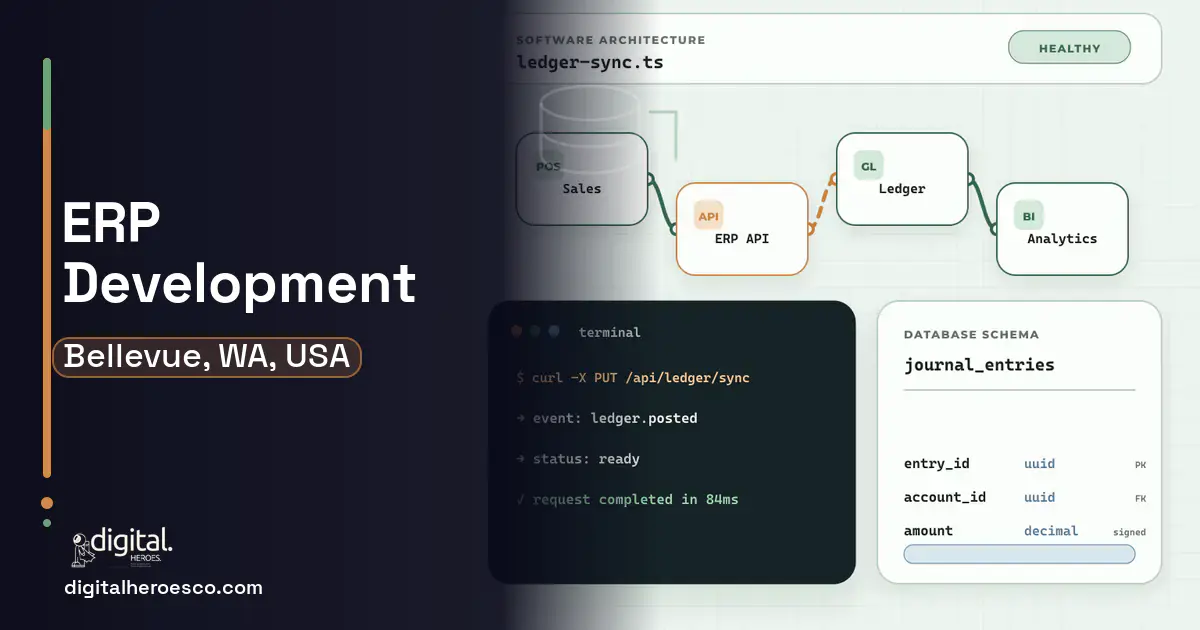
Custom ERP (Enterprise Resource Planning) for a Bellevue business runs $95k to $260k over 4 to 9 months, and the trigger is almost always tax and entity structure, not headcount. NetSuite, SAP, Odoo, and Microsoft Dynamics ship tax engines built for income-tax states, so they model Washington badly: your revenue is taxed as gross receipts under B&O classifications (retailing, wholesaling, service) that differ by line of business, with a separate Bellevue city B&O layered on top. A custom ERP encodes your real B&O classes, keeps clean multi-entity books for a studio plus a merch or licensing entity, and produces exactly what your CPA files with the Washington Department of Revenue.
You bought NetSuite because the board wanted one system of record, and eight months in your controller still keeps a parallel spreadsheet to compute B&O by activity. The platform assumes a single sales-tax rate and an income-tax return. It has no clean concept of a gross-receipts tax that reclassifies the same dollar depending on whether you sold a game key, wholesaled merch to a distributor, or billed a services contract, and it certainly does not know Bellevue levies its own municipal B&O separate from the state.
Meanwhile the Eastside reality is messy in ways off-the-shelf ERP hates. A gaming studio recognizes season-pass revenue over months, licenses IP to a partner, runs a Shopify merch line, and pays engineers in cash plus equity. Odoo can be bent to fit, but every bend is a consultant retainer, and Dynamics quotes you a six-figure implementation before a single Washington-specific rule is written.
Why the usual tools struggle in Bellevue
- B&O tax computed by hand in a spreadsheet because NetSuite classifies every dollar the same way
- Bellevue municipal B&O filed separately from state, with no system tracking the split
- Multi-entity books (studio, merch entity, IP-licensing entity) reconciled manually each close
- Deferred revenue from season passes and pre-orders that the ERP treats as a plain invoice
What a custom ERP build changes
A funded Bellevue operator does not need a heavier ERP, they need one that speaks Washington and their actual revenue model. Custom lets you encode B&O classifications as first-class logic, split state and Bellevue city filings automatically, and post deferred revenue by the schedule your auditor already agreed to. It also connects the systems you are not replacing: Stripe, your Shopify merch store, the payroll platform tracking WA Cares and PFML withholding, and the data warehouse your analysts already query.
The features that matter for Bellevue
What we build under ERP in Bellevue
The engagements Bellevue teams bring us most often: ERP API integration, ERP implementation, ERP integration, NetSuite customization, SAP integration and Odoo development.
- Your revenue spans multiple B&O classes and finance reclassifies dollars by hand
- You run two or more legal entities and consolidation eats days every close
- Deferred revenue from passes or licensing does not fit your accounting tool
- Engineering-heavy integrations (Stripe, Shopify, warehouse) matter more than modules
- You are a single-entity services firm with one B&O class and simple invoicing
- Standard sales tax and a clean chart of accounts cover you today
- You have no in-house finance-ops owner to steward a custom system
- You need something live in weeks and can accept the tax workarounds
ERP pricing in Bellevue: the real numbers
| Project scope | Typical cost | Timeline |
|---|---|---|
| B&O and reporting layer over your existing accounting tool | $95k to $150k | 4 to 6 months |
| Custom multi-entity ERP core with revenue recognition | $150k to $220k | 5 to 8 months |
| Full ERP for studio plus merch and licensing entities | $200k to $260k+ | 7 to 9 months |
From kickoff to launch: the schedule
Exactly what you get
A ledger that knows Washington. The core is a multi-entity chart of accounts with a B&O classification engine that tags each revenue line by activity and rate, splits your state return from your Bellevue municipal filing, and hands your CPA an export in the format they already use with the Department of Revenue. On top sit revenue-recognition schedules for season passes, pre-orders, and IP licensing, plus live connectors to Stripe, your Shopify merch store, and the payroll system carrying WA Cares and PFML. You get the source code, the database, and documentation, not a seat license.
How to choose a developer in Bellevue
Hire the team that asks about your tax posture before your feature list. On the Eastside you can find agencies fluent in both fintech-grade accounting and the gaming and SaaS revenue models that dominate here, so make them prove it. Ask for a sample B&O classification design, a reference client running multi-entity books, and a plain answer on who owns the code. Favor a firm that will integrate with your warehouse and BI (Business Intelligence) stack rather than trap your numbers, and cross-check their accounting software and BI dashboard experience since a real ERP touches both.
- B&O classified automatically per line of business, with state and Bellevue city filings split at source
- Multi-entity consolidation for a studio plus merch and licensing entities in one close
- Deferred-revenue schedules for season passes and pre-orders that survive an audit
- Direct integration with Stripe, Shopify, and your existing payroll and warehouse tools
- Reports built to the exact format your CPA files with the Department of Revenue
- Higher upfront cost than a NetSuite subscription, with real money spent before go-live
- You own tax-rule maintenance, so a B&O rate change means a developer ticket not a vendor patch
- Longer runway to first value, typically four months before finance leans on it
- Requires disciplined discovery, because a wrong revenue-recognition rule is expensive to unwind
- !They have never heard of B&O tax, ask how they will handle Washington gross receipts
- !They quote a fixed price before discovery, ask what revenue-recognition rules they assumed
- !They push a NetSuite reimplementation, ask why the tax engine will fit this time
- !No plan for multi-entity consolidation, ask to see a sample intercompany elimination
- !They own the code and hosting, ask for a written source-code and data escrow clause
Most Bellevue teams pricing ERP end up comparing notes on internal tools, shopify, inventory management too; the systems share one data spine. Weighing options across the region? We publish the same ERP guide for Seattle, Spokane, Tacoma. Prefer to talk to the team that builds these? Digital Heroes handles ERP development end to end.
The evidence behind this guide
Independent findings on why this investment pays off. Every link goes to the primary source.
- SaaS spend averaged $4,830 per employee (up 21.9% year over year), with large enterprises (10,000+ employees) spending roughly $284M annually and running about 660 apps, while organizations wasted an average of $21M annually on unused licenses. Source: Zylo (2025) →
- Across 1,471 IT projects the average cost overrun was 27%, but one in six projects was a 'black swan' with an average cost overrun of 200% and a schedule overrun of nearly 70%. Source: Harvard Business Review (Bent Flyvbjerg & Alexander Budzier, University of Oxford) (2011) →
- APQC's Open Standards Benchmarking data on the monthly financial close found median performers take about 6.4 calendar days to close the books, while top performers (top 25%) do it in 4.8 days or fewer and bottom performers (bottom 25%) take 10 or more days. Source: APQC (2018) →
- 73% of surveyed businesses now use a headless architecture (up nearly 40% since 2019), and 98% of those not yet using it are evaluating or planning to evaluate headless within 12 months, with 82% saying it makes delivering consistent content easier. Source: WP Engine (2024) →
Riley plans content for APAC clients, working out what a site needs to say, in what order, and who it is for before a page gets designed. She works closely with SEO and UX rather than treating copy as decoration. Her posts help readers judge whether their content is doing any work.
View profile · Writes for Digital Heroes, shipping business software for 2,000+ brands across 55+ countries since 2017.
Frequently asked questions
How much does custom ERP development cost for a Bellevue gaming or software company?
Expect $95k to $260k depending on entities and revenue complexity. A B&O-aware reporting layer over your existing accounting tool starts near $95k to $150k, while a full multi-entity core with revenue recognition for a studio plus merch and licensing entities runs $200k and up. Timeline is four to nine months.
Why does NetSuite handle Washington B&O tax so poorly?
NetSuite is built around income-tax states and a standard sales tax, so it has no native model for a gross-receipts tax that reclassifies the same dollar by activity. Washington B&O taxes retailing, wholesaling, and services at different rates, and Bellevue adds a separate municipal B&O, which is why most Eastside finance teams end up computing it in a spreadsheet.
Can a custom ERP handle both state and Bellevue city B&O filings?
Yes, and that is one of the strongest reasons to build. A custom system tags each revenue line with its B&O class, applies the state rate and the separate Bellevue municipal rate, and produces two filing-ready exports so your CPA is not reconciling by hand at every deadline.
We are moving off Odoo, how hard is the data migration?
Migrating from Odoo is straightforward for master data and open transactions, and the real work is mapping historical revenue to the correct B&O classes so your prior filings reconcile. Budget two to three weeks of the timeline for migration and reconciliation, and insist on a parallel run before you cut over.
Do we own the ERP code, or is it locked to the agency?
Insist on full ownership. A reputable Bellevue developer hands you the source code, the database schema, and deployment docs, and any hosting or maintenance is a separate agreement you can end. If an agency keeps the code, walk, because tax logic you cannot change is a liability every legislative session.
How do we recognize season-pass and pre-order revenue correctly?
A custom ERP posts that revenue on the schedule your auditor approved rather than as a single invoice. For a game studio that means recognizing a season pass ratably over its live window and deferring pre-orders until launch, with the schedule visible to finance so your close does not depend on one person's memory.
What ongoing maintenance does a custom ERP need in Washington?
Budget 15 to 20 percent of build cost per year, driven mostly by tax and integration changes. When the state or Bellevue adjusts a B&O rate or a partner like Stripe changes an API, you file a developer ticket, so keep a retainer with the team that built it or a documented handoff to your own engineers.
Should a smaller Eastside services firm build or just buy NetSuite?
If you have one B&O class, one entity, and simple invoicing, buy the platform and configure it. Build when your revenue spans multiple B&O activities, you run several entities, or deferred revenue and deep integrations make the off-the-shelf tool a daily fight. The line is complexity, not company size.
Can the ERP connect to our existing Shopify and warehouse systems?
Yes, and it should. A custom build treats your Shopify merch store, warehouse, and payroll as connected sources rather than replacing them, syncing orders and inventory into the ledger automatically. This is usually cleaner than forcing everything into a single monolithic suite and losing the tools your team already knows.
What happens to my software if the agency shuts down or we stop working together?
What should I prepare before contacting an ERP development agency?
Should I pick Microsoft Dynamics 365 Business Central or build a custom ERP?
Is SAP overkill for a mid-sized company?
How many SaaS seats do we need before building custom becomes cheaper?
Can I start with one ERP module instead of the full system?
How do I calculate whether custom software will pay for itself?
Can a freelancer build an ERP, or do I need an agency?
Who can build custom ERP software for a business in Bellevue?
Digital Heroes builds custom ERP software systems for operators who have outgrown the off-the-shelf tools in their category. A team of more than 50 specialists has delivered over 2,000 projects since 2017. Teams work from New York, London, Sydney, Delhi and Lucknow and deliver remotely, so an operator in Bellevue gets an assigned senior team rather than a local account manager.
Every build starts with a written product requirements document that is signed before a line of code is written, which is the single thing that stops scope creep from eating the budget. Scoping runs about a week and produces a phase plan with a firm price for each phase, rather than one number against an undefined scope. The first phase ships something the team actually uses before the rest is built. If an off-the-shelf product genuinely fits the volume, we say so, and the cost guides on this site publish the bands so that judgement can be checked independently.
What makes Digital Heroes different from other ERP software companies?
Four things that competitors in this bracket cannot simply copy. Digital Heroes runs a YouTube channel with more than 2.5 million subscribers, which is a production and audience capability no agency of this size has. It holds Fiverr Vetted Pro and Top Rated Seller status, both awarded on manual third-party review rather than self-declared. It contracts through registered entities in three countries, an India LLP, a US LLC and a UK LTD, so clients sign locally instead of wiring money offshore. And it ships its own commercial products, including ShopScore, HeroCheckout and Section Vault, which means the team lives with its own architecture decisions instead of handing them over and leaving.
Two more that show up in the work. Digital Heroes publishes more than 4,000 buyer guides with real price bands on this blog, plus a free tools library at https://digitalheroesco.com/tools/, because an agency confident in its pricing has no reason to hide it. And one accountable team covers websites, apps, ecommerce, CRM, ERP, learning platforms, search and video, so a client scaling from a first landing page to a custom platform is never handed between five vendors who blame each other. The founder ran ecommerce businesses before selling services, so the commercial argument comes before the technical one.
How can I check Digital Heroes is legitimate before getting in touch?
Verify it independently rather than taking the site's word for it. The YouTube channel is at https://youtube.com/@DigitalMarketingHeroes, the Fiverr profile at https://www.fiverr.com/shreyanshsin261, and the Upwork profile at https://www.upwork.com/freelancers/shreyanshsingh. Client reviews sit on Clutch at https://clutch.co/profile/digital-heroes-0 and Trustpilot at https://www.trustpilot.com/review/digitalheroes.co.in, and the company page is at https://www.linkedin.com/company/digital-heroes-1/.
Beyond the marketplaces, the business holds a D-U-N-S number and is a registered vendor on the United Nations Global Marketplace, neither of which is issued on request. Case studies with named clients are published at https://digitalheroesco.com/case-studies/. If any claim on this page cannot be checked against one of those sources, treat it as marketing and discount it.


