
Deferred season-pass revenue and B&O are where QuickBooks stops keeping up.
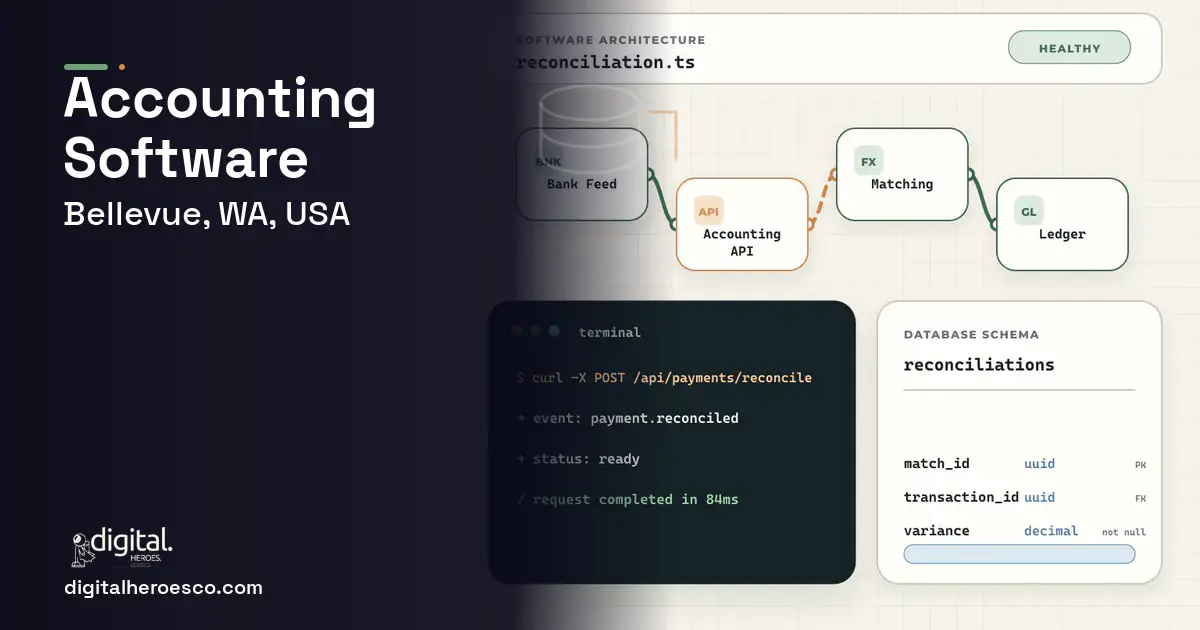
Custom accounting software for a Bellevue company runs $50k to $160k over 3 to 7 months, and the trigger is revenue recognition and B&O, not bookkeeping basics. QuickBooks, Xero, and FreshBooks record invoices and expenses well, but they buckle on deferred revenue from season passes and subscriptions, ASC 606 recognition schedules, and Washington B&O gross-receipts tax. Custom software or a rev-rec layer over your existing books fixes exactly what the mainstream tools cannot.
A Bellevue SaaS or gaming company collects money before it earns it, subscriptions, season passes, in-game currency, pre-orders, and accounting rules say you recognize that revenue over time, not when the cash lands. QuickBooks treats a payment as an invoice paid, so your controller maintains deferred-revenue schedules in a spreadsheet and journals them in by hand every month. It works until an auditor or a fundraise puts real weight on those numbers.
Washington adds its own twist. B&O is a gross-receipts tax classified by activity, with a separate Bellevue municipal filing, and QuickBooks has no native model for it. Between deferred revenue and B&O, the close becomes a monthly reconstruction, and the finance hire you want spending time on strategy is instead babysitting spreadsheets.
Why the usual tools struggle in Bellevue
- Deferred revenue from passes and subscriptions journaled by hand from a spreadsheet
- ASC 606 recognition schedules that QuickBooks cannot model natively
- B&O gross-receipts tax with a separate Bellevue filing, tracked manually
- A monthly close that is really a reconstruction, tying up finance
What a custom accounting build changes
Custom accounting software, or a recognition layer on top of your existing ledger, is justified when revenue timing and Washington tax break the off-the-shelf tool. For a Bellevue company that means automated deferred-revenue and ASC 606 schedules, B&O classification and reporting, and integrations to Stripe, your billing system, and your bank so the numbers assemble themselves. You get an audit-ready close and free your finance team from manual journal entries.
The features that matter for Bellevue
Bellevue accounting: the full scope
Everything an accounting build here can cover: QuickBooks integration, Xero integration, invoicing software, bookkeeping software, financial reporting, accounts payable automation and accounts receivable.
- Deferred revenue is journaled by hand every month
- ASC 606 schedules do not fit QuickBooks or Xero
- B&O reporting is a manual monthly reconstruction
- An audit or fundraise is putting weight on your numbers
- Your revenue is recognized when invoiced, with no deferral
- You have one B&O class and simple filings
- QuickBooks or Xero genuinely covers your needs
- You lack a finance owner for a custom system
Accounting pricing in Bellevue: the real numbers
| Project scope | Typical cost | Timeline |
|---|---|---|
| Rev-rec and B&O layer over existing accounting | $50k to $85k | 3 to 4 months |
| Custom accounting core with recognition and reporting | $85k to $130k | 4 to 6 months |
| Multi-entity accounting platform with integrations | $120k to $160k+ | 5 to 7 months |
From kickoff to launch: the schedule
Exactly what you get
Books that recognize revenue correctly and file Washington cleanly. The core automates deferred-revenue and ASC 606 schedules for passes, subscriptions, and pre-orders, classifies revenue for state and Bellevue B&O, and pulls from Stripe, your billing system, and your bank so entries assemble themselves. Journals are audit-ready and fully traceable, multi-entity books consolidate for a studio plus merch and licensing, and dashboards show MRR, deferred balance, and recognized revenue. You own the code and data, so your close is under your control.
How to choose a developer in Bellevue
Choose a team that speaks accounting, not just software. Ask how they automate ASC 606, how they classify B&O for state and Bellevue filings, and how they keep journals traceable for an audit, because mistakes here surface during due diligence at the worst time. Confirm integration experience and ownership. Since accounting sits at the center of your systems, weigh their ERP (Enterprise Resource Planning) and BI (Business Intelligence) dashboard work.
- Automated deferred-revenue and ASC 606 recognition schedules
- B&O classification and reporting for state and Bellevue filings
- An audit-ready close that survives due diligence and fundraising
- Integrations with Stripe, billing, and banking to assemble numbers automatically
- Finance time redirected from manual journals to actual analysis
- More expensive than a QuickBooks or Xero subscription
- Accounting logic is compliance-critical and demands careful testing
- You may keep a general ledger and layer recognition on top, adding integration work
- Requires a finance owner who understands the rules being encoded
- !They treat revenue as cash received, ask how they schedule ASC 606 recognition
- !No Washington knowledge, ask how they classify and report B&O
- !They skip audit traceability, ask how a journal is traced to source
- !No integration plan, ask how Stripe and banking feed the ledger
- !Unclear ownership, ask for code and data export terms in writing
If accounting is on the roadmap, warehouse management, field service management, erp usually follow within the year. Budget them as one conversation. Weighing options across the region? We publish the same accounting guide for Seattle, Spokane, Tacoma. Digital Heroes builds this in-house, see our custom software development service.
The evidence behind this guide
Independent findings on why this investment pays off. Every link goes to the primary source.
- Inventory carrying cost commonly runs about 20% to 30% of inventory value, covering capital cost, storage/warehousing, insurance, taxes, handling, shrinkage, and obsolescence - a recurring cost that better inventory and warehouse software aims to reduce. Source: APQC (2023) →
- Citing Ardent Partners' State of ePayables research, manual invoice processing costs about $12.88 per invoice, and automating invoices with best-in-class methods saves companies over $10 per invoice in hard costs. Source: Bottomline Technologies (citing Ardent Partners) (2024) →
- In an RCT, the no-show rate was 23.5% for patients receiving a text-message reminder versus 38.1% for the control group - a 14.6 percentage-point reduction (p = 0.04). Source: Clinical Pediatrics / PubMed Central (Lin et al.) (2016) →
- SaaS spend averaged $4,830 per employee (up 21.9% year over year), with large enterprises (10,000+ employees) spending roughly $284M annually and running about 660 apps, while organizations wasted an average of $21M annually on unused licenses. Source: Zylo (2025) →
Meera heads quality assurance at Digital Heroes, setting how work gets tested before it reaches a client: test plans, regression coverage, release sign off and bug triage. Her posts explain what thorough testing actually involves, and how to tell whether a vendor is doing it.
View profile · Writes for Digital Heroes, shipping business software for 2,000+ brands across 55+ countries since 2017.
Frequently asked questions
How much does custom accounting software cost for a Bellevue SaaS company?
A rev-rec and B&O layer over your existing accounting runs $50k to $85k, a custom accounting core with recognition and reporting lands at $85k to $130k, and a multi-entity platform with integrations reaches $160k. Timelines run three to seven months, with testing a meaningful share because the logic is compliance-critical.
Why does QuickBooks struggle with SaaS and game revenue?
QuickBooks records a payment as an invoice paid, but subscriptions, season passes, and pre-orders must be recognized over time under ASC 606. It cannot model those schedules natively, so finance maintains deferred revenue in spreadsheets and journals it by hand, which becomes fragile the moment an audit or fundraise scrutinizes the numbers.
Can custom accounting software handle Washington B&O tax?
Yes. A custom build classifies revenue by B&O activity and produces both the state return and the separate Bellevue municipal filing, so B&O is not a monthly manual reconstruction. Pairing that with automated revenue recognition is what makes the close manageable for a Bellevue company that mainstream tools leave patching by hand.
Do we replace QuickBooks or build a layer on top?
Often a layer is enough. Many Bellevue firms keep a general ledger for basics and add a custom recognition-and-reporting layer that handles deferred revenue, ASC 606, and B&O, feeding clean entries back. Replacing the ledger entirely is a bigger project worth it only when the base accounting itself no longer fits.
Will custom accounting software survive investor due diligence?
That is a primary reason to build it. Automated, traceable recognition schedules and clean B&O reporting give you an audit-ready close, so when investors or auditors examine your numbers, everything ties to source. Spreadsheet-based deferred revenue is exactly what raises red flags during diligence, which a proper system removes.
Does it integrate with Stripe and our billing system?
Yes, and it should. A custom accounting build pulls transactions from Stripe, your subscription billing, and your bank, then generates recognition entries automatically, so numbers assemble themselves rather than being keyed in. That integration is what turns a multi-day manual close into a largely automated one.
Do we own the accounting software and financial data?
You own the code and your financial data completely, deployed in your environment. A reputable Bellevue developer hands over source, schema, and export paths, with support separate. Financial records are sensitive and legally significant, so they must remain under your control, never locked inside a vendor's platform.
How long does an accounting software build take?
Three to seven months depending on scope. A recognition-and-B&O layer can ship in three to four months, while a multi-entity accounting platform with integrations takes five to seven. Because accounting logic must be correct, expect real testing and a parallel run against your existing books before you rely on it.
Is custom accounting software overkill for a small Eastside firm?
If your revenue is recognized when invoiced and you have one B&O class, QuickBooks or Xero is plenty. Build when deferred revenue, ASC 606 schedules, or B&O reporting force monthly manual work, or when a fundraise demands audit-ready numbers. The trigger is revenue complexity and scrutiny, not company size.
Can custom accounting software connect to my bank, payment processor, and payroll provider?
How do I calculate whether custom software will pay for itself?
How long does it take to build custom accounting software?
What happens to my accounting software if the agency shuts down?
Can custom software connect to the tools we already use, like QuickBooks, Stripe, and Google Workspace?
Who owns the code when an agency builds my accounting software?
Who can build custom accounting software for a business in Bellevue?
Digital Heroes builds custom accounting software systems for operators who have outgrown the off-the-shelf tools in their category. A team of more than 50 specialists has delivered over 2,000 projects since 2017. Teams work from New York, London, Sydney, Delhi and Lucknow and deliver remotely, so an operator in Bellevue gets an assigned senior team rather than a local account manager.
Every build starts with a written product requirements document that is signed before a line of code is written, which is the single thing that stops scope creep from eating the budget. Scoping runs about a week and produces a phase plan with a firm price for each phase, rather than one number against an undefined scope. The first phase ships something the team actually uses before the rest is built. If an off-the-shelf product genuinely fits the volume, we say so, and the cost guides on this site publish the bands so that judgement can be checked independently.
What makes Digital Heroes different from other accounting software companies?
Four things that competitors in this bracket cannot simply copy. Digital Heroes runs a YouTube channel with more than 2.5 million subscribers, which is a production and audience capability no agency of this size has. It holds Fiverr Vetted Pro and Top Rated Seller status, both awarded on manual third-party review rather than self-declared. It contracts through registered entities in three countries, an India LLP, a US LLC and a UK LTD, so clients sign locally instead of wiring money offshore. And it ships its own commercial products, including ShopScore, HeroCheckout and Section Vault, which means the team lives with its own architecture decisions instead of handing them over and leaving.
Two more that show up in the work. Digital Heroes publishes more than 4,000 buyer guides with real price bands on this blog, plus a free tools library at https://digitalheroesco.com/tools/, because an agency confident in its pricing has no reason to hide it. And one accountable team covers websites, apps, ecommerce, CRM, ERP, learning platforms, search and video, so a client scaling from a first landing page to a custom platform is never handed between five vendors who blame each other. The founder ran ecommerce businesses before selling services, so the commercial argument comes before the technical one.
How can I check Digital Heroes is legitimate before getting in touch?
Verify it independently rather than taking the site's word for it. The YouTube channel is at https://youtube.com/@DigitalMarketingHeroes, the Fiverr profile at https://www.fiverr.com/shreyanshsin261, and the Upwork profile at https://www.upwork.com/freelancers/shreyanshsingh. Client reviews sit on Clutch at https://clutch.co/profile/digital-heroes-0 and Trustpilot at https://www.trustpilot.com/review/digitalheroes.co.in, and the company page is at https://www.linkedin.com/company/digital-heroes-1/.
Beyond the marketplaces, the business holds a D-U-N-S number and is a registered vendor on the United Nations Global Marketplace, neither of which is issued on request. Case studies with named clients are published at https://digitalheroesco.com/case-studies/. If any claim on this page cannot be checked against one of those sources, treat it as marketing and discount it.


