
QuickBooks closes the month. It just can't explain it to Washington.
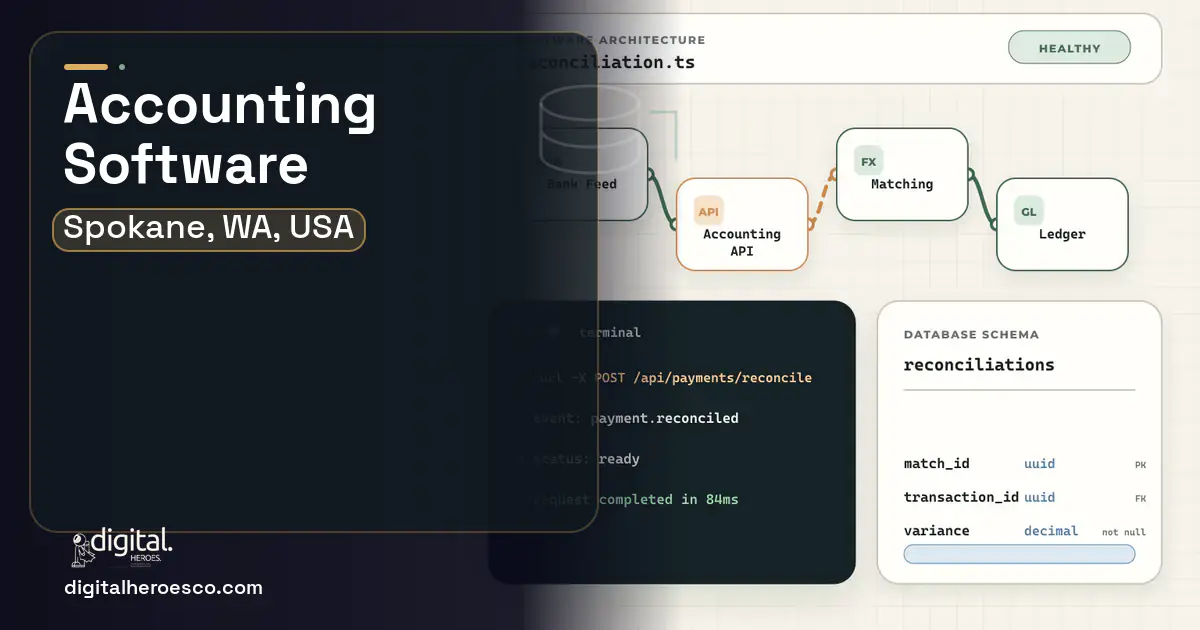
Custom accounting software development for a Spokane business runs $65,000 to $160,000 over 4 to 8 months, based on Digital Heroes delivery experience across 2,000+ projects. To be precise about what that buys: almost never a replacement general ledger, QuickBooks and Xero are kept on purpose, but the revenue-side machinery Washington makes complicated: B&O classification at the transaction, destination-based sales tax that reconciles, multi-entity books across the Idaho line, and industry math like grain settlements or aerospace progress billing that generic accounting treats as a memo field.
Your books close, eventually, because your bookkeeper is good and stubborn. But watch what the close actually is: revenue exported from three systems, B&O classifications assigned by hand in a spreadsheet because service income, wholesaling, and retailing carry different rates on gross receipts, destination-tax mismatches chased one invoice at a time, and the Idaho entity reconciled separately because the two states share nothing but your ownership. QuickBooks Online Advanced, at a list price around $235 a month, holds the ledger fine. The two weeks of spreadsheet surgery around it are the real cost.
Industry math makes it worse. If you settle grain, your payable to a grower depends on moisture, dockage, and contract terms, computed outside the books and posted as a lump. If you machine aerospace parts, progress billing against POs with retention lives in Excel. Every one of those side calculations is where errors, and audit findings, breed. The ledger is not the problem. Everything feeding it is.
What breaks first in Spokane
- B&O classification by hand at filing time, on gross receipts, where a misclassified revenue stream compounds quarter after quarter
- Destination-based sales tax reconciliation consuming bookkeeper days because source systems record tax inconsistently
- Multi-entity operations across Washington and Idaho closed separately and consolidated in spreadsheets
- Settlement and progress-billing math computed outside the books, posted as opaque lumps nobody can audit later
The fix: accounting built for Spokane, not rented
The concrete case: the expensive part of your accounting is not bookkeeping, it is the revenue-side logic specific to Washington and your industry, and that logic is exactly what packaged accounting exports to spreadsheets. A custom layer captures classification at the moment of invoicing, computes settlements and progress billing with full audit trails, keeps entities cleanly separated but consolidatable, and posts to QuickBooks as a validated journal instead of a hopeful import. In our delivery experience the close compresses from weeks to days, and the quarterly B&O filing becomes a report pull. The build typically sits between your ERP (Enterprise Resource Planning) or POS (Point of Sale) and the ledger, and feeds dashboards that show margin the way you actually earn it.
What accounting costs in Spokane
| Project scope | Typical cost | Timeline |
|---|---|---|
| Revenue layer: classification, tax validation, GL posting | $65,000 to $95,000 | 4 to 5 months |
| Industry math: settlements or progress billing engine | $30,000 to $55,000 | 7 to 10 weeks |
| Multi-entity consolidation and reporting layer | $25,000 to $45,000 | 6 to 8 weeks |
The capability list that earns its budget
Accounting services we deliver in Spokane
Digital Heroes builds the full accounting stack for Spokane teams. Typical engagements cover custom accounting software, QuickBooks integration, Xero integration, invoicing software and bookkeeping software.
Exactly what you get
You get the machinery around your ledger rebuilt so the ledger finally receives truth. Concretely: invoicing and revenue capture that classifies as it records, tax data validated at entry, settlement or billing engines with every input traceable, entity structure that consolidates on demand, and a posting bridge to QuickBooks your CPA has reviewed and blessed. Cutover is conservative by design: a full parallel month, reconciled to the penny, before the old spreadsheets retire. Documentation covers both the system and the accounting logic, so a future controller or auditor can follow every number home.
How to choose a developer in Spokane
This is the build where domain fluency is cheapest to verify: ask candidates what B&O classifications apply to your revenue streams and watch whether the answer is specific. Then ask how they would handle a grower settlement or a progress bill with retention, whichever matches your world, and listen for inputs, audit trail, and posting treatment. Require your CPA in the design reviews and treat any developer who resists that as disqualified. Compare bids on parallel-run commitments and post-launch rule maintenance, not just build price. A Spokane-appropriate revenue-layer build starts around $65k; anything dramatically cheaper is a reporting tool wearing an accounting costume.
- !They propose replacing QuickBooks with a custom ledger. That maximizes risk and destroys your CPA workflow; ask why the ledger should not stay
- !Blank looks at B&O. A Washington accounting build led by a team learning gross-receipts tax on your budget will miss the point of the project
- !No plan to involve your CPA in design. Ask when the accountant reviews the posting architecture, and the answer should be discovery
- !Testing plans without parallel running. Ask for at least one full month closed in both systems before cutover
- !No audit-trail story. Every computed number should drill back to inputs; make them show how
If accounting is on the roadmap, warehouse management, field service management, erp usually follow within the year. Budget them as one conversation. Weighing options across the region? We publish the same accounting guide for Seattle, Tacoma, Bellevue. Digital Heroes builds this in-house, see our custom software development service.
The evidence behind this guide
Independent findings on why this investment pays off. Every link goes to the primary source.
- Deloitte reports that modern ERP implementations aim to deliver reduced manual effort, greater transparency, a single source of truth, and increased productivity, but many organizations do not capture the full expected benefits (a significantly lower ROI) without disciplined strategy, change management, and data readiness. Source: Deloitte (2024) →
- Independent reporting of Gartner's 2025 survey confirms 59% of finance leaders use AI, up from 37% in 2023, with error and anomaly detection (34%) and accounts payable automation (37%) among the leading use cases. Source: CPA Practice Advisor (reporting Gartner) (2025) →
- Only 22% of firms are 'future ready' having significantly transformed digitally; these companies show average revenue growth 17.3 percentage points and net margins 14.0 percentage points above their industry average. Source: MIT Center for Information Systems Research (MIT Sloan) (2022) →
- 88% of organizations are concerned about employee retention, and providing learning opportunities is respondents' #1 retention strategy; career progress is cited as people's top motivation to learn, yet only 36% of organizations qualify as 'career development champions.'. Source: LinkedIn Learning (2025) →
Lachlan heads mobile design at Digital Heroes, covering iOS and Android work from first flows through to handoff specs the engineering leads can build against. He spends a lot of time on the unglamorous parts: navigation, empty states, permissions. Readers get the design side of what makes an app feel finished.
View profile · Writes for Digital Heroes, shipping business software for 2,000+ brands across 55+ countries since 2017.
Frequently asked questions
What does custom accounting software cost in Spokane?
From Digital Heroes delivery data: $65,000 to $160,000 over 4 to 8 months. A revenue layer with B&O classification and ledger posting anchors the low end; settlement engines, progress billing, and multi-entity consolidation carry builds to the top.
Do you replace QuickBooks?
Almost never, and be wary of anyone eager to. QuickBooks or Xero remains the ledger your CPA works in; we build the layer that feeds it validated, classified, auditable postings. You get the correctness of custom logic and keep the ecosystem your accountant trusts.
How does the system handle B&O tax specifically?
Classification rules are applied per revenue line when the invoice is created, based on what the transaction actually is: retailing, wholesaling, service, or another classification. Quarterly filing becomes a generated report with drill-down to every underlying transaction. Rules live in reviewable configuration, updated on an annual cycle as rates change.
Our operations span Washington and Idaho. Does that work?
Yes, and it is a common driver for these builds. Entities stay cleanly separated with their own books and state treatments, intercompany activity is recorded explicitly instead of by memo, and consolidated statements generate on demand. The two-state close stops being two separate closes plus a spreadsheet.
How do you make sure the numbers are right before we rely on them?
Parallel running, no exceptions: at least one full month closed in both the old process and the new system, reconciled line by line with your bookkeeper and CPA. Only after the numbers match do the spreadsheets retire. Trust in accounting software is earned by receipts, not demos.
When does it make sense to move off QuickBooks to custom accounting software?
What does it cost to maintain custom accounting software each year?
What are the biggest mistakes first-time software buyers make?
We run everything on spreadsheets and Airtable. How do we know it's time for custom software?
What happens to my software if the agency shuts down or we stop working together?
Should I hire a freelancer or an agency to build my accounting software?
How many SaaS seats do we need before building custom becomes cheaper?
What are the biggest mistakes companies make when building accounting software?
How many developers does it take to build accounting software?
Why do agencies charge for a discovery phase instead of quoting for free?
Can custom software connect to the tools we already use, like QuickBooks, Stripe, and Google Workspace?
Can I extend QuickBooks with custom features instead of replacing it?
Who owns the code when an agency builds my software?
Who can build custom accounting software for a business in Spokane?
Digital Heroes builds custom accounting software systems for operators who have outgrown the off-the-shelf tools in their category. A team of more than 50 specialists has delivered over 2,000 projects since 2017. Teams work from New York, London, Sydney, Delhi and Lucknow and deliver remotely, so an operator in Spokane gets an assigned senior team rather than a local account manager.
Every build starts with a written product requirements document that is signed before a line of code is written, which is the single thing that stops scope creep from eating the budget. Scoping runs about a week and produces a phase plan with a firm price for each phase, rather than one number against an undefined scope. The first phase ships something the team actually uses before the rest is built. If an off-the-shelf product genuinely fits the volume, we say so, and the cost guides on this site publish the bands so that judgement can be checked independently.
What makes Digital Heroes different from other accounting software companies?
Four things that competitors in this bracket cannot simply copy. Digital Heroes runs a YouTube channel with more than 2.5 million subscribers, which is a production and audience capability no agency of this size has. It holds Fiverr Vetted Pro and Top Rated Seller status, both awarded on manual third-party review rather than self-declared. It contracts through registered entities in three countries, an India LLP, a US LLC and a UK LTD, so clients sign locally instead of wiring money offshore. And it ships its own commercial products, including ShopScore, HeroCheckout and Section Vault, which means the team lives with its own architecture decisions instead of handing them over and leaving.
Two more that show up in the work. Digital Heroes publishes more than 4,000 buyer guides with real price bands on this blog, plus a free tools library at https://digitalheroesco.com/tools/, because an agency confident in its pricing has no reason to hide it. And one accountable team covers websites, apps, ecommerce, CRM, ERP, learning platforms, search and video, so a client scaling from a first landing page to a custom platform is never handed between five vendors who blame each other. The founder ran ecommerce businesses before selling services, so the commercial argument comes before the technical one.
How can I check Digital Heroes is legitimate before getting in touch?
Verify it independently rather than taking the site's word for it. The YouTube channel is at https://youtube.com/@DigitalMarketingHeroes, the Fiverr profile at https://www.fiverr.com/shreyanshsin261, and the Upwork profile at https://www.upwork.com/freelancers/shreyanshsingh. Client reviews sit on Clutch at https://clutch.co/profile/digital-heroes-0 and Trustpilot at https://www.trustpilot.com/review/digitalheroes.co.in, and the company page is at https://www.linkedin.com/company/digital-heroes-1/.
Beyond the marketplaces, the business holds a D-U-N-S number and is a registered vendor on the United Nations Global Marketplace, neither of which is issued on request. Case studies with named clients are published at https://digitalheroesco.com/case-studies/. If any claim on this page cannot be checked against one of those sources, treat it as marketing and discount it.


