
Square thinks tax is one number. Your registers ring sales in nine Washington jurisdictions plus Idaho.
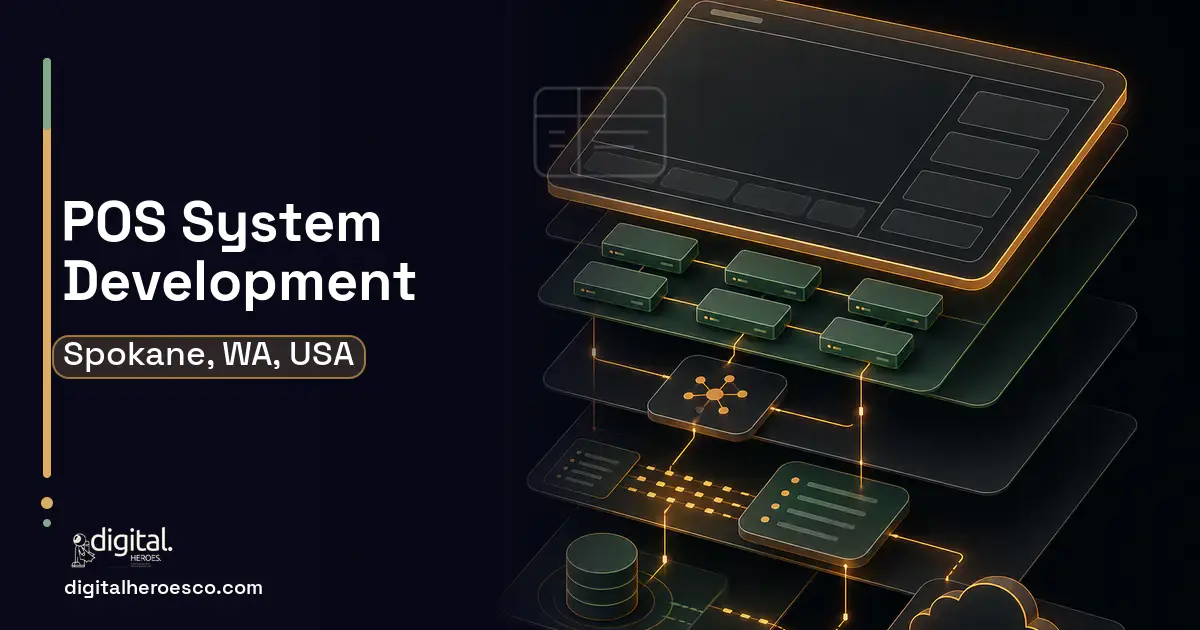
Custom POS (Point of Sale) system development for a Spokane retailer runs $60,000 to $150,000 over 4 to 7 months, based on Digital Heroes delivery experience across 2,000+ projects. The trigger is a checkout reality the national platforms flatten: Washington's destination-based sales tax across dozens of local jurisdictions, farm-use exemptions that must be documented at the register, house accounts settled monthly for growers, and stores on both sides of the Idaho line running different rules on the same brand. Square is superb for a single coffee counter. It was never designed for a border-straddling farm-and-ranch operation.
Your counter staff are fast, and the POS keeps making them slow. A wheat grower buys parts on the farm account, half the basket qualifies for an ag exemption that requires a certificate on file, and the delivery portion ships to a job site taxed at a different rate than the store. In Square that transaction is three workarounds and a sticky note; the reconciliation lands on your bookkeeper at month end, and the exemption documentation lands nowhere, which is precisely what a state auditor will notice.
Multiply by geography. Your Post Falls store runs Idaho's flat six percent and its own exemption logic; your Washington stores each sit in different local tax jurisdictions, and delivery sales tax by destination, not by store. Toast and Clover treat all this as an afterthought because their model customer sells sandwiches in one place. Meanwhile the house-account book, the real spine of an ag retail business, lives outside the POS entirely, in an aging AR system nobody dares touch during harvest.
Why the usual tools struggle in Spokane
- Destination-based Washington sales tax on delivered goods handled by manual override, producing filing-time reconciliation and audit exposure
- Ag and farm-use exemptions rung as generic tax-free sales with certificates filed in a drawer, not attached to transactions
- House accounts and monthly settlement living outside the POS, so credit limits and balances are invisible at the counter
- Two-state store networks forcing staff to remember which rules apply where, with turnover erasing that memory annually
What a custom POS build changes
The concrete case: checkout is where your compliance, credit, and customer relationships converge, and generic POS platforms model none of the three deeply. A custom POS built for this region rings the transaction correctly the first time: destination tax computed from the ship-to, exemption certificates attached and verified at tender, house accounts with live balances and limits at the register. In our delivery experience, the payoff shows up in three ledgers at once, faster lines during peak weeks, a bookkeeper who stops reconciling overrides, and an audit file that assembles itself. The POS integrates tightly with your inventory system for real-time availability, your accounting software for settlement, and a CRM (Customer Relationship Management) that finally knows what each account actually buys.
The features that matter for Spokane
POS services we deliver in Spokane
Everything a POS build here can cover: restaurant POS, Square alternative, Toast alternative, Clover and Lightspeed.
- Tax overrides and month-end reconciliation are a standing line item of bookkeeper hours
- Exempt sales are material to revenue and their documentation would not survive an audit
- House accounts drive your volume and live outside the register today
- You operate stores or deliveries across the Washington-Idaho line with different rule sets
- One location, walk-in retail, standard tax: Square or Clover with a 2.6 percent swipe fee is the rational answer
- Your pain is purely payment fees, which custom software does not remove
- Volume is too small to amortize $60k-plus against saved labor and reduced audit exposure
- You lack anyone to own hardware, uptime, and training across stores
POS pricing in Spokane: the real numbers
| Project scope | Typical cost | Timeline |
|---|---|---|
| Register core: checkout, offline mode, per-store rules | $60,000 to $90,000 | 4 to 5 months |
| Compliance layer: destination tax, exemptions, audit file | $25,000 to $40,000 | 6 to 9 weeks |
| House accounts, statements, and accounting integration | $20,000 to $40,000 | 5 to 8 weeks |
From kickoff to launch: the schedule
Exactly what you get
You get registers that encode your rules so staff do not have to remember them. Concretely: checkout screens tuned to your counter flow, a tax engine validated against your real transaction history across every jurisdiction you sell into, exemption and house-account handling built into tender, offline resilience with queued sync, and integrations that keep inventory and accounting continuously true. Delivery includes the physical layer: hardware selection, staging, and a pilot store running for weeks before the fleet converts. Post-launch you get monitoring with response commitments, because a register outage during harvest is not a ticket, it is an emergency, and the support model reflects that.
How to choose a developer in Spokane
Test candidates against your gnarliest real transaction: the split-tax, partially exempt, house-account sale with a delivery to a different jurisdiction. Teams that have built retail systems will ask clarifying questions and sketch the tender flow; teams that have built websites will change the subject. Insist on seeing offline behavior in a demo, pull the network cable and watch, because promises about resilience are cheap and implementations are not. Check the support commitment in writing with response times. On price, a border-aware multi-store POS below $50k means the compliance engine you actually need was quietly descoped; that discovery arrives at your first audit.
- Tax correctness by construction: jurisdiction and destination logic computed per line, not per sticky note
- Exemption certificates captured, attached to transactions, and verified before tender, closing the audit gap
- House accounts at the counter: live balances, credit limits, and statement generation without a separate AR system
- One system across Washington and Idaho stores, with per-location rules applied automatically
- Checkout speed engineered for peak season, because harvest week is your Black Friday and lines cost accounts
- Payment processing stays with certified processors; a custom POS orchestrates rather than replaces that layer, and processing fees continue
- Hardware selection, deployment, and spares become your responsibility, with a support plan to match
- A custom register cannot go down during harvest, so offline mode and monitoring are non-negotiable costs, not options
- A single-location shop with simple tax reality genuinely belongs on Square; custom is overkill until the rules bite
- !They have never shipped an offline-capable register. Rural connectivity is your reality; ask exactly what happens mid-transaction when the internet drops
- !Payment certification hand-waving. Ask which certified processors they integrate and who carries PCI scope
- !They call Washington tax a lookup table. Destination sourcing plus exemptions is workflow, not a table; make them walk through your grower transaction
- !No hardware opinion. A POS partner without tested register, printer, and scanner recommendations has not deployed one
- !Big-bang rollout across all stores. Ask which single store pilots first and for how long
Most Spokane teams pricing POS end up comparing notes on supply chain, business intelligence (BI) dashboards, booking & scheduling too; the systems share one data spine. Weighing options across the region? We publish the same POS guide for Seattle, Tacoma, Bellevue. Prefer to talk to the team that builds these? Digital Heroes handles custom software development end to end.
The evidence behind this guide
Independent findings on why this investment pays off. Every link goes to the primary source.
- Retailers connecting point-of-sale and loyalty data in an omnichannel strategy reported up to 15% lower cost per purchase and nearly 20% higher incremental store revenue. Source: Deloitte (2024) →
- Vendor case material reports that tableside/handheld mobile POS transmits orders directly to the kitchen and improves table turnover, with a hotel client example citing a 30% increase in table turns from faster handheld payment and service - illustrating the transaction-speed-to-revenue link in restaurant POS (qualitative vendor claim, not independent research). Source: NCR Voyix (2024) →
- Salesforce's field-service research (State of Service / field service trends, survey of 5,500+ service professionals) found that 74% of mobile workers report increasing workloads and 47% say appointments don't go as planned due to customer miscommunication, unaccounted-for parts, or insufficient appointment lengths and travel times. (The separate claim that admin tasks consume ~30% of a technician's hours is NOT supported by the report - the seventh-edition data instead states technicians spend about 18% of working hours, ~7 hours/week, on admin, and only ~32% of time interacting with customers.). Source: Salesforce (2024) →
- EMARKETER reports that over 54% of mobile commerce transactions now happen within shopping apps rather than mobile browsers, underscoring the app channel's growing dominance of m-commerce. Source: EMARKETER (2025) →
Sofia builds identity systems, the logo, type, color and rules that keep a brand consistent once it hits a website, an app and a hundred small places nobody planned for. Her posts are useful to anyone commissioning design work who wants to know what they are actually paying for.
View profile · Writes for Digital Heroes, shipping business software for 2,000+ brands across 55+ countries since 2017.
Frequently asked questions
What does custom POS development cost in Spokane?
Digital Heroes POS builds run $60,000 to $150,000 over 4 to 7 months. The register core with offline capability anchors the low end; destination-tax compliance, exemption management, and house-account integration carry multi-store builds toward the top.
Why is Washington sales tax such a problem for standard POS platforms?
Because Washington sources sales tax to the destination on delivered goods, and rates vary by local jurisdiction. A store selling over the counter and delivering across the region needs per-line, per-address logic plus documented exemptions. Generic platforms bolt this on with overrides, and overrides are what auditors find.
Do you handle payment processing too?
We integrate certified payment processors rather than building processing, which keeps you inside established PCI scope and keeps card liability where it belongs. You keep processor choice and can renegotiate rates independently. The custom layer owns everything around the payment: tax, exemptions, accounts, inventory.
What happens when the internet goes down at a rural store?
The register keeps selling. Transactions queue locally with the full rule engine still applied, cards process through offline-capable flows within the processor's limits, and everything syncs when the connection returns. We test this by unplugging things, repeatedly, before launch, because your busiest week will do the same.
Can it replace our separate house-account AR system?
Usually yes, and that consolidation is often the strongest line in the business case. Accounts, limits, aging, and statements move into the POS, and settled activity posts to your accounting system automatically. The counter finally sees what the office sees, which ends the awkward over-limit conversations after the fact.
If an agency builds my POS, who actually owns the source code?
Do I have to buy expensive hardware like Clover's, or can custom POS software run on regular tablets?
How do I calculate whether custom software will pay for itself?
What happens to a custom POS when the internet goes down?
Can a custom POS beat Square's 2.6% plus 10 cents processing rate?
Should we launch a POS MVP first or wait for the complete system?
Does my development team need to be located in Spokane?
What does it cost to keep custom software running after launch?
Is custom software more secure than off-the-shelf SaaS?
Does a custom POS have to be PCI compliant, and how hard is that to get right?
What tech stack should a custom POS be built on?
Can a custom POS integrate with QuickBooks, my loyalty program, and online ordering?
What are the biggest mistakes first-time software buyers make?
We run multiple restaurant locations on Toast. Would switching to a custom POS actually save money?
Who can build custom POS software for a business in Spokane?
Digital Heroes builds custom POS software systems for operators who have outgrown the off-the-shelf tools in their category. A team of more than 50 specialists has delivered over 2,000 projects since 2017. Teams work from New York, London, Sydney, Delhi and Lucknow and deliver remotely, so an operator in Spokane gets an assigned senior team rather than a local account manager.
Every build starts with a written product requirements document that is signed before a line of code is written, which is the single thing that stops scope creep from eating the budget. Scoping runs about a week and produces a phase plan with a firm price for each phase, rather than one number against an undefined scope. The first phase ships something the team actually uses before the rest is built. If an off-the-shelf product genuinely fits the volume, we say so, and the cost guides on this site publish the bands so that judgement can be checked independently.
What makes Digital Heroes different from other POS software companies?
Four things that competitors in this bracket cannot simply copy. Digital Heroes runs a YouTube channel with more than 2.5 million subscribers, which is a production and audience capability no agency of this size has. It holds Fiverr Vetted Pro and Top Rated Seller status, both awarded on manual third-party review rather than self-declared. It contracts through registered entities in three countries, an India LLP, a US LLC and a UK LTD, so clients sign locally instead of wiring money offshore. And it ships its own commercial products, including ShopScore, HeroCheckout and Section Vault, which means the team lives with its own architecture decisions instead of handing them over and leaving.
Two more that show up in the work. Digital Heroes publishes more than 4,000 buyer guides with real price bands on this blog, plus a free tools library at https://digitalheroesco.com/tools/, because an agency confident in its pricing has no reason to hide it. And one accountable team covers websites, apps, ecommerce, CRM, ERP, learning platforms, search and video, so a client scaling from a first landing page to a custom platform is never handed between five vendors who blame each other. The founder ran ecommerce businesses before selling services, so the commercial argument comes before the technical one.
How can I check Digital Heroes is legitimate before getting in touch?
Verify it independently rather than taking the site's word for it. The YouTube channel is at https://youtube.com/@DigitalMarketingHeroes, the Fiverr profile at https://www.fiverr.com/shreyanshsin261, and the Upwork profile at https://www.upwork.com/freelancers/shreyanshsingh. Client reviews sit on Clutch at https://clutch.co/profile/digital-heroes-0 and Trustpilot at https://www.trustpilot.com/review/digitalheroes.co.in, and the company page is at https://www.linkedin.com/company/digital-heroes-1/.
Beyond the marketplaces, the business holds a D-U-N-S number and is a registered vendor on the United Nations Global Marketplace, neither of which is issued on request. Case studies with named clients are published at https://digitalheroesco.com/case-studies/. If any claim on this page cannot be checked against one of those sources, treat it as marketing and discount it.


