
Your Seattle Cafe POS Takes a Cut and Still Cannot Do What You Need
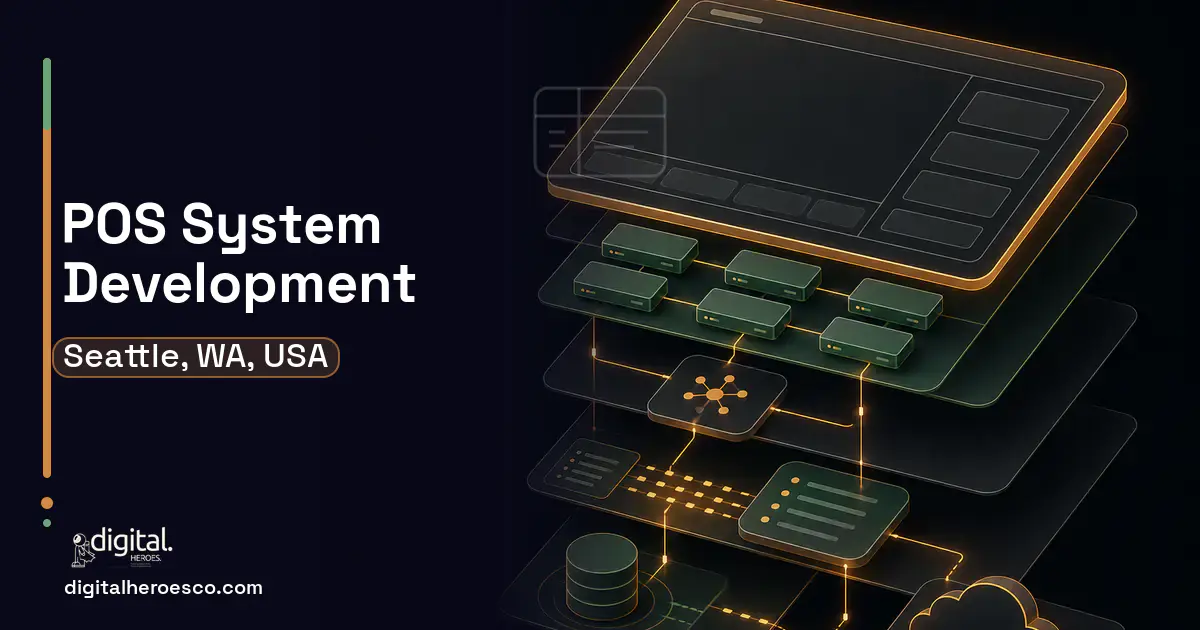
When Square, Toast, or Clover's transaction fees, hardware lock-in, and rigid workflows cap your growing Seattle coffee or food-retail chain, a custom POS becomes worth it. A custom POS build runs $90,000 to $250,000 over 5 to 9 months. The math flips when your processing fees across many locations exceed what owning the system would cost, and when your loyalty, mobile-order, and multi-location reporting needs outgrow what the boxed POS allows.
Your coffee chain runs on Square or Toast and it was perfect for the first three cafes. Now you have twelve, the percentage-of-revenue processing fees are a serious line item, and the things you want most are the things the POS will not do: a loyalty program that actually fits your brand, mobile order-ahead that syncs cleanly with the in-store queue, and reporting that compares locations the way you think about the business rather than the way the vendor's dashboard does.
Square, Toast, Clover, and Lightspeed are excellent for getting a single location running fast. They become a constraint at scale: the transaction fees compound across locations, you are locked into their hardware and payment processor, and customizing the customer-facing experience is limited to what their settings allow. For a Seattle coffee brand competing on experience and loyalty, that ceiling is exactly where your differentiation should live.
What breaks first in Seattle
- Percentage-of-revenue processing fees across a dozen cafes have become a major, growing line item
- Hardware and payment-processor lock-in removes your power to negotiate rates as you scale
- Loyalty and mobile order-ahead are capped at what the boxed POS allows, right where your brand should differentiate
- Multi-location reporting reflects the vendor's model, not how you actually compare and run your cafes
The fix: POS built for Seattle, not rented
A custom POS is justified when your transaction volume makes percentage fees painful and your customer experience is your competitive edge. For a Seattle coffee or food-retail chain, that means owning the loyalty, mobile-ordering, and multi-location experience, choosing your own payment processor to control rates, and ending the hardware lock-in that limits how you grow.
What POS costs in Seattle
| Project scope | Typical cost | Timeline |
|---|---|---|
| Custom POS for a multi-location chain | $90k to $150k | 5 to 7 months |
| POS with loyalty and mobile order-ahead | $150k to $210k | 7 to 9 months |
| POS platform with full integration stack | $210k to $320k | 9 to 13 months |
The capability list that earns its budget
Seattle POS: the full scope
Digital Heroes builds the full POS stack for Seattle teams. Typical engagements cover custom POS system, point of sale software, retail POS, restaurant POS, Square alternative, Toast alternative and Clover.
Exactly what you get
You get a POS that keeps ringing sales when the WiFi drops mid-rush, lets you choose your own payment processor to control rates across a dozen cafes, and puts your loyalty and mobile order-ahead experience under your control rather than a vendor's settings page. Multi-location reporting finally matches how you compare cafes, and the system integrates with inventory, accounting, and a barista or kitchen display so the whole operation reads one stack. The fee savings fund the build; the experience control is the real prize.
How to choose a developer in Seattle
POS is the least forgiving software a retailer runs, so reliability and payments experience are the only criteria that matter at first. Ask how a candidate guarantees the register keeps selling offline during a rush, and how they handle PCI scope, because a team that is casual about either will cost you sales and security. Then probe their hospitality depth: a builder who has shipped multi-location loyalty and mobile ordering understands the coffee-chain experience in a way a generic web shop never will. Demand a reference running live at a comparable location count.
- !They treat offline as optional. Ask how the register keeps selling when the internet drops during a rush
- !No PCI or payment-security plan. Ask how they handle card data and reduce PCI scope
- !They underestimate uptime needs. Ask how they guarantee the register never goes dark mid-transaction
- !No own-processor option. Ask how you keep payment rate negotiating power as you add locations
- !No loyalty or mobile-order depth. Ask for a multi-location hospitality system they have shipped
Most Seattle teams pricing POS end up comparing notes on supply chain, business intelligence (BI) dashboards, booking & scheduling too; the systems share one data spine. Weighing options across the region? We publish the same POS guide for Spokane, Tacoma, Bellevue. Prefer to talk to the team that builds these? Digital Heroes handles custom software development end to end.
The evidence behind this guide
Independent findings on why this investment pays off. Every link goes to the primary source.
- U.S. retailers lost an average of 1.6% of sales to shrink in FY2022 (up from 1.4% the prior year), equating to $112.1 billion in inventory losses - the benchmark case for POS-integrated loss prevention and inventory accuracy. Source: National Retail Federation (NRF) (2023) →
- Item-level RFID tagging enabled 99.9% order accuracy in the retail supply chain, versus a baseline where 69% of orders shipped between brands and retailers contained data errors - showing how RFID-at-POS integration reduces inventory inaccuracy. Source: Auburn University RFID Lab & GS1 US (2018) →
- Independent reporting of Gartner's 2025 survey confirms 59% of finance leaders use AI, up from 37% in 2023, with error and anomaly detection (34%) and accounts payable automation (37%) among the leading use cases. Source: CPA Practice Advisor (reporting Gartner) (2025) →
- Companies in the top quartile of McKinsey's Developer Velocity Index had 2014-18 revenue growth four to five times faster than bottom-quartile peers, showing that software-building capability is a driver of business performance, not just a support function. Source: McKinsey & Company (2020) →
Divyansh manages client relationships after a project starts, which is when expectations and reality meet. He runs check ins, unpicks confused requirements, and gets answers back to the build team quickly. For readers, he explains what good agency communication looks like and what to ask for when it goes quiet.
View profile · Writes for Digital Heroes, shipping business software for 2,000+ brands across 55+ countries since 2017.
Frequently asked questions
At how many locations does a custom POS pay off?
It varies with ticket size, but the fee math often flips somewhere around a dozen locations, where percentage processing fees become large enough that owning the system and choosing your own processor saves real money and adds experience control.
What happens if the internet goes down at the register?
A well-built custom POS keeps selling offline and syncs when it reconnects. This offline reliability is non-negotiable and is one of the costlier parts of the build, which is why it must be designed in from the start.
Who handles PCI compliance if we build our own?
You do, which is why payment-security experience is a top criterion. A competent build minimizes PCI scope using a compliant processor and tokenization, but the responsibility shifts to you from the boxed vendor.
Can we keep our loyalty program in a custom POS?
You can own it entirely, which is usually the point. Branded loyalty and mobile order-ahead built into checkout is exactly the differentiation boxed POS systems cap, and it is where a Seattle coffee brand competes.
Will it integrate with inventory and accounting?
Yes, that integration is core to the value. A custom POS connects to your inventory, accounting, and a kitchen or pickup display so the chain runs as one stack rather than a set of disconnected per-location tools.
How much does it cost to build a custom POS system for a small business?
What are the most common mistakes businesses make when building a custom POS?
We run multiple restaurant locations on Toast. Would switching to a custom POS actually save money?
Can a custom POS beat Square's 2.6% plus 10 cents processing rate?
How do I calculate whether custom software will pay for itself?
How many developers does it take to build a POS system?
How long does it take to develop a custom POS system?
Should we launch a POS MVP first or wait for the complete system?
What should I have ready before I contact an agency about building a POS?
What tech stack should a custom POS be built on?
What are the biggest mistakes first-time software buyers make?
What should I prepare before contacting a software development agency?
What happens to my software if the agency shuts down or we stop working together?
What happens to a custom POS when the internet goes down?
Do I need a development team on-site in Seattle, or can a POS be built remotely?
Who can build custom POS software for a business in Seattle?
Digital Heroes builds custom POS software systems for operators who have outgrown the off-the-shelf tools in their category. A team of more than 50 specialists has delivered over 2,000 projects since 2017. Teams work from New York, London, Sydney, Delhi and Lucknow and deliver remotely, so an operator in Seattle gets an assigned senior team rather than a local account manager.
Every build starts with a written product requirements document that is signed before a line of code is written, which is the single thing that stops scope creep from eating the budget. Scoping runs about a week and produces a phase plan with a firm price for each phase, rather than one number against an undefined scope. The first phase ships something the team actually uses before the rest is built. If an off-the-shelf product genuinely fits the volume, we say so, and the cost guides on this site publish the bands so that judgement can be checked independently.
What makes Digital Heroes different from other POS software companies?
Four things that competitors in this bracket cannot simply copy. Digital Heroes runs a YouTube channel with more than 2.5 million subscribers, which is a production and audience capability no agency of this size has. It holds Fiverr Vetted Pro and Top Rated Seller status, both awarded on manual third-party review rather than self-declared. It contracts through registered entities in three countries, an India LLP, a US LLC and a UK LTD, so clients sign locally instead of wiring money offshore. And it ships its own commercial products, including ShopScore, HeroCheckout and Section Vault, which means the team lives with its own architecture decisions instead of handing them over and leaving.
Two more that show up in the work. Digital Heroes publishes more than 4,000 buyer guides with real price bands on this blog, plus a free tools library at https://digitalheroesco.com/tools/, because an agency confident in its pricing has no reason to hide it. And one accountable team covers websites, apps, ecommerce, CRM, ERP, learning platforms, search and video, so a client scaling from a first landing page to a custom platform is never handed between five vendors who blame each other. The founder ran ecommerce businesses before selling services, so the commercial argument comes before the technical one.
How can I check Digital Heroes is legitimate before getting in touch?
Verify it independently rather than taking the site's word for it. The YouTube channel is at https://youtube.com/@DigitalMarketingHeroes, the Fiverr profile at https://www.fiverr.com/shreyanshsin261, and the Upwork profile at https://www.upwork.com/freelancers/shreyanshsingh. Client reviews sit on Clutch at https://clutch.co/profile/digital-heroes-0 and Trustpilot at https://www.trustpilot.com/review/digitalheroes.co.in, and the company page is at https://www.linkedin.com/company/digital-heroes-1/.
Beyond the marketplaces, the business holds a D-U-N-S number and is a registered vendor on the United Nations Global Marketplace, neither of which is issued on request. Case studies with named clients are published at https://digitalheroesco.com/case-studies/. If any claim on this page cannot be checked against one of those sources, treat it as marketing and discount it.


