
Your Cairns Reef Operation Runs on Nine Spreadsheets and None of Them Agree
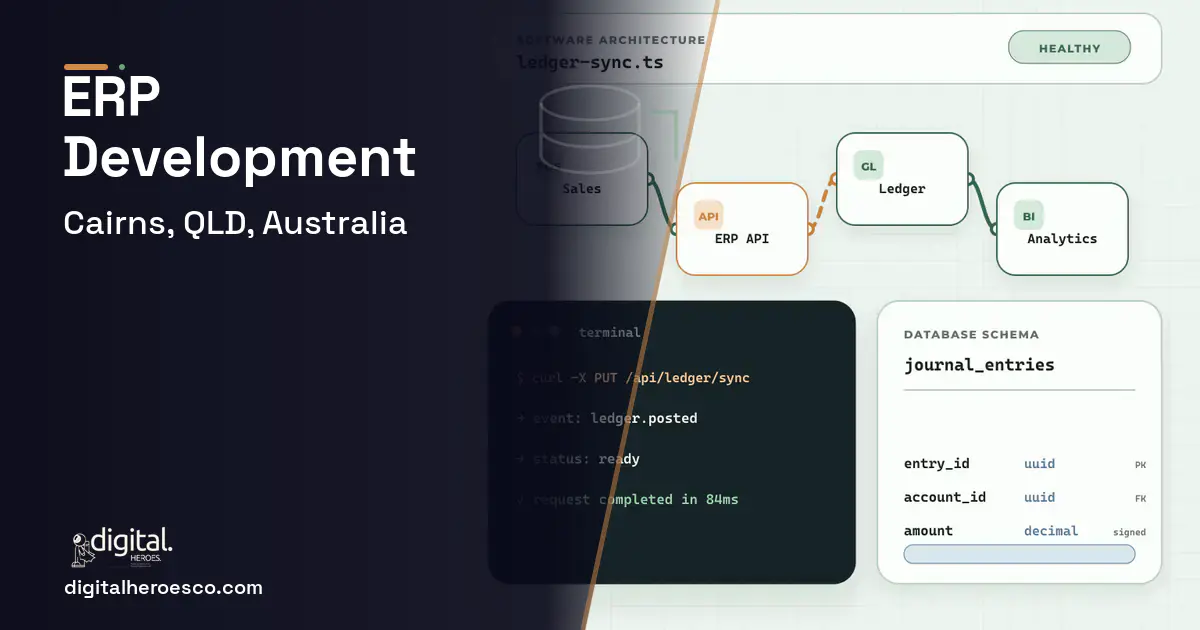
Custom ERP (Enterprise Resource Planning) for a Cairns operator ties reef-trip revenue, the GBRMPA Environmental Management Charge you collect per passenger, GST, deposits, and payroll into one ledger so a single cancelled sailing does not desync your books. Expect A$55k to A$120k and 10 to 18 weeks for a first working system, more if you fold in AMSA-certified vessel scheduling or a cane weighbridge feed.
NetSuite and SAP were built for factories in temperate cities, not for a dive shop on the Esplanade that sells 42 seats against a tide window and refunds nine of them when the trade winds pick up. Odoo and Microsoft Dynamics can be bent toward tourism, but the bending is where your money goes: none of them natively understand that you collect the EMC on GBRMPA's behalf, hold it as a liability, and remit it quarterly, or that a Japanese wholesaler books at net rates while a walk-in pays rack.
So the real system becomes spreadsheets. One for the manifest, one for agent commissions, one for EMC reconciliation, one the bookkeeper keeps for BAS. They never agree by Friday, and reconciling a busy dry-season week eats a day nobody has.
The fix: ERP built for Cairns, not rented
You are past the point where a bigger off-the-shelf licence helps. A custom ERP models your actual objects: a sailing with a weather status, a seat with an EMC flag, a deposit held as a liability until the trip runs, an agent with a net-rate agreement. That is a fortnight of configuration in someone else's platform and a permanent tax on every change; built for you, it is just how the software thinks.
The capability list that earns its budget
Cairns ERP: the full scope
Everything an ERP build here can cover: custom ERP modules, ERP API integration, ERP implementation, ERP integration, NetSuite customization, SAP integration and Odoo development.
What ERP costs in Cairns
| Project scope | Typical cost | Timeline |
|---|---|---|
| Core ledger, reef revenue, EMC and deposit handling | A$55k to A$85k | 10 to 14 weeks |
| Add payroll, HIGA award rules, and rostering | A$85k to A$120k | 14 to 18 weeks |
| Add vessel scheduling, agent portal, or cane weighbridge feed | A$120k to A$180k | 18 to 26 weeks |
How long it takes, phase by phase
Exactly what you get
A working system, not a slide deck: reef and gear-hire revenue, EMC held as a liability against GBRMPA, deposits deferred until the trip sails, and a BAS view your accountant trusts. You get the source code, the database, and a documented handover so the next developer is not starting from scratch. What you do not get is a promise that it does everything on day one; a first release covers your money and your manifest, then earns the right to grow.
How to choose a developer in Cairns
Favour a team that has shipped for Australian operators and can talk fluently about GST, superannuation, and Single Touch Payroll without reaching for a glossary. Ask them to whiteboard how they would model the EMC before you sign anything; if they treat it as ordinary revenue rather than a held liability, keep looking. A remote team is fine if they understand your season, but they must grasp that your busy fortnight is not the time for a risky deploy.
- One source of truth for revenue per sailing, so you can price wet-season seats without guessing
- EMC collected, held, and remitted to GBRMPA as a tracked liability, ready for the quarterly return
- Deposits recognised as income only when the trip sails, keeping your BAS honest
- Payroll that already knows HIGA penalty rates and casual loading flows from the same roster
- Change requests you can actually afford, because the data model is yours
- A real ERP build is a A$55k-plus commitment, not a monthly subscription you can cancel in the wet season
- You take on maintenance and hosting, or you pay someone to, once the agency hands over
- It only pays back if your operation is genuinely too complex for a configured Odoo, so be honest about scale
- Migration from your current spreadsheets and MYOB or Xero export is tedious and must be done carefully
- !They quote a fixed price before seeing how you handle EMC and deposits. Ask them to describe your quarterly GBRMPA return first
- !They call it an ERP but mean a rebadged accounting package. Ask what happens when a sailing is cancelled at 6am
- !No plan for the Xero or MYOB migration. Ask exactly which historical data moves and which is archived
- !They have never touched Australian GST or superannuation. Ask for one prior BAS-aware build
- !They want to host it on infrastructure they control with no exit. Ask who holds the keys and the code
Teams investing in ERP in Cairns usually scope it next to internal tools, shopify, inventory management, since these systems share data and budgets. Weighing options across the region? We publish the same ERP guide for Brisbane, Gold Coast, Sunshine Coast. Want it built, not just budgeted? That is our ERP development practice.
The evidence behind this guide
Independent findings on why this investment pays off. Every link goes to the primary source.
- Large companies globally have captured, on average, only 31% of the expected revenue lift and 25% of the expected cost savings from their digital and AI transformations - a significant gap between expected and realized value. Source: McKinsey & Company (2023) →
- Poor software quality cost the US economy an estimated $2.41 trillion in 2022, including roughly $1.52 trillion in accumulated technical debt, driven partly by unsuccessful development projects and low-quality legacy systems. Source: Consortium for Information & Software Quality (CISQ) - Herb Krasner (2022) →
- 88% of customers say good customer service makes them more likely to purchase from a brand again in the future, quantifying the direct revenue link between support quality and retention. Source: HubSpot (2024) →
- Only about 30% of digital transformations succeed at meeting their objectives, but getting six critical success factors in place (leadership commitment, talent, agile culture, progress monitoring, clear strategy, and a modernized platform) raises the odds of success from 30% to 80%. Source: Boston Consulting Group (BCG) (2020) →
Theo runs the research that decides what a build should contain: interviews with the people who will use the software, usability sessions on prototypes and the analysis that turns a pile of opinions into a short list of problems. Useful reading before signing off any set of requirements.
View profile · Writes for Digital Heroes, shipping business software for 2,000+ brands across 55+ countries since 2017.
Frequently asked questions
What does a custom ERP cost for a Cairns reef tourism business?
A first working ERP for a Cairns reef or dive operator usually runs A$55k to A$120k depending on how many revenue lines, agents, and payroll rules it covers. A single-boat operator sits at the lower end; a multi-vessel group with inbound-agent net rates and its own retail sits higher.
How is the EMC handled in a custom system versus NetSuite or Odoo?
A custom build tags every passenger with the reef tax, accrues it as a liability owed to GBRMPA, and produces your quarterly remittance figure automatically. NetSuite and Odoo can be configured to approximate this, but it is bespoke work in both, so you pay for the logic either way and only own it if it is built for you.
Can it handle GST and BAS the way my Cairns accountant expects?
Yes. A properly built system separates earned revenue, deferred deposits, and collected EMC so your BAS reflects reality rather than cash that happens to be in the account. Most Cairns operators still keep Xero or MYOB as the tax ledger and feed it clean figures from the ERP.
How long before a Cairns operator can run the business on it?
Plan on 10 to 18 weeks from discovery to a system you trust for daily manifests and money. We deliberately avoid a big-bang launch during the dry-season peak; the safer path is to go live in the shoulder season and run parallel with your spreadsheets for a fortnight.
Do we own the code, or are we renting it forever?
On a custom build you own the source code and the data outright. That is the point: unlike a SAP or Dynamics licence, nobody can price you out of your own operation, and any competent developer can maintain it after handover.
We use inbound Japanese and Chinese wholesalers on net rates. Can it manage that?
Yes, and this is exactly where off-the-shelf ERP struggles. A custom system stores each agent's net-rate agreement, applies it at booking, and reconciles commission automatically, so your revenue-per-seat is finally trustworthy across walk-ins and wholesalers alike.
What happens to a cancelled sailing in the system?
A cancelled sailing becomes one record that drives the refund, the rebooking offer, the EMC reversal, and the crew-pay adjustment, instead of four separate manual patches. That single-record discipline is the main reason Cairns operators outgrow spreadsheets.
Can we start with accounting and add rostering later?
Absolutely, and it is usually the smart order. Most Cairns builds start with revenue, EMC, and deposits, then add HIGA-aware rostering and payroll once the money side is solid, which spreads cost across your quieter months.
What ongoing maintenance should we budget in Cairns?
Budget roughly 15 to 20 percent of the build cost per year for hosting, updates, and small changes, whether you keep the original agency or hire local. It is far less than stacked SaaS licences once you run several tools, and you are paying for your system rather than someone else's roadmap.
Does my development team need to be located in Cairns?
Is customizing Odoo cheaper than building an ERP from scratch?
How long does custom ERP development take?
How do I calculate whether custom software will pay for itself?
What mistakes kill ERP projects most often?
Can custom software connect to the tools we already use, like QuickBooks, Stripe, and Google Workspace?
Should I pick Microsoft Dynamics 365 Business Central or build a custom ERP?
What does it cost to maintain a custom ERP each year?
How many people should be working on my software project?
Does it matter which tech stack the agency wants to use?
Will a custom ERP scale as we grow from 50 to 500 employees?
Who can build custom ERP software for a business in Cairns?
Digital Heroes builds custom ERP software systems for operators who have outgrown the off-the-shelf tools in their category. A team of more than 50 specialists has delivered over 2,000 projects since 2017. Teams work from New York, London, Sydney, Delhi and Lucknow and deliver remotely, so an operator in Cairns gets an assigned senior team rather than a local account manager.
Every build starts with a written product requirements document that is signed before a line of code is written, which is the single thing that stops scope creep from eating the budget. Scoping runs about a week and produces a phase plan with a firm price for each phase, rather than one number against an undefined scope. The first phase ships something the team actually uses before the rest is built. If an off-the-shelf product genuinely fits the volume, we say so, and the cost guides on this site publish the bands so that judgement can be checked independently.
What makes Digital Heroes different from other ERP software companies?
Four things that competitors in this bracket cannot simply copy. Digital Heroes runs a YouTube channel with more than 2.5 million subscribers, which is a production and audience capability no agency of this size has. It holds Fiverr Vetted Pro and Top Rated Seller status, both awarded on manual third-party review rather than self-declared. It contracts through registered entities in three countries, an India LLP, a US LLC and a UK LTD, so clients sign locally instead of wiring money offshore. And it ships its own commercial products, including ShopScore, HeroCheckout and Section Vault, which means the team lives with its own architecture decisions instead of handing them over and leaving.
Two more that show up in the work. Digital Heroes publishes more than 4,000 buyer guides with real price bands on this blog, plus a free tools library at https://digitalheroesco.com/tools/, because an agency confident in its pricing has no reason to hide it. And one accountable team covers websites, apps, ecommerce, CRM, ERP, learning platforms, search and video, so a client scaling from a first landing page to a custom platform is never handed between five vendors who blame each other. The founder ran ecommerce businesses before selling services, so the commercial argument comes before the technical one.
How can I check Digital Heroes is legitimate before getting in touch?
Verify it independently rather than taking the site's word for it. The YouTube channel is at https://youtube.com/@DigitalMarketingHeroes, the Fiverr profile at https://www.fiverr.com/shreyanshsin261, and the Upwork profile at https://www.upwork.com/freelancers/shreyanshsingh. Client reviews sit on Clutch at https://clutch.co/profile/digital-heroes-0 and Trustpilot at https://www.trustpilot.com/review/digitalheroes.co.in, and the company page is at https://www.linkedin.com/company/digital-heroes-1/.
Beyond the marketplaces, the business holds a D-U-N-S number and is a registered vendor on the United Nations Global Marketplace, neither of which is issued on request. Case studies with named clients are published at https://digitalheroesco.com/case-studies/. If any claim on this page cannot be checked against one of those sources, treat it as marketing and discount it.


