
ERP for Gold Coast operators when the summer rush snaps NetSuite in two
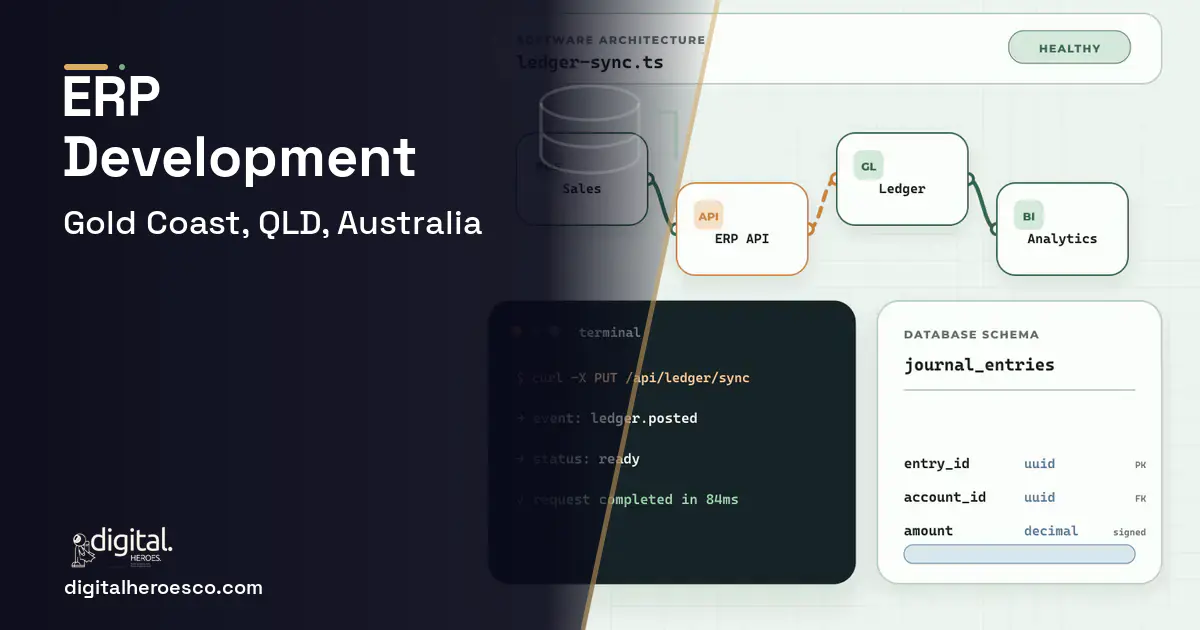
A custom ERP (Enterprise Resource Planning) ties your reservations, casual rostering, GST reporting and multi-venue finances into one system that holds up when Surfers Paradise fills for summer and empties by June. With Digital Heroes, a Gold Coast ERP build typically runs A$70k to A$200k over 4 to 7 months, and it is worth it once NetSuite or Dynamics licence tiers and add-on sprawl cost more than the problem they solve.
You run a hospitality group across Broadbeach and Surfers, or a property developer juggling QBCC progress claims, and your ERP was sold to you as one platform. In practice it is NetSuite for finance, a separate rostering tool for casuals, a booking engine that does not talk to either, and a spreadsheet that reconciles the gap every Monday. During Schoolies and the December school holidays the whole stack is under load and the seams show.
Off-the-shelf ERP like SAP, Odoo or Microsoft Dynamics assumes steady demand and permanent staff. Your revenue triples over summer and casual headcount swings weekly under the Hospitality Industry Award. The generic modules cannot model that, so you end up paying for user seats you only need eight weeks a year and bolting on integrations that break every time a vendor pushes an update.
- You run three or more venues or entities and reconcile them by hand every month
- Your seasonal swing makes per-seat SaaS licensing wasteful for most of the year
- You have a workflow, such as combined hospitality and property operations, that no single vendor models
- You are a single venue with steady trade where Xero plus a booking tool already covers you
- Your processes are standard enough that Odoo modules fit without heavy customisation
- You need something live in weeks and have no appetite for a discovery phase
- One live data model across venues, so a booking in Surfers updates finance, housekeeping and stock without an overnight batch
- Award and penalty-rate logic built in for the Hospitality and Restaurant awards, so labour cost is accurate before you roster
- GST at 10% and multi-entity BAS handled natively instead of reconciled by hand each quarter
- Seasonal user model that does not charge you permanent-seat pricing for eight weeks of casual staff
- You own the code and the roadmap, so a new venue or event line is a sprint, not a vendor upgrade cycle
- Higher upfront cost than a NetSuite subscription, and the value only lands if your seasonal complexity is real
- You carry hosting, security patching and support, either in-house or on a retainer, that a SaaS vendor would absorb
- A full ERP touches every department, so discovery and change management take real time from your operators
- Rebuilding finance from scratch is rarely wise when Xero plus a custom layer would do the same job cheaper
The honest cost picture for Gold Coast
| Project scope | Typical cost | Timeline |
|---|---|---|
| Focused ERP for one operation (finance plus one core workflow) | A$70k to A$110k | 4 to 5 months |
| Multi-venue ERP with reservations, rostering and finance | A$110k to A$160k | 5 to 6 months |
| Group ERP spanning hospitality and property with QBCC claims | A$160k to A$200k+ | 6 to 7 months |
Feature priorities for Gold Coast teams
Gold Coast ERP: the full scope
The engagements Gold Coast teams bring us most often: distribution ERP, custom ERP modules, ERP API integration, ERP implementation, ERP integration, NetSuite customization and SAP integration.
Exactly what you get
A working ERP shaped around your operation, not a demo. That means a live finance core with GST and multi-entity BAS, a reservation and capacity engine tuned to your seasonal peaks, casual rostering with award penalty rates and Single Touch Payroll, and dashboards that give owners one number instead of four spreadsheets. You get the source code, deployment on infrastructure you control, and documentation so the next developer is not starting blind. Where it makes sense, we integrate rather than rebuild, keeping Xero or your bank feeds and wrapping the custom logic around them.
How to choose a developer in Gold Coast
Look for a team that has shipped systems with real seasonal load and Australian payroll rules, not just brochureware. Ask to see how they handle award interpretation, GST and STP, because getting those wrong is expensive with the ATO and Fair Work. A local or Australian-timezone team matters when a booking bug hits on a Saturday in peak season. Push on ownership, hosting and what happens after launch, and favour a firm that will start with a paid discovery over one that quotes a full ERP sight unseen. Adjacent builds like a BI (Business Intelligence) dashboard or POS (Point of Sale) often come from the same team, so ask about the wider roadmap.
Timeline: what happens, and when
- !They quote a fixed price before seeing how your venues reconcile, ask instead for a paid discovery that maps your real data flows
- !No one mentions the Hospitality Industry Award or penalty rates, ask how they will model casual labour cost
- !They push a single off-the-shelf platform for everything, ask what they would build versus configure and why
- !No plan for peak-week load testing, ask how the system behaves during a December booking surge
- !Vague on code ownership, ask for a written clause that you own the repository and can hire another team later
Teams investing in ERP in Gold Coast usually scope it next to internal tools, shopify, inventory management, since these systems share data and budgets. Weighing options across the region? We publish the same ERP guide for Brisbane, Sunshine Coast, Townsville. Want it built, not just budgeted? That is our ERP development practice.
The evidence behind this guide
Independent findings on why this investment pays off. Every link goes to the primary source.
- In PMI's 2014 Pulse of the Profession report on requirements management, inaccurate requirements management is cited as a leading cause of project failure, with 47% of unsuccessful projects failing to meet goals due to poor requirements management. Source: Project Management Institute (PMI) (2014) →
- The Standish Group 1995 CHAOS Report found only 16.2% of software projects fully succeeded; success varied sharply by size, with large-company projects succeeding about 9% of the time versus far higher rates for small projects - best treated as an industry survey, not an audited dataset. Source: Standish Group (1995) →
- U.S. retailers lost an average of 1.6% of sales to shrink in FY2022 (up from 1.4% the prior year), equating to $112.1 billion in inventory losses - the benchmark case for POS-integrated loss prevention and inventory accuracy. Source: National Retail Federation (NRF) (2023) →
- Only about 30% of digital transformations succeed at meeting their objectives, but getting six critical success factors in place (leadership commitment, talent, agile culture, progress monitoring, clear strategy, and a modernized platform) raises the odds of success from 30% to 80%. Source: Boston Consulting Group (BCG) (2020) →
Lachlan heads mobile design at Digital Heroes, covering iOS and Android work from first flows through to handoff specs the engineering leads can build against. He spends a lot of time on the unglamorous parts: navigation, empty states, permissions. Readers get the design side of what makes an app feel finished.
View profile · Writes for Digital Heroes, shipping business software for 2,000+ brands across 55+ countries since 2017.
Frequently asked questions
What does a custom ERP cost for a Gold Coast hospitality group?
For a Gold Coast hospitality group, a custom ERP with Digital Heroes typically runs A$70k to A$200k depending on how many venues and entities you consolidate. A single-operation build with finance and one core workflow sits at the lower end, while a group spanning multiple Broadbeach and Surfers venues with reservations and rostering reaches the top. Expect 4 to 7 months from discovery to go-live.
Should I replace NetSuite or build around it?
If NetSuite handles your finance well and only the seasonal and rostering pieces hurt, build a custom layer around it rather than ripping it out. Full replacement makes sense when licence tiers, add-on costs and per-seat pricing for casual staff exceed what a build plus hosting would cost over three years. A discovery phase pays for itself by answering this before you commit.
How do you handle casual staff and penalty rates under the Hospitality Award?
We build award interpretation directly into the rostering and payroll logic, so Hospitality Industry Award penalty rates, casual loading and public holiday rates are calculated before you publish a roster. That feeds Single Touch Payroll reporting to the ATO and superannuation at the current 12% rate. It means your labour cost for a Schoolies weekend is accurate up front, not discovered after payroll runs.
Can the ERP handle our GST and BAS across multiple venues?
Yes. We model each trading entity separately so GST at 10% is captured per venue and BAS can be lodged per entity or consolidated for the group. That removes the manual reconciliation most Gold Coast operators do every quarter across NetSuite exports and spreadsheets. Your accountant gets clean, auditable figures instead of a stitched-together workbook.
Who owns the code once the ERP is built?
You do. Every Digital Heroes ERP ships with the source repository, documentation and deployment on infrastructure you control, with ownership written into the contract. That means you can bring the maintenance in-house or hire another Gold Coast developer later without permission from us. Vendor lock-in is exactly what you are escaping by going custom.
How long before we can run a peak season on the new system?
Plan for 4 to 7 months from discovery to go-live, and time the launch so you are stable well before the December school holidays or Schoolies. We stage a soft launch in a quieter month, usually the winter off-season, so casual staff are trained and load-tested before the summer surge. Launching into peak week is the one mistake we will talk you out of.
Can we hire a developer on the Gold Coast to maintain it, or are we locked to you?
You can hire anyone. Because the codebase uses mainstream frameworks and ships with documentation, a local Gold Coast or Brisbane developer can pick it up. Many clients keep us on a light retainer for peak-season support and use their own staff for day-to-day changes. The point of custom is that the choice stays yours.
How does the ERP help us win back off-season guests?
The build keeps a single guest profile that links a summer booking to contact details and preferences, so you can run a targeted July win-back instead of guessing. Off-the-shelf ERP usually loses that thread because reservations and marketing live in different systems. Pairing the ERP with a custom CRM makes the recapture campaigns automatic rather than manual.
Do we need a full ERP or would a few connected tools do?
Many Gold Coast operators do not need a full ERP. If your pain is one workflow, a focused custom application or an internal tool connected to Xero often solves it for a fraction of the cost. We will tell you in discovery if a full ERP is overkill, because selling you more than you need is how firms lose repeat clients.
Is SAP overkill for a mid-sized company?
What mistakes kill ERP projects most often?
What does it cost to maintain a custom ERP each year?
How long does custom ERP development take?
Is a custom ERP cheaper than NetSuite over five years?
Can I start with one ERP module instead of the full system?
How long does it take to build a custom web or mobile app from scratch?
Can a freelancer build an ERP, or do I need an agency?
Who can build custom ERP software for a business in Gold Coast?
Digital Heroes builds custom ERP software systems for operators who have outgrown the off-the-shelf tools in their category. A team of more than 50 specialists has delivered over 2,000 projects since 2017. Teams work from New York, London, Sydney, Delhi and Lucknow and deliver remotely, so an operator in Gold Coast gets an assigned senior team rather than a local account manager.
Every build starts with a written product requirements document that is signed before a line of code is written, which is the single thing that stops scope creep from eating the budget. Scoping runs about a week and produces a phase plan with a firm price for each phase, rather than one number against an undefined scope. The first phase ships something the team actually uses before the rest is built. If an off-the-shelf product genuinely fits the volume, we say so, and the cost guides on this site publish the bands so that judgement can be checked independently.
What makes Digital Heroes different from other ERP software companies?
Four things that competitors in this bracket cannot simply copy. Digital Heroes runs a YouTube channel with more than 2.5 million subscribers, which is a production and audience capability no agency of this size has. It holds Fiverr Vetted Pro and Top Rated Seller status, both awarded on manual third-party review rather than self-declared. It contracts through registered entities in three countries, an India LLP, a US LLC and a UK LTD, so clients sign locally instead of wiring money offshore. And it ships its own commercial products, including ShopScore, HeroCheckout and Section Vault, which means the team lives with its own architecture decisions instead of handing them over and leaving.
Two more that show up in the work. Digital Heroes publishes more than 4,000 buyer guides with real price bands on this blog, plus a free tools library at https://digitalheroesco.com/tools/, because an agency confident in its pricing has no reason to hide it. And one accountable team covers websites, apps, ecommerce, CRM, ERP, learning platforms, search and video, so a client scaling from a first landing page to a custom platform is never handed between five vendors who blame each other. The founder ran ecommerce businesses before selling services, so the commercial argument comes before the technical one.
How can I check Digital Heroes is legitimate before getting in touch?
Verify it independently rather than taking the site's word for it. The YouTube channel is at https://youtube.com/@DigitalMarketingHeroes, the Fiverr profile at https://www.fiverr.com/shreyanshsin261, and the Upwork profile at https://www.upwork.com/freelancers/shreyanshsingh. Client reviews sit on Clutch at https://clutch.co/profile/digital-heroes-0 and Trustpilot at https://www.trustpilot.com/review/digitalheroes.co.in, and the company page is at https://www.linkedin.com/company/digital-heroes-1/.
Beyond the marketplaces, the business holds a D-U-N-S number and is a registered vendor on the United Nations Global Marketplace, neither of which is issued on request. Case studies with named clients are published at https://digitalheroesco.com/case-studies/. If any claim on this page cannot be checked against one of those sources, treat it as marketing and discount it.


