
POS systems for Gold Coast venues that Square and Toast cannot ring through peak fast enough
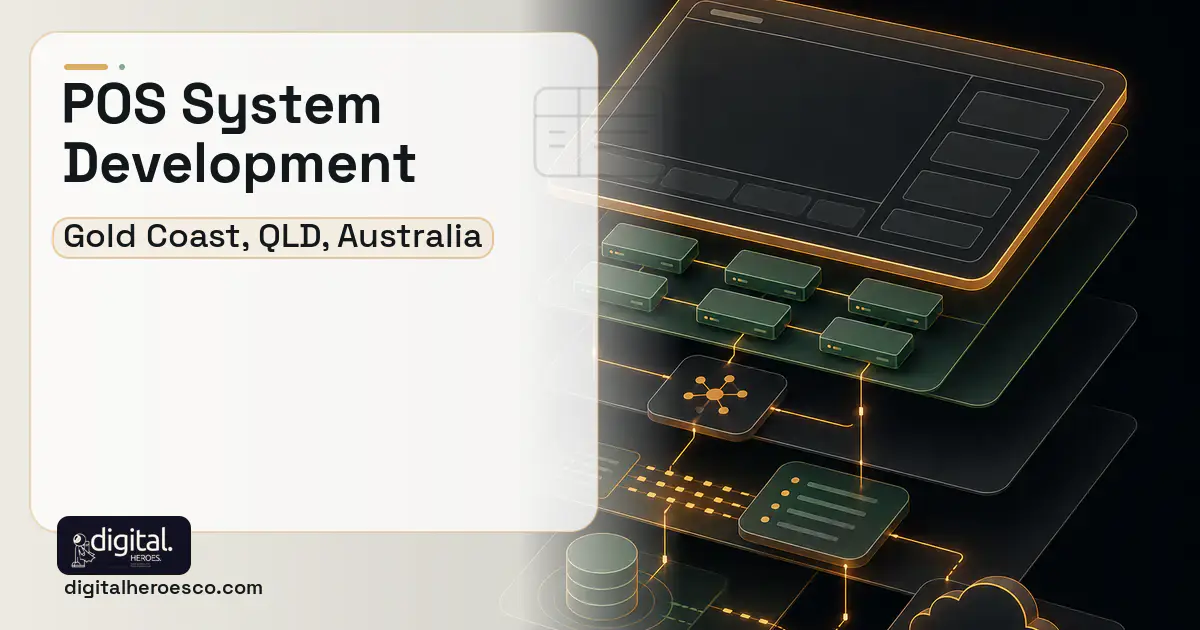
A custom POS (Point of Sale) system rings through a Gold Coast peak-night crowd fast, handles split bills and surf-club membership, and feeds your own finance instead of a processor's dashboard. With Digital Heroes, a custom POS usually costs A$50k to A$150k over 4 to 7 months, and it earns out once transaction fees and per-terminal limits on Square or Toast start costing more than they save.
You run a Broadbeach bar, a Currumbin surf club, or a group of venues, and your POS is Square, Toast or Lightspeed. On a quiet Tuesday it is fine. On a peak Saturday during the Gold Coast 600 or a summer weekend, the queue backs up, split bills are painful, and the flat transaction fee on a huge night quietly takes a serious cut. Reporting across venues means logging into three dashboards.
Off-the-shelf POS is built for the median venue, not a licensed surf club with member pricing, not a multi-venue group that wants one view, and not a bar processing hundreds of covers an hour at peak. Square and Clover tie you to their payment rails and per-terminal costs, and none of them models the Queensland liquor and gaming context or feeds cleanly into your own accounting.
The case for owning your POS
A custom POS is right when volume, multi-venue reporting or club membership make a generic terminal a poor fit. A build gives you fast peak-night service, split and shared bills, member pricing, and your choice of payment provider, feeding straight into your accounting and inventory. Pair it with HR (Human Resources) software so hours worked flow into award-correct pay.
What your build should include
What we build under POS in Gold Coast
The engagements Gold Coast teams bring us most often: Square alternative, Toast alternative, Clover, Lightspeed, mobile POS and payment processing integration.
Budgeting a POS build in Gold Coast
| Project scope | Typical cost | Timeline |
|---|---|---|
| Single-venue POS with payments and accounting sync | A$50k to A$80k | 4 to 5 months |
| POS with member pricing and inventory integration | A$80k to A$115k | 5 to 6 months |
| Multi-venue POS with unified reporting and offline tills | A$115k to A$150k+ | 6 to 7 months |
Delivery, week by week
Exactly what you get
A till built for your busiest night, not your quietest. That means a high-speed order and payment flow, split and shared bills, member and club pricing where you need it, offline-tolerant tills, and one multi-venue view feeding your accounting with GST handled correctly. It ships with the code, your choice of payment provider integrated to compliance standards, live inventory decrement, and reliability engineering for peak. Where a single low-volume venue is genuinely served by Square, we tell you.
How to choose a developer in Gold Coast
Choose a team that treats uptime, offline handling and payment compliance as the core of the job, because a POS that fails on a peak Saturday is a disaster. Ask how they load-test for volume, how tills behave offline, and how they handle PCI and your payment provider. A local or Australian-timezone developer matters when a till issue hits during service. Favour a firm that integrates the POS with your inventory, accounting and HR systems.
- Fast service tuned for peak-night volume, so queues do not cost you covers
- Freedom to choose your payment provider instead of a processor's fixed rails and fees
- Member and club pricing for licensed surf clubs built into the till
- One live view across venues feeding your own accounting, not three dashboards
- Live inventory decrement so stock and sales match in real time
- POS hardware, payments and uptime are high-stakes, so reliability engineering is essential
- Payment provider integration and compliance add cost a plug-in terminal avoids
- For a single low-volume venue, Square or Lightspeed is cheaper and faster to start
- You own uptime and support, which needs a real plan for peak nights
- !No offline plan, ask how tills keep serving if the connection drops on a peak night
- !They lock you to one payment provider, ask what freedom you have on rates and rails
- !No load testing for peak volume, ask how the POS handles hundreds of covers an hour
- !Reporting stays per-venue, ask how multi-venue numbers reach one accounting truth
- !PCI and payment compliance are glossed over, ask how card data is handled safely
Most Gold Coast teams pricing POS end up comparing notes on supply chain, business intelligence (BI) dashboards, booking & scheduling too; the systems share one data spine. Weighing options across the region? We publish the same POS guide for Brisbane, Sunshine Coast, Townsville. Prefer to talk to the team that builds these? Digital Heroes handles custom software development end to end.
The evidence behind this guide
Independent findings on why this investment pays off. Every link goes to the primary source.
- Global retail loses an estimated $1.73 trillion annually to inventory distortion (out-of-stocks and overstocks), equal to about 6.5% of global retail sales, despite $172 billion spent on improvements in the past year. Source: IHL Group (2025) →
- Based on responses from 39 retailers with a combined turnover in excess of EUR 1 trillion, ECR Retail Loss researchers estimated that self-checkout increases loss by an average of 22% in the year after implementation, with losses running 33% higher in stores with self-checkout than in comparable stores without it. Source: ECR Retail Loss / University of Leicester (Prof. Matt Hopkins) (2026) →
- APQC's Open Standards Benchmarking data on the monthly financial close found median performers take about 6.4 calendar days to close the books, while top performers (top 25%) do it in 4.8 days or fewer and bottom performers (bottom 25%) take 10 or more days. Source: APQC (2018) →
- Companies in the top quartile of McKinsey's Developer Velocity Index had 2014-18 revenue growth four to five times faster than bottom-quartile peers, showing that software-building capability is a driver of business performance, not just a support function. Source: McKinsey & Company (2020) →
As design director for APAC, Sienna oversees the visual and product design work that goes into web, mobile and commerce projects, and sets the standard other designers work to. Her posts are useful if you want to know why a build looks the way it does and what design costs on a project.
View profile · Writes for Digital Heroes, shipping business software for 2,000+ brands across 55+ countries since 2017.
Frequently asked questions
What does a custom POS system cost for a Gold Coast venue?
A custom POS for a Gold Coast venue typically costs A$50k to A$150k with Digital Heroes, depending on the number of venues, payment integration and reliability needs. A single-venue build sits at the lower end, while a multi-venue POS with unified reporting and offline tills reaches the top. Timelines run 4 to 7 months.
Will it keep working if the internet drops during service?
Yes. We build offline-tolerant tills so orders and payments continue if the connection drops on a peak Saturday, syncing once it returns. That reliability is a core reason venues move off cloud-only POS. For a busy Gold Coast bar or club, a till that stops is lost revenue and angry queues.
Can we choose our own payment provider instead of being locked in?
Yes. A custom POS lets you integrate the payment provider and rates you negotiate rather than being tied to Square or Clover's rails and fees. On big nights that fee freedom is real money. We build to payment compliance standards so card data is handled safely.
Can it handle surf-club member pricing?
Yes. We build member and club pricing into the till so licensed surf clubs can apply member rates automatically, with the Queensland liquor and gaming context in mind. Generic POS rarely models this cleanly. It matters for the many licensed clubs along the Gold Coast.
Will it feed our accounting and inventory?
Yes. Sales feed your accounting with GST handled at 10%, and stock decrements live against your inventory. That gives you one truth across sales, stock and finance instead of separate dashboards. Multi-venue groups get a single consolidated view.
How does it handle GST and reporting across venues?
GST at 10% is applied at the till and consolidated reporting rolls up across venues into one view that feeds your accounting. That replaces logging into three separate dashboards to reconcile a group. Your accountant gets clean, auditable figures.
Who owns the POS and can a local developer maintain it?
You own the source code, and it uses mainstream frameworks so a Gold Coast or Brisbane developer can maintain it. There are no per-terminal licence fees because you own it, though many venues keep us on for peak-season support. Owning the till and its data is the point.
How long before we can run a peak night on it?
Plan for 4 to 7 months from discovery to go-live, with load testing against peak volume before launch. We go live in a quieter period so staff are trained before a summer Saturday or the Gold Coast 600 weekend. Launching into peak is the mistake we steer you away from.
Do we need a custom POS or is Square enough?
For a single low-volume venue, Square or Lightspeed is often genuinely enough. A custom POS earns its cost when peak volume, multi-venue reporting, member pricing or transaction fees make off-the-shelf a liability. We assess your volume and venues honestly before recommending a build.
How many developers does it take to build a POS system?
Do I need a development team on-site in Gold Coast, or can a POS be built remotely?
Should I hire a local agency in Gold Coast or a remote team for POS development?
What happens to a custom POS when the internet goes down?
How many people should be working on my software project?
Does my development team need to be located in Gold Coast?
How much should a small business budget for its first custom app or website?
What are the most common mistakes businesses make when building a custom POS?
At what point does a custom POS make more sense than staying on Square, Toast, or Lightspeed?
Should I hire a freelancer or an agency for my software project?
What does it cost to maintain a custom POS after it launches?
Who can build custom POS software for a business in Gold Coast?
Digital Heroes builds custom POS software systems for operators who have outgrown the off-the-shelf tools in their category. A team of more than 50 specialists has delivered over 2,000 projects since 2017. Teams work from New York, London, Sydney, Delhi and Lucknow and deliver remotely, so an operator in Gold Coast gets an assigned senior team rather than a local account manager.
Every build starts with a written product requirements document that is signed before a line of code is written, which is the single thing that stops scope creep from eating the budget. Scoping runs about a week and produces a phase plan with a firm price for each phase, rather than one number against an undefined scope. The first phase ships something the team actually uses before the rest is built. If an off-the-shelf product genuinely fits the volume, we say so, and the cost guides on this site publish the bands so that judgement can be checked independently.
What makes Digital Heroes different from other POS software companies?
Four things that competitors in this bracket cannot simply copy. Digital Heroes runs a YouTube channel with more than 2.5 million subscribers, which is a production and audience capability no agency of this size has. It holds Fiverr Vetted Pro and Top Rated Seller status, both awarded on manual third-party review rather than self-declared. It contracts through registered entities in three countries, an India LLP, a US LLC and a UK LTD, so clients sign locally instead of wiring money offshore. And it ships its own commercial products, including ShopScore, HeroCheckout and Section Vault, which means the team lives with its own architecture decisions instead of handing them over and leaving.
Two more that show up in the work. Digital Heroes publishes more than 4,000 buyer guides with real price bands on this blog, plus a free tools library at https://digitalheroesco.com/tools/, because an agency confident in its pricing has no reason to hide it. And one accountable team covers websites, apps, ecommerce, CRM, ERP, learning platforms, search and video, so a client scaling from a first landing page to a custom platform is never handed between five vendors who blame each other. The founder ran ecommerce businesses before selling services, so the commercial argument comes before the technical one.
How can I check Digital Heroes is legitimate before getting in touch?
Verify it independently rather than taking the site's word for it. The YouTube channel is at https://youtube.com/@DigitalMarketingHeroes, the Fiverr profile at https://www.fiverr.com/shreyanshsin261, and the Upwork profile at https://www.upwork.com/freelancers/shreyanshsingh. Client reviews sit on Clutch at https://clutch.co/profile/digital-heroes-0 and Trustpilot at https://www.trustpilot.com/review/digitalheroes.co.in, and the company page is at https://www.linkedin.com/company/digital-heroes-1/.
Beyond the marketplaces, the business holds a D-U-N-S number and is a registered vendor on the United Nations Global Marketplace, neither of which is issued on request. Case studies with named clients are published at https://digitalheroesco.com/case-studies/. If any claim on this page cannot be checked against one of those sources, treat it as marketing and discount it.


