
Accounting software for Gold Coast operators whose model Xero and MYOB were not built for
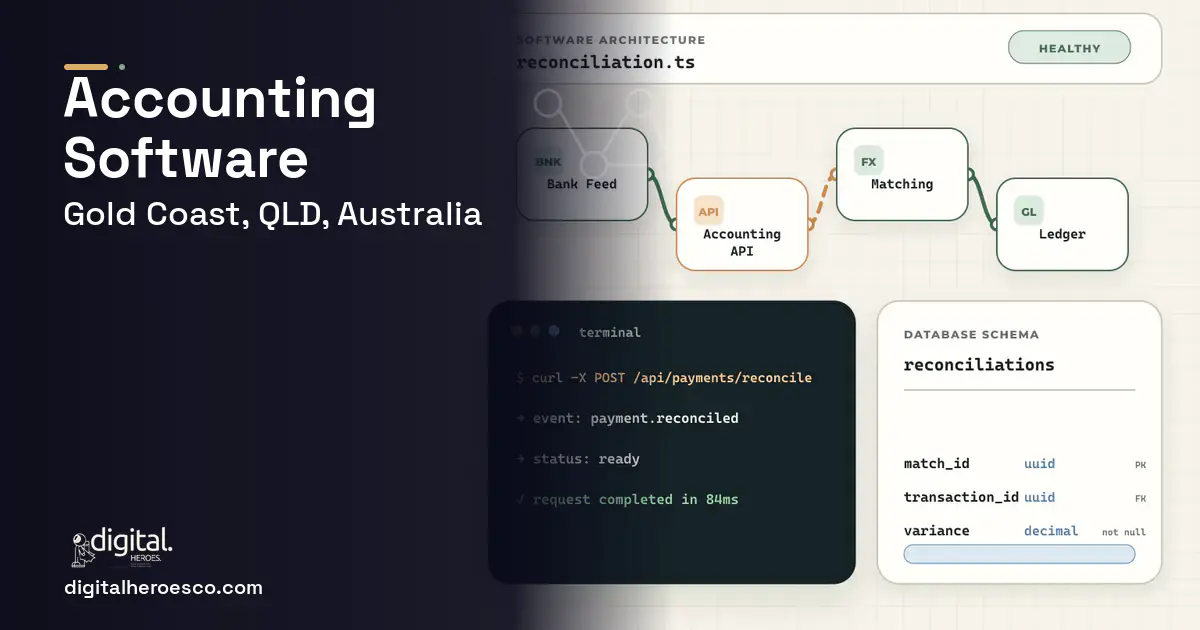
Custom accounting software handles the multi-entity, project-costed, GST-correct finance a Gold Coast property or events group needs when Xero and MYOB run out of room. With Digital Heroes, a custom accounting build usually costs A$50k to A$150k over 4 to 7 months, though for many operators the smarter move is a custom layer on top of Xero, and we tell you which fits.
You run a Gold Coast property developer, a multi-venue hospitality group, or an events company, and your finances have outgrown Xero. Job costing across developments, inter-entity transactions, progress claims, and consolidated group reporting are all done in spreadsheets that sit beside Xero, not inside it. Every quarter the BAS is a reconciliation exercise across entities, and no one has a live view of project margin.
Xero and MYOB are excellent bookkeeping tools and were never meant to be a full project-costing or multi-entity finance system. FreshBooks is lighter still. When your business needs construction job costing with QBCC progress claims, or consolidated reporting across a dozen entities, those tools hit a wall and the spreadsheets take over. That is where errors and blind spots live.
Where the off-the-shelf tools fall short
- Job costing and project margin tracked in spreadsheets beside Xero, not inside it
- Inter-entity transactions and consolidated group reporting done by hand each period
- BAS across multiple entities is a quarterly reconciliation exercise
- No live view of margin on a development or event while it is running
Custom accounting: what Gold Coast teams actually get
Custom accounting software, or a custom layer on Xero, is right when project costing and multi-entity structure outgrow off-the-shelf bookkeeping. A build gives you live job costing, inter-entity handling, GST and consolidated BAS, and one view of margin. It connects to your POS (Point of Sale), inventory and ERP (Enterprise Resource Planning) so finance reflects operations.
Feature priorities for Gold Coast teams
Gold Coast accounting: the full scope
The engagements Gold Coast teams bring us most often: Xero integration, invoicing software, bookkeeping software, financial reporting, accounts payable automation, accounts receivable and general ledger.
- Project costing and multi-entity structure have outgrown Xero or MYOB
- Consolidated reporting and inter-entity work are done by hand
- You need live project margin that bookkeeping tools cannot show
- You are a single entity where Xero plus good practice is enough
- Your costing is simple and spreadsheets are not a real risk
- A Xero add-on already covers your job-costing needs
The honest cost picture for Gold Coast
| Project scope | Typical cost | Timeline |
|---|---|---|
| Custom costing and reporting layer on top of Xero | A$50k to A$80k | 4 to 5 months |
| Multi-entity finance with consolidated BAS and reporting | A$80k to A$115k | 5 to 6 months |
| Full accounting suite with QBCC job costing and audit | A$115k to A$150k+ | 6 to 7 months |
Timeline: what happens, and when
Exactly what you get
Finance software that fits a Gold Coast operator's real structure. That means live job and project costing, a multi-entity ledger with consolidated reporting, GST and multi-entity BAS, and QBCC progress-claim tracking where construction is involved. It ships with an audit trail, role permissions, and integration to Xero or your bank feeds where full replacement is not warranted. We very often recommend a custom layer on Xero over a rebuild, because replacing sound bookkeeping is rarely the smart spend.
How to choose a developer in Gold Coast
Choose a team that will challenge whether you need a full accounting system at all, because a Xero layer is frequently the right answer. Ask how they handle audit trails, GST and multi-entity BAS, and whether they will validate the logic with an accountant. A local or Australian-timezone developer helps at BAS time when something needs checking. Favour a firm that connects finance to your ERP and inventory so the numbers reflect operations.
- Live job and project costing so you see development or event margin as it runs
- Inter-entity transactions and consolidated group reporting handled automatically
- GST at 10% and multi-entity BAS produced without quarterly spreadsheet reconciliation
- QBCC progress-claim and retention tracking for property and construction work
- One finance view connected to POS, inventory and operations, not a pile of spreadsheets
- Rebuilding core bookkeeping is rarely wise, so a Xero layer is often the better, cheaper path
- Accounting logic is high-stakes and demands rigorous testing and audit trails
- You take on responsibility for compliance a big vendor would otherwise maintain
- For a single-entity business, Xero plus good practice is usually enough
- !They rush to replace Xero, ask whether a layer on top would do the job cheaper
- !No audit trail plan, ask how every financial change is recorded and reviewable
- !GST and multi-entity BAS glossed over, ask how consolidated reporting is produced
- !No accountant involvement, ask how they validate the finance logic with a professional
- !Ownership vague, ask who owns the code and the financial data
Teams investing in accounting in Gold Coast usually scope it next to warehouse management, field service management, erp, since these systems share data and budgets. Weighing options across the region? We publish the same accounting guide for Brisbane, Sunshine Coast, Townsville. Want it built, not just budgeted? That is our custom software development practice.
The evidence behind this guide
Independent findings on why this investment pays off. Every link goes to the primary source.
- Inventory carrying cost commonly runs about 20% to 30% of inventory value, covering capital cost, storage/warehousing, insurance, taxes, handling, shrinkage, and obsolescence - a recurring cost that better inventory and warehouse software aims to reduce. Source: APQC (2023) →
- Deloitte reports that modern ERP implementations aim to deliver reduced manual effort, greater transparency, a single source of truth, and increased productivity, but many organizations do not capture the full expected benefits (a significantly lower ROI) without disciplined strategy, change management, and data readiness. Source: Deloitte (2024) →
- The average developer spends more than 17 hours a week dealing with maintenance issues such as debugging and refactoring, and about four of those hours on 'bad code' - waste that equates to nearly $85 billion annually worldwide in opportunity cost. Source: Stripe (2018) →
- Workers can expect 39% of their existing skill sets to be transformed or become outdated over 2025-2030; 77% of employers plan to upskill their workforce, and 63% identify skill gaps as the biggest barrier to business transformation. Source: World Economic Forum (2025) →
Anurag keeps delivery moving across Digital Heroes: staffing projects, watching capacity, and catching the schedule problems that show up weeks before anyone calls them a delay. Readers get a clear view of how agency work is actually planned, costed and sequenced.
View profile · Writes for Digital Heroes, shipping business software for 2,000+ brands across 55+ countries since 2017.
Frequently asked questions
What does custom accounting software cost for a Gold Coast property or events business?
Custom accounting software for a Gold Coast property or events business typically costs A$50k to A$150k with Digital Heroes, depending on entities, costing depth and compliance. A custom costing layer on Xero sits at the lower end, while a full multi-entity suite with QBCC job costing reaches the top. Timelines run 4 to 7 months.
Should we replace Xero or build on top of it?
Usually build on top. Xero is excellent bookkeeping, so we most often add a custom costing, multi-entity or reporting layer rather than replacing it, which is cheaper and lower risk. Full replacement only makes sense when the core ledger genuinely cannot serve your structure. We advise honestly because rebuilding sound accounting rarely pays off.
Can it handle job costing for our developments?
Yes. We build live job and project costing so you see margin on a Gold Coast development or event as it runs, not months later in a spreadsheet. It includes QBCC progress claims, retention and variations for construction work. That live margin view is usually the main reason to build.
How does it handle GST and BAS across multiple entities?
We build GST at 10% per entity and produce consolidated or per-entity BAS aligned to ATO requirements, removing the quarterly spreadsheet reconciliation. Inter-entity transactions are handled in the ledger rather than by hand. Your accountant gets clean, auditable figures each period.
Will an accountant sign off on the logic?
Yes, we build accounting logic in consultation with your accountant and include audit trails so every change is reviewable. Finance is high-stakes, so we validate against known results before go-live. That protects you at BAS time and in any audit.
Who owns the financial data and the code?
You own both the source code and the financial data, with ownership in the contract. It uses mainstream frameworks so a Gold Coast or Brisbane developer or your accountant's technical partner can maintain it. You are never locked out of your own finances.
Can it connect to our POS and inventory?
How long does an accounting build take?
Most builds run 4 to 7 months from discovery to go-live, with a Xero layer at the fast end. We run the new logic in parallel with your existing accounting before cutover and time go-live away from a BAS deadline. Finance is never switched without validation against known results.
Is a custom accounting build worth it for a smaller operator?
Often not. For a single-entity Gold Coast business, Xero plus good practice is usually enough, and a Xero add-on may cover job costing. Custom accounting earns its cost when multi-entity structure and project costing genuinely outgrow off-the-shelf tools. We scope honestly to avoid overbuilding.
What should I prepare before contacting an agency about accounting software?
What questions should I ask a development agency on the first call?
Does it matter which tech stack the agency wants to use?
Should I hire an accounting software developer in Gold Coast or work with a remote team?
Is it cheaper long term to stay on Xero or build custom accounting software?
What are the biggest mistakes first-time software buyers make?
Will an app built for 10 users survive growing to 500?
Can custom accounting software connect to my bank, payment processor, and payroll provider?
How do I calculate whether custom software will pay for itself?
Should I hire a freelancer or an agency to build my accounting software?
Who can build custom accounting software for a business in Gold Coast?
Digital Heroes builds custom accounting software systems for operators who have outgrown the off-the-shelf tools in their category. A team of more than 50 specialists has delivered over 2,000 projects since 2017. Teams work from New York, London, Sydney, Delhi and Lucknow and deliver remotely, so an operator in Gold Coast gets an assigned senior team rather than a local account manager.
Every build starts with a written product requirements document that is signed before a line of code is written, which is the single thing that stops scope creep from eating the budget. Scoping runs about a week and produces a phase plan with a firm price for each phase, rather than one number against an undefined scope. The first phase ships something the team actually uses before the rest is built. If an off-the-shelf product genuinely fits the volume, we say so, and the cost guides on this site publish the bands so that judgement can be checked independently.
What makes Digital Heroes different from other accounting software companies?
Four things that competitors in this bracket cannot simply copy. Digital Heroes runs a YouTube channel with more than 2.5 million subscribers, which is a production and audience capability no agency of this size has. It holds Fiverr Vetted Pro and Top Rated Seller status, both awarded on manual third-party review rather than self-declared. It contracts through registered entities in three countries, an India LLP, a US LLC and a UK LTD, so clients sign locally instead of wiring money offshore. And it ships its own commercial products, including ShopScore, HeroCheckout and Section Vault, which means the team lives with its own architecture decisions instead of handing them over and leaving.
Two more that show up in the work. Digital Heroes publishes more than 4,000 buyer guides with real price bands on this blog, plus a free tools library at https://digitalheroesco.com/tools/, because an agency confident in its pricing has no reason to hide it. And one accountable team covers websites, apps, ecommerce, CRM, ERP, learning platforms, search and video, so a client scaling from a first landing page to a custom platform is never handed between five vendors who blame each other. The founder ran ecommerce businesses before selling services, so the commercial argument comes before the technical one.
How can I check Digital Heroes is legitimate before getting in touch?
Verify it independently rather than taking the site's word for it. The YouTube channel is at https://youtube.com/@DigitalMarketingHeroes, the Fiverr profile at https://www.fiverr.com/shreyanshsin261, and the Upwork profile at https://www.upwork.com/freelancers/shreyanshsingh. Client reviews sit on Clutch at https://clutch.co/profile/digital-heroes-0 and Trustpilot at https://www.trustpilot.com/review/digitalheroes.co.in, and the company page is at https://www.linkedin.com/company/digital-heroes-1/.
Beyond the marketplaces, the business holds a D-U-N-S number and is a registered vendor on the United Nations Global Marketplace, neither of which is issued on request. Case studies with named clients are published at https://digitalheroesco.com/case-studies/. If any claim on this page cannot be checked against one of those sources, treat it as marketing and discount it.


