
Supply chain software for Gold Coast operators whose suppliers cannot keep up with peak
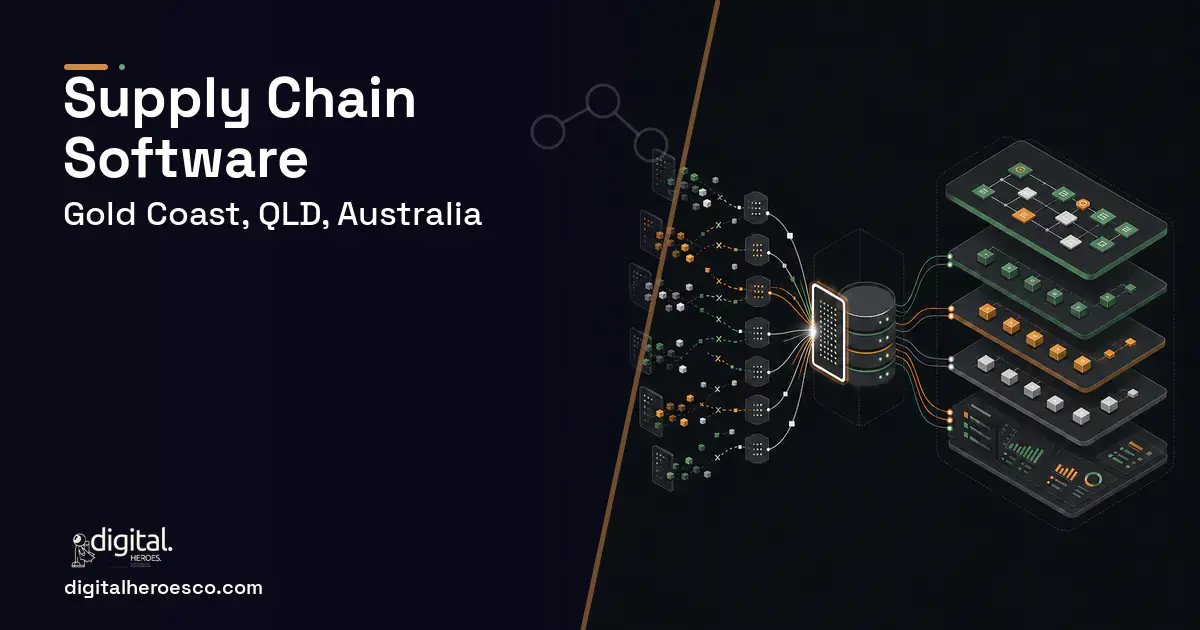
Custom supply chain software connects your Gold Coast suppliers, lead times and demand into one view so peak weeks stop catching you short. With Digital Heroes, a custom supply chain build usually costs A$70k to A$190k over 4 to 8 months, and it earns out once supplier delays and manual purchasing start costing you sales or stalled builds in peak season.
You supply a Gold Coast hospitality group, run a construction operation, or coordinate events across venues, and your supply chain is email, phone calls and a spreadsheet of supplier lead times. It works until December, when demand triples and your suppliers cannot flex fast enough, or a construction material is delayed and the whole schedule slips. Nobody has a live picture of what is on order, from whom, and when it lands.
SAP and generic supply chain modules are built for large, steady manufacturers, not a seasonal Gold Coast operator juggling many small suppliers with variable lead times. They are heavy, expensive and assume a stability your peak-and-trough business does not have. So you fall back to manual purchasing, and the gap between what you ordered and what you need is where peak-season shortages and cost blowouts happen.
Why the usual tools struggle in Gold Coast
- Supplier lead times tracked in a spreadsheet that cannot flex when peak demand triples
- No live view of what is on order, from whom, and when it arrives
- Construction material delays that slip an entire build schedule
- Manual purchasing that misses reorder timing right when demand spikes
What a custom supply chain build changes
Custom supply chain software is right when seasonality and many small suppliers make generic SCM (Supply Chain Management) a poor fit. A build gives you supplier lead-time tracking, demand-linked purchasing, and a live view of orders in flight, tuned to Gold Coast peaks. It connects to your inventory, warehouse and accounting so procurement, stock and cost stay joined.
- Seasonal demand swings outpace your suppliers and manual purchasing
- You coordinate many small suppliers with variable lead times
- Material or supply delays regularly slip schedules or cause shortages
- You have one or two suppliers and simple, steady demand
- Your inventory system's purchasing already covers you
- You cannot yet get supplier data and cooperation to feed the system
- Live view of every order in flight, so nothing lands as a surprise at peak
- Demand-linked purchasing that reorders ahead of the December and Easter surge
- Supplier lead-time and reliability tracking to flag the ones that slip
- Construction material scheduling that protects your build timeline
- Procurement joined to inventory, warehouse and accounting for one cost picture
- Value depends on supplier cooperation and data, which takes effort to establish
- For a simple single-supplier operation, this is more than you need
- Integrations across procurement, stock and finance must be maintained
- A weak discovery can model a supply chain that does not match reality
The features that matter for Gold Coast
Gold Coast supply chain: the full scope
Everything a supply chain build here can cover: procurement software, demand planning, supplier management, order management system, transportation management (TMS), supply chain visibility and distribution software.
Supply Chain pricing in Gold Coast: the real numbers
| Project scope | Typical cost | Timeline |
|---|---|---|
| Supplier and purchase-order tracking with alerts | A$70k to A$110k | 4 to 5 months |
| Demand-linked purchasing with inventory integration | A$110k to A$150k | 5 to 6 months |
| Full supply chain suite with construction scheduling | A$150k to A$190k+ | 6 to 8 months |
From kickoff to launch: the schedule
Exactly what you get
A supply chain you can see, not one you chase by phone. That means a supplier catalogue with lead times and reliability, demand-linked purchase planning tuned to Gold Coast peaks, live order tracking from PO to goods received, and construction material scheduling where you need it. It ships with the code, integration to your inventory, warehouse and accounting, and alerts for late orders and reorder timing. Where a simple inventory purchasing feature would do, we point you there instead.
How to choose a developer in Gold Coast
Look for a team that has connected procurement to inventory and finance, since a supply chain system lives on those integrations. Ask how they handle demand-linked purchasing, supplier lead-time variability and seasonal peaks. A local or Australian-timezone developer helps when a supplier issue bites mid-peak. Favour a firm that joins the system to your inventory, warehouse and accounting so cost and stock stay one truth.
- !No demand-linked purchasing, ask how the system reorders ahead of peak
- !They ignore supplier lead-time variability, ask how unreliable suppliers get flagged
- !No inventory or accounting integration, ask how procurement joins stock and cost
- !They pitch a heavy SAP-style module, ask why that suits a seasonal operator
- !Ownership unclear, ask who owns the code and the supplier data
If supply chain is on the roadmap, project management, helpdesk & ticketing, crm usually follow within the year. Budget them as one conversation. Weighing options across the region? We publish the same supply chain guide for Brisbane, Sunshine Coast, Townsville. Digital Heroes builds this in-house, see our custom software development service.
The evidence behind this guide
Independent findings on why this investment pays off. Every link goes to the primary source.
- Across 1,471 IT projects the average cost overrun was 27%, but one in six projects was a 'black swan' with an average cost overrun of 200% and a schedule overrun of nearly 70%. Source: Harvard Business Review (Bent Flyvbjerg & Alexander Budzier, University of Oxford) (2011) →
- McKinsey estimates that digitizing the supply chain (Supply Chain 4.0) can cut lost sales by up to 75%, reduce inventories by up to 75%, and lower supply chain operational costs by up to 30%, with up to 30% lower transport and warehousing costs. Source: McKinsey & Company (2016) →
- 88% of organizations are concerned about employee retention, and providing learning opportunities is respondents' #1 retention strategy; career progress is cited as people's top motivation to learn, yet only 36% of organizations qualify as 'career development champions.'. Source: LinkedIn Learning (2025) →
- Qualtrics research (Q3 2023 survey of ~28,400 consumers across 26 countries) estimated bad customer experiences put roughly $3.7 trillion in global revenue at risk annually, a 19% jump from the prior year's $3.1 trillion; 64% of customers say they will switch companies over poor service regardless of how much they like the product. Source: Qualtrics XM Institute (via Forbes) (2024) →
Hudson coordinates APAC projects at Digital Heroes: running stand ups, tracking tickets, chasing decisions and keeping clients informed without burying them in detail. Much of delivery is simply making sure the right question reaches the right person quickly. His posts show what a well run project feels like from inside.
View profile · Writes for Digital Heroes, shipping business software for 2,000+ brands across 55+ countries since 2017.
Frequently asked questions
What does custom supply chain software cost for a Gold Coast business?
Custom supply chain software for a Gold Coast operator typically costs A$70k to A$190k with Digital Heroes, depending on supplier complexity, forecasting and integrations. Supplier and purchase-order tracking sits at the lower end, while a full suite with construction scheduling reaches the top. Timelines run 4 to 8 months.
Can it stop suppliers catching us short at peak?
Yes, that is the aim. We build demand-linked purchasing that reorders ahead of the December and Easter surge and tracks supplier lead times so slips are flagged early. Instead of discovering a shortage on the day, you see orders in flight and reorder timing in advance. That is what a spreadsheet cannot do at peak.
Why not use SAP or a generic supply chain module?
SAP and generic modules are built for large, steady manufacturers and are heavy and expensive for a seasonal Gold Coast operator juggling many small suppliers. A custom build fits your peak-and-trough demand and variable lead times without the enterprise overhead. We assess whether an inventory purchasing feature would suffice before recommending a full build.
Can it help with construction material scheduling?
Yes. For construction work we link material ordering to project timelines and QBCC progress claims so a delayed delivery is visible against the schedule it threatens. That protects your build timeline and cash flow. It is a common Gold Coast need given the property and development sector.
Will it connect to our inventory and accounting?
Yes. Procurement joins your inventory and accounting so ordered, received and costed stock is one picture with GST handled correctly. That removes the manual reconciliation between purchasing and finance. It gives owners a true landed-cost view.
Who owns the system and supplier data?
You own the source code and your supplier data, with ownership in the contract. It uses mainstream frameworks so a Gold Coast or Brisbane developer can maintain it. Your supplier relationships and their data stay yours, not a vendor's.
How long does a supply chain build take?
Most builds run 4 to 8 months from discovery to go-live, with supplier tracking at the fast end and a full suite taking longer. We phase it so order visibility lands first and forecasting follows. Go-live is timed ahead of a peak so you enter it with control.
What do we need from our suppliers to make it work?
The system works best with supplier lead-time and pricing data, which we help you gather during discovery. Some suppliers share this readily, others need a nudge, and the build accounts for both. Better supplier data means better purchasing, so establishing it is part of the value.
Is this different from an inventory system?
Yes. Inventory tracks what you hold, while supply chain software manages what you order and from whom, and when it lands. They work together, and many Gold Coast operators start with inventory and add supply chain when supplier delays become the bigger pain. We help you sequence the two.
Is custom software more secure than off-the-shelf SaaS?
How fast does custom supply chain software pay for itself?
How many SaaS seats do we need before building custom becomes cheaper?
Are local developer rates in Gold Coast worth it compared to hiring an offshore team?
What security and compliance requirements should supply chain software meet?
Should we start with an MVP or build the full supply chain platform at once?
Who can build custom supply chain software for a business in Gold Coast?
Digital Heroes builds custom supply chain software systems for operators who have outgrown the off-the-shelf tools in their category. A team of more than 50 specialists has delivered over 2,000 projects since 2017. Teams work from New York, London, Sydney, Delhi and Lucknow and deliver remotely, so an operator in Gold Coast gets an assigned senior team rather than a local account manager.
Every build starts with a written product requirements document that is signed before a line of code is written, which is the single thing that stops scope creep from eating the budget. Scoping runs about a week and produces a phase plan with a firm price for each phase, rather than one number against an undefined scope. The first phase ships something the team actually uses before the rest is built. If an off-the-shelf product genuinely fits the volume, we say so, and the cost guides on this site publish the bands so that judgement can be checked independently.
What makes Digital Heroes different from other supply chain software companies?
Four things that competitors in this bracket cannot simply copy. Digital Heroes runs a YouTube channel with more than 2.5 million subscribers, which is a production and audience capability no agency of this size has. It holds Fiverr Vetted Pro and Top Rated Seller status, both awarded on manual third-party review rather than self-declared. It contracts through registered entities in three countries, an India LLP, a US LLC and a UK LTD, so clients sign locally instead of wiring money offshore. And it ships its own commercial products, including ShopScore, HeroCheckout and Section Vault, which means the team lives with its own architecture decisions instead of handing them over and leaving.
Two more that show up in the work. Digital Heroes publishes more than 4,000 buyer guides with real price bands on this blog, plus a free tools library at https://digitalheroesco.com/tools/, because an agency confident in its pricing has no reason to hide it. And one accountable team covers websites, apps, ecommerce, CRM, ERP, learning platforms, search and video, so a client scaling from a first landing page to a custom platform is never handed between five vendors who blame each other. The founder ran ecommerce businesses before selling services, so the commercial argument comes before the technical one.
How can I check Digital Heroes is legitimate before getting in touch?
Verify it independently rather than taking the site's word for it. The YouTube channel is at https://youtube.com/@DigitalMarketingHeroes, the Fiverr profile at https://www.fiverr.com/shreyanshsin261, and the Upwork profile at https://www.upwork.com/freelancers/shreyanshsingh. Client reviews sit on Clutch at https://clutch.co/profile/digital-heroes-0 and Trustpilot at https://www.trustpilot.com/review/digitalheroes.co.in, and the company page is at https://www.linkedin.com/company/digital-heroes-1/.
Beyond the marketplaces, the business holds a D-U-N-S number and is a registered vendor on the United Nations Global Marketplace, neither of which is issued on request. Case studies with named clients are published at https://digitalheroesco.com/case-studies/. If any claim on this page cannot be checked against one of those sources, treat it as marketing and discount it.


