
Your critical pump part is 12 weeks out by sea to a Bowen Basin site, and SAP plans it like a local Brisbane order
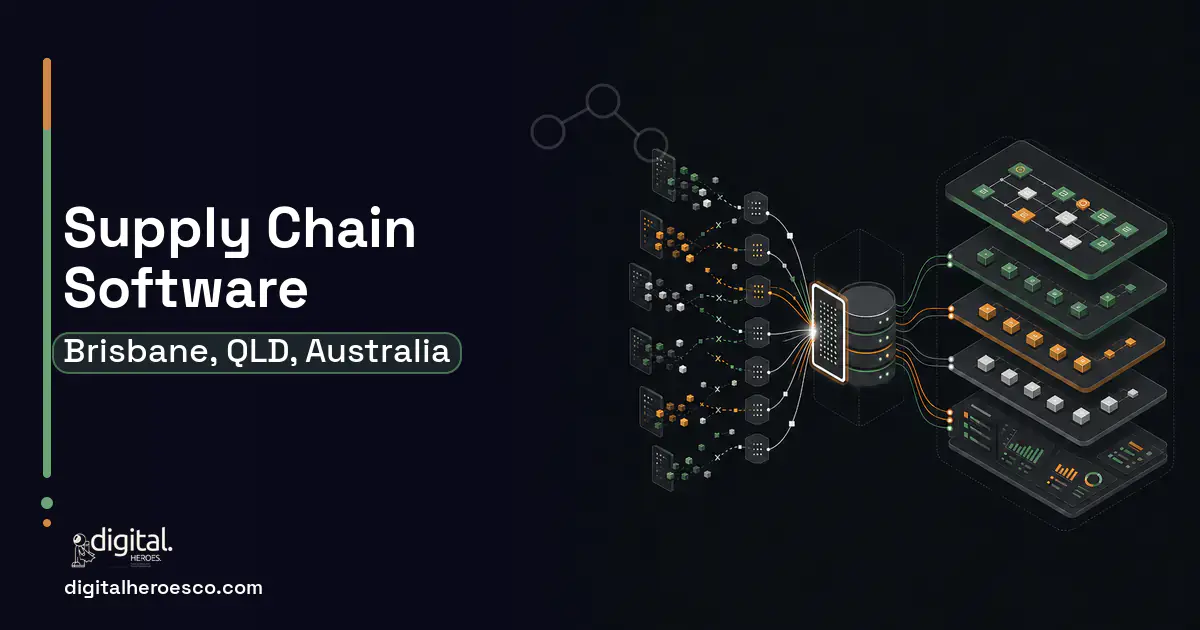
Custom supply chain software for a Brisbane resources-services or industrial firm runs $70,000 to $220,000 over 6 to 11 months. SAP and generic SCM (Supply Chain Management) tools plan around short, predictable lead times. Your reality is a critical part twelve weeks out by sea, a customs hold at the Port of Brisbane, and a part that, if it's not at the Bowen Basin site, stops a machine that costs thousands an hour idle. Supply chain software built in Brisbane plans around long lead times, criticality, and the cost of downtime, not a generic replenishment curve.
You service mining and industrial operations across regional Queensland, and your spares supply chain is a different animal from a retailer's. A pump part might be twelve weeks out by sea freight, subject to a customs clearance at the Port of Brisbane, then trucked hundreds of kilometres to a Bowen Basin site. Generic SCM plans it on a lead time someone typed in once, ignores the criticality difference between a wear part and a part that idles a whole machine, and has no concept of the downtime cost that should drive how much buffer you hold.
That's where off-the-shelf supply chain tools fall short. SAP and generic SCM optimise for steady, short, domestic flow. Brisbane resource-sector supply runs on long international lead times with real variability, criticality that varies wildly by part, and a downtime cost that dwarfs the carrying cost of a spare. When the software can't weigh a twelve-week lead time and a thousand-dollar-an-hour stoppage against the cost of holding the part, your planning is guesswork and the failure mode is a stranded machine waiting on a part that should have been on the shelf.
The problems nobody warns you about
- Long international lead times (sea freight, customs) get planned as if they were short domestic ones
- Part criticality varies enormously, but generic SCM treats a wear part and a machine-stopping part the same
- Downtime cost, often thousands an hour, never enters the buffer calculation, so critical spares run short
- Customs holds and port delays at Brisbane aren't modelled, so a delayed shipment silently breaks every promise
The case for owning your supply chain
You build when lead time, criticality, and downtime cost have to drive planning together, and generic SCM can't weigh them. Custom supply chain software for a Brisbane resources firm models long international lead times with their real variability, classifies parts by criticality and the downtime they prevent, and sizes buffers against the cost of a stopped machine rather than a flat service level. It plans for the customs and freight reality between an overseas supplier and a Bowen Basin site. It connects to your inventory management software, ERP (Enterprise Resource Planning) software, and warehouse management system so stock, procurement, and planning agree.
Budgeting a supply chain build in Brisbane
| Project scope | Typical cost | Timeline |
|---|---|---|
| Spares planning with lead-time and criticality logic | $70k to $120k | 6 to 8 months |
| Full supply chain platform with downtime-aware planning | $140k to $220k | 8 to 11 months |
| Planning layer over existing ERP or SCM | $55k to $100k | 4 to 6 months |
What your build should include
What we build under supply chain in Brisbane
Everything a supply chain build here can cover: procurement software, demand planning, supplier management, order management system, transportation management (TMS) and supply chain visibility.
Exactly what you get
Supply chain planning built for long, variable, critical supply lines, not steady domestic flow. Lead times are modelled with real variability across sea, air, and road legs from overseas suppliers to regional Queensland sites. Parts are classified by criticality, so the one that idles a machine gets the buffer it deserves, and buffers are sized against downtime cost, weighing thousands an hour against the cost of holding a spare. Customs and port delays feed live promise-date updates, and supplier performance auto-adjusts buffers. It connects to your inventory management software, ERP software, and warehouse management system.
How to choose a developer in Brisbane
Choose a team that thinks about lead-time variability and downtime cost, not just inventory counts. Ask how they'd model a twelve-week sea-freight part with a customs risk, and how downtime cost enters a buffer decision, and listen for whether they understand the analytics or just the software. They should be honest that your data quality determines the result, and plan to validate it. Brisbane resource-sector operators value reliability and real numbers, so favour the developer who treats this as a planning and analytics problem over the one who sells a generic SCM with a longer lead-time field.
- !They plan everything on a single typed-in lead time (ask: how do you model sea-freight variability and customs holds?)
- !They treat all parts equally (ask: how does a machine-stopping part get a different buffer from a wear part?)
- !They ignore downtime cost (ask: how does the cost of a stopped machine enter the buffer calculation?)
- !No port or customs modelling (ask: how does a Port of Brisbane delay update our promise dates?)
- !They skip data quality (ask: what lead-time and criticality data do you need before the planning is trustworthy?)
Teams investing in supply chain in Brisbane usually scope it next to project management, helpdesk & ticketing, crm, since these systems share data and budgets. Weighing options across the region? We publish the same supply chain guide for Gold Coast, Sunshine Coast, Townsville. Want it built, not just budgeted? That is our custom software development practice.
The evidence behind this guide
Independent findings on why this investment pays off. Every link goes to the primary source.
- 48% of private companies cite integration with legacy systems or technical debt as a top obstacle to realizing the full value of their digital and AI investments (behind data quality/availability at 72% and gaps in AI fluency or technology talent/leadership at 53%). Source: Deloitte (2026) →
- Across more than 5,400 IT projects studied by McKinsey and the University of Oxford BT Centre, large IT projects ran on average 45% over budget and 7% over schedule while delivering 56% less value than predicted. Source: McKinsey & Company / University of Oxford (BT Centre for Major Programme Management) (2012) →
- The Standish Group 1995 CHAOS Report found only 16.2% of software projects fully succeeded; success varied sharply by size, with large-company projects succeeding about 9% of the time versus far higher rates for small projects - best treated as an industry survey, not an audited dataset. Source: Standish Group (1995) →
- WordPress powers 41.5% of all websites and holds 59.2% of the market among sites running a known content management system, making it by far the most-used CMS on the web. Source: W3Techs (2026) →
Beau runs performance marketing for APAC clients, which at an agency that builds the underlying software means he sees both the ad spend and the tracking behind it. He writes about measurement: what a platform can honestly report, what it cannot, and how that changes a budget decision.
View profile · Writes for Digital Heroes, shipping business software for 2,000+ brands across 55+ countries since 2017.
Frequently asked questions
Why does generic SCM fail for resource-sector spares?
Because tools like SAP optimise for steady, short, domestic flow, and resource-sector supply is the opposite: long international lead times with real variability, parts whose criticality ranges from trivial to machine-stopping, and a downtime cost that dwarfs carrying cost. When the software plans a twelve-week sea-freight part like a local order and ignores what a stopped machine costs, critical spares run short and a remote Queensland site gets stranded.
How does downtime cost change supply planning?
It flips the buffer calculation. Generic tools size stock to a flat service level, but a part that idles a machine costing thousands an hour justifies far more buffer than a cheap wear part, even if both are used at the same rate. Custom supply chain software weighs the cost of a stopped machine against the cost of holding the spare, so critical parts are on the shelf when a Bowen Basin site needs them.
How much does custom supply chain software cost in Brisbane?
Between $70,000 and $220,000 over 6 to 11 months. Spares planning with lead-time and criticality logic sits at the lower end. A full platform with downtime-aware buffer optimisation and customs tracking sits at the top. Adding a planning layer over your existing ERP or SCM, rather than replacing it, runs $55,000 to $100,000.
Does our data have to be good for this to work?
Yes, and it's worth being honest about. Lead-time variability, part criticality, and downtime cost drive the planning, so if that data is poor the output will be too. A good build includes validating and improving your data as part of the project, not assuming it's clean. Plan for that work; a sophisticated model fed bad inputs just produces confident wrong answers.
Can we add this to our existing ERP?
Often the best path. If your ERP handles purchasing and inventory but plans poorly for long, critical supply, a custom planning layer can add lead-time variability, criticality, and downtime-aware buffers on top, feeding recommendations back. That runs $55,000 to $100,000 and avoids replacing a working ERP. Confirm during discovery that the ERP exposes the data the planning model needs.
How fast does custom supply chain software pay for itself?
Should I hire a freelancer or an agency to build supply chain software?
Does my development team need to be located in Brisbane?
What happens to my software if the agency shuts down or we stop working together?
We are a growing distributor. Should we pick SAP Business One or go custom?
Can we migrate years of data out of our current system into new custom software?
Why do companies replace generic SCM software with custom systems?
How do I calculate whether custom software will pay for itself?
How many SaaS seats do we need before building custom becomes cheaper?
Will custom software scale as we add warehouses, SKUs, and order volume?
Who owns the code when an agency builds my supply chain software?
Who can build custom supply chain software for a business in Brisbane?
Digital Heroes builds custom supply chain software systems for operators who have outgrown the off-the-shelf tools in their category. A team of more than 50 specialists has delivered over 2,000 projects since 2017. Teams work from New York, London, Sydney, Delhi and Lucknow and deliver remotely, so an operator in Brisbane gets an assigned senior team rather than a local account manager.
Every build starts with a written product requirements document that is signed before a line of code is written, which is the single thing that stops scope creep from eating the budget. Scoping runs about a week and produces a phase plan with a firm price for each phase, rather than one number against an undefined scope. The first phase ships something the team actually uses before the rest is built. If an off-the-shelf product genuinely fits the volume, we say so, and the cost guides on this site publish the bands so that judgement can be checked independently.
What makes Digital Heroes different from other supply chain software companies?
Four things that competitors in this bracket cannot simply copy. Digital Heroes runs a YouTube channel with more than 2.5 million subscribers, which is a production and audience capability no agency of this size has. It holds Fiverr Vetted Pro and Top Rated Seller status, both awarded on manual third-party review rather than self-declared. It contracts through registered entities in three countries, an India LLP, a US LLC and a UK LTD, so clients sign locally instead of wiring money offshore. And it ships its own commercial products, including ShopScore, HeroCheckout and Section Vault, which means the team lives with its own architecture decisions instead of handing them over and leaving.
Two more that show up in the work. Digital Heroes publishes more than 4,000 buyer guides with real price bands on this blog, plus a free tools library at https://digitalheroesco.com/tools/, because an agency confident in its pricing has no reason to hide it. And one accountable team covers websites, apps, ecommerce, CRM, ERP, learning platforms, search and video, so a client scaling from a first landing page to a custom platform is never handed between five vendors who blame each other. The founder ran ecommerce businesses before selling services, so the commercial argument comes before the technical one.
How can I check Digital Heroes is legitimate before getting in touch?
Verify it independently rather than taking the site's word for it. The YouTube channel is at https://youtube.com/@DigitalMarketingHeroes, the Fiverr profile at https://www.fiverr.com/shreyanshsin261, and the Upwork profile at https://www.upwork.com/freelancers/shreyanshsingh. Client reviews sit on Clutch at https://clutch.co/profile/digital-heroes-0 and Trustpilot at https://www.trustpilot.com/review/digitalheroes.co.in, and the company page is at https://www.linkedin.com/company/digital-heroes-1/.
Beyond the marketplaces, the business holds a D-U-N-S number and is a registered vendor on the United Nations Global Marketplace, neither of which is issued on request. Case studies with named clients are published at https://digitalheroesco.com/case-studies/. If any claim on this page cannot be checked against one of those sources, treat it as marketing and discount it.


