
Generic SCM plans a steady flow; your produce comes off in a fortnight and has to clear before it spoils
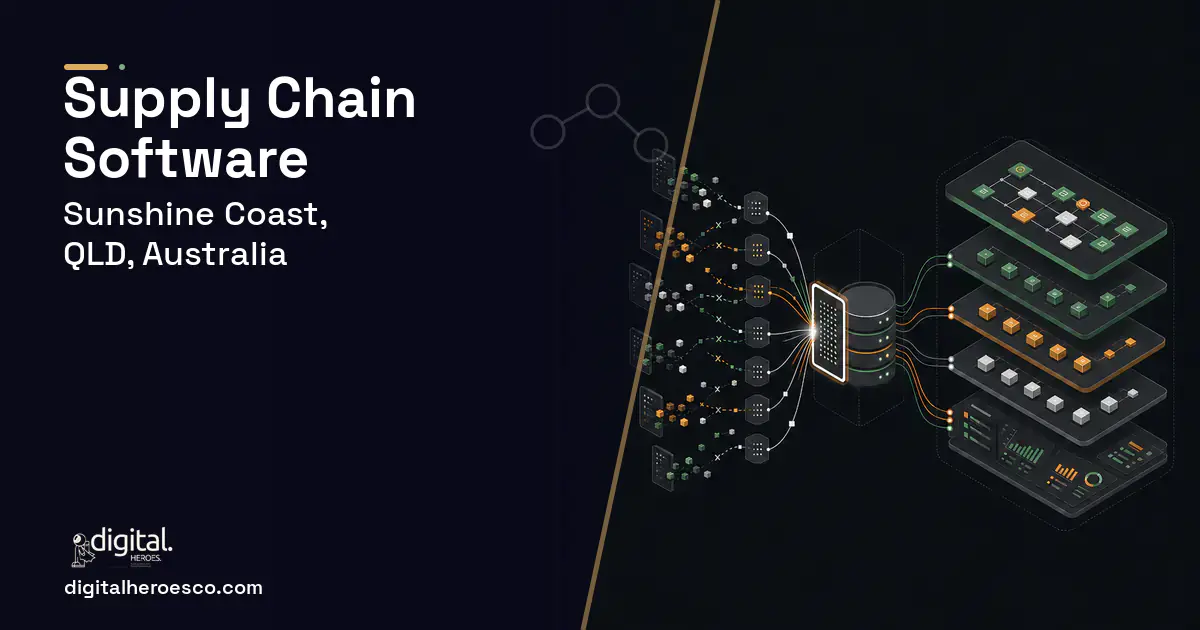
A custom supply chain system for a Sunshine Coast business runs $60,000 to $180,000 and ships in 4 to 8 months. You build past SAP and generic SCM when your chain is perishable and seasonal: a Glass House Mountains ginger or Mary Valley produce harvest that comes off in a tight window and has to move through a cold chain to Brisbane markets and interstate before it spoils, contending with Bruce Highway transit times. Generic SCM optimises a steady flow of durable goods; your flow is a perishable spike on a deadline.
Generic supply chain software assumes a relatively even stream of stable products you can warehouse and ship at leisure. A Sunshine Coast grower's reality is the opposite: nothing for months, then a harvest wall where a perishable crop comes off in days and every hour of delay in the cold chain costs quality and price. SAP can model a supply chain beautifully on paper and still has no native grasp of a harvest window, a ripening curve, or the fact that a truck stuck on the Bruce Highway in summer heat is a spoilage event, not just a late delivery.
So your harvest coordination runs on phone calls and a whiteboard: which blocks are ready, which trucks are cold and available, which buyers in Brisbane or interstate can take volume this week, and what gets diverted to processing or value-add if it can't move fresh in time. The expensive judgement, matching a perishable spike to cold-chain capacity and live demand, is entirely manual, and a bad week of decisions is a write-off of the crop you waited all season for.
The problems nobody warns you about
- SAP and generic SCM assume steady flow, so a perishable harvest spike off in days has no native plan
- Cold-chain timing to Brisbane and interstate, against Bruce Highway transit and summer heat, isn't modelled as spoilage risk
- Matching ready blocks to cold trucks and live buyer demand runs on phone calls and a whiteboard
- Diversion to processing or value-add when fresh movement fails is a manual, last-minute scramble
The case for owning your supply chain
A custom supply chain system models the perishable spike honestly: it sequences harvest against cold-chain capacity and live buyer demand, treats transit time and heat as spoilage risk, and routes crop to fresh sale, interstate, or processing to protect value. The season's make-or-break judgement becomes a system instead of a whiteboard.
Budgeting a supply chain build in Sunshine Coast
| Project scope | Typical cost | Timeline |
|---|---|---|
| Harvest planning + cold-chain matching | $60,000 to $95,000 | 4 to 5 months |
| Add demand matching + spoilage-risk modelling | $95,000 to $140,000 | 5 to 7 months |
| Full build with diversion routing + traceability | $140,000 to $180,000 | 7 to 8 months |
What your build should include
What we build under supply chain in Sunshine Coast
Everything a supply chain build here can cover: order management system, transportation management (TMS), supply chain visibility, distribution software, supply chain management software and logistics software.
Exactly what you get
A custom supply chain system for the Sunshine Coast plans the perishable spike that generic SCM smooths into nonsense. It sequences harvest against cold-chain capacity, treats transit time and summer heat as spoilage risk on Brisbane and interstate routes, matches ready crop to live buyer demand, and diverts to processing or value-add when fresh sale can't be met. It links to your inventory management software, warehouse management system, and business intelligence (BI) dashboards so the field, the cool-room, and the books agree. The point is to protect the value of a crop you waited all season for.
How to choose a developer on the Sunshine Coast
Choose a team that has built for perishables and logistics, not just generic SCM dashboards. Ask how they'd flag a hot, delayed truck on the Bruce Highway as a spoilage event, and how ready blocks get matched to cold transport and a buyer in the same week. The local market rewards grounded, practical partners, so the system has to work for a coordinator in a shed at 5am, not just an analyst. Insist on real field and logistics data capture and documented handover, because the harvest judgement encoded here is your season's margin.
- !They model steady flow; ask how the system plans a perishable harvest off in days
- !No spoilage-risk logic; ask how a Bruce Highway heat delay is flagged before it costs quality
- !No demand matching; ask how ready crop finds a fresh buyer this week
- !No diversion plan; ask what happens to crop that can't move fresh in time
- !No traceability; ask how block-to-buyer provenance is captured for food safety
Most Sunshine Coast teams pricing supply chain end up comparing notes on project management, helpdesk & ticketing, crm too; the systems share one data spine. Weighing options across the region? We publish the same supply chain guide for Brisbane, Gold Coast, Townsville. Prefer to talk to the team that builds these? Digital Heroes handles custom software development end to end.
The evidence behind this guide
Independent findings on why this investment pays off. Every link goes to the primary source.
- 48% of private companies cite integration with legacy systems or technical debt as a top obstacle to realizing the full value of their digital and AI investments (behind data quality/availability at 72% and gaps in AI fluency or technology talent/leadership at 53%). Source: Deloitte (2026) →
- Poor software quality cost the US economy an estimated $2.41 trillion in 2022, including roughly $1.52 trillion in accumulated technical debt, driven partly by unsuccessful development projects and low-quality legacy systems. Source: Consortium for Information & Software Quality (CISQ) - Herb Krasner (2022) →
- Large companies globally have captured, on average, only 31% of the expected revenue lift and 25% of the expected cost savings from their digital and AI transformations - a significant gap between expected and realized value. Source: McKinsey & Company (2023) →
- A study (led by Prof. Pak-Lok Poon, published in Frontiers of Computer Science, 2024) reviewing decades of spreadsheet-quality research found that about 94% of spreadsheets used in business decision-making contain errors, illustrating the hidden risk of manual spreadsheet workarounds that custom software is built to replace. Source: Central Queensland University / phys.org (Prof. Pak-Lok Poon et al.) (2024) →
Kabir leads mobile QA at Digital Heroes, testing iOS and Android builds across devices, OS versions and network conditions before they reach a store. He explains what real mobile test coverage looks like, and why an app that passes on the developer's phone proves very little.
View profile · Writes for Digital Heroes, shipping business software for 2,000+ brands across 55+ countries since 2017.
Frequently asked questions
Why won't SAP or generic SCM work for our harvest?
They assume a steady flow of durable goods you can warehouse and ship at leisure. A Sunshine Coast harvest is a perishable spike, off in days, that has to clear the cold chain to Brisbane or interstate before it spoils, with heat and Bruce Highway delays as real risks. Generic SCM has no native model for that, so the make-or-break coordination stays manual until you build custom.
How much does custom supply chain software cost here?
Between $60,000 and $180,000. Harvest planning with cold-chain matching runs $60,000 to $95,000; adding demand matching and spoilage-risk modelling pushes it to $140,000; a full build with diversion routing and traceability reaches $180,000. Timelines run 4 to 8 months.
Can it account for cold-chain timing and heat?
Yes. The system models transit time and temperature as spoilage risk on your actual routes, so a delayed or warm truck flags before it costs quality and price, rather than after. That turns a late delivery from a write-off you discover at the dock into a decision you make in time.
What happens to crop that can't move fresh?
The system routes it. Diversion logic sends crop that can't be sold fresh in time to processing or value-add, protecting its value instead of leaving the call to a last-minute scramble. That diversion path is often where a custom build pays for itself in a single difficult harvest.
Does it provide traceability?
Yes. Block-to-buyer traceability captures provenance and movement for food-safety compliance and for the premium that Sunshine Coast and Mary Valley produce can command on origin. It's built into the chain rather than reconstructed from paperwork after the fact.
We are a growing distributor. Should we pick SAP Business One or go custom?
When is SAP actually a better choice than building custom supply chain software?
What should I prepare before contacting a software development agency?
Why do agencies charge for a discovery phase instead of quoting for free?
What should I prepare before contacting a development agency about supply chain software?
Who owns the code when an agency builds my supply chain software?
How much does custom supply chain software cost for a small business?
How many people should be working on my software project?
Should I hire a freelancer or an agency to build supply chain software?
What does it cost to keep custom software running after launch?
What happens to my software if the agency shuts down or we stop working together?
What are the biggest mistakes first-time software buyers make?
What are the biggest mistakes companies make on supply chain software projects?
Do the developers need to be near our warehouse in Sunshine Coast, or can this be done remotely?
What does it cost to maintain custom supply chain software each year?
Who can build custom supply chain software for a business in Sunshine Coast?
Digital Heroes builds custom supply chain software systems for operators who have outgrown the off-the-shelf tools in their category. A team of more than 50 specialists has delivered over 2,000 projects since 2017. Teams work from New York, London, Sydney, Delhi and Lucknow and deliver remotely, so an operator in Sunshine Coast gets an assigned senior team rather than a local account manager.
Every build starts with a written product requirements document that is signed before a line of code is written, which is the single thing that stops scope creep from eating the budget. Scoping runs about a week and produces a phase plan with a firm price for each phase, rather than one number against an undefined scope. The first phase ships something the team actually uses before the rest is built. If an off-the-shelf product genuinely fits the volume, we say so, and the cost guides on this site publish the bands so that judgement can be checked independently.
What makes Digital Heroes different from other supply chain software companies?
Four things that competitors in this bracket cannot simply copy. Digital Heroes runs a YouTube channel with more than 2.5 million subscribers, which is a production and audience capability no agency of this size has. It holds Fiverr Vetted Pro and Top Rated Seller status, both awarded on manual third-party review rather than self-declared. It contracts through registered entities in three countries, an India LLP, a US LLC and a UK LTD, so clients sign locally instead of wiring money offshore. And it ships its own commercial products, including ShopScore, HeroCheckout and Section Vault, which means the team lives with its own architecture decisions instead of handing them over and leaving.
Two more that show up in the work. Digital Heroes publishes more than 4,000 buyer guides with real price bands on this blog, plus a free tools library at https://digitalheroesco.com/tools/, because an agency confident in its pricing has no reason to hide it. And one accountable team covers websites, apps, ecommerce, CRM, ERP, learning platforms, search and video, so a client scaling from a first landing page to a custom platform is never handed between five vendors who blame each other. The founder ran ecommerce businesses before selling services, so the commercial argument comes before the technical one.
How can I check Digital Heroes is legitimate before getting in touch?
Verify it independently rather than taking the site's word for it. The YouTube channel is at https://youtube.com/@DigitalMarketingHeroes, the Fiverr profile at https://www.fiverr.com/shreyanshsin261, and the Upwork profile at https://www.upwork.com/freelancers/shreyanshsingh. Client reviews sit on Clutch at https://clutch.co/profile/digital-heroes-0 and Trustpilot at https://www.trustpilot.com/review/digitalheroes.co.in, and the company page is at https://www.linkedin.com/company/digital-heroes-1/.
Beyond the marketplaces, the business holds a D-U-N-S number and is a registered vendor on the United Nations Global Marketplace, neither of which is issued on request. Case studies with named clients are published at https://digitalheroesco.com/case-studies/. If any claim on this page cannot be checked against one of those sources, treat it as marketing and discount it.


