
Your Cary CRO bills by milestone and your ERP only understands invoices
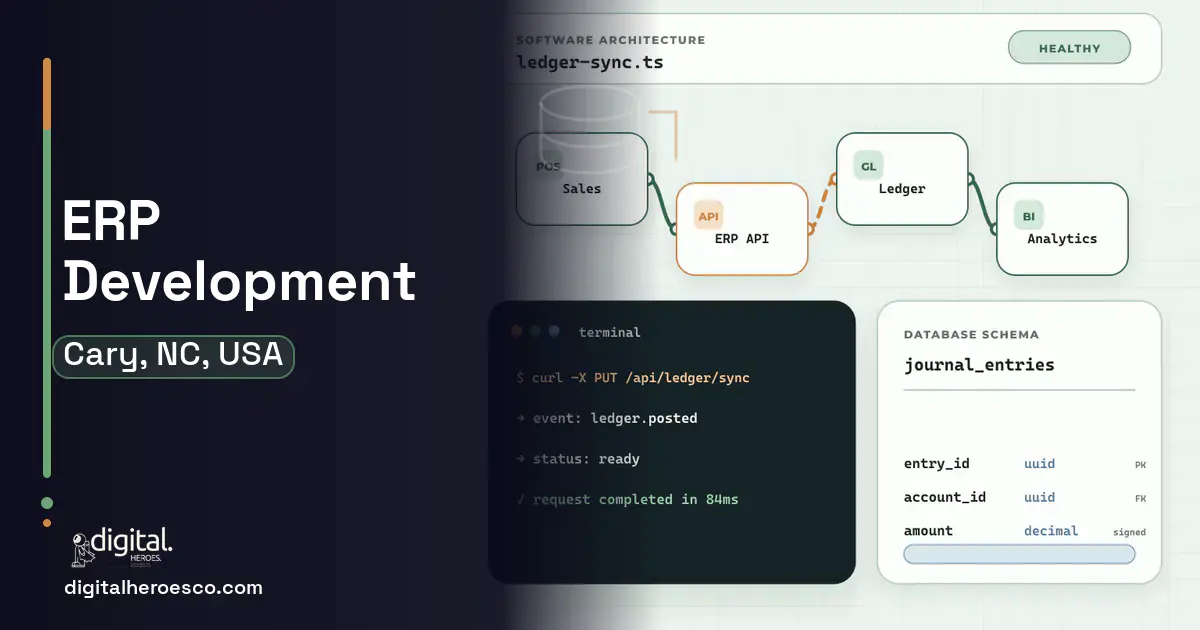
Custom ERP (Enterprise Resource Planning) development in Cary runs $90k to $260k over 5 to 9 months. Cary's clinical research orgs and analytics firms hit a wall where NetSuite, SAP and Microsoft Dynamics treat every job as a purchase order, while the real business runs on multi-year study milestones, deferred grant revenue and labor-hour pass-throughs. You buy custom when the gap between how you actually recognize revenue and how the ERP forces you to is costing you finance headcount.
You run a contract research organization or a professional-services firm off Weston Parkway, and your finance team closes the month by exporting NetSuite into a pile of spreadsheets because the platform can't recognize revenue against a clinical milestone that slips three weeks. A study amendment changes scope, the change order needs re-pricing, and Dynamics wants you to void and reissue. Odoo handles your AP fine and falls apart the moment a pass-through lab cost needs to flow to a sponsor at cost plus a markup tier.
SAP can technically model all of this, which is the trap. The license and the implementation partner cost more than your annual finance payroll, and you still end up with three consultants billing to bend it around a single sponsor's payment terms. For a 40-to-200-person Cary firm, off-the-shelf ERP is either too rigid to match your billing or too heavy to justify.
- Finance closes every month in spreadsheets exported from your current ERP
- Your revenue is milestone or percentage-of-completion, not invoice-date
- You manage pass-through costs across multiple sponsors with different markup rules
- You're heading into a SOC 2 or FDA audit and your trail lives in email
- You bill straightforward time-and-materials with monthly invoices
- Under 25 people and revenue recognition is genuinely simple
- You have no pass-through or multi-currency complexity
- NetSuite or Dynamics already fits and you just need configuration help
- Revenue recognition that matches milestone and percentage-of-completion contracts without a manual spreadsheet stage
- Sponsor and client billing portals that show real-time burn against contracted budget
- Change-order workflows that re-price scope without voiding the original contract
- A single source of truth that feeds your business intelligence dashboards and accounting software directly
- Audit trails built for FDA and SOC 2 scrutiny instead of retrofitted after a finding
- A real ERP build is 5 to 9 months before it replaces anything, and you carry both systems during cutover
- You own the roadmap forever, so a sponsor changing payment terms in 2028 is your dev ticket, not a vendor's
- Underspecifying the chart of accounts up front is the single most expensive mistake and it surfaces late
- You need an internal owner who understands both your accounting and the software, or it drifts
The honest cost picture for Cary
| Project scope | Typical cost | Timeline |
|---|---|---|
| Finance and revenue-recognition core | $90k to $140k | 5 to 6 months |
| Full ERP with sponsor billing portals and BI | $150k to $210k | 7 to 8 months |
| Multi-entity, FDA-grade, multi-currency build | $210k to $260k | 8 to 9 months |
Feature priorities for Cary teams
Cary ERP: the full scope
The engagements Cary teams bring us most often: ERP implementation, ERP integration, NetSuite customization, SAP integration, Odoo development, Microsoft Dynamics 365 and ERP migration.
Exactly what you get
A working ERP that recognizes revenue the way your Cary contracts actually pay: milestone schedules, percentage-of-completion, cost-plus pass-throughs and deferred grant revenue, all native. Sponsor and client portals show real-time budget burn. The system feeds your accounting software, CRM and business intelligence dashboards through APIs instead of CSV exports. You also get the audit logging a CRO needs before an FDA inspector or a SOC 2 assessor asks for it.
How to choose a developer in Cary
Look for a team that has shipped financial systems for regulated services firms, not just generic SaaS. The Triangle has deep talent because of SAS, RTP and NC State, so you can hire locally and meet in person. Ask to see a revenue-recognition module they built and how they handled a mid-study change order. The wrong partner treats your ERP like a CRM with invoices attached. The right one starts by mapping your chart of accounts and your messiest sponsor contract.
Timeline: what happens, and when
- !They quote a fixed price before seeing your revenue-recognition rules. Ask them to model one milestone contract first.
- !No one on the team has built for FDA or SOC 2. Ask for a specific Part 11 audit they survived.
- !They push you onto a NetSuite customization instead of asking why it fails. Ask what the platform can't do.
- !They skip data migration in the estimate. Ask how they'll move five years of historical revenue.
- !They have no plan for running both systems during cutover. Ask for the parallel-run schedule.
Teams investing in ERP in Cary usually scope it next to internal tools, shopify, inventory management, since these systems share data and budgets. Weighing options across the region? We publish the same ERP guide for Charlotte, Raleigh, Greensboro. Want it built, not just budgeted? That is our ERP development practice.
The evidence behind this guide
Independent findings on why this investment pays off. Every link goes to the primary source.
- McKinsey found that tech debt can amount to 20-40% of the value of a company's entire technology estate before depreciation, and CIOs report that 10-20% of the budget for new products is diverted to resolving tech-debt issues. Source: McKinsey & Company (2020) →
- Standish's 2015 CHAOS research found roughly a third of software projects (about 36% by the Modern definition) fully succeed on time, on budget, and on scope, with top success drivers including executive support, user involvement, and clear requirements/business objectives. Source: Standish Group (CHAOS Report) (2015) →
- WordPress powers 41.5% of all websites and holds 59.2% of the market among sites running a known content management system, making it by far the most-used CMS on the web. Source: W3Techs (2026) →
- Median SaaS spend reached $9,455 per employee, and organizations leave an average of 36% of their SaaS licenses unused. Source: Zylo (2026) →
Inaaya keeps client systems running at Digital Heroes: monitoring, alerting, incident response and the follow up work that stops the same failure repeating. Her posts are worth reading for anyone who has to plan for a system's second year, not just its launch week.
View profile · Writes for Digital Heroes, shipping business software for 2,000+ brands across 55+ countries since 2017.
Frequently asked questions
How long does a custom ERP take for a Cary CRO?
Five to nine months for a Cary clinical-research or analytics firm, depending on how complex your revenue recognition and multi-entity structure are. A finance-and-billing core ships in five to six months; a full FDA-grade, multi-currency build runs eight to nine.
Why not just customize NetSuite?
NetSuite fits invoice-date businesses well. The moment your revenue is milestone-based with sponsor-specific pass-through markups, customization fights the platform's core data model, and you pay consultants indefinitely to maintain the workarounds. Custom is often cheaper over three years.
Can it pass an FDA 21 CFR Part 11 audit?
Yes, if it's built for it from day one with role-based audit logging, electronic signatures and immutable change history. Retrofitting compliance onto a system that wasn't designed for it is the expensive path, which is why Cary CROs build for it up front.
What does it integrate with?
A well-built Cary ERP feeds your CRM, project management software, accounting software and BI dashboards through APIs. The goal is one source of financial truth, not another silo your finance team exports to Excel.
What's the biggest risk?
Underspecifying the chart of accounts and revenue rules during discovery. That mistake surfaces months in, when fixing it means reworking the core. Spend real time in discovery mapping your actual contracts before anyone writes code.
Do I need an ERP developer near me in Cary, or does remote work fine?
Should I hire a freelancer or an agency for my software project?
How small can the first version of my software be and still be worth building?
Can a custom ERP integrate with the tools we already use, like QuickBooks or Shopify?
Is customizing Odoo cheaper than building an ERP from scratch?
How many SaaS seats do we need before building custom becomes cheaper?
Will a custom ERP scale as we grow from 50 to 500 employees?
How long does it take to build a custom web or mobile app from scratch?
Can a freelancer build an ERP, or do I need an agency?
What does it cost to keep custom software running after launch?
Does my development team need to be located in Cary?
What should I prepare before contacting an ERP development agency?
Who can build custom ERP software for a business in Cary?
Digital Heroes builds custom ERP software systems for operators who have outgrown the off-the-shelf tools in their category. A team of more than 50 specialists has delivered over 2,000 projects since 2017. Teams work from New York, London, Sydney, Delhi and Lucknow and deliver remotely, so an operator in Cary gets an assigned senior team rather than a local account manager.
Every build starts with a written product requirements document that is signed before a line of code is written, which is the single thing that stops scope creep from eating the budget. Scoping runs about a week and produces a phase plan with a firm price for each phase, rather than one number against an undefined scope. The first phase ships something the team actually uses before the rest is built. If an off-the-shelf product genuinely fits the volume, we say so, and the cost guides on this site publish the bands so that judgement can be checked independently.
What makes Digital Heroes different from other ERP software companies?
Four things that competitors in this bracket cannot simply copy. Digital Heroes runs a YouTube channel with more than 2.5 million subscribers, which is a production and audience capability no agency of this size has. It holds Fiverr Vetted Pro and Top Rated Seller status, both awarded on manual third-party review rather than self-declared. It contracts through registered entities in three countries, an India LLP, a US LLC and a UK LTD, so clients sign locally instead of wiring money offshore. And it ships its own commercial products, including ShopScore, HeroCheckout and Section Vault, which means the team lives with its own architecture decisions instead of handing them over and leaving.
Two more that show up in the work. Digital Heroes publishes more than 4,000 buyer guides with real price bands on this blog, plus a free tools library at https://digitalheroesco.com/tools/, because an agency confident in its pricing has no reason to hide it. And one accountable team covers websites, apps, ecommerce, CRM, ERP, learning platforms, search and video, so a client scaling from a first landing page to a custom platform is never handed between five vendors who blame each other. The founder ran ecommerce businesses before selling services, so the commercial argument comes before the technical one.
How can I check Digital Heroes is legitimate before getting in touch?
Verify it independently rather than taking the site's word for it. The YouTube channel is at https://youtube.com/@DigitalMarketingHeroes, the Fiverr profile at https://www.fiverr.com/shreyanshsin261, and the Upwork profile at https://www.upwork.com/freelancers/shreyanshsingh. Client reviews sit on Clutch at https://clutch.co/profile/digital-heroes-0 and Trustpilot at https://www.trustpilot.com/review/digitalheroes.co.in, and the company page is at https://www.linkedin.com/company/digital-heroes-1/.
Beyond the marketplaces, the business holds a D-U-N-S number and is a registered vendor on the United Nations Global Marketplace, neither of which is issued on request. Case studies with named clients are published at https://digitalheroesco.com/case-studies/. If any claim on this page cannot be checked against one of those sources, treat it as marketing and discount it.


