
Your Rolleston subdivision is profitable in Xero and losing money on site, and your Christchurch ERP cannot tell you which
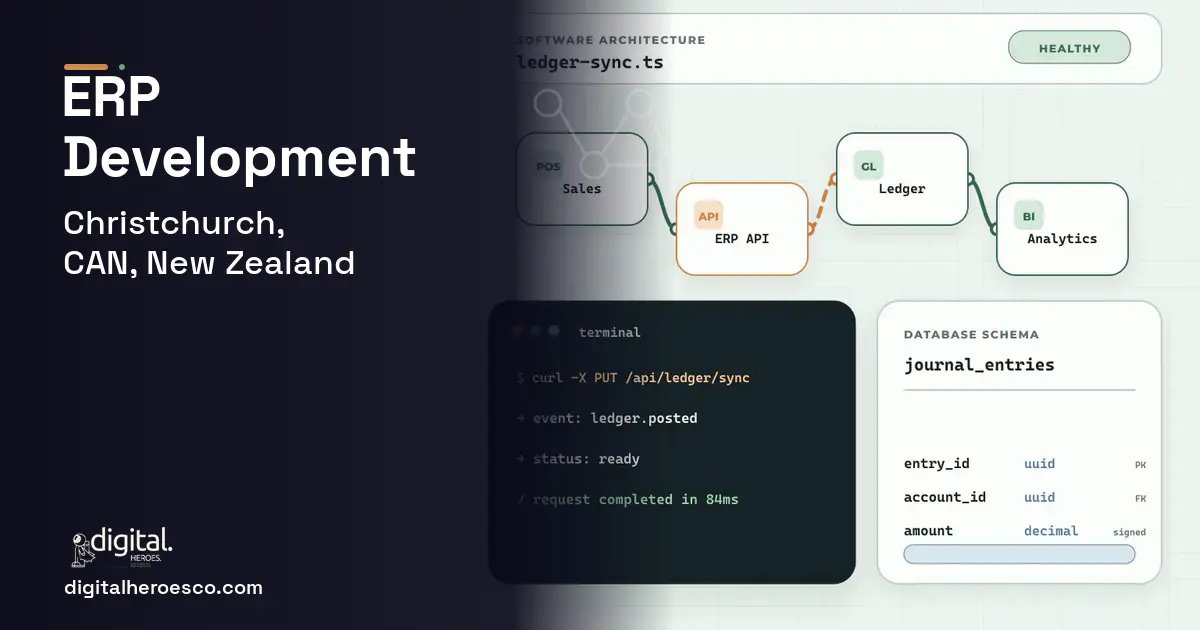
A Christchurch ERP (Enterprise Resource Planning) build that actually holds retentions, progress claims and job costing together runs NZD 120,000 to NZD 320,000 for a first production release, delivered in five to nine months. That buys a system where a lot at Rolleston, a variation signed on site, a subcontractor retention held on trust and a GST return all reference the same job number. The cheaper path is keeping Xero and building the operational layer around it, which lands closer to NZD 120,000.
You run twelve to forty jobs at once across Halswell, Rangiora and the Selwyn subdivisions. Odoo or MYOB Advanced holds your invoices, Xero holds your GST, a project spreadsheet holds the real budget, and the quantity surveyor holds the truth in his head. Month end takes nine days because someone has to reconcile progress claims against actual site spend by hand, and by the time the numbers land the job is three weeks further along.
NetSuite and SAP were built for companies that manufacture a product and ship it. They have no native concept of a payment claim under the Construction Contracts Act 2002, no concept of a payment schedule that has to go back inside 20 working days or the full claimed amount becomes payable, and no concept of retention money that since October 2023 has to be held on trust and reported to the subcontractor it belongs to. Odoo will let you bolt a construction module on. It will not stop your site manager approving a variation that nobody has priced.
Why the usual tools struggle in Christchurch
- Retentions tracked on a spreadsheet with no per subcontractor ledger, so you cannot produce the trust records the 2023 retention money rules require
- Progress claims assembled manually from site diaries, so payment schedules go out late and disputed amounts become payable in full
- Variations approved verbally on site at Prebbleton and priced six weeks later, by which time the client has moved on
- No live job margin, so you find out a TC3 foundation job blew out only when the final invoice from the piling contractor arrives
What a custom ERP build changes
Custom earns its keep here because your cost structure is Canterbury specific and nobody sells software for it. Your jobs are priced per lot, your labour is a mix of employees and labour only subcontractors, your foundations change cost dramatically between TC1 and TC3 land, and your consent milestones sit with three different councils. A build that models a job as lot, stage, cost code and retention line lets you answer the only question that matters, which job is bleeding, on the day it starts bleeding rather than at year end. Most Christchurch clients pair this with a business intelligence (BI) dashboard for margin reporting, a project management system for site variations and a inventory system for plant and materials.
The features that matter for Christchurch
ERP services we deliver in Christchurch
Digital Heroes builds the full ERP stack for Christchurch teams. Typical engagements cover ERP integration, NetSuite customization, SAP integration, Odoo development and Microsoft Dynamics 365.
- You are running more than fifteen concurrent jobs and month end takes over a week
- Retention exposure across your subcontractor base is large enough that a trust account error is a real legal risk
- Your quoting logic includes Canterbury specific factors like land technical category, wind zone and travel to Selwyn sites
- You have already paid for two off the shelf attempts and both were abandoned by the site team
- You run fewer than eight jobs at a time and a good job costing add on over Xero covers it
- Your work is single trade and repetitive, where a field service tool fits better than an ERP
- You are about to be acquired or merged, and the parent company already has a platform
- Nobody internally can own the data, because an ERP with bad data is worse than a spreadsheet
ERP pricing in Christchurch: the real numbers
| Project scope | Typical cost | Timeline |
|---|---|---|
| Job costing and retentions core over Xero | NZD 120,000 to NZD 180,000 | 16 to 22 weeks |
| Full ERP with procurement, plant and site mobile | NZD 200,000 to NZD 320,000 | 28 to 38 weeks |
| Migration from Odoo or MYOB Advanced plus data cleanup | NZD 25,000 to NZD 60,000 | 4 to 8 weeks |
From kickoff to launch: the schedule
Exactly what you get
A working system, the source code, the database schema, deployment scripts and a person who answers the phone. In practice the first release covers job setup, cost codes, purchase orders, subcontractor agreements, progress claims, retentions and a site app for daily entries.
The second release usually adds procurement against supplier price files, plant utilisation and forecasting. We deliberately leave payroll where it is, because New Zealand leave calculation under the Holidays Act 2003 is a specialist problem and rebuilding it inside an ERP is a way to lose six months. If you do need it, treat it as its own project alongside HR (Human Resources) software.
You also get the boring things that decide whether this survives: a data dictionary, a runbook, and an admin screen so your ops manager can add a cost code without ringing us.
How to choose a developer in Christchurch
Ask for a system they built that handles money owed under contract, not just invoices. Progress claims, retentions and variations are where construction ERPs fail, and a team that has only built ecommerce will underestimate all three.
Ask how they will handle your consent milestones across Christchurch City Council, Selwyn District Council and Waimakariri District Council, because the three do not behave identically and a single hardcoded workflow will break. Ask where your data will be hosted and how they satisfy the Privacy Act 2020 if any of it sits offshore.
Then ask the question most buyers skip: who maintains this in year three. A Christchurch firm that can put a named developer on your account beats a cheaper quote from a team that will have rotated staff twice by the time you need a change.
- Live job margin per lot and per stage, so a subdivision at Lincoln shows its true position before the next claim goes out
- Retention ledger per subcontractor with trust account reconciliation and release dates tied to practical completion
- Payment claims and payment schedules generated with the statutory clock visible, so the 20 working day deadline is never missed by accident
- One job number carried from quote to consent to variation to final claim, which kills the manual reconciliation that eats month end
- GST and payday filing data drawn from the same records your site team already enters, rather than rekeyed
- Five to nine months before it replaces anything, and your team runs both systems for part of that
- You now own the roadmap, so every Holidays Act or retention rule change becomes a scoped change request rather than a vendor patch
- Site adoption is the real risk, not the code. If your leading hands keep using the paper diary the data stays wrong
- Odoo gives you a hundred modules for a subscription. A custom build gives you exactly what you scoped and nothing more
- !They have never heard of a payment schedule. Ask them to explain what happens if one is not issued within 20 working days
- !They quote a fixed price before seeing your cost code structure. Ask what happens when discovery finds forty cost codes rather than twelve
- !They propose replacing Xero. Ask why, because in New Zealand your accountant and your bank both expect it
- !No named Christchurch or New Zealand delivery reference. Ask to speak to a client who runs progress claims through their system
- !They cannot describe how retention money is held on trust. That is the single highest risk area of your build
Most Christchurch teams pricing ERP end up comparing notes on internal tools, shopify, inventory management too; the systems share one data spine. Weighing options across the region? We publish the same ERP guide for Timaru. Prefer to talk to the team that builds these? Digital Heroes handles ERP development end to end.
The evidence behind this guide
Independent findings on why this investment pays off. Every link goes to the primary source.
- McKinsey estimates that digitizing the supply chain (Supply Chain 4.0) can cut lost sales by up to 75%, reduce inventories by up to 75%, and lower supply chain operational costs by up to 30%, with up to 30% lower transport and warehousing costs. Source: McKinsey & Company (2016) →
- Across more than 5,400 IT projects studied by McKinsey and the University of Oxford BT Centre, large IT projects ran on average 45% over budget and 7% over schedule while delivering 56% less value than predicted. Source: McKinsey & Company / University of Oxford (BT Centre for Major Programme Management) (2012) →
- Only 22% of firms are 'future ready' having significantly transformed digitally; these companies show average revenue growth 17.3 percentage points and net margins 14.0 percentage points above their industry average. Source: MIT Center for Information Systems Research (MIT Sloan) (2022) →
- A study (led by Prof. Pak-Lok Poon, published in Frontiers of Computer Science, 2024) reviewing decades of spreadsheet-quality research found that about 94% of spreadsheets used in business decision-making contain errors, illustrating the hidden risk of manual spreadsheet workarounds that custom software is built to replace. Source: Central Queensland University / phys.org (Prof. Pak-Lok Poon et al.) (2024) →
Saanvi works on B2B Shopify builds at Digital Heroes, where the requirements shift from consumer checkout to company accounts, customer specific pricing, purchase orders and approval steps. Her posts help wholesale businesses see how much of that a commerce platform handles and how much needs building.
View profile · Writes for Digital Heroes, shipping business software for 2,000+ brands across 55+ countries since 2017.
Frequently asked questions
What does a construction ERP cost for a Christchurch building company?
Expect NZD 120,000 to NZD 180,000 for a first release that covers job costing, progress claims and retentions sitting over Xero, delivered in about 16 to 22 weeks. A full ERP with procurement, plant management and a site mobile app runs NZD 200,000 to NZD 320,000. Those are our delivery bands from comparable builds, not a market survey.
Can a custom ERP handle the retention money trust rules?
Yes, and it should be a headline requirement rather than an afterthought. Since October 2023 retention money must be held on trust with records identifying which subcontractor each amount belongs to, so your ERP needs a per subcontractor retention ledger, reconciliation against the trust account and statements you can issue on request. Building this properly is roughly two to three weeks of work and it is the part we never compress.
Should we replace Xero as part of an ERP project in Canterbury?
Almost never. Xero is the default general ledger for New Zealand businesses, your accountant knows it, and your bank feeds already work. The better pattern is to keep Xero for GST, payroll interfaces and statutory reporting, and build the operational layer above it with a clean two way sync on invoices, bills and coding.
How long does it take to migrate off Odoo or MYOB Advanced?
Four to eight weeks for the data, running in parallel with the main build. The time goes into cleaning rather than moving, because most Canterbury firms find duplicate suppliers, jobs coded to the wrong entity and half finished variations. Budget NZD 25,000 to NZD 60,000 depending on how many years of history you actually need.
Do we own the code if a Christchurch agency builds our ERP?
You should own all of it, including the repository, the infrastructure configuration and the database schema. Get it in writing before the first invoice, with the repository in your organisation account from day one rather than transferred at the end. If an agency wants to license the system back to you, walk.
Can the ERP track jobs differently for TC1 and TC3 land?
Yes. Technical category drives foundation type and therefore cost, so we model it as a job attribute that feeds the estimating template and the cost code set. A TC3 job in the east of Christchurch picks up different default cost lines from a TC1 job in Rolleston, and the variance report compares like with like.
What ongoing cost should a Canterbury firm budget after launch?
Plan for 15 to 20 percent of the build cost per year covering hosting, support, security patching and a steady flow of small changes. Firms that budget nothing for year two end up with a frozen system, and a frozen ERP starts drifting back to spreadsheets within about eighteen months.
Will the ERP handle GST filing to Inland Revenue?
It will produce correctly coded transactions and push them to Xero, which files. We do not recommend building a direct GST filing integration for a single company, because the rules change and the maintenance burden is out of proportion to the value. Where custom work pays off is coding accuracy on retentions and progress claims, which is where GST errors actually originate.
Can our site foremen use it without office training?
They can if the site app is designed for one hand, gloves and a nor'wester blowing sideways. That means large touch targets, offline capture with sync when they hit signal, and no more than four taps to log a variation with a photo. If your foreman needs a manual, the design failed and adoption will fail with it.
Can custom software connect to the tools we already use, like QuickBooks, Stripe, and Google Workspace?
Is customizing Odoo cheaper than building an ERP from scratch?
Can we migrate years of data out of our current system into new custom software?
What should I prepare before contacting a software development agency?
Can a custom ERP meet compliance requirements like SOC 2 or GDPR?
How do I vet a software development agency before signing a contract?
Who can build custom ERP software for a business in Christchurch?
Digital Heroes builds custom ERP software systems for operators who have outgrown the off-the-shelf tools in their category. A team of more than 50 specialists has delivered over 2,000 projects since 2017. Teams work from New York, London, Sydney, Delhi and Lucknow and deliver remotely, so an operator in Christchurch gets an assigned senior team rather than a local account manager.
Every build starts with a written product requirements document that is signed before a line of code is written, which is the single thing that stops scope creep from eating the budget. Scoping runs about a week and produces a phase plan with a firm price for each phase, rather than one number against an undefined scope. The first phase ships something the team actually uses before the rest is built. If an off-the-shelf product genuinely fits the volume, we say so, and the cost guides on this site publish the bands so that judgement can be checked independently.
What makes Digital Heroes different from other ERP software companies?
Four things that competitors in this bracket cannot simply copy. Digital Heroes runs a YouTube channel with more than 2.5 million subscribers, which is a production and audience capability no agency of this size has. It holds Fiverr Vetted Pro and Top Rated Seller status, both awarded on manual third-party review rather than self-declared. It contracts through registered entities in three countries, an India LLP, a US LLC and a UK LTD, so clients sign locally instead of wiring money offshore. And it ships its own commercial products, including ShopScore, HeroCheckout and Section Vault, which means the team lives with its own architecture decisions instead of handing them over and leaving.
Two more that show up in the work. Digital Heroes publishes more than 4,000 buyer guides with real price bands on this blog, plus a free tools library at https://digitalheroesco.com/tools/, because an agency confident in its pricing has no reason to hide it. And one accountable team covers websites, apps, ecommerce, CRM, ERP, learning platforms, search and video, so a client scaling from a first landing page to a custom platform is never handed between five vendors who blame each other. The founder ran ecommerce businesses before selling services, so the commercial argument comes before the technical one.
How can I check Digital Heroes is legitimate before getting in touch?
Verify it independently rather than taking the site's word for it. The YouTube channel is at https://youtube.com/@DigitalMarketingHeroes, the Fiverr profile at https://www.fiverr.com/shreyanshsin261, and the Upwork profile at https://www.upwork.com/freelancers/shreyanshsingh. Client reviews sit on Clutch at https://clutch.co/profile/digital-heroes-0 and Trustpilot at https://www.trustpilot.com/review/digitalheroes.co.in, and the company page is at https://www.linkedin.com/company/digital-heroes-1/.
Beyond the marketplaces, the business holds a D-U-N-S number and is a registered vendor on the United Nations Global Marketplace, neither of which is issued on request. Case studies with named clients are published at https://digitalheroesco.com/case-studies/. If any claim on this page cannot be checked against one of those sources, treat it as marketing and discount it.


