
Your Coventry Tier-2 plant ships to JLR and the ERP can't produce a PPAP on demand
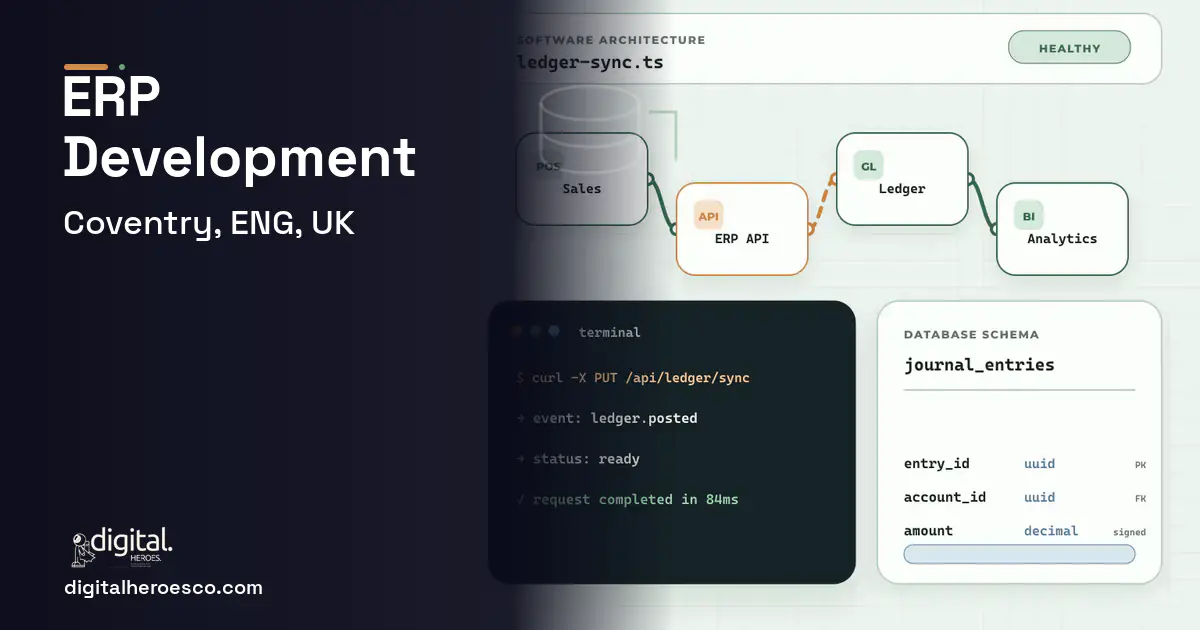
Most Coventry automotive Tier-2 and Tier-3 suppliers reach the limit of NetSuite, SAP Business One, or Odoo the first time a JLR or BMW quality auditor asks for lot-level traceability that crosses three modules and two spreadsheets. A custom ERP (Enterprise Resource Planning) for a Coventry manufacturer typically runs £70,000 to £180,000 over 5 to 9 months, and it earns its keep by making PPAP packs, EDI delivery schedules, and IATF 16949 records a query instead of a fire drill.
You bought NetSuite or Odoo because it promised one system for purchasing, production, and finance. It works fine until your biggest customer (likely JLR, BMW Hams Hall, or a Tier-1 like Bosch) changes a delivery schedule over EDI and your planning team rekeys it into a spreadsheet because the connector only handles standard ANSI X12, not the OEM's variant. Now your delivery performance number lives in two places that disagree.
The off-the-shelf systems were built for generic distribution, not for a Coventry plant that has to prove which heat-treat batch went into which part number on which date. When the auditor asks for that chain, you assemble it by hand across the ERP, a quality spreadsheet, and the shop-floor whiteboard. One transcription error in that chain is what turns a routine surveillance audit into a customer escalation.
- You supply two or more OEMs with conflicting EDI and reporting formats
- Traceability and PPAP are your competitive moat, not a checkbox
- Spreadsheets sit between your ERP and your quality system on a daily basis
- An audit finding has already cost you delivery volume or a customer escalation
- You're a single-product shop with no OEM EDI obligations
- Standard distribution costing covers your margin questions
- You have under 15 staff and processes are still settling
- An Odoo automotive add-on covers your traceability without customisation
- Generate an audit-ready PPAP or IATF 16949 record in minutes instead of assembling it across spreadsheets
- Native OEM EDI handling for JLR, BMW, and Tier-1 delivery schedules without manual rekeying
- End-to-end batch genealogy so a recall or 8D investigation traces to the exact heat and supplier lot
- Real costing that separates freight and tariff swings from true manufacturing margin
- One source of truth that ends the daily reconciliation between ERP and quality spreadsheets
- A custom ERP is a 6-to-9-month commitment before full cutover, longer than a NetSuite go-live
- You take on ownership of maintenance and the OEM EDI mapping as customers change formats
- Migrating years of part, BOM, and supplier history is genuinely hard and easy to underestimate
- If your processes are still changing weekly, you'll be paying to rebuild as you go
The honest cost picture for Coventry
| Project scope | Typical cost | Timeline |
|---|---|---|
| Core ERP for one plant (purchasing, production, finance) | £70k to £110k | 5 to 6 months |
| Add OEM EDI gateway and PPAP automation | £110k to £150k | 6 to 8 months |
| Multi-plant with full batch genealogy and supplier portal | £150k to £180k+ | 8 to 9 months |
Feature priorities for Coventry teams
ERP services we deliver in Coventry
Everything an ERP build here can cover: Odoo development, Microsoft Dynamics 365, ERP migration, cloud ERP and manufacturing ERP.
Exactly what you get
A working ERP that holds your production, purchasing, and finance in one place, plus the automotive-specific layer that off-the-shelf skips: an EDI gateway that speaks your OEM customers' delivery schedules, batch genealogy from certificate-of-conformity to dispatch, and a PPAP generator that assembles a submission pack from live data. You also get a costing model that tells you whether a thin margin on a battery-tray contract is a freight problem or a pricing problem. Adjacent systems worth scoping alongside it: an inventory management system for the stores, a warehouse management system if you run a high-bay, and BI (Business Intelligence) dashboards on top of the ERP data.
How to choose a developer in Coventry
Pick a team that can talk fluently about IATF 16949, PPAP levels, and the difference between a DELFOR and a DELJIT, because that vocabulary is the whole job. Ask to see a traceability chain they built for another manufacturer and ask how they handled an OEM that changed its EDI spec mid-contract. A local team that understands the Coventry and Warwickshire supply base, where Tier-1 and Tier-2 plants cluster around the JLR and BMW ecosystems, will scope your reporting obligations correctly the first time rather than discovering them in user acceptance testing.
Timeline: what happens, and when
- !They've never handled automotive EDI; ask which OEM delivery-schedule formats they've shipped
- !They quote a fixed price before seeing your BOM and traceability rules; ask how they scope batch genealogy
- !They treat PPAP as a document export; ask how the data stays linked to the live production record
- !They want to migrate all legacy data at once; ask for their phased cutover and reconciliation plan
- !No shop-floor experience; ask to see a WIP terminal they've built for a manufacturer
Most Coventry teams pricing ERP end up comparing notes on internal tools, shopify, inventory management too; the systems share one data spine. Weighing options across the region? We publish the same ERP guide for London, Birmingham, Manchester. Prefer to talk to the team that builds these? Digital Heroes handles ERP development end to end.
The evidence behind this guide
Independent findings on why this investment pays off. Every link goes to the primary source.
- 48% of private companies cite integration with legacy systems or technical debt as a top obstacle to realizing the full value of their digital and AI investments (behind data quality/availability at 72% and gaps in AI fluency or technology talent/leadership at 53%). Source: Deloitte (2026) →
- In a survey of 113 supply chain leaders (conducted late March to mid-April 2022), 67% had implemented digital dashboards for end-to-end visibility, and those companies were about twice as likely as others to avoid supply chain problems during the disruptions of early 2022; 71% expected to revise inventory policies going forward. Source: McKinsey & Company (2022) →
- Independent reporting of Gartner's 2025 survey confirms 59% of finance leaders use AI, up from 37% in 2023, with error and anomaly detection (34%) and accounts payable automation (37%) among the leading use cases. Source: CPA Practice Advisor (reporting Gartner) (2025) →
- The average developer spends more than 17 hours a week dealing with maintenance issues such as debugging and refactoring, and about four of those hours on 'bad code' - waste that equates to nearly $85 billion annually worldwide in opportunity cost. Source: Stripe (2018) →
Vikram runs the engineering function at Digital Heroes, from how teams are structured to how code gets reviewed and released. He writes about the trade offs behind build decisions: what to buy, what to build, and where technical debt is worth taking on deliberately.
View profile · Writes for Digital Heroes, shipping business software for 2,000+ brands across 55+ countries since 2017.
Frequently asked questions
Can a custom ERP replace our quality spreadsheets entirely?
Yes, and that's usually the point. When control plans, inspection results, and PSW data live in the same database as production, you stop maintaining a parallel quality system and PPAP assembly becomes a query rather than a manual rebuild across files.
How do you handle JLR or BMW EDI delivery schedules?
Through a dedicated EDI gateway that parses DELFOR and DELJIT messages directly into your planning records, with ASN/DESADV going back out automatically. The mapping is built to the specific OEM's variant, not generic ANSI X12, which is where standard connectors fall down.
What does a Coventry Tier-2 ERP typically cost?
A single-plant core runs £70,000 to £110,000. Adding OEM EDI and PPAP automation pushes it to £110,000 to £150,000, and a multi-plant build with a supplier portal reaches £180,000 or more. Timelines run 5 to 9 months.
Is Odoo or NetSuite ever enough for an automotive supplier?
For a small, single-customer shop without EDI obligations, yes. The moment you supply two OEMs with conflicting formats and need lot-level traceability for audit, the customisation cost of bending an off-the-shelf system usually exceeds a focused custom build.
How long before we can run the plant on it?
Plan for 5 to 9 months depending on scope, with a phased cutover rather than a big-bang switch. Most Coventry suppliers run the new ERP in parallel for one reporting cycle before retiring the spreadsheets.
How many SaaS seats do we need before building custom becomes cheaper?
Can a freelancer build an ERP, or do I need an agency?
How do I vet an agency for an ERP project?
Can we keep our current ERP and just build custom modules around it?
Do I need an ERP developer near me in Coventry, or does remote work fine?
What happens to my software if the agency shuts down or we stop working together?
Is SAP overkill for a mid-sized company?
Who owns the source code if an agency builds my ERP?
Should I hire a freelancer or an agency for my software project?
Will a custom ERP scale as we grow from 50 to 500 employees?
Who can build custom ERP software for a business in Coventry?
Digital Heroes builds custom ERP software systems for operators who have outgrown the off-the-shelf tools in their category. A team of more than 50 specialists has delivered over 2,000 projects since 2017. Teams work from New York, London, Sydney, Delhi and Lucknow and deliver remotely, so an operator in Coventry gets an assigned senior team rather than a local account manager.
Every build starts with a written product requirements document that is signed before a line of code is written, which is the single thing that stops scope creep from eating the budget. Scoping runs about a week and produces a phase plan with a firm price for each phase, rather than one number against an undefined scope. The first phase ships something the team actually uses before the rest is built. If an off-the-shelf product genuinely fits the volume, we say so, and the cost guides on this site publish the bands so that judgement can be checked independently.
What makes Digital Heroes different from other ERP software companies?
Four things that competitors in this bracket cannot simply copy. Digital Heroes runs a YouTube channel with more than 2.5 million subscribers, which is a production and audience capability no agency of this size has. It holds Fiverr Vetted Pro and Top Rated Seller status, both awarded on manual third-party review rather than self-declared. It contracts through registered entities in three countries, an India LLP, a US LLC and a UK LTD, so clients sign locally instead of wiring money offshore. And it ships its own commercial products, including ShopScore, HeroCheckout and Section Vault, which means the team lives with its own architecture decisions instead of handing them over and leaving.
Two more that show up in the work. Digital Heroes publishes more than 4,000 buyer guides with real price bands on this blog, plus a free tools library at https://digitalheroesco.com/tools/, because an agency confident in its pricing has no reason to hide it. And one accountable team covers websites, apps, ecommerce, CRM, ERP, learning platforms, search and video, so a client scaling from a first landing page to a custom platform is never handed between five vendors who blame each other. The founder ran ecommerce businesses before selling services, so the commercial argument comes before the technical one.
How can I check Digital Heroes is legitimate before getting in touch?
Verify it independently rather than taking the site's word for it. The YouTube channel is at https://youtube.com/@DigitalMarketingHeroes, the Fiverr profile at https://www.fiverr.com/shreyanshsin261, and the Upwork profile at https://www.upwork.com/freelancers/shreyanshsingh. Client reviews sit on Clutch at https://clutch.co/profile/digital-heroes-0 and Trustpilot at https://www.trustpilot.com/review/digitalheroes.co.in, and the company page is at https://www.linkedin.com/company/digital-heroes-1/.
Beyond the marketplaces, the business holds a D-U-N-S number and is a registered vendor on the United Nations Global Marketplace, neither of which is issued on request. Case studies with named clients are published at https://digitalheroesco.com/case-studies/. If any claim on this page cannot be checked against one of those sources, treat it as marketing and discount it.


