
Your Coventry plant runs on eleven Airtable bases and nobody trusts the numbers
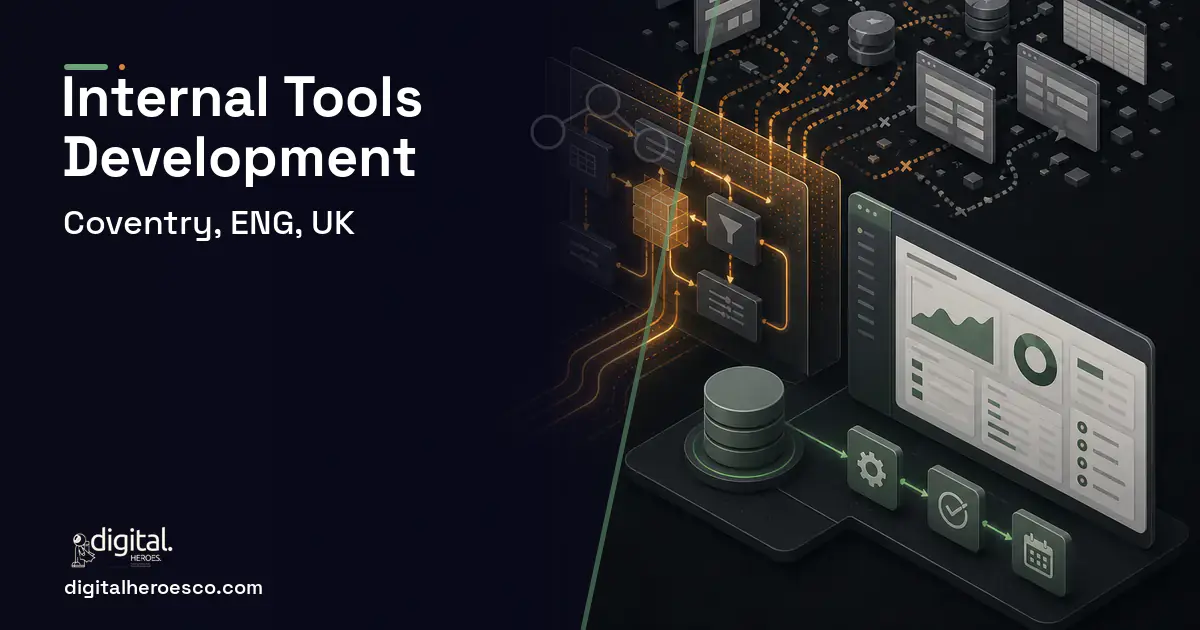
Internal tools in a Coventry plant usually start as one Airtable base or a Retool dashboard and quietly multiply until the real operating system of the business is a dozen disconnected apps. A consolidated set of custom internal tools costs £30,000 to £90,000 over 2 to 5 months and pays back by replacing the brittle spreadsheet layer that sits between your ERP (Enterprise Resource Planning), your shop floor, and your OEM reporting.
Retool and Airtable are genuinely good at the first 80%. A Coventry engineering or logistics firm builds a tool to track first-off inspections, another for goods-in, another for a JLR-specific reporting return, and within a year there are eleven of them, each owned by whoever built it. They don't share data, they don't enforce the same rules, and when someone leaves, their base becomes a black box.
The breaking point is usually trust. The despatch team's numbers don't match the planning team's because each tool has its own copy of the truth, and the version that goes to the OEM is whichever spreadsheet someone exported on Friday. You don't have an internal-tools problem so much as a single-source-of-truth problem wearing eleven different interfaces.
Why the usual tools struggle in Coventry
- A dozen Airtable bases and Retool apps that each hold their own copy of production data
- Tools break or become unmaintainable when the person who built them leaves
- The OEM-facing report is a manual export reconciled against three different bases
- No access control or audit trail on data that ends up in a customer audit
What a custom internal tools build changes
Custom internal tools sit on one shared data layer, so the despatch view and the planning view are reading the same record, not two copies. You replace the most load-bearing Airtable bases with proper tools that enforce your rules, log who changed what, and produce the OEM report straight from the source. The throwaway tools can stay in Airtable; the ones your audit depends on get built to last.
The features that matter for Coventry
Internal Tools services we deliver in Coventry
Digital Heroes builds the full internal tools stack for Coventry teams. Typical engagements cover business process automation, data-entry tools, admin panel development, internal dashboards and Retool alternative.
- Critical operations run on Airtable bases nobody fully understands
- Your OEM report is reconciled from multiple tools each cycle
- A departed employee left a black-box base behind
- Quality-critical data has no access control or audit trail
- Your tools are genuinely throwaway and low-stakes
- Airtable's permissions and history are enough for your data
- Nothing in the tools feeds an OEM audit
- You have under a handful of internal apps and they're stable
Internal Tools pricing in Coventry: the real numbers
| Project scope | Typical cost | Timeline |
|---|---|---|
| Replace 2 to 3 load-bearing tools on a shared data layer | £30k to £50k | 2 to 3 months |
| Add OEM/quality reporting and audit trails | £50k to £70k | 3 to 4 months |
| Full internal-tools platform with admin and roles | £70k to £90k | 4 to 5 months |
From kickoff to launch: the schedule
Exactly what you get
A consolidated set of internal tools sitting on one shared data layer, so the views your despatch, planning, and quality teams use are reading the same records instead of private copies. The load-bearing tools, the ones whose numbers reach an OEM, get proper access control, audit trails, and report generation from source. The genuinely disposable stuff stays in Airtable, with a clear governance line between the two. These tools usually sit alongside your ERP, your inventory management system, and your BI (Business Intelligence) dashboards, reading and writing to the same core data.
How to choose a developer in Coventry
Look for a team that starts by triaging your existing bases rather than rebuilding everything, because the skill here is knowing what deserves a proper build and what doesn't. Ask how they'd keep the despatch and planning views consistent, and how they'd hand the tools over so they don't become a new black box. A developer used to Coventry's manufacturing and logistics operators will recognise that the tools touching OEM reporting need audit trails the moment they're built, not bolted on after an audit finding.
- One shared data layer, so every internal tool reads the same numbers
- Proper access control and audit trails on data that ends up in OEM audits
- Tools that survive staff turnover because they're documented and owned, not personal bases
- OEM and quality reports generated from source data, not reconciled exports
- A clear line between disposable tools (keep in Airtable) and load-bearing ones (build properly)
- More upfront cost than spinning up another Airtable base
- You give up the instant self-serve editing that made Airtable popular internally
- Requires deciding which tools matter enough to rebuild, which is a real governance exercise
- If your processes change weekly, hard-coded tools fight you
- !They want to rebuild every tool; ask how they decide which stay in Airtable
- !No shared-data-layer plan; ask how the despatch and planning views stay in sync
- !No audit-trail experience; ask how they'd log changes to quality records
- !They ignore your existing bases; ask for their migration and triage approach
- !No handover plan; ask how the tool survives the developer leaving too
Most Coventry teams pricing internal tools end up comparing notes on custom software, wordpress, accounting too; the systems share one data spine. Weighing options across the region? We publish the same internal tools guide for London, Birmingham, Manchester. Prefer to talk to the team that builds these? Digital Heroes handles custom software development end to end.
The evidence behind this guide
Independent findings on why this investment pays off. Every link goes to the primary source.
- A study (led by Prof. Pak-Lok Poon, published in Frontiers of Computer Science, 2024) reviewing decades of spreadsheet-quality research found that about 94% of spreadsheets used in business decision-making contain errors, illustrating the hidden risk of manual spreadsheet workarounds that custom software is built to replace. Source: Central Queensland University / phys.org (Prof. Pak-Lok Poon et al.) (2024) →
- 76% of developers are using or planning to use AI tools in their development process in 2024 (up from 70% in 2023), with current active use rising to 62% from 44%; 81% agree increasing productivity is the biggest benefit of AI tools. Source: Stack Overflow (2024) →
- Mordor Intelligence sizes the field service management market at USD 6.26 billion in 2026, forecasting USD 9.87 billion by 2031 at a 9.54% CAGR, confirming sustained double-digit-adjacent demand for FSM software. Source: Mordor Intelligence (2026) →
- Bersin by Deloitte research found organizations that use HR technology and employee-centric design to build a flexible, empowering workplace are more than 5 times more effective at improving employee engagement and retention than their peers, and 2.5 times more likely to reach 'high-impact' status by leveraging HR for digital transformation. Source: Bersin by Deloitte (2017) →
Rishabh builds and maintains client storefronts and marketing sites, including Shopify theme work. Product pages, checkout flows and the small template changes a retailer asks for on a Friday all land with him. Readers get the practical detail of what is easy to change on an ecommerce site and what is not.
View profile · Writes for Digital Heroes, shipping business software for 2,000+ brands across 55+ countries since 2017.
Frequently asked questions
Should we abandon Airtable entirely?
No. Airtable and Retool are excellent for throwaway and low-stakes tools, and rebuilding those would waste money. The job is to identify the handful of load-bearing tools whose data reaches an OEM audit and build those properly on a shared data layer, while leaving the rest where they are.
Why do internal tools become a problem?
Because each Airtable base holds its own copy of the data, so views diverge and nobody trusts the numbers. When the OEM-facing report is reconciled from several bases each cycle, a single mismatch becomes an audit risk. Consolidating onto one data layer fixes the trust problem at its root.
How do we stop the new tools becoming black boxes too?
By insisting on documentation, role-based ownership, and a handover plan as part of the build, not after it. Good internal tools are documented and owned by a function, not by the individual who happened to create them.
What does consolidation cost?
Replacing two or three load-bearing tools on a shared data layer runs £30,000 to £50,000. Adding OEM reporting and audit trails takes it to £70,000, and a full platform with admin and roles reaches £90,000, over 2 to 5 months.
Can non-developers still make changes?
Yes. A good build keeps a lightweight admin layer so staff can adjust dropdowns, rules, and simple configuration without touching code, while the data model and audit logic stay protected.
Is custom software more secure than off-the-shelf SaaS?
How do I vet a software development agency before signing a contract?
How do we migrate years of spreadsheet or Airtable data into a new internal tool?
How much should a small business budget for its first custom app or website?
Does it matter which tech stack the agency wants to use?
How do I vet a development agency for an internal tools project?
How long does it take to build an internal tool from scratch?
How many SaaS seats do we need before building custom becomes cheaper?
Who owns the code when an agency builds our internal tool?
Can we start on Airtable or Retool now and move to custom software later?
Who owns the code when an agency builds my software?
How many developers does it take to build an internal tool?
Does my development team need to be located in Coventry?
Are local developer rates in Coventry worth it compared to hiring an offshore team?
Who can build custom internal tools for a business in Coventry?
Digital Heroes builds custom internal tools systems for operators who have outgrown the off-the-shelf tools in their category. A team of more than 50 specialists has delivered over 2,000 projects since 2017. Teams work from New York, London, Sydney, Delhi and Lucknow and deliver remotely, so an operator in Coventry gets an assigned senior team rather than a local account manager.
Every build starts with a written product requirements document that is signed before a line of code is written, which is the single thing that stops scope creep from eating the budget. Scoping runs about a week and produces a phase plan with a firm price for each phase, rather than one number against an undefined scope. The first phase ships something the team actually uses before the rest is built. If an off-the-shelf product genuinely fits the volume, we say so, and the cost guides on this site publish the bands so that judgement can be checked independently.
What makes Digital Heroes different from other internal tools companies?
Four things that competitors in this bracket cannot simply copy. Digital Heroes runs a YouTube channel with more than 2.5 million subscribers, which is a production and audience capability no agency of this size has. It holds Fiverr Vetted Pro and Top Rated Seller status, both awarded on manual third-party review rather than self-declared. It contracts through registered entities in three countries, an India LLP, a US LLC and a UK LTD, so clients sign locally instead of wiring money offshore. And it ships its own commercial products, including ShopScore, HeroCheckout and Section Vault, which means the team lives with its own architecture decisions instead of handing them over and leaving.
Two more that show up in the work. Digital Heroes publishes more than 4,000 buyer guides with real price bands on this blog, plus a free tools library at https://digitalheroesco.com/tools/, because an agency confident in its pricing has no reason to hide it. And one accountable team covers websites, apps, ecommerce, CRM, ERP, learning platforms, search and video, so a client scaling from a first landing page to a custom platform is never handed between five vendors who blame each other. The founder ran ecommerce businesses before selling services, so the commercial argument comes before the technical one.
How can I check Digital Heroes is legitimate before getting in touch?
Verify it independently rather than taking the site's word for it. The YouTube channel is at https://youtube.com/@DigitalMarketingHeroes, the Fiverr profile at https://www.fiverr.com/shreyanshsin261, and the Upwork profile at https://www.upwork.com/freelancers/shreyanshsingh. Client reviews sit on Clutch at https://clutch.co/profile/digital-heroes-0 and Trustpilot at https://www.trustpilot.com/review/digitalheroes.co.in, and the company page is at https://www.linkedin.com/company/digital-heroes-1/.
Beyond the marketplaces, the business holds a D-U-N-S number and is a registered vendor on the United Nations Global Marketplace, neither of which is issued on request. Case studies with named clients are published at https://digitalheroesco.com/case-studies/. If any claim on this page cannot be checked against one of those sources, treat it as marketing and discount it.


