
Your Detroit Plant Runs on Spreadsheets and Paper Travelers, and the OEM Just Found Out
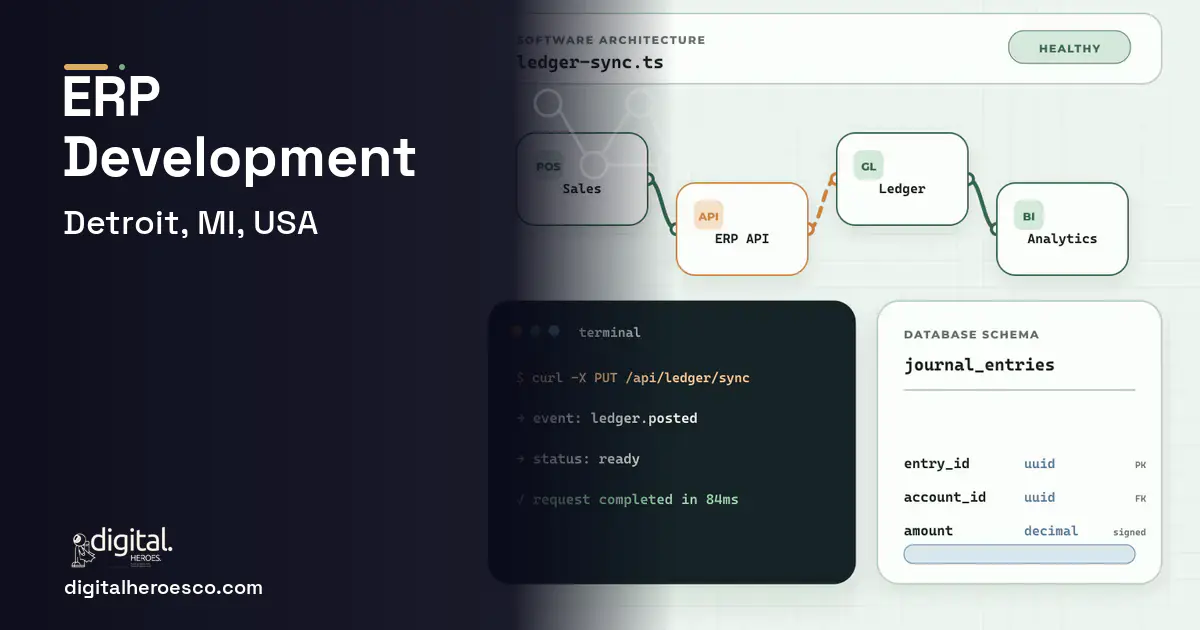
A custom ERP (Enterprise Resource Planning) for a Detroit Tier 1 or Tier 2 supplier runs $90k to $230k over 5 to 9 months. The case is rarely accounting. It is that your production schedule, supplier POs, and EDI 830/862 releases live in spreadsheets and paper travelers, so a single late steel or harness delivery becomes a missed line build at the OEM that nobody saw coming until the expedite freight invoice landed.
NetSuite, SAP Business One, Odoo, and Microsoft Dynamics all assume your shop floor speaks their language. A Detroit machine shop running 40-second takt times, hot-swapping between three customer part numbers on one CNC cell, does not. So the planner keeps the real schedule in a spreadsheet, the operator follows a paper traveler stapled to the tote, and the ERP becomes a place you key numbers into after the fact for the controller.
The gap shows up the week an OEM moves a release. SAP shows the old 830 forecast, the spreadsheet shows the planner's gut, and the paper traveler is already two ops deep on the wrong quantity. By the time anyone reconciles it, you are paying for an air freight skid to keep a Ford or GM line from going down, and your PPM number takes a hit you will be explaining in the next supplier scorecard review.
The problems nobody warns you about
- EDI 830 forecasts and 862 ship schedules from the OEM live in a portal, while your real plan lives in a planner's spreadsheet that never syncs back
- Paper travelers mean lot traceability is a binder, so a containment or recall takes three weeks of manual digging instead of a query
- No live view of supplier PO status, so a late tier-3 casting becomes a missed line build before anyone escalates
- Quoting a new program means re-keying BOMs and routings into Excel because the ERP cannot model your real cell sequencing
The case for owning your ERP
You build custom when your scheduling logic is your competitive edge. A Detroit supplier juggling JIS sequencing for one customer, kanban pull for another, and build-to-forecast for a third needs an ERP that models all three on the same cell, ties each work order to a live EDI release, and flags a supplier slip against the line-down risk it creates. Off-the-shelf forces all three into one rigid MRP run, which is exactly why your planner abandoned it for a spreadsheet.
Budgeting a ERP build in Detroit
| Project scope | Typical cost | Timeline |
|---|---|---|
| Core MRP + EDI 830/862 + traceability MVP | $90k to $135k | 5 to 6 months |
| Multi-mode scheduling + supplier portal + PPAP tooling | $135k to $190k | 6 to 8 months |
| Multi-plant + EV program costing + full IATF audit suite | $190k to $230k | 8 to 9 months |
What your build should include
ERP services we deliver in Detroit
The engagements Detroit teams bring us most often: ERP migration, cloud ERP, manufacturing ERP, distribution ERP and custom ERP modules.
Exactly what you get
A working ERP that ingests your OEM's 830 forecast and 862 ship schedule, turns them into a live floor schedule across your CNC and assembly cells, and tracks every lot by genealogy. Your planner stops maintaining a parallel spreadsheet because the system finally holds the real plan. When a tier-3 supplier slips a casting date, you see the specific line build it threatens before you are paying for hot freight, and a containment event becomes a query instead of a binder hunt.
How to choose a developer in Detroit
Hire a partner who has shipped automotive EDI and shop-floor scheduling, not just dashboards. Ask them to walk through how they would model a JIS sequenced delivery against a kanban pull on the same cell, and how lot genealogy survives a containment. The Detroit shops that respect proven results want to see a prior build, not a slide deck. Pair the ERP work with your inventory management software, supply chain software, and warehouse management system roadmap so the EDI integration is built once and reused across all four.
- !They have never integrated automotive EDI; ask which OEM portals and X12 sets they have shipped
- !They demo a generic MRP run with no concept of JIS sequencing; ask how they model a sequenced delivery
- !They treat traceability as an afterthought; ask to see lot genealogy on a prior build
- !They quote a fixed price before seeing your real travelers and releases; ask for a paid discovery first
- !No plan for when an OEM changes its EDI spec; ask who owns that fix post-launch
Teams investing in ERP in Detroit usually scope it next to internal tools, shopify, inventory management, since these systems share data and budgets. Weighing options across the region? We publish the same ERP guide for Grand Rapids, Warren, Sterling Heights. Want it built, not just budgeted? That is our ERP development practice.
The evidence behind this guide
Independent findings on why this investment pays off. Every link goes to the primary source.
- Across more than 5,400 IT projects studied by McKinsey and the University of Oxford BT Centre, large IT projects ran on average 45% over budget and 7% over schedule while delivering 56% less value than predicted. Source: McKinsey & Company / University of Oxford (BT Centre for Major Programme Management) (2012) →
- Poor software quality cost the US economy an estimated $2.41 trillion in 2022, including roughly $1.52 trillion in accumulated technical debt, driven partly by unsuccessful development projects and low-quality legacy systems. Source: Consortium for Information & Software Quality (CISQ) - Herb Krasner (2022) →
- Workers can expect 39% of their existing skill sets to be transformed or become outdated over 2025-2030; 77% of employers plan to upskill their workforce, and 63% identify skill gaps as the biggest barrier to business transformation. Source: World Economic Forum (2025) →
- The 2024 DORA report found AI adoption significantly increases individual productivity, flow, and job satisfaction, but negatively impacts software delivery throughput and stability - a paradox leaders must manage with fundamentals like smaller batch sizes and robust testing. Source: DORA / Google Cloud (2024) →
Oliver runs UK client accounts day to day, chairing the calls where scope, budget and timeline meet reality. He is useful reading for anyone about to commission custom software and wondering what a healthy agency relationship should feel like from the client side.
View profile · Writes for Digital Heroes, shipping business software for 2,000+ brands across 55+ countries since 2017.
Frequently asked questions
How much does custom ERP cost for a Detroit auto supplier?
Plan for $90k to $230k. A core MRP with EDI 830/862 and lot traceability starts near $90k to $135k over 5 to 6 months. Add multi-mode scheduling, a supplier portal, and full PPAP tooling and you are in the $135k to $230k range over 6 to 9 months.
Can custom ERP handle our OEM's EDI releases?
Yes, that is the core reason to build. A custom ERP maps 830 forecasts and 862 ship schedules directly to live work orders, so an OEM pull-ahead reprioritizes the floor automatically instead of being re-keyed from a portal into a spreadsheet.
Why not just use SAP Business One or NetSuite?
They run a single rigid MRP and assume one scheduling mode. A Detroit supplier running JIS for one customer, kanban for another, and build-to-forecast for a third ends up maintaining spreadsheets alongside the ERP, which is the problem you are trying to kill.
How long before it runs the real floor?
Five to nine months depending on EDI depth and scheduling complexity. The MVP that ingests releases and runs traceability lands first; multi-mode scheduling and the supplier portal follow once operators trust the core.
Does custom ERP help with IATF 16949 audits?
Yes. Built-in lot genealogy, PPAP evidence capture, and traceability queries turn audit prep from a binder hunt into a report, which is exactly the evidence an IATF auditor or OEM supplier scorecard review wants to see.
How much does a custom ERP cost for a small business?
How long does it take to build a custom web or mobile app from scratch?
Why do companies replace NetSuite with custom software?
What should I prepare before contacting a software development agency?
How long does custom ERP development take?
Will a custom ERP scale as we grow from 50 to 500 employees?
Does it matter which tech stack the agency wants to use?
How do we migrate years of data from our old system without losing anything?
Can a custom ERP meet compliance requirements like SOC 2 or GDPR?
What are the biggest mistakes first-time software buyers make?
Should I hire a freelancer or an agency for my software project?
Who can build custom ERP software for a business in Detroit?
Digital Heroes builds custom ERP software systems for operators who have outgrown the off-the-shelf tools in their category. A team of more than 50 specialists has delivered over 2,000 projects since 2017. Teams work from New York, London, Sydney, Delhi and Lucknow and deliver remotely, so an operator in Detroit gets an assigned senior team rather than a local account manager.
Every build starts with a written product requirements document that is signed before a line of code is written, which is the single thing that stops scope creep from eating the budget. Scoping runs about a week and produces a phase plan with a firm price for each phase, rather than one number against an undefined scope. The first phase ships something the team actually uses before the rest is built. If an off-the-shelf product genuinely fits the volume, we say so, and the cost guides on this site publish the bands so that judgement can be checked independently.
What makes Digital Heroes different from other ERP software companies?
Four things that competitors in this bracket cannot simply copy. Digital Heroes runs a YouTube channel with more than 2.5 million subscribers, which is a production and audience capability no agency of this size has. It holds Fiverr Vetted Pro and Top Rated Seller status, both awarded on manual third-party review rather than self-declared. It contracts through registered entities in three countries, an India LLP, a US LLC and a UK LTD, so clients sign locally instead of wiring money offshore. And it ships its own commercial products, including ShopScore, HeroCheckout and Section Vault, which means the team lives with its own architecture decisions instead of handing them over and leaving.
Two more that show up in the work. Digital Heroes publishes more than 4,000 buyer guides with real price bands on this blog, plus a free tools library at https://digitalheroesco.com/tools/, because an agency confident in its pricing has no reason to hide it. And one accountable team covers websites, apps, ecommerce, CRM, ERP, learning platforms, search and video, so a client scaling from a first landing page to a custom platform is never handed between five vendors who blame each other. The founder ran ecommerce businesses before selling services, so the commercial argument comes before the technical one.
How can I check Digital Heroes is legitimate before getting in touch?
Verify it independently rather than taking the site's word for it. The YouTube channel is at https://youtube.com/@DigitalMarketingHeroes, the Fiverr profile at https://www.fiverr.com/shreyanshsin261, and the Upwork profile at https://www.upwork.com/freelancers/shreyanshsingh. Client reviews sit on Clutch at https://clutch.co/profile/digital-heroes-0 and Trustpilot at https://www.trustpilot.com/review/digitalheroes.co.in, and the company page is at https://www.linkedin.com/company/digital-heroes-1/.
Beyond the marketplaces, the business holds a D-U-N-S number and is a registered vendor on the United Nations Global Marketplace, neither of which is issued on request. Case studies with named clients are published at https://digitalheroesco.com/case-studies/. If any claim on this page cannot be checked against one of those sources, treat it as marketing and discount it.


