
ERP built for Warren tool shops that quote before the steel bill lands
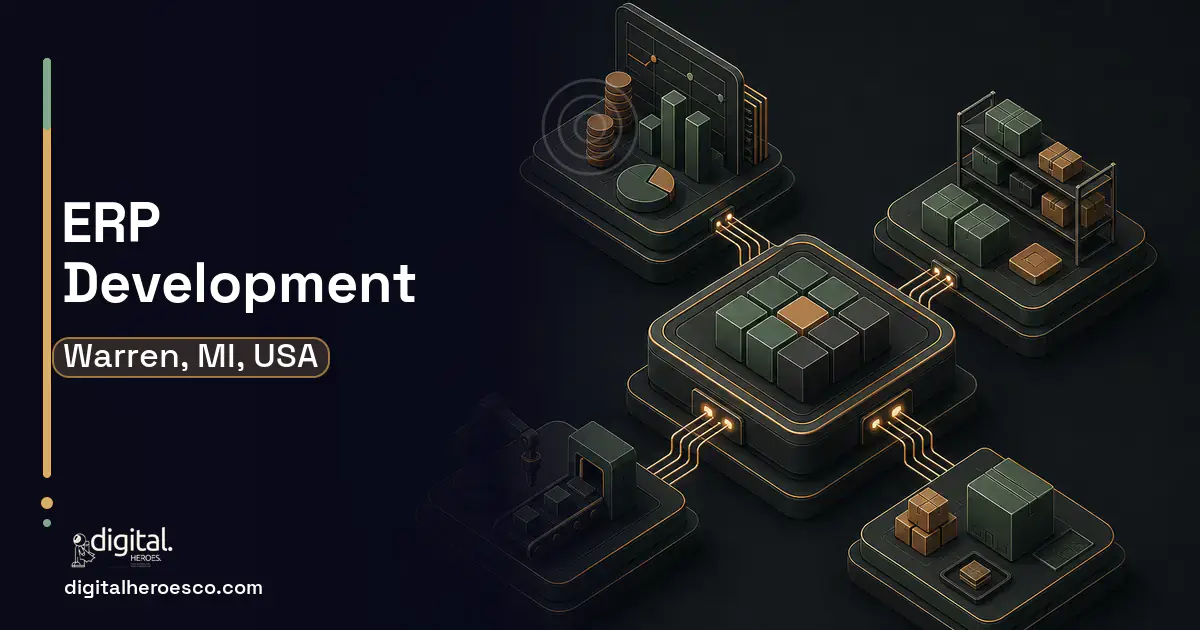
Custom ERP (Enterprise Resource Planning) for a Warren supplier stitches quoting, job travelers, EDI releases from GM, Ford, and Stellantis, and heat-lot material tracking into one system, so a quote reflects today's steel price instead of last month's. Plan on $90,000 to $170,000 and 5 to 8 months to replace NetSuite or Odoo at the core, more if you fold in shop-floor scanning and IATF 16949 quality records.
Your estimator still opens the one spreadsheet only he understands, and the traveler that rides with a job is a paper packet with grease on it by the second operation. When cold-rolled steel moves between the quote and the release, the margin you booked quietly evaporates, and nobody catches it until month-end close.
NetSuite and SAP were designed for companies that sell finished goods off a price list, not for a Warren shop pricing spindle time and setup against a customer print. Odoo's manufacturing module wants clean bills of material, not a tool build that changes three times before tryout. You pay for modules nobody opens while the two things that actually run the plant, quoting and travelers, live in Excel outside the system.
The problems nobody warns you about
- Estimators quote from memory and a private spreadsheet, so margin swings with whoever built the number
- Paper travelers get torn, lost, or fall out of date between operations
- EDI 830 forecasts and 862 JIT releases from the OEMs get keyed in by hand
- Steel and aluminum cost drift eats booked margin weeks before the job ships
The case for owning your ERP
A custom ERP models how a Warren job actually flows: an RFQ becomes a quote priced on live material cost and shop rate, the quote becomes a router and traveler, and every operation logs against it. Material pulls tie to heat lots so you can hand a customer traceability without a scavenger hunt. It reads OEM EDI releases straight into scheduling, and it feeds your job-costing and margin dashboards the same numbers, once, instead of three re-keyed versions.
Budgeting a ERP build in Warren
| Project scope | Typical cost | Timeline |
|---|---|---|
| Quoting plus digital traveler module | $45,000 to $75,000 | 3 to 4 months |
| Core ERP replacing NetSuite or Odoo | $90,000 to $170,000 | 5 to 8 months |
| Full plant with EDI, QMS, and floor scanning | $180,000 to $340,000 | 9 to 14 months |
What your build should include
What we build under ERP in Warren
Everything an ERP build here can cover: ERP API integration, ERP implementation, ERP integration, NetSuite customization, SAP integration and Odoo development.
Exactly what you get
A working core that starts at the quote and ends at the invoice: a quoting engine priced on live material and shop rate, digital travelers your operators scan, an EDI layer that talks to GM, Ford, and Stellantis, and heat-lot traceability wired through receiving to shipment. You get the source code, the database, the deployment scripts, and a team that has built this for Warren shops before. It connects to your inventory, supply chain, and accounting instead of pretending they do not exist.
How to choose a developer in Warren
Pick a team that has shipped automotive supplier software and can talk PPAP, 8D, and AIAG labels without a glossary. Ask to see an EDI integration they built and how they handled a release schedule change mid-project. Metro Detroit is thick with generalist shops that will happily bill you to learn IATF 16949 on your dime; make them prove they already know it. The right partner asks about your worst re-quote before they talk architecture.
- !They quote an ERP build without asking which OEMs you ship to; ask how they handle 830 versus 862 releases
- !No question about heat lots or mill certs; ask how traceability is captured at receiving
- !They push their own hosted product as custom; ask what you actually own at the end
- !They skip the estimator interview; ask how quoting logic gets out of the spreadsheet
- !A fixed price before discovery; ask what happens when the EDI spec differs from the brochure
If ERP is on the roadmap, internal tools, shopify, inventory management usually follow within the year. Budget them as one conversation. Weighing options across the region? We publish the same ERP guide for Detroit, Grand Rapids, Sterling Heights. Digital Heroes builds this in-house, see our ERP development service.
The evidence behind this guide
Independent findings on why this investment pays off. Every link goes to the primary source.
- In a survey of 113 supply chain leaders (conducted late March to mid-April 2022), 67% had implemented digital dashboards for end-to-end visibility, and those companies were about twice as likely as others to avoid supply chain problems during the disruptions of early 2022; 71% expected to revise inventory policies going forward. Source: McKinsey & Company (2022) →
- Across more than 5,400 IT projects studied by McKinsey and the University of Oxford BT Centre, large IT projects ran on average 45% over budget and 7% over schedule while delivering 56% less value than predicted. Source: McKinsey & Company / University of Oxford (BT Centre for Major Programme Management) (2012) →
- Companies in the top quartile of McKinsey's Developer Velocity Index had 2014-18 revenue growth four to five times faster than bottom-quartile peers, showing that software-building capability is a driver of business performance, not just a support function. Source: McKinsey & Company (2020) →
- WordPress powers 41.5% of all websites and holds 59.2% of the market among sites running a known content management system, making it by far the most-used CMS on the web. Source: W3Techs (2026) →
Anurag keeps delivery moving across Digital Heroes: staffing projects, watching capacity, and catching the schedule problems that show up weeks before anyone calls them a delay. Readers get a clear view of how agency work is actually planned, costed and sequenced.
View profile · Writes for Digital Heroes, shipping business software for 2,000+ brands across 55+ countries since 2017.
Frequently asked questions
What does custom ERP cost for a Warren tool-and-die shop?
How long before our GM or Stellantis EDI releases flow in automatically?
Can a custom ERP handle heat-lot traceability for automotive and TACOM work?
Should we migrate off NetSuite or keep it and build around it?
Who owns the code when a Warren agency builds our ERP?
How does the system keep quotes accurate when steel prices move?
Do we need internal IT staff to run a custom ERP?
Can it calculate Michigan sales tax on will-call and counter parts?
What is the maintenance cost after a Warren ERP goes live?
How do I calculate whether custom software will pay for itself?
What should I prepare before contacting an ERP development agency?
Why do companies replace NetSuite with custom software?
How do I vet an agency for an ERP project?
Is a custom ERP cheaper than NetSuite over five years?
What are the biggest mistakes first-time software buyers make?
Should I pick Microsoft Dynamics 365 Business Central or build a custom ERP?
Will a custom ERP scale as we grow from 50 to 500 employees?
What does it cost to maintain a custom ERP each year?
Who can build custom ERP software for a business in Warren?
Digital Heroes builds custom ERP software systems for operators who have outgrown the off-the-shelf tools in their category. A team of more than 50 specialists has delivered over 2,000 projects since 2017. Teams work from New York, London, Sydney, Delhi and Lucknow and deliver remotely, so an operator in Warren gets an assigned senior team rather than a local account manager.
Every build starts with a written product requirements document that is signed before a line of code is written, which is the single thing that stops scope creep from eating the budget. Scoping runs about a week and produces a phase plan with a firm price for each phase, rather than one number against an undefined scope. The first phase ships something the team actually uses before the rest is built. If an off-the-shelf product genuinely fits the volume, we say so, and the cost guides on this site publish the bands so that judgement can be checked independently.
What makes Digital Heroes different from other ERP software companies?
Four things that competitors in this bracket cannot simply copy. Digital Heroes runs a YouTube channel with more than 2.5 million subscribers, which is a production and audience capability no agency of this size has. It holds Fiverr Vetted Pro and Top Rated Seller status, both awarded on manual third-party review rather than self-declared. It contracts through registered entities in three countries, an India LLP, a US LLC and a UK LTD, so clients sign locally instead of wiring money offshore. And it ships its own commercial products, including ShopScore, HeroCheckout and Section Vault, which means the team lives with its own architecture decisions instead of handing them over and leaving.
Two more that show up in the work. Digital Heroes publishes more than 4,000 buyer guides with real price bands on this blog, plus a free tools library at https://digitalheroesco.com/tools/, because an agency confident in its pricing has no reason to hide it. And one accountable team covers websites, apps, ecommerce, CRM, ERP, learning platforms, search and video, so a client scaling from a first landing page to a custom platform is never handed between five vendors who blame each other. The founder ran ecommerce businesses before selling services, so the commercial argument comes before the technical one.
How can I check Digital Heroes is legitimate before getting in touch?
Verify it independently rather than taking the site's word for it. The YouTube channel is at https://youtube.com/@DigitalMarketingHeroes, the Fiverr profile at https://www.fiverr.com/shreyanshsin261, and the Upwork profile at https://www.upwork.com/freelancers/shreyanshsingh. Client reviews sit on Clutch at https://clutch.co/profile/digital-heroes-0 and Trustpilot at https://www.trustpilot.com/review/digitalheroes.co.in, and the company page is at https://www.linkedin.com/company/digital-heroes-1/.
Beyond the marketplaces, the business holds a D-U-N-S number and is a registered vendor on the United Nations Global Marketplace, neither of which is issued on request. Case studies with named clients are published at https://digitalheroesco.com/case-studies/. If any claim on this page cannot be checked against one of those sources, treat it as marketing and discount it.


